Legal Name on a Job Application: When You Need It and When You Don't
Do you need your legal name on a job application? Use it on the I-9, W-4 and background check. See where a preferred name works, with scripts to copy.

On this pageDo you have to put your legal name on a job application?
- Do you have to put your legal name on a job application?
- Which hiring forms need your legal name?
- When is a preferred name fine on a job application?
- What if the form has only one name field?
- How do you list a maiden name or a past legal name?
- What happens if your background check name doesn't match?
- How do you tell HR which name to use?
- FAQ
- Sources
You need your legal name on a job application only when the field asks for it, or when the employer runs a background check. After the offer, the Form I-9, Form W-4, payroll and benefits forms all need your legal name. Your resume, emails, interviews and any "preferred name" field can use the name you go by. If the form has one field, use your legal name and add the other name in a note.
Put your legal name on a job application when the field says "legal name" or when the employer will run a background check. Your resume, interviews and any preferred-name field can use the name you go by.
The strict rules come after the offer. That is when the I-9, the W-4, payroll and the background check all need the name on your Social Security card. So this guide shows which form needs which name, and what to type when a form gives you only one box.
Quick answers by situation
| Your situation | What to do | Example line |
|---|---|---|
| The field says "Legal first name" | Type your legal name | Legal first name: Alexandra |
| There is a "Preferred name" field | Put the name you go by there | Preferred name: Alex |
| The form has only one name field | Use your legal name, note the other | Alexandra (goes by Alex) Rivera |
| Your resume header | Preferred name is fine | ALEX RIVERA |
| Background check consent form | Legal name plus all past legal names | Other names: Alexandra Chen |
| Form I-9 and Form W-4 | Exact legal name, as on your SSN card | Rivera, Alexandra M. |
Do you have to put your legal name on a job application?
Only in the fields that ask for it. A resume and most application name fields are not legal documents, so the name you go by is fine there. But if a field says "legal name," or the employer will run a background check, give your full legal name. The I-9, W-4 and payroll forms come later and always need it.
Career centers agree on the basic split. The University of Vermont's career office puts it plainly.
A resume is not a legal document, so it is acceptable to use your preferred name on the resume.
University of Vermont Career Center, FAQs for Transgender Job Seekers
The same page adds a limit. When an application form asks for your legal name, you should list it1, because the employer may use it for a background check. The University of Denver's career team says you can use your preferred name throughout the process2, as long as you give your legal name when the background check starts.
Why the application itself is usually flexible
We found no federal rule that says the first job application must carry your legal name. The federal forms with name rules come after you accept the offer. State laws and employer policies vary, though, so we could not confirm a rule that covers every state.
So the real question is the field label. A plain "Name" field gives you a choice, but a "Legal name" field does not. Our guide to the preferred name on a job application explains what that field means.
Which hiring forms need your legal name?
Four kinds of forms need your legal name. The Form I-9 asks for your current legal name and other last names used. The W-4 and payroll records must match your Social Security card. Background check consent forms need your legal name and past legal names. Benefits and insurance forms also need it, because they tie to your SSN.
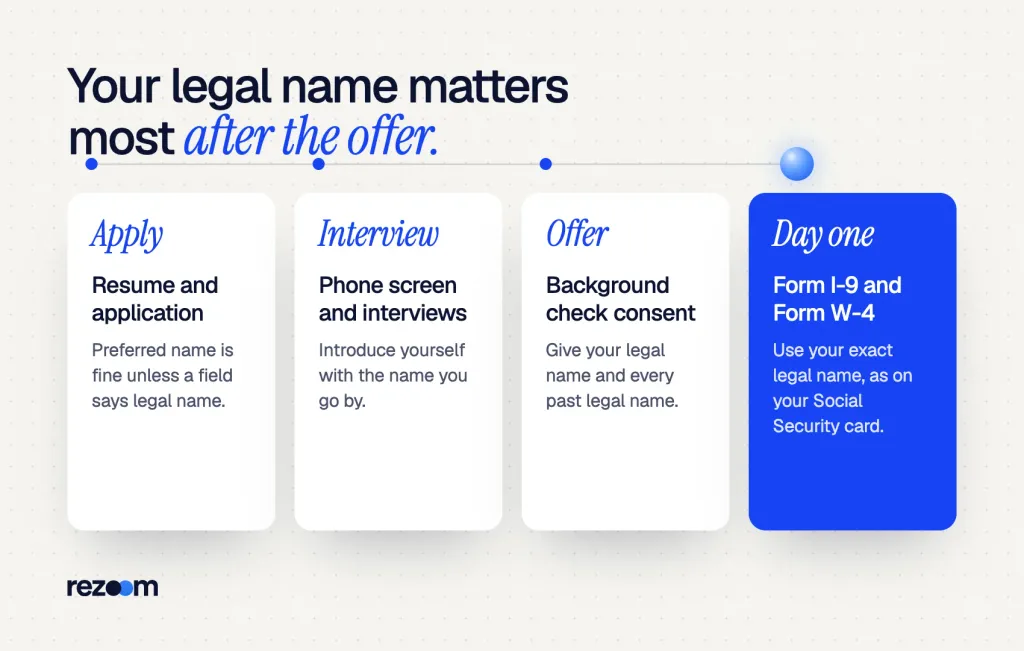
| Form | When you see it | Which name | Why |
|---|---|---|---|
| Job application name field | When you apply | Legal or preferred, per the label | Some employers use it for screening |
| Background check consent | After a conditional offer, often | Legal name plus past legal names | Records sit under legal names |
| Form I-9 | No later than your first day | Current legal name, other last names | Federal work eligibility |
| Form W-4 and payroll | First week | Name on your Social Security card | W-2 must match SSA records |
| Benefits and insurance | First month | Legal name | Plans tie to your SSN |
Form I-9
The USCIS employer handbook says employees must enter their current legal name4 and any other last names they have used. That includes a maiden name.
The handbook also says you complete Section 1 no later than your first day of work, and an employer may not ask you to fill it in before you accept the offer. So the I-9 is never part of the first application.
Form W-4 and payroll
The 2026 Form W-4 asks one direct question: does your name match the name on your social security card5? If not, it tells you to contact the Social Security Administration (SSA) so you get credit for your earnings.
The SSA tells employers to enter the name on the W-2 as shown on the card6 and to avoid nicknames or shortened names. So payroll will use "Robert" even if every coworker calls you "Bobby."
Background checks
UConn's career center notes that forms asking for your legal name are usually for background checks3, so the screening finds the right records.
An application page may say "Personal details" at the top, but each field has its own label. Look for the words "legal," "as it appears on your ID" or "for background check." If you see them, use your legal name in that field only.
When is a preferred name fine on a job application?
A preferred name is fine on your resume, cover letter, email signature, LinkedIn and in interviews. It is also fine in any application field labeled "preferred name," "known as" or "display name." Use one name the whole way through, so the recruiter can match your resume to your application and your interview.
The University of Denver page calls a resume a personal marketing document. So it does not need your legal name. You can list only the name you go by, or both, as in Robert "Bobby" Doe.
UConn also says a preferred name is fine in an interview. Then keep that one name. If your resume says "Alex" and your email signature says "Alexandra," a recruiter may think they have two people.
ALEX RIVERA
Denver, CO | alex.rivera@email.com | (303) 555-0182
HR Coordinator with 4 years in onboarding and benefits
If you want both names on the resume, our guide on the preferred name in parentheses on a resume shows the formats that read cleanly. For the full resume side, see our guide to a preferred name on a resume.
What does preferred name on job application forms mean? It is the name you go by. See what to type, when to leave it blank and where your legal name goes.
Where to use each name
Do
- On your resume and cover letter header.
- In the "preferred name" or "known as" field.
- In your email signature and LinkedIn profile.
- When you introduce yourself in interviews.
Don’t
- In any field labeled "legal name."
- On the background check consent form.
- On the Form I-9 and Form W-4.
- On benefits, insurance and tax forms.
What if the form has only one name field?
Type your legal name in a single name field when the form will feed a background check or offer letter. Then add the name you go by in a note, a "known as" box or your cover letter. If the form is only a quick interest form, your preferred name is fine. When in doubt, use your legal name and tell the recruiter.
Some application systems still give you one name box. In that case your legal name on a job application is the safer choice, because the system may push that field into the background check.
Then add your preferred name somewhere a person will read it. Look for a "Notes," "Additional information" or "Anything else we should know" box.
Legal name: Alexandra Rivera I go by Alex Rivera. My resume and references use that name.
"Known as" and "display name" fields
A "known as" field holds the name people call you at work. A "display name" field controls what shows in the employer's system, such as on your profile or badge. Neither one replaces your legal name on tax or I-9 forms.
Some systems reject certain characters in a display name. If you see an error, our guide on the preferred full name display name is invalid message walks through the fixes.
What goes in the known as name on job application forms? Learn the two meanings, what to enter, when to leave it blank and how it ties to background checks.
If you used your legal name in a single field, mention your preferred name in your first email or phone screen. Then the recruiter can update their notes before the interview.
Free ATS score, the text the software extracts and your missing keywords. No sign-up.
How do you list a maiden name or a past legal name?
Give your current legal name in the main field. Put past legal names, such as a maiden name, in the "other names used" or "aliases" field when the form has one. Background checks and the I-9 both ask for them. If you changed your name, update the SSA first, so payroll and E-Verify match.
The I-9 handbook says employees must enter their maiden name or any other legal last name in the "Other Last Names Used" field. A background check form often asks the same thing.
The Vermont page also notes that a screening form may ask for any other names you have legally gone by. The Denver page warns that leaving out a current or past legal name can look like lying on the application. That can become grounds for firing.
What an employer can and can't ask
North Carolina State University's pre-employment guidelines draw a clear line. An employer can ask whether your work records are under another name7, as long as it asks everyone. But that guide says an employer can't ask for a woman's maiden name or about a name changed by court order.
Current legal name: [FIRST] [MIDDLE] [LAST]
Other legal names used: [PAST LAST NAME], [YEARS USED]
Name on school or license records, if different: [NAME]
If you changed your name recently
The SSA tells employers to keep using your old name on payroll until you get a new card. Then they change their records. The I-9 handbook also says employees should record a legal name change with the SSA to avoid E-Verify mismatches.
So update your Social Security record before your first day if you can. Bring your marriage certificate or court order in case HR asks for proof of the change.
What happens if your background check name doesn't match?
A mismatch usually means the screening company finds no records, the wrong person's records or a delay. Under the FCRA, the employer must get your written consent first. If a report hurts your chances, they must send you a copy and a summary of your rights before they decide. You can dispute wrong information, and it usually gets fixed within 30 days.
The FTC gives an example of what can go wrong: a report that includes a person with a different middle name or date of birth9 than the applicant. That is why the form asks for your legal name, past names and date of birth.

Your rights under the FCRA
- Consent first. The FTC says an employer must get written permission8 before it orders the report.
- A copy before a "no." If the report may cost you the job, the employer must send you a copy and a summary of your rights first.
- A right to dispute. The CFPB summary says agencies must fix or remove wrong information, usually within 30 days10.
- A free report. After an adverse action notice, you can get another free report from the company if you ask within 60 days.
What to say if they push back
- "Your name doesn't match our records." Say which name your records use and offer your past legal names.
- "Why did you apply as Alex?" Say it is the name you go by, and that you gave your legal name on the legal forms.
- "The report shows a record that isn't yours." Ask for a copy of the report, then dispute it with the screening company.
HR: "Your background check came back with no records under the name Alex Rivera."
"Thanks for checking. My legal name is Alexandra Rivera, and my records before 2022 are under Alexandra Chen."
HR: "Why didn't you list that name on the application?"
"The form had one name field, so I used my current legal name. I'm glad to add my past name to the consent form now."
How do you tell HR which name to use?
Tell HR once, in writing, when you accept the offer. Give your legal name for the I-9, W-4 and benefits, and the name you want on your email, badge and directory. Most HR teams handle this every week. A short email now keeps your first day from starting with the wrong name.
If you are applying for HR jobs
If you work in HR yourself, our HR resume examples show how onboarding and compliance work reads on a page.
For a talent acquisition role, the recruiter resume example is a good model.
Recruiter resume example
See how a recruiter lists screening, offers and onboarding results on a one-page resume.
Pair it with our human resources cover letter examples when you apply for HR jobs. You can also build the whole page in our AI resume builder, then set the header to the name you go by.
Five steps to get your name right
- Check every field labelUse your legal name only where a field says legal, ID or background check.
- Keep one name on your resumeUse the same name on your resume, email and LinkedIn.
- List all past legal namesAdd maiden or past legal names on the consent form and I-9.
- Update the SSA firstIf your name changed, get a new Social Security card before payroll starts.
- Email HR onceGive your legal name and the name for your badge and email.
Hi Jordan, Thanks again for the offer. For the I-9, payroll and benefits, my legal name is Alexandra Rivera. I go by Alex, so please use Alex Rivera for my email, badge and team directory.
Before you submit the application
Free plan, no card.
Frequently asked questions
Do you have to put your legal name on a job application?
Only in fields that ask for your legal name, or when the employer will run a background check. A resume and a preferred-name field can use the name you go by.
Can I use a nickname on a job application?
Yes, on your resume and in a preferred-name field. Use your legal name in any field marked "legal" and on the I-9, W-4 and background check forms.
Is it illegal to use a different name on a job application?
We found no federal rule against using the name you go by on an application. But leaving out a legal name on a background check form can look like lying and can cost you the job.
Does my name on the W-4 have to match my Social Security card?
Yes. The W-4 asks if your name matches your card, and the SSA tells employers to report the name on the card. If it doesn't match, contact the SSA.
Should I list my maiden name on a job application?
List it in an "other names used" field, or on a background check form that asks for past legal names. You don't have to put it in the main name field.
What if my background check is under a different name?
Tell HR your past legal names right away. If the report shows wrong records, ask for a copy and dispute it with the screening company.
Sources
We opened and read each page below. The small numbers in the text point here. Pages that carry no publication date show n.d.
- University of Vermont Career Centern.d.
A resume is not a legal document, but list your legal name when an application asks for it because it may be used for a background check
- University of Denver Career Servicesn.d.
You can use a preferred name throughout the hiring process if you give your legal name for the background check, and leaving out legal names can be grounds for firing
- UConn Center for Career Readiness and Life Skills2023
Forms asking for a legal name are usually for background checks, and a preferred name is fine on a resume and in interviews
- USCIS Handbook for Employers M-274n.d.
Employees enter their current legal name and other last names on Form I-9 no later than the first day of work, and should record name changes with the SSA
- Internal Revenue Service, Form W-4 (2026)2026
The 2026 Form W-4 asks whether your name matches your Social Security card and tells you to contact the SSA if not
- Social Security Administrationn.d.
Employers enter the name on the W-2 as shown on the Social Security card and keep the old name until the employee gets an updated card
- NC State University Office for Institutional Equity and Diversityn.d.
Employers may ask all applicants whether their records are under another name but may not ask for a maiden name
- Federal Trade Commission2016
Employers need written permission for a background report and must share a copy before adverse action, with a free report available within 60 days
- Federal Trade Commission2016
Screening companies must use reasonable procedures for maximum possible accuracy, such as avoiding records for a person with a different middle name or birth date
- Consumer Financial Protection Bureau2015
Consumer reporting agencies must correct or remove inaccurate information, usually within 30 days
Mohammad has spent more than ten years designing consumer products and leads product at Rezoom, deciding what gets built and what gets left out. His guides cover the whole job search, from resume sections and cover letters to interview answers and career moves.
Goodi, M. (2026, November 1). Legal Name on a Job Application: When You Need It and When You Don't. Rezoom. https://rezoom.io/legal-name-on-job-application/