Protected Veteran Status on a Job Application: What Each Answer Means
Protected veteran status on a job application, explained: the 4 VEVRAA groups, what each answer means, if you must reply, and what changed in 2026.

On this pageWhat does protected veteran status mean on a job application?
- What does protected veteran status mean on a job application?
- Who counts as a protected veteran under VEVRAA?
- What do the three answers mean?
- Do you have to answer, and can it hurt you?
- What changed for veteran self-identification in 2026?
- What is the difference between pre-offer and post-offer forms?
- How should you answer the protected veteran question?
- FAQ
- Sources
Protected veteran status means you fit one of four groups under VEVRAA, a federal law for employers with federal contracts: disabled veteran, recently separated veteran (three years from discharge), active duty wartime or campaign badge veteran, or Armed Forces service medal veteran. Answering is voluntary and confidential. The disability form ended in 2026, but contractors must still invite veterans to self-identify before and after a job offer.
Protected veteran status on a job application means you fit one of four groups that a federal law, VEVRAA, protects. Federal contractors must ask. Your answer is voluntary, it stays confidential, and it can't count against you.
Not every veteran has protected veteran status. So the question is not "Did you serve?" but "Do you fit one of these four groups?" This guide shows who counts, what each checkbox means and what changed in 2026.
Quick answers by situation
| Your situation | What to check | Example line |
|---|---|---|
| You left active duty less than 3 years ago | I identify as a protected veteran | Recently separated veteran |
| You get VA disability pay, at any rating | I identify as a protected veteran | Disabled veteran |
| You earned a campaign badge or served in wartime | I identify as a protected veteran | Active duty wartime or campaign badge veteran |
| You served, but fit none of the four groups | I am not a protected veteran | Veteran, not protected under VEVRAA |
| You never served | I am not a protected veteran | Not a veteran |
| You'd rather keep it private | I don't wish to answer | No answer recorded |
What does protected veteran status mean on a job application?
Protected veteran status is a legal label, not a service record. It covers veterans who fit at least one of four groups in the Vietnam Era Veterans' Readjustment Assistance Act (VEVRAA). Employers with federal contracts must ask about it, so they can track outreach to veterans. The question is voluntary, and the answer stays out of your hiring file.
The question comes from VEVRAA and its rules at 41 CFR Part 60-300. Those rules tell federal contractors to invite applicants to self-identify3 as protected veterans. If a company has no federal contract, VEVRAA does not make it ask.
The name trips people up, because protected veteran status covers far more than the Vietnam era. The Department of Labor's sample form5 says it also protects veterans of World War II, Korea and the Gulf War era from August 2, 1990 on.
Why employers ask
The form says the employer asks so it can measure how well it reaches and recruits veterans. Contractors also file a yearly count of protected veterans with the Labor Department. That report, the VETS-42128, is due each September 30.
It sits next to the other voluntary questions on the same page. Our guide to voluntary self-identification on job applications covers the race, gender and disability parts.
Voluntary self-identification on job applications: what the race, sex, veteran and disability questions mean, who sees them and if you should answer.
Who counts as a protected veteran under VEVRAA?
You are a protected veteran if you fit at least one of four groups: a disabled veteran, a recently separated veteran, an active duty wartime or campaign badge veteran, or an Armed Forces service medal veteran. The recently separated window is three years from your discharge or release. You only need to fit one group to check "yes."
The four groups come straight from the VEVRAA definitions4. Here they are in plain words.
- Disabled veteran. You get VA disability pay, or would get it if not for military retired pay. You also count if a service-connected disability ended your active duty.
- Recently separated veteran. You left active duty within the last three years. The VETS page puts it as 36 months.
- Active duty wartime or campaign badge veteran. You served on active duty during a war, or in a campaign or expedition with an authorized campaign badge.
- Armed Forces service medal veteran. You took part in a US military operation that earned an Armed Forces service medal.
Check the three-year window
The recently separated group has a clock. It starts on the day you leave active duty and runs for three years. So if you left in March 2024, you fit this group until March 2027.
When the clock runs out, you may still fit another group. A campaign badge or a VA rating does not expire. So check all four before you pick "not a protected veteran."
| Group | You fit if... | Does it expire? |
|---|---|---|
| Disabled veteran | You get VA disability pay or left for a service-connected disability | No |
| Recently separated veteran | You left active duty in the last 3 years | Yes, after 3 years |
| Active duty wartime or campaign badge veteran | You served in wartime or in a badged campaign | No |
| Armed Forces service medal veteran | You served in an operation that earned the medal | No |
What do the three answers mean?
"I identify as one or more of the classifications of protected veteran" means you fit at least one of the four groups. "I am not a protected veteran" means you fit none of them, even if you served. "I don't wish to answer" means you skip the question. The pre-offer form doesn't ask which group you fit.
The DOL sample form lists three boxes.
[ ] I identify as one or more of the classifications of protected veteran [ ] I am not a protected veteran [ ] I do not wish to answer
"I identify as one or more of the classifications"
This box means "I fit at least one group." You don't say which one at this stage. That detail, if asked at all, comes on the post-offer form.
"I am not a protected veteran"
Pick this if you fit none of the four groups. That includes veterans who left more than three years ago with no badge, medal or VA rating. It also includes people who never served.
"I don't wish to answer"
This box keeps your status private. It means the same thing as a skip, with no penalty. Our guide on what "I do not wish to self-identify" means explains how employers log this answer.
What I do not wish to self identify means on race, veteran and disability forms, who sees your answer, why it can't count against you and the 2026 changes.
I left active duty on [MONTH YEAR], which is [under / over] 3 years ago.
I [do / do not] get VA disability pay.
I [do / do not] hold a campaign badge or an Armed Forces service medal.
If any line is "under" or "do," check "I identify as one or more of the classifications."
Do you have to answer, and can it hurt you?
No, you don't have to answer. The law makes the question voluntary and tells employers to keep your answer confidential and away from hiring choices. Covered contractors also have to take affirmative action to recruit protected veterans, so a "yes" should not count against you. If you think an employer held your protected veteran status against you, you can file a complaint with OFCCP.
The sample invitation in the federal rules spells this out.
Submission of this information is voluntary and refusal to provide it will not subject you to any adverse treatment.
41 CFR Part 60-300, Appendix B (sample invitation to self-identify)
The DOL FAQ on VEVRAA makes the same point. It says that "although it is voluntary to disclose your veteran status, there are mutual benefits."7 Military.com asks if a "yes" hurts your chances and answers "Probably not."12
Who sees your answer
The rules tell contractors to keep it confidential. A manager may learn of work limits or a needed accommodation for a disabled veteran. Safety staff and officials who enforce the law can also see it.
The hiring benchmark
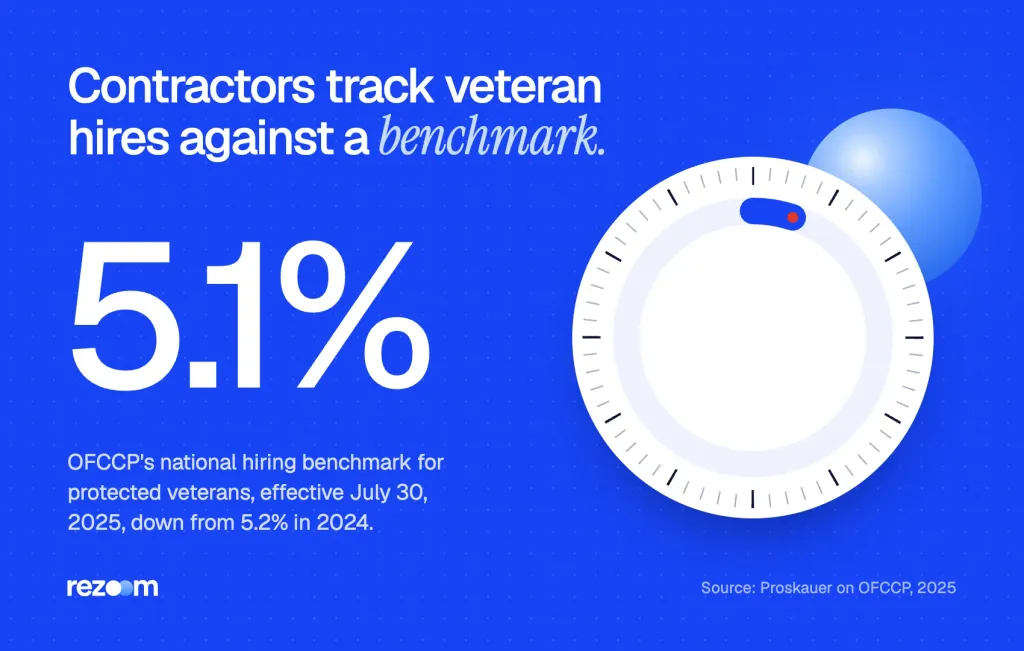
Contractors with an affirmative action plan track veteran hires against a benchmark. OFCCP set the national figure at 5.1% as of July 30, 202511, down from 5.2% in 2024. We could not find a 2026 figure on dol.gov, so check the OFCCP benchmark database for the latest one.
Checking "yes" does not give you veterans' preference. That is a separate system for federal civil service jobs. A private contractor still hires on fit, so your resume has to carry the case.
ClearedJobs.Net makes the same split in its guide to the veteran question13. Veterans' preference comes from a different law, 5 U.S.C. 2108, and applies to federal civil service hiring.
Free ATS score, the text the software extracts and your missing keywords. No sign-up.
What changed for veteran self-identification in 2026?
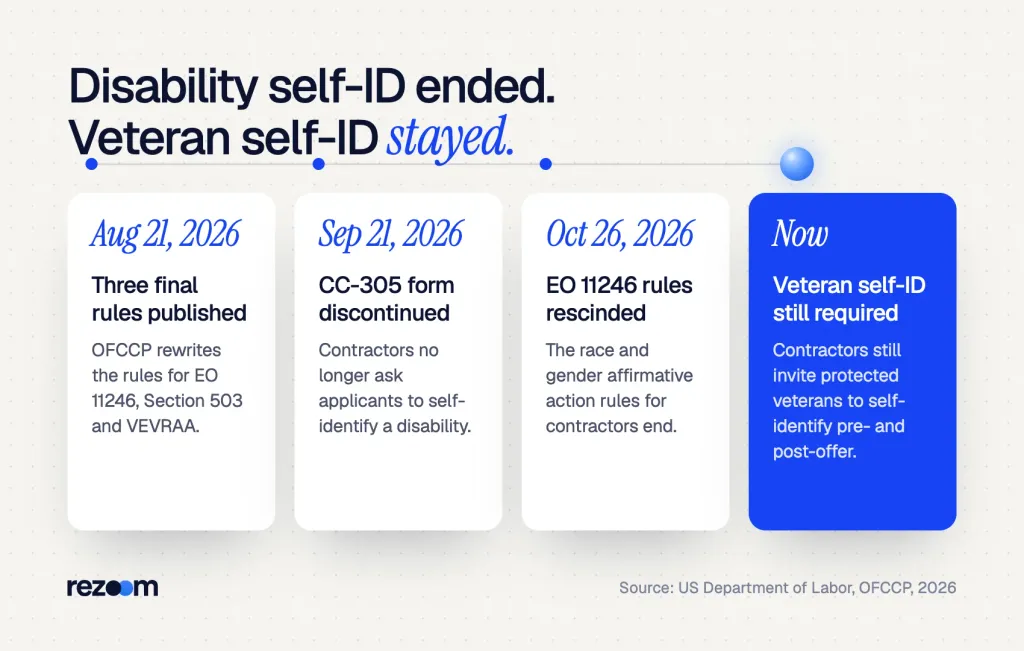
OFCCP published three final rules on August 21, 2026. They ended the disability self-ID form CC-305 on September 21, 2026, and removed the EO 11246 race and gender rules on October 26, 2026. But VEVRAA stayed in force. Contractors must still invite applicants to self-identify protected veteran status before and after an offer.
The OFCCP self-ID forms page1 says the disability form is "discontinued, effective September 21, 2026." The rules for EO 11246, which covered race and gender in contracting, ended effective October 26, 20269.
What stayed the same
The OFCCP home page2 says Section 503 and VEVRAA "remain in effect." Berkshire Associates summed up the VEVRAA rule10 as "largely technical." It says contractors must still offer the chance to self-identify as a protected veteran.
The eCFR text of the veteran self-ID rule, section 60-300.42, still shows its 2013 wording as of October 16, 2026. So the pre-offer and post-offer invitations stand.
What we could not confirm
Crowell & Moring reports that the rule raises the contract size for VEVRAA from $150,000 to $200,000, effective September 21, 2026. But the VETS-4212 page on dol.gov still shows $150,000. We could not confirm the new figure or its date on a dol.gov page, so treat it as a law firm's reading of the rule.
What is the difference between pre-offer and post-offer forms?
The pre-offer form comes with your application and asks one yes or no question: are you a protected veteran? The post-offer form comes after a job offer but before your first day. It asks which of the four groups you fit, because the employer reports those counts each year. Both are voluntary.
The self-ID rule3 sets both steps. The DOL FAQ adds that contractors "need only invite those offered a job" to the second form.
| Pre-offer form | Post-offer form | |
|---|---|---|
| When you see it | With the application | After the offer, before day one |
| What it asks | Are you a protected veteran? | Which groups do you fit? |
| Answer choices | Yes, no, or no answer | Check all that apply, or decline |
| Why they ask | To track veteran outreach | For the yearly VETS-4212 count |
The post-offer choices
The post-offer sample lists the four groups, and you check all that fit. It also has a box that reads "I am a protected veteran, but I choose not to self-identify the classifications to which I belong."
[x] Recently separated veteran [x] Active duty wartime or campaign badge veteran [ ] Disabled veteran [ ] Armed Forces service medal veteran
If you check "disabled veteran" here, the employer should ask if you need an accommodation. The rule ties that step to the ADA. The DOL FAQ adds one more detail: if you said "yes" before the offer but skip the post-offer form, the employer may still count you as a protected veteran.
How should you answer the protected veteran question?
Check the four groups against your dates, VA letter and awards. If you fit one, check "I identify as one or more of the classifications." If you fit none, check "I am not a protected veteran." If you want privacy, pick "I don't wish to answer." Then put your service on your resume, because the box itself doesn't sell your skills.
- Find your datesLook up your separation date on your DD-214 and count three years forward.
- Check your VA statusIf you get VA disability pay at any rating, you fit the disabled veteran group.
- Check your awardsLook for a campaign badge or an Armed Forces service medal in your record.
- Pick one boxFit one group or more? Check yes. Fit none? Check no. Want privacy? Decline.
Before you submit the veteran question
Put your service on the resume too
Your protected veteran status stays out of the hiring file, so your resume does the real work. Our security and protective service resume examples show how roles like guard, officer and analyst turn service into civilian skills. If you are leaving the service now, our military to civilian resume guide shows how to swap jargon for plain terms.
For a full page to copy, open the military to civilian resume example. It shows rank, duties and results in words a civilian recruiter reads fast.
Military resume example
A full military to civilian resume that turns ranks, duties and awards into plain civilian results.
The same goes for your letter. Our military cover letter example shows how to name your service in one plain line. If a disability came with your service, our guide on how to answer the disability question on a job application covers that form's 2026 status.
If you mention a recent discharge in your cover letter, you can check "yes" on the form with no conflict. The form stays confidential either way. But keep your dates the same on every page.
What to say if they push back
- "Why did you skip the veteran question?" Say the form is voluntary and you chose privacy, then talk about your skills.
- "Are you a protected veteran?" in an interview. You can say you answered the confidential form, and steer back to the job.
- "Can you prove your protected veteran status?" We found no OFCCP rule on proof in the pages we read. So ask HR what the post-offer form needs.
Interviewer: "I saw you left the veteran question blank. Are you a veteran?"
"I served four years in the Army. I kept the form private, but I'm glad to talk about what I did."
Interviewer: "What did you do?"
"I ran supply for a 120-person unit, so I know how to keep a team stocked and on time."
Do
- Check yes if you fit even one of the four groups.
- Count three years from your separation date.
- Show your service on your resume in civilian terms.
Don’t
- Assume every veteran counts as a protected veteran.
- Treat the checkbox as veterans' preference.
- Rely on old guides that still list the CC-305 as current.
You can turn your service record into a clean page with Rezoom's AI resume builder.
Free plan, no card.
Frequently asked questions
What does protected veteran status mean on a job application?
It means you fit one of four VEVRAA groups: disabled, recently separated, active duty wartime or campaign badge, or Armed Forces service medal veteran. Federal contractors must ask, and your answer is voluntary.
Am I a protected veteran if I served but left years ago?
Maybe. The recently separated group ends three years after discharge. But you still count if you have a VA disability rating, a campaign badge or an Armed Forces service medal.
What does "protected veteran declines to self-identify" mean?
It means you chose "I don't wish to answer." The employer records no status for you, and the rules bar any adverse treatment for that choice.
Can checking protected veteran hurt my application?
It should not. The answer is confidential and stays out of hiring choices, and covered contractors must take affirmative action to recruit protected veterans.
Did the 2026 OFCCP rules end the veteran self-ID form?
No. The disability form CC-305 ended on September 21, 2026, and the EO 11246 rules ended on October 26, 2026. VEVRAA veteran self-identification remains in effect.
Is protected veteran status the same as veterans' preference?
No. Veterans' preference applies to federal civil service jobs. Protected veteran status is a VEVRAA label that federal contractors track.
Sources
We opened and read each page below. The small numbers in the text point here. Pages that carry no publication date show n.d.
- US Department of Labor, OFCCP2026
The disability self-identification form CC-305 is discontinued effective September 21, 2026
- US Department of Labor, OFCCP2026
Section 503 and VEVRAA and their regulations remain in effect after EO 11246 was revoked
- eCFR, 41 CFR 60-300.422026
Contractors must invite applicants to self-identify as protected veterans before an offer and again after an offer
- eCFR, 41 CFR 60-300.22026
A protected veteran is a disabled, recently separated, active duty wartime or campaign badge, or Armed Forces service medal veteran
- US Department of Labor, OFCCPn.d.
The sample form offers three answers and covers veterans from World War II through the Gulf War era
- Cornell Legal Information Instituten.d.
The sample invitation says answering is voluntary and refusal brings no adverse treatment
- US Department of Labor, OFCCPn.d.
Disclosing veteran status is voluntary, and only people offered a job need the post-offer invitation
- US Department of Labor, VETSn.d.
The VETS-4212 report counts protected veterans and is due September 30 each year
- Crowell & Moring2026
The EO 11246 rules are rescinded effective October 26, 2026, and the VEVRAA threshold rises to $200,000
- Berkshire Associates2026
OFCCP published three final rules on August 21, 2026, and the VEVRAA changes are largely technical
- Proskauer2025
The VEVRAA hiring benchmark is 5.1% effective July 30, 2025, down from 5.2% in 2024
- Military.comn.d.
Self-identifying as a protected veteran probably won't hurt your chances
- ClearedJobs.Net2026
Protected veteran status is separate from veterans' preference in federal civil service hiring
Mohammad has spent more than ten years designing consumer products and leads product at Rezoom, deciding what gets built and what gets left out. His guides cover the whole job search, from resume sections and cover letters to interview answers and career moves.
Goodi, M. (2026, November 1). Protected Veteran Status on a Job Application: What Each Answer Means. Rezoom. https://rezoom.io/protected-veteran-status-on-job-application/