Recruiter, Light Industrial Colin Rasmussen
Recruiter, Light Industrial Desk
[email protected] | (303) 555-0201 | Denver, United States
Profile
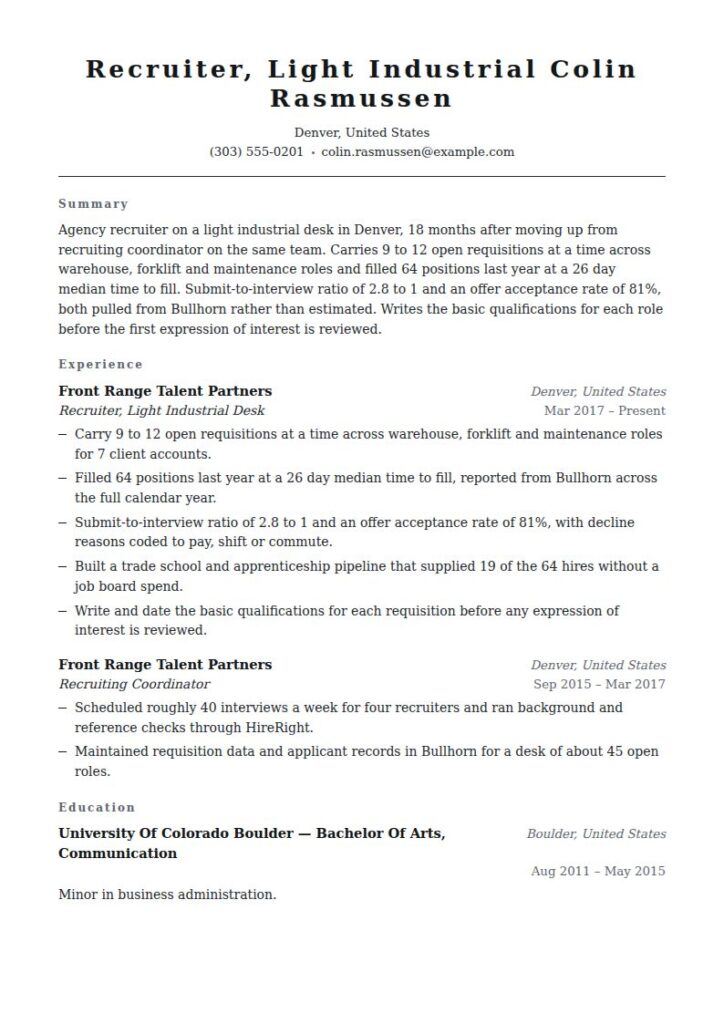
Agency recruiter on a light industrial desk in Denver, 18 months after moving up from recruiting coordinator on the same team. Carries 9 to 12 open requisitions at a time across warehouse, forklift and maintenance roles and filled 64 positions last year at a 26 day median time to fill. Submit-to-interview ratio of 2.8 to 1 and an offer acceptance rate of 81%, both pulled from Bullhorn rather than estimated. Writes the basic qualifications for each role before the first expression of interest is reviewed.
Work Experience
03/2017 - Present, Recruiter, Light Industrial Desk, Front Range Talent Partners, Denver, United States
- Carry 9 to 12 open requisitions at a time across warehouse, forklift and maintenance roles for 7 client accounts.
- Filled 64 positions last year at a 26 day median time to fill, reported from Bullhorn across the full calendar year.
- Submit-to-interview ratio of 2.8 to 1 and an offer acceptance rate of 81%, with decline reasons coded to pay, shift or commute.
- Built a trade school and apprenticeship pipeline that supplied 19 of the 64 hires without a job board spend.
- Write and date the basic qualifications for each requisition before any expression of interest is reviewed.
09/2015 - 03/2017, Recruiting Coordinator, Front Range Talent Partners, Denver, United States
- Scheduled roughly 40 interviews a week for four recruiters and ran background and reference checks through HireRight.
- Maintained requisition data and applicant records in Bullhorn for a desk of about 45 open roles.
Education
08/2011 - 05/2015, Bachelor of Arts, Communication, University of Colorado Boulder, Boulder, United States
Minor in business administration.
Skills
Boolean and x-ray search, 80
Bullhorn, 85
High-volume phone screening, 85
Trade school and apprenticeship pipelines, 75
Offer decline reason coding, 70
HireRight background screening, 75
Basic qualifications drafting, 70
Languages
English, native
Spanish, conversational
Certificates
05/2018, AIRS Certified Internet Recruiter (CIR), AIRS, CIR-2018-77140
Sourcing methodology and search syntax certification.
Summary
A recruiter resume is a one to two page document stating the requisitions you carried at once, what kind they were, and the funnel numbers that came out of them: time to fill, offer acceptance, source mix and the ratios between stages. This guide gives you three adaptable versions, a method for reporting numbers honestly, and current Bureau of Labor Statistics pay and outlook.
Recruiter resume examples by experience level
A recruiter resume is a one to two page document that states how many requisitions you carried at once, what kind they were, and what came out of the funnel.
Everything else on the page is secondary. A recruiter who closed 147 roles a year on a skilled trades desk and one who closed 11 executive searches are both recruiters, and neither can be priced against the other without the load and the seniority written down. Yet most recruiter resumes describe the process rather than the volume, which leaves the reader guessing at the only two facts that matter.
Resume guide for a recruiter resume
This guide and the corresponding recruiter resume example will cover:
- How to write a recruiter resume, section by section
- Your requisition load and your funnel numbers, and how to state them honestly
- Three adaptable summaries: agency desk, corporate recruiter, and talent acquisition lead
- The applicant records obligation recruiters carry, and what it means for federal contractors
- What the job market looks like and what you can expect to earn
How to write a recruiter resume
Six sections: contact header, summary, requisition and funnel block, work experience, sourcing and systems, and education and certifications. One page for your first three years, two once you carry a mixed-seniority load or lead a team.
The requisition block goes directly under the summary. It is the equivalent of the caseload line in clinical work: a single number that tells a reader how hard your week was and what they would be handing you.
| Section | What it is answering | Where it goes |
|---|---|---|
| Requisition load | How many open reqs at once, and of what kind? | Under the summary |
| Funnel numbers | Time to fill, acceptance rate, stage ratios | Inside the requisition block |
| Work experience | What did they close, and what did they build? | Reverse chronological, a figure per bullet |
| Source mix | Where do their hires actually come from? | Named percentages, not a list of channels |
Requisition load beats hires per year
Annual hires is the number recruiters reach for first, and it is the weaker of the two.
A hiring manager reads annual hires and cannot tell whether you worked ten requisitions hard or forty badly. Concurrent load is the honest measure of capacity: "carried 19 to 23 open requisitions at a time" is a workload statement, and the reader can immediately picture you inside their own req list.
Give both, in that order, and add the split: "19 to 23 open requisitions at a time, roughly 60% skilled trades, 25% frontline supervision, 15% finance." Three numbers and you have described a desk.
Run the finished file through the free Rezoom ATS resume checker before you submit. You of all applicants should not lose a role to a parsing failure in a product you administer.
Choosing the best resume format for a recruiter resume
Reverse chronological, always. You screen resumes for a living, so you already know what a rearranged history looks like from the other side of the desk.
One page until you have three years or a mixed-seniority load. Two once you lead a team, carry executive searches alongside volume roles, or have a source mix worth breaking out by year.
Agency and corporate experience should be labeled as such, because they are different jobs. Agency is a desk with a fee attached and multiple clients competing for your hours; corporate is a stakeholder relationship with a single hiring committee and a longer memory. A reader who cannot tell which one you did will assume the one that fits their prejudice.
Include your contact information
| ✅ Right | ❌ Wrong |
|---|---|
| Colin Rasmussen | Colin Rasmussen |
| Talent Acquisition Lead, Manufacturing and Skilled Trades | Recruiting professional and connector of talent |
| SHRM-CP; AIRS Certified Internet Recruiter, #CIR-2018-77140 | Certified recruiter, LinkedIn expert |
| (303) 555-0201, [email protected], Denver, CO | (303) 555-0201, [email protected] |
Put the function in the title line, not just the word recruiter. A manufacturing and skilled trades recruiter and a professional services recruiter are hired for different networks, and the network is what the employer is buying.
Make use of a summary
Four lines: your concurrent requisition load with its seniority split, one time-to-fill figure, one acceptance rate, and where your hires come from.
Agency recruiter on a light industrial desk in Denver, 18 months after moving up from recruiting coordinator on the same team. Carries 9 to 12 open requisitions at a time across warehouse, forklift and maintenance roles and filled 64 positions last year at a 26 day median time to fill. Submit-to-interview ratio of 2.8 to 1 and an offer acceptance rate of 81%, both pulled from Bullhorn rather than estimated. Writes the basic qualifications for each role before the first expression of interest is reviewed.
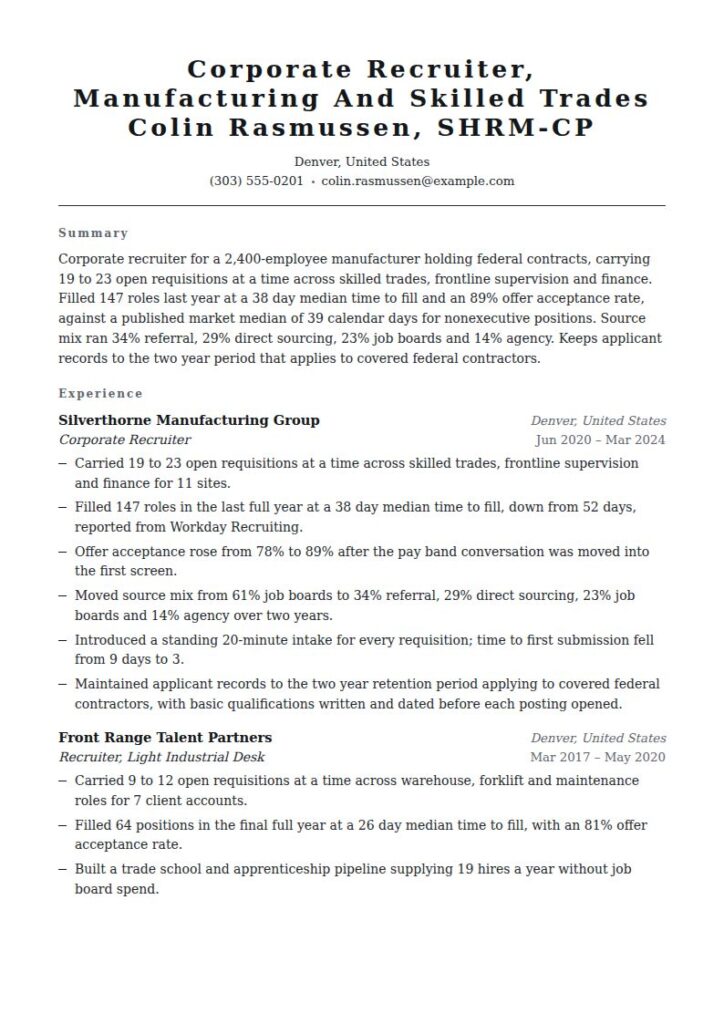
Corporate recruiter for a 2,400-employee manufacturer holding federal contracts, carrying 19 to 23 open requisitions at a time across skilled trades, frontline supervision and finance. Filled 147 roles last year at a 38 day median time to fill and an 89% offer acceptance rate, against a published market median of 39 calendar days for nonexecutive positions. Source mix ran 34% referral, 29% direct sourcing, 23% job boards and 14% agency. Keeps applicant records to the two year period that applies to covered federal contractors.
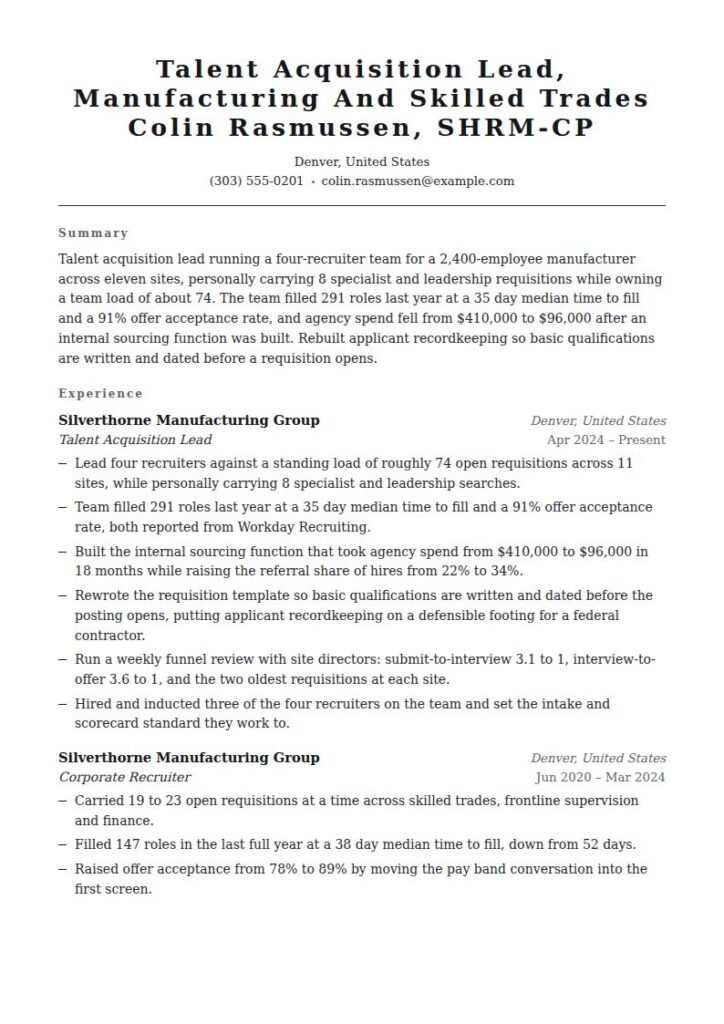
Talent acquisition lead running a four-recruiter team for a 2,400-employee manufacturer across eleven sites, personally carrying 8 specialist and leadership requisitions while owning a team load of about 74. The team filled 291 roles last year at a 35 day median time to fill and a 91% offer acceptance rate, and agency spend fell from $410,000 to $96,000 after an internal sourcing function was built. Rebuilt applicant recordkeeping so basic qualifications are written and dated before a requisition opens.
Right vs wrong: the same recruiter summary, twice
| ✅ Right | ❌ Wrong |
|---|---|
| Carried 19 to 23 open requisitions at a time across skilled trades, supervision and finance. | Managed a high volume of requisitions in a fast-paced environment. |
| Filled 147 roles at a 38 day median time to fill and an 89% offer acceptance rate. | Consistently exceeded hiring targets and delivered quality candidates. |
| Source mix ran 34% referral, 29% direct sourcing, 23% job boards and 14% agency. | Utilized a variety of sourcing channels to build robust talent pipelines. |
The right column is a desk a hiring director can hand over on Monday. The left column is every other recruiter resume in the folder, and the person reading it screens for a living.
Outline your experience
Employer, headcount, whether agency or corporate, dates, then three to five bullets. Every bullet carries a number, and at least one describes something you built rather than something you filled.
| Instead of | Use |
|---|---|
| Managed full cycle recruitment for multiple departments | Carried 19 to 23 open requisitions at a time across skilled trades, supervision and finance |
| Sourced qualified candidates through various channels | Moved source mix from 61% job boards to 34% referral and 29% direct sourcing over two years |
| Built strong relationships with hiring managers | Ran a standing 20-minute intake for every new requisition; time to first submission fell from 9 days to 3 |
| Reduced time to hire | Median time to fill went from 52 days to 38 across 147 roles after the intake and scorecard change |
| Improved candidate experience | Offer acceptance rose from 78% to 89% after moving the pay conversation into the first screen |
| Used the applicant tracking system daily | Administered Workday Recruiting for eleven sites and rebuilt the requisition template to capture basic qualifications |
Talent Acquisition Lead, Silverthorne Manufacturing Group, 2,400 employees, 11 sites, Denver, CO, April 2024 to Present
Lead four recruiters against a standing load of roughly 74 open requisitions, while personally carrying 8 specialist and leadership searches.
Team filled 291 roles last year at a 35 day median time to fill and a 91% offer acceptance rate, both reported from Workday Recruiting.
Built the internal sourcing function that took agency spend from $410,000 to $96,000 in 18 months while raising the referral share of hires from 22% to 34%.
Rewrote the requisition template so basic qualifications are written and dated before the posting opens, which put applicant recordkeeping on a defensible footing for a federal contractor.
Run a weekly funnel review with site directors: submit-to-interview 3.1 to 1, interview-to-offer 3.6 to 1, and the two requisitions in each site with the worst age.
Your requisition load and your funnel numbers
This is the section that decides a recruiting hire, and the one most candidates replace with adjectives.
Six numbers describe a recruiting desk. Give as many as you honestly have.
| Number | What it tells the reader | How to write it |
|---|---|---|
| Concurrent requisition load | Your capacity, and what they can hand you | 19 to 23 open reqs at a time |
| Seniority and function split | Which network you actually have | 60% skilled trades, 25% supervision, 15% finance |
| Time to fill | Whether your desk moves | 38 day median across 147 roles |
| Offer acceptance rate | Whether you price and close properly | 89%, up from 78% |
| Source mix | Whether you source or post and pray | 34% referral, 29% direct, 23% boards, 14% agency |
| Stage ratios | Where your funnel leaks | Submit-to-interview 3.1 to 1, interview-to-offer 3.6 to 1 |
Two of these carry more weight than the rest. Offer acceptance is the closest thing recruiting has to a quality measure, because it captures whether you understood the pay band, the commute, the shift pattern and the competing offer before the offer went out. Source mix is the one that separates a sourcer from a poster: a desk running 60% job boards is a desk that waits, and a reader knows it.
When the ATS reporting was poor. This is the normal case, not the exception. Requisitions get cloned, statuses are never closed, one system replaces another mid-year, and the dashboard produces a number nobody in the room believes.
Say so, and say what you counted instead. Three sentences fix it:
- Label the source: "reported from Greenhouse" or "hand-counted from signed offer letters".
- Give the population and the window: "147 roles closed between January and December".
- Name the exclusion: "excludes 14 requisitions canceled before first submission".
A recruiter who writes "hand-counted from signed offer letters, excludes requisitions canceled before first submission" reads as more credible than one quoting a clean dashboard figure, not less. Every hiring director has watched an ATS produce a number that was wrong, and a candidate who acknowledges that is speaking their language.
Never invent a stage ratio. If your ATS never tracked submit-to-interview, give the two numbers you do have and leave the ratio out.
What the published benchmarks actually say
SHRM's 2026 Recruiting Executives Benchmarking report, drawn from more than 4,600 organizations, puts median time to fill at 39 calendar days for nonexecutive positions, down from the prior year, and records that the median share of nonexecutive positions filled externally rose from 93% in 2025 to 97% in 2026 (SHRM, published 24 June 2026).
The same report finds that extra-large organizations saw a 67% increase in requisitions per recruiter in 2026, and that two in three organizations reported struggling to hire for open positions.
Read those together before you write your own numbers down. A 38 day median is roughly at market. A load that rose sharply is the market condition, not a personal failure. And with 97% of nonexecutive roles filled externally at the median organization, internal mobility is not competing for your requisitions the way a decade of commentary suggested it would.
The records obligation. Recruiters generate the records that get subpoenaed. The Equal Employment Opportunity Commission requires employers to keep all personnel or employment records for one year, and for one year from the date of termination where an employee is involuntarily terminated; where a charge has been filed, records relating to it must be kept until final disposition of the charge or any lawsuit based on it (EEOC recordkeeping requirements, checked 12 September 2026).
For federal contractors the period is longer and the obligation is more specific. Personnel and employment records must be preserved for not less than two years from the date of the record or the personnel action, whichever is later, dropping to one year where the contractor has fewer than 150 employees or does not hold a government contract of at least $150,000 (41 CFR 60-1.12, checked 12 September 2026). The related Internet Applicant rule defines who counts as an applicant through four conditions, including that the person's expression of interest indicates they possess the basic qualifications for the position, and expects those qualifications to be established in advance of considering any expression of interest (41 CFR 60-1.3, checked 12 September 2026).
That last point is a resume line, not a footnote. A recruiter who writes basic qualifications before the posting opens is doing the thing that makes an adverse impact analysis survivable two years later, and very few candidates know to say it.
Build a snapshot of your key skills
Twelve to fourteen entries in four groups. Systems by product name, sourcing by method, and the compliance line that almost nobody includes.
Sourcing: Boolean and x-ray search, Direct outreach and sequencing, Referral program design, Trade school and apprenticeship pipelines, Talent mapping for hard-to-fill sites
Systems: Workday Recruiting, Greenhouse, Bullhorn, LinkedIn Recruiter, HireRight background screening
Funnel and reporting: Requisition load management, Time to fill and aging analysis, Stage conversion reporting, Offer acceptance and decline reason coding, Agency spend tracking
Compliance and process: Basic qualifications written before posting, Internet Applicant recordkeeping, Structured interview scorecards, Offer approval and pay band adherence, Intake meeting standards
Leave out "communication skills" and "relationship building". They are the job, not a differentiator, and each one costs you a line that a stage ratio could have used.
List your education and certifications
Certifications first, since sourcing credentials are current and degrees are not.
SHRM Certified Professional (SHRM-CP), SHRM, 2022. Maintained with 60 professional development credits over three years.
AIRS Certified Internet Recruiter (CIR), AIRS, certificate #CIR-2018-77140, 2018
AIRS Certified Diversity and Inclusion Recruiter (CDR), AIRS, 2023
Bachelor of Arts, Communication, University of Colorado Boulder, Boulder, CO, 2015
Structured interviewing and scorecard design, internal facilitator certification, 2024
Sourcing certifications age quickly, so give the year. A CIR from 2018 with nothing since reads as a recruiter who stopped learning the year LinkedIn changed its search syntax.
Choose the right layout and design
Single column, 11 or 12 point, no photograph, no charts. PDF unless the portal specifies otherwise.
Resist the funnel graphic. Recruiters reach for one because the numbers are the argument, and it is the one profession where a visual will be read as a parsing risk by someone who knows exactly how parsing fails. Put the numbers in sentences and let the reader's eye do the work.
Lead with concurrent requisition load, then annual hires. Split the load by function and seniority. Give time to fill as a median with the population attached. Label every number as ATS-reported or hand-counted. State your source mix as percentages. Say whether the role was agency or corporate. Mention that you write basic qualifications before posting.
Do not report a stage ratio your system never tracked. Do not quote a time to fill without saying how many roles it covers. Do not describe yourself as a connector, a hunter or a closer. Do not name a candidate, a client contact or a confidential search. Do not use a funnel graphic. Do not claim agency and corporate experience interchangeably; a reader can tell which desk you sat at.
Recruiter job market and outlook
Recruiters do not have their own profile in the Occupational Outlook Handbook. The Handbook places recruitment specialists, sometimes called recruiters or talent acquisition specialists, inside the human resources specialists occupation, and that is the data your pay will be benchmarked against.
| Measure | Value |
|---|---|
| Human resources specialist jobs, 2025 | 939,700 |
| Projected change, 2025 to 2035 | 6% growth, faster than average |
| Projected annual openings | About 73,700 |
| Typical entry-level education | Bachelor's degree |
| Median annual wage, May 2025 | $75,940 |
Source: Bureau of Labor Statistics Occupational Outlook Handbook, May 2025 wage data and 2025 to 2035 projections.
Recruiting is also the most cyclical seat in human resources. The requisition load that defines your resume is set by someone else's hiring plan, which is why SHRM's finding that extra-large organizations saw requisitions per recruiter rise 67% in 2026 matters more to your next interview than any personal metric (SHRM 2026 Recruiting Executives Benchmarking, published 24 June 2026). Write your load with its date attached, because a reader who knows the market will read it in context.
What salary you can expect as a recruiter
Benchmark against human resources specialists. The median annual wage was $75,940 in May 2025, with the lowest 10 percent under $47,180 and the highest 10 percent over $128,720 (Bureau of Labor Statistics Occupational Outlook Handbook, May 2025).
Industry is the largest single factor, and it is where agency and corporate recruiters part company. In May 2025 the median for human resources specialists was $84,100 in government excluding state and local education and hospitals, $82,800 in professional, scientific and technical services, $79,270 in manufacturing, $64,130 in healthcare and social assistance, and $60,550 in employment services (Bureau of Labor Statistics Occupational Outlook Handbook, May 2025).
Employment services is where most agency recruiting sits, and it carries the lowest median of the five by a wide margin, although commission can move an individual desk well above it in a strong year and well below it in a weak one. Moving from an agency desk to a corporate seat in manufacturing or professional services is worth roughly $19,000 to $22,000 at the median before any variable pay, which is the single largest financial decision most recruiters make.
Above the specialist band sits management. Human resources managers had a median annual wage of $149,280 in May 2025 across about 224,900 jobs, with employment projected to grow 6 percent from 2025 to 2035 and about 16,800 openings a year on average (Bureau of Labor Statistics Occupational Outlook Handbook, May 2025 and 2025 to 2035 projections). Talent acquisition leadership is one of the common routes into that band, and the resume that gets there is the one that already reports on a team rather than a desk.
Key takeaways for a recruiter resume
- Lead with concurrent requisition load, not annual hires, and split it by function and seniority.
- Give time to fill as a median with the number of roles it covers.
- Report offer acceptance rate; it is the closest thing recruiting has to a quality measure.
- State source mix as percentages, because it separates sourcing from posting.
- Label every figure as ATS-reported or hand-counted, and name the exclusions.
- Never invent a stage ratio your system did not track.
- Say that you write basic qualifications before the posting opens; federal contractor recordkeeping turns on it.
Build your recruiter resume in 15 minutes.
Related human resource resume examples
- Technical recruiter resume
- Entry level HR resume
- Human resources assistant resume
- HR coordinators resume
- Human resource generalist resume
- Human resource resume
- HR business partner resume
- Human resources manager resume
- HR director resume
- Chief happiness officer resume
- Operations manager resume
- Business manager resume
Pair it with a matching recruiter cover letter.
Recruiter resume questions, answered
How long should a recruiter resume be?
One page for your first three years. Two once you carry a mixed-seniority load, lead a team, or have a source mix worth showing across more than one year. Never three, and never a one-page file that omits your numbers to fit.
What if my ATS reporting was unreliable?
Say so and show your working. Label each figure as reported or hand-counted, give the population and the window, and name what you excluded. A recruiter who writes "hand-counted from signed offer letters, 147 roles, excludes 14 requisitions canceled before first submission" reads as more trustworthy than one quoting a suspiciously round dashboard number.
Should I put my requisition load or my hires per year first?
Load first. Annual hires tells a reader what happened; concurrent load tells them what you can carry, which is the question they are actually asking. Give both, and add the function and seniority split so the reader knows which network they are buying.
Is agency experience a disadvantage when moving to corporate?
No, but it has to be translated. Agency proves volume, speed and outbound sourcing under fee pressure. What corporate readers want to see added is stakeholder management: intake standards, scorecards, pay band discipline and the recordkeeping that comes with an internal requisition. Label the desk you sat at and address the gap directly rather than hoping it goes unnoticed.
What is a realistic time to fill to compare myself against?
SHRM's 2026 Recruiting Executives Benchmarking report, drawn from more than 4,600 organizations, puts the median at 39 calendar days for nonexecutive positions (SHRM, published 24 June 2026). Executive and specialist searches run considerably longer, so always state which population your figure covers. A 38 day median on skilled trades and a 38 day median on senior finance roles are very different achievements.
Do recruiters have their own Bureau of Labor Statistics profile?
No. The Occupational Outlook Handbook places recruitment specialists, also called recruiters or talent acquisition specialists, inside the human resources specialists occupation: median annual wage $75,940 in May 2025, about 939,700 jobs, and 6 percent projected growth from 2025 to 2035 (page last modified 27 August 2026). Any recruiter-specific salary figure you see quoted elsewhere comes from a survey rather than from federal data, and should be cited as such.