HR Director, 420 Employees, $12.4m Rewards Spend Bernard Okonkwo-Hale SPHR
HR Director
[email protected] | (203) 555-0186 | Stamford, United States
Profile
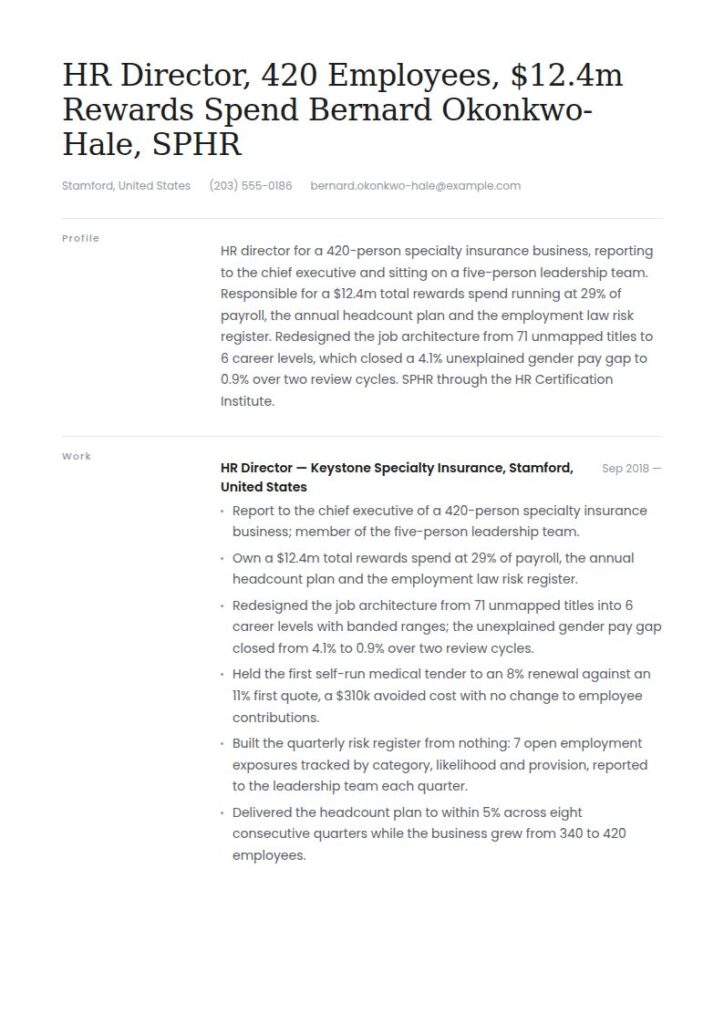
HR director for a 420-person specialty insurance business, reporting to the chief executive and sitting on a five-person leadership team. Responsible for a $12.4m total rewards spend running at 29% of payroll, the annual headcount plan and the employment law risk register. Redesigned the job architecture from 71 unmapped titles to 6 career levels, which closed a 4.1% unexplained gender pay gap to 0.9% over two review cycles. SPHR through the HR Certification Institute.
Work Experience
09/2018 - Present, HR Director, Keystone Specialty Insurance, Stamford, United States
- Report to the chief executive of a 420-person specialty insurance business; member of the five-person leadership team.
- Own a $12.4m total rewards spend at 29% of payroll, the annual headcount plan and the employment law risk register.
- Redesigned the job architecture from 71 unmapped titles into 6 career levels with banded ranges; the unexplained gender pay gap closed from 4.1% to 0.9% over two review cycles.
- Held the first self-run medical tender to an 8% renewal against an 11% first quote, a $310k avoided cost with no change to employee contributions.
- Built the quarterly risk register from nothing: 7 open employment exposures tracked by category, likelihood and provision, reported to the leadership team each quarter.
- Delivered the headcount plan to within 5% across eight consecutive quarters while the business grew from 340 to 420 employees.
06/2014 - 08/2018, Human Resources Manager, Keystone Specialty Insurance, Stamford, United States
- Ran the HR function for 340 employees with two HR staff reporting in, covering hiring, employee relations, leave administration and performance.
- Rebuilt the annual merit cycle onto a single calibrated process, cutting the cycle from 11 weeks to 6.
Education
09/2012 - 05/2014, Master of Science, Human Resources Management, Rutgers University School of Management and Labor Relations, New Brunswick, United States
Concentration in compensation and labor relations.
09/2006 - 05/2010, Bachelor of Arts, Economics, University of Connecticut, Storrs, United States
Skills
Job architecture and levelling, 85
Benefits strategy and renewal, 80
Pay equity review, 85
Headcount planning and budget ownership, 80
Employment law risk register, 75
Organizational design, 75
Leadership team reporting, 80
Languages
English, native
Igbo, native
French, intermediate
Certificates
06/2017, Senior Professional in Human Resources (SPHR), HR Certification Institute
HRCI's strategic credential. Recertification every three years.
Summary
An HR director resume is a two page document written for a chief executive or a board, built on total rewards spend, organizational design and workforce planning, employment law exposure and the numbers a director carries. This guide gives you three adaptable versions, the differentiating block most applicants leave out, and current Bureau of Labor Statistics pay and outlook.
HR Director resume examples by experience level
An HR director resume is a two page document that names the money you were responsible for, the workforce you planned, the risk you carried, and the decisions you sat in the room for.
The reader is usually not another HR person. It is a chief executive, a chief financial officer, a board chair or a nominations committee, and they read this resume the way they read a functional director's business case: what does this cost, what could go wrong, and does this person understand both. An operational HR resume put in front of that reader looks like a candidate for the job below.
Resume guide for an HR director resume
This guide and the corresponding HR director resume example will cover:
- How to write an HR director resume, section by section
- Why this is a different document from a human resources manager resume
- Three adaptable summaries: first director post, established director, group director
- The numbers block a director carries: rewards spend, headcount plan and risk
- What the job market looks like and what you can expect to earn
How to write an HR director resume
Six sections: contact header, summary, a director's numbers block, work experience, education and certifications, and board or committee service. Two pages, because a director who fits on one page has not owned enough to fill two.
The difference from the level below is worth stating plainly once and then living by it for the rest of the page. A human resources manager runs the function day to day for a defined population: hiring, employee relations, leave, performance, compliance. An HR director owns what that function costs, how the organization is shaped, and what it is exposed to. The manager's resume is a scope and ratio document. The director's resume is a money and risk document.
| Section | What it is answering | Where it goes |
|---|---|---|
| Director's numbers | What did this cost, what was planned, what is exposed? | Directly under the summary |
| Work experience | What did they decide, and what did it change? | Reverse chronological, one decision per bullet |
| Education and certifications | Is there a strategic credential behind the title? | After experience, issuing body spelled out |
| Board and committee service | Do they operate at governance level? | Last, short, factual |
Never put a person on your resume
This matters more at director level than anywhere else in the profession, because restructuring, exits and litigation are part of the job and they are all made of individuals.
Do not name an employee or an executive. Do not describe an individual case, settlement, investigation, grievance or dismissal. Do not reference anyone's medical information, accommodation, leave, complaint or discipline, and do not do it in disguised form, which at this level means anything as specific as "managed the exit of a divisional managing director".
Write those things as programs and numbers instead. "Delivered a restructuring across two sites: 112 roles out of scope, 31 redeployed, program closed in 14 weeks with no charges filed" is complete, verifiable and discloses nothing. The version with a person in it tells a chief executive exactly how their own leadership team would eventually be described.
Run the file through the free Rezoom ATS resume checker before you send it. Director searches are often run through an executive search firm's own system, and a figure sitting inside a text box does not come out the other side.
Choosing the best resume format for an HR director resume
Reverse chronological, two pages. The argument is that the size and seriousness of what you owned grew, and that is a timeline.
Resist the executive one-pager. It is a genuine convention in some search processes, but it works by leaving out numbers, and numbers are what separate a director candidate from a senior manager candidate. If a search firm asks for one page, send a one-page profile alongside the full resume rather than instead of it.
Include your contact information
| ✅ Right | ❌ Wrong |
|---|---|
| Bernard Okonkwo-Hale, SPHR, SHRM-SCP | Bernard Okonkwo-Hale |
| HR Director, 1,200 employees, $41m rewards spend | Strategic HR leader and trusted business advisor |
| SPHR, HR Certification Institute; SHRM-SCP, SHRM | Certified senior HR professional |
| (203) 555-0186, [email protected], Stamford, CT | (203) 555-0186, [email protected] |
Put a headcount and a money figure in the title line. A board member reading a shortlist wants to know the weight class before the first bullet, and "HR Director" on its own covers everything from a 200-person company to a 20,000-person group.
Make use of a summary
Four lines: the organization and its size, the spend you were responsible for, the strategic work you led, and one governance or risk line.
HR director for a 420-person specialty insurance business, reporting to the chief executive and sitting on a five-person leadership team. Responsible for a $12.4m total rewards spend running at 29% of payroll, the annual headcount plan and the employment law risk register. Redesigned the job architecture from 71 unmapped titles to 6 career levels, which closed a 4.1% unexplained gender pay gap to 0.9% over two review cycles. SPHR through the HR Certification Institute.
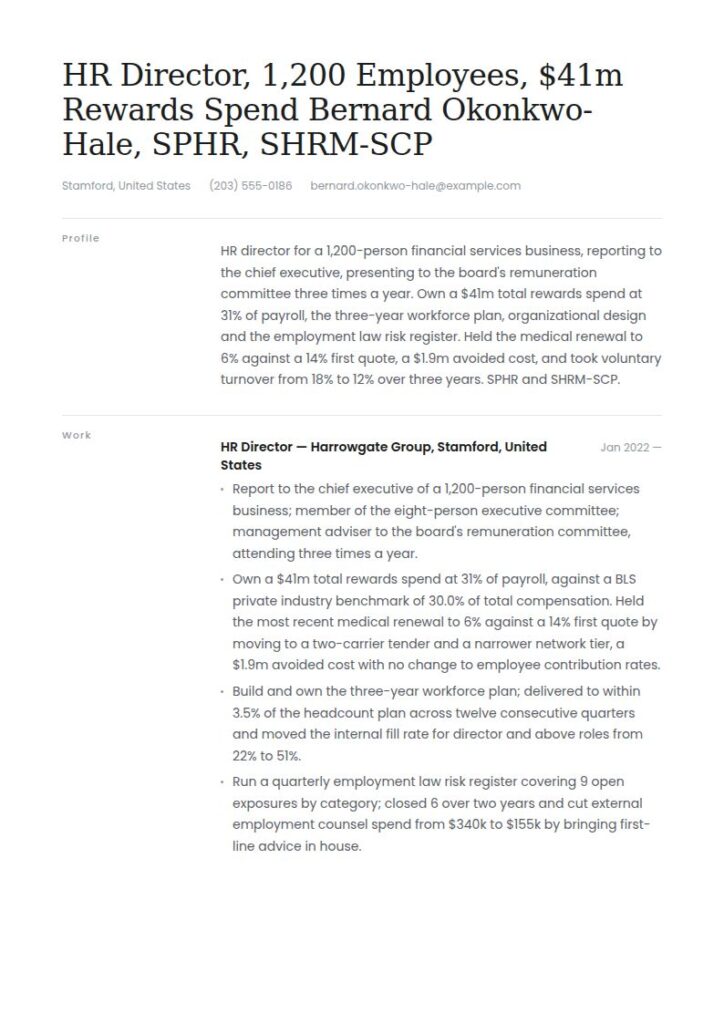
HR director for a 1,200-person financial services business, reporting to the chief executive, presenting to the board's remuneration committee three times a year. Own a $41m total rewards spend at 31% of payroll, the three-year workforce plan, organizational design and the employment law risk register. Held the medical renewal to 6% against a 14% first quote, a $1.9m avoided cost, and took voluntary turnover from 18% to 12% over three years. SPHR and SHRM-SCP.
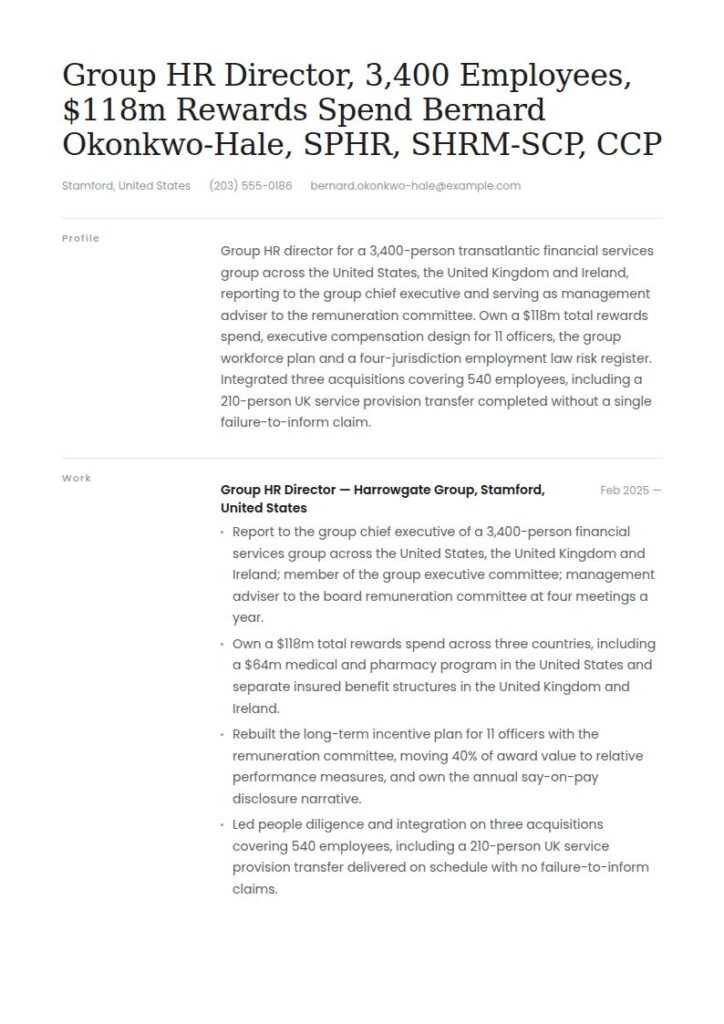
Group HR director for a 3,400-person transatlantic financial services group across the United States, the United Kingdom and Ireland, reporting to the group chief executive and serving as management adviser to the remuneration committee. Own a $118m total rewards spend, executive compensation design for 11 officers, the group workforce plan and a four-jurisdiction employment law risk register. Integrated three acquisitions covering 540 employees, including a 210-person UK service provision transfer completed without a single failure-to-inform claim.
Right vs wrong: the same HR director summary, twice
| ✅ Right | ❌ Wrong |
|---|---|
| HR director for a 1,200-person financial services business, reporting to the chief executive. | Senior HR leader with extensive experience across the full employee lifecycle. |
| Own a $41m total rewards spend at 31% of payroll and the three-year workforce plan. | Responsible for compensation, benefits and strategic workforce initiatives. |
| Held the medical renewal to 6% against a 14% first quote, a $1.9m avoided cost. | Managed vendor relationships and delivered cost savings on benefits. |
| Present to the board's remuneration committee three times a year. | Partner closely with executive leadership and the board. |
The left column has been in the room. The right column has been near it, and a nominations committee can tell the difference in one pass.
Outline your experience
Organization, headcount, reporting line, and the committees you attended. Then four to six bullets per role, each one a decision rather than a duty, with the money, the population or the exposure attached.
| Instead of | Use |
|---|---|
| Led all HR strategy for the organization | Built the three-year workforce plan for a 1,200-person business; delivered to within 3.5% of the headcount plan across twelve quarters |
| Managed compensation and benefits | Owned a $41m total rewards spend at 31% of payroll; held the medical renewal to 6% against a 14% first quote |
| Oversaw organizational restructuring | Delivered a restructuring across two sites: 112 roles out of scope, 31 redeployed, program closed in 14 weeks with no charges filed |
| Reduced legal risk for the company | Ran a quarterly employment law risk register with 9 open exposures; closed 6 and cut external employment counsel spend from $340k to $155k |
| Supported M&A activity | Led people integration on three acquisitions covering 540 employees, including a 210-person UK service provision transfer |
| Worked on executive compensation | Rebuilt the long-term incentive plan for 11 officers with the remuneration committee, moving 40% of award value to relative performance measures |
HR Director, Harrowgate Group, Stamford, CT, January 2022 to Present
Report to the chief executive of a 1,200-person financial services business; member of the eight-person executive committee; management adviser to the board's remuneration committee, attending three times a year.
Own a $41m total rewards spend running at 31% of payroll, against a BLS private industry benchmark of 30.0% of total compensation. Held the most recent medical renewal to 6% against a 14% first quote by moving to a two-carrier tender and a narrower network tier, a $1.9m avoided cost with no change to employee contribution rates.
Build and own the three-year workforce plan. Delivered to within 3.5% of plan across twelve consecutive quarters, and moved the internal fill rate for director and above roles from 22% to 51%.
Run a quarterly employment law risk register covering 9 open exposures by category. Closed 6 over two years and cut external employment counsel spend from $340k to $155k by bringing first-line advice in house.
Delivered a two-site restructuring as a program: 112 roles out of scope, 31 redeployed into open requisitions, closed in 14 weeks with no charges filed against the process.
Took voluntary turnover from 18% to 12% over three years while the business grew headcount by 14%.
The director's numbers: rewards spend, headcount plan and the risk register
This is the block that decides whether a board reads you as a director or as a very good manager. Almost nobody writes it, because almost nobody thinks of HR as carrying three numbers of its own. It does.
Total rewards spend: $41.0m, 31% of a $132m payroll. Medical and pharmacy $23.1m, retirement match $7.4m, insured benefits $3.8m, wellbeing and leave programs $2.1m, variable pay funding $4.6m. Most recent renewal held to 6% against a 14% first quote.
Workforce plan: three-year plan for 1,200 employees. Twelve consecutive quarters delivered within 3.5% of the headcount plan. Internal fill rate for director and above, 51%. Succession coverage across 24 critical roles, 2.1 ready-now candidates per role against a target of 2.0.
Risk register: 9 open employment exposures tracked quarterly by category, with likelihood and provision. External employment counsel spend $155k, down from $340k. No charges filed against the two-site restructuring program.
Governance: executive committee member; management adviser to the remuneration committee, three meetings a year; owner of the annual say-on-pay disclosure narrative.
Take the three numbers in order.
Total rewards spend is the one that most changes how you are read, and it needs a denominator. A figure of $41m means nothing on its own; $41m at 31% of payroll means something immediately, because it can be compared. The Bureau of Labor Statistics measured private industry employer costs at $46.89 per hour worked in June 2026, of which wages and salaries were $32.82, or 70.0%, and benefits $14.07, or 30.0% (BLS Employer Costs for Employee Compensation, released 9 September 2026). Quoting your own ratio against that benchmark tells a chief financial officer in one line whether your rewards structure is rich, lean or normal, and that you know which.
The headcount plan is the second, and it is the number that proves you operate as a business leader rather than as a service function. Plan versus actual across consecutive quarters is the workforce equivalent of a budget variance, and it is the single most persuasive figure an HR director can put on a page. A director who can say "within 3.5% of plan across twelve quarters" is describing a forecasting discipline that most functions do not have.
The risk register is the third and the most uncomfortable to write, because the instinct is to say nothing. Say it in categories and counts. The Equal Employment Opportunity Commission resolved 90,743 charges of discrimination in fiscal year 2025, a 4% increase over fiscal 2024, and recovered $660m for 17,680 individuals (EEOC, April 2026). Employment exposure is a normal operating cost of employing people, and a director who tracks it openly, quantifies it, and can show it falling is more credible than one whose resume implies nothing ever happened.
Build a snapshot of your key skills
Twelve to sixteen entries in four labeled groups, weighted towards design and governance rather than administration. At director level, listing "onboarding" costs you more than leaving it out.
Total rewards: Benefits strategy and renewal, Carrier tender and network design, Job architecture and levelling, Pay equity review, Short and long-term incentive design, Executive compensation and say-on-pay disclosure
Organization and workforce: Organizational design and layer analysis, Three-year workforce planning, Succession planning and talent review governance, Restructuring and redeployment programs, Span of control analysis
Risk and governance: Employment law risk register, Multi-jurisdiction compliance, Works council and service provision transfer consultation, External counsel management, Policy architecture and delegation of authority
Commercial: Mergers and acquisitions people diligence and integration, HR operating model design, HR budget ownership, Board and remuneration committee reporting
List your education and certifications
Degree, postgraduate qualification, then the strategic credentials with the issuing body and year. Add board or committee service as its own short block if you have it.
Master of Science, Human Resources Management, Rutgers University School of Management and Labor Relations, New Brunswick, NJ, 2014
Bachelor of Arts, Economics, University of Connecticut, Storrs, CT, 2010
Senior Professional in Human Resources (SPHR), HR Certification Institute, 2017. HRCI describes the SPHR as its strategic credential, requiring five years of professional-level HR experience with a bachelor's degree, four with a master's, or seven without a degree.
SHRM Senior Certified Professional (SHRM-SCP), SHRM, 2019. SHRM requires at least three years of strategic-level HR work for this credential.
Certified Compensation Professional (CCP), WorldatWork, 2021
Board and committee service: Trustee, 401(k) plan investment committee, 2019 to present. Management adviser, board remuneration committee, 2022 to present.
The credential choice carries a signal at this level. HRCI positions the PHR as its operational and technical credential and the SPHR as its strategic one, and SHRM draws the same line between the SHRM-CP and the SHRM-SCP (HR Certification Institute and SHRM, 2026). Holding only the operational credential while applying for a director post is a small inconsistency that an HR-literate board member will notice.
Choose the right layout and design
Single column, two pages, 10.5 or 11 point body type, no photograph, no rating bars, no branded footer. The director's numbers block sits under the summary as a short labeled list. Use a page break that keeps the current role whole rather than splitting it.
Give rewards spend with a payroll denominator, not a raw dollar figure. State headcount plan versus actual across consecutive quarters. Quantify the risk register in categories and counts. Name your reporting line and the committees you attended. Write restructuring and exits as programs with numbers. Name the jurisdictions, because multi-jurisdiction exposure is priced. Spell out the issuing body of every credential.
Do not name an employee or an executive, describe an individual case, settlement, grievance or dismissal, or reference anyone's medical information, accommodation, leave or discipline. Do not claim you owned executive compensation if you assembled the committee pack. Do not list operational duties such as onboarding or offer letters. Do not imply nothing ever went wrong; a register with zero entries reads as a register nobody kept. Do not send one page.
HR director job market and outlook
HR directors are counted by the Bureau of Labor Statistics within human resources managers, which is a mid-sized management occupation growing faster than the average for all occupations.
| Measure | Value |
|---|---|
| Human resources manager jobs, 2025 | 224,900 |
| Projected employment, 2035 | 237,400 |
| Projected change, 2025-35 | 6% (faster than average), +12,500 |
| Projected annual openings | About 16,800 |
| Typical entry-level education | Bachelor's degree |
| Work experience typically required | 5 years or more |
| Median annual wage, May 2025 | $149,280 |
Source: U.S. Bureau of Labor Statistics, Occupational Outlook Handbook, 2025-35 projections and May 2025 wage data.
Director pay lives in the top quartile, and sector decides where
The median for the occupation as a whole was $149,280 in May 2025, but the top 10 percent earned more than $267,810 and the bottom 10 percent less than $88,200 (BLS, May 2025). A director-level post sits in the upper part of that distribution rather than at the median, which is why benchmarking yourself against the headline figure understates your market.
Sector moves it further. Median annual wages in May 2025 were $170,590 in professional, scientific and technical services, $166,200 in management of companies and enterprises, $145,680 in manufacturing, $128,650 in government excluding state and local education and hospitals, and $126,900 in healthcare and social assistance (BLS, May 2025).
Management of companies and enterprises, which is where most group and holding company HR director roles are counted, employed 14% of the occupation in 2025, with professional, scientific and technical services the largest at 15% (BLS, 2025). Those two settings together hold close to a third of the occupation and pay the two highest medians in it.
What salary you can expect as an HR director
The median annual wage for human resources managers, the occupation that contains HR directors, was $149,280 as of May 2025, with the top 10 percent above $267,810 (BLS, May 2025).
Three things move a director offer inside that range, and all three are things the resume controls.
Total rewards spend is the first, because it is the closest thing HR has to a budget under management figure and executive pay is priced against budget under management everywhere else in a business. A director who states $41m at 31% of payroll is negotiating in a different band from one who states "responsible for compensation and benefits".
Governance exposure is the second. Remuneration committee work, say-on-pay disclosure, plan trusteeship and board reporting are priced separately from operational HR leadership, because they are what makes a director appointable into a group or listed environment.
Jurisdiction count is the third. Multi-country exposure, particularly where consultation regimes and service provision transfers are involved, is scarce and it is one of the few HR skills a company cannot build quickly when it needs it.
Key takeaways for an HR director resume
- Write for a chief executive and a board, not for another HR person.
- Give total rewards spend with a payroll denominator so it can be compared.
- Put headcount plan versus actual across consecutive quarters on the page.
- Quantify the employment law risk register by category and count.
- Write restructuring, exits and integrations as programs and numbers, never as people.
- Never name an employee or describe an individual case, settlement or grievance.
- Name your reporting line, your committees and your jurisdictions, then take two pages.
Build your HR director resume in 15 minutes.
Related human resource resume examples
- Human resources manager resume
- HR business partner resume
- Human resource generalist resume
- Human resource resume
- HR coordinator resume
- Human resources assistant resume
- Entry level HR resume
- Recruiter resume
- Technical recruiter resume
- Chief happiness officer resume
- Business manager resume
- Operations manager resume
Pair it with a matching HR director cover letter.
HR director resume questions, answered
How long should an HR director resume be?
Two pages. One page at this level forces you to remove the numbers, and the numbers are the argument. Three pages reads as a candidate who cannot prioritize, which is a competency the role is assessed on.
What is the difference between an HR director and a human resources manager resume?
The unit of account. A [human resources manager](/resume/human-resources-manager/) resume is built on scope and ratio: headcount supported, HR to employee ratio, sites and states, disciplines owned. An HR director resume is built on money and risk: rewards spend as a share of payroll, headcount plan versus actual, the employment law register, and the committees you report to. Submitting the first document for a director post is the most common reason strong candidates are screened out.
How do I write about restructuring and redundancies?
As programs with numbers and never as people. Roles out of scope, roles redeployed, consultation period, program duration, cost and outcome. Do not describe an individual exit, a settlement, or a conversation. A board reading a specific exit on your resume is thinking about how their own leadership team would be described on the next one.
Should I put litigation and employment claims on my resume?
In aggregate, yes, and it strengthens the page. Open exposures by category, matters closed, external counsel spend and its direction of travel. Never a specific case, party, claim or settlement figure. The EEOC resolved 90,743 charges of discrimination in fiscal year 2025 (EEOC, April 2026), so exposure is an ordinary cost of employing people, and a register that shows it managed is more credible than a resume implying it never arose.
Do I need SPHR or SHRM-SCP for a director role?
Neither is required, and the BLS lists a bachelor's degree plus five years or more of related experience as the typical entry route (BLS, 2025). But both bodies draw an explicit line between their operational and strategic credentials, so holding only the operational one while applying at director level is a mismatch an HR-literate reader will notice. If you hold the senior credential, put it in the title line.
How do I show executive compensation experience without overclaiming?
State the mechanism and your actual role in it. "Rebuilt the long-term incentive plan for 11 officers with the remuneration committee, moving 40% of award value to relative performance measures" is checkable and honest. "Led executive compensation" when you prepared the committee pack is not, and executive search reference checks in this profession are thorough enough to find the difference.