Associate HR Business Partner, Operations, 240 Employees Lucia Ferrante-Wykes SHRM-CP
Associate HR Business Partner, Distribution and Customer Operations
[email protected] | (612) 555-0129 | Minneapolis, United States
Profile
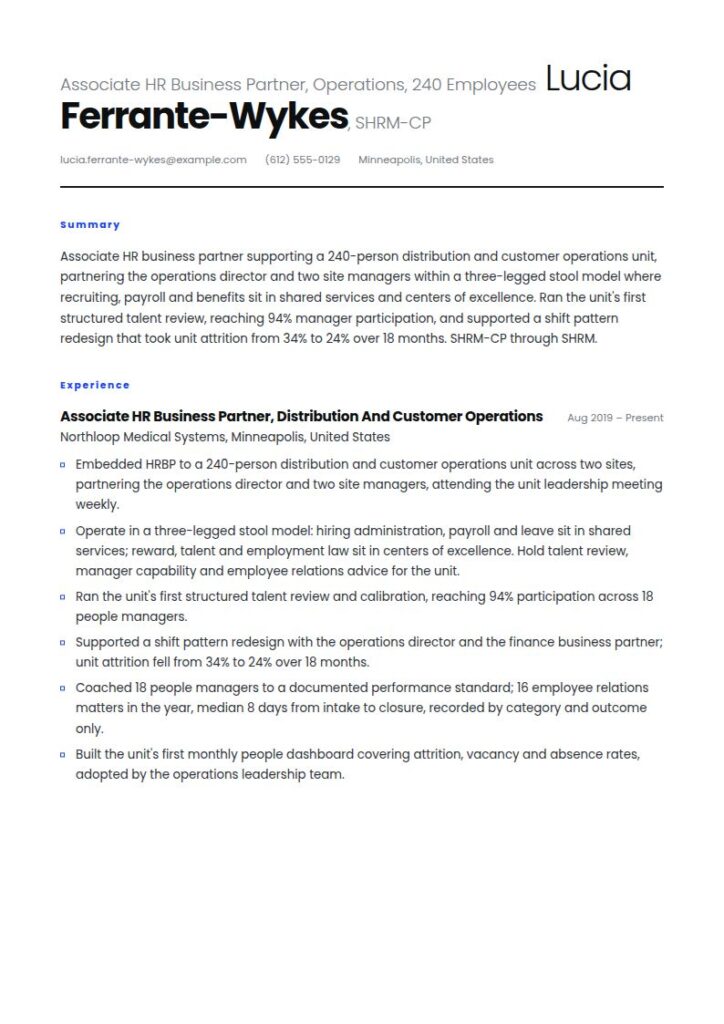
Associate HR business partner supporting a 240-person distribution and customer operations unit, partnering the operations director and two site managers within a three-legged stool model where recruiting, payroll and benefits sit in shared services and centers of excellence. Ran the unit's first structured talent review, reaching 94% manager participation, and supported a shift pattern redesign that took unit attrition from 34% to 24% over 18 months. SHRM-CP through SHRM.
Work Experience
08/2019 - Present, Associate HR Business Partner, Distribution and Customer Operations, Northloop Medical Systems, Minneapolis, United States
- Embedded HRBP to a 240-person distribution and customer operations unit across two sites, partnering the operations director and two site managers, attending the unit leadership meeting weekly.
- Operate in a three-legged stool model: hiring administration, payroll and leave sit in shared services; reward, talent and employment law sit in centers of excellence. Hold talent review, manager capability and employee relations advice for the unit.
- Ran the unit's first structured talent review and calibration, reaching 94% participation across 18 people managers.
- Supported a shift pattern redesign with the operations director and the finance business partner; unit attrition fell from 34% to 24% over 18 months.
- Coached 18 people managers to a documented performance standard; 16 employee relations matters in the year, median 8 days from intake to closure, recorded by category and outcome only.
- Built the unit's first monthly people dashboard covering attrition, vacancy and absence rates, adopted by the operations leadership team.
03/2017 - 07/2019, Human Resources Generalist, Cedar Grove Retail Group, Minneapolis, United States
- Generalist support to a 430-person store estate: hiring coordination, leave administration, performance cycle and policy advice.
- Rebuilt the new manager induction, cutting time to first solo shift from 6 weeks to 4.
07/2015 - 03/2017, Human Resources Coordinator, Cedar Grove Retail Group, Minneapolis, United States
- Ran the applicant tracking queue and new hire onboarding for roughly 140 hires a year.
Education
09/2017 - 05/2019, Master of Arts, Human Resources and Industrial Relations, University of Minnesota Carlson School of Management, Minneapolis, United States
Studied part time alongside full-time HR work. Concentration in organizational design and staffing.
09/2011 - 05/2015, Bachelor of Arts, Psychology, University of Minnesota, Minneapolis, United States
Skills
Influence without authority, 70
Talent review and calibration, 75
Manager coaching, 75
Employee relations advice, 75
Attrition and absence analysis, 80
Leadership meeting facilitation, 65
Workday HCM, 75
Languages
English, native
Italian, advanced
Certificates
06/2018, SHRM Certified Professional (SHRM-CP), SHRM
SHRM's operational credential.
Summary
An HR business partner resume is a one to two page document naming the business unit you are embedded in, its size and its leadership, and what changed there because of advice you had no authority to enforce. This guide gives you three adaptable versions, the client unit block most applicants leave out, and current Bureau of Labor Statistics pay and outlook.
HR Business Partner resume examples by experience level
An HR business partner resume is a one to two page document that names the business unit you sit inside, how big it is, who leads it, and what moved in that unit's own numbers because of work you had no authority to make anyone do.
That last clause is the job. An HRBP does not run the unit and does not control its budget, its headcount decisions or its promotions. You advise the people who do. A resume that describes an HRBP role as though you decided things is read as inflated, and a resume that describes it as support is read as a coordinator. The document has to sit precisely between those two, and almost none of them do.
Resume guide for an HR business partner resume
This guide and the corresponding HR business partner resume example will cover:
- How to write an HR business partner resume, section by section
- The three-legged stool, and why it decides what belongs on your page
- Three adaptable summaries: associate partner, business partner, senior partner
- The client unit block that almost no applicant writes
- What the job market looks like and what you can expect to earn
How to write an HR business partner resume
Six sections: contact header, summary, a client unit block, work experience, skills, and education with certifications. One page for an associate partner, two once you have partnered a leadership team through a reorganisation or a full talent cycle.
The section that does the work is the client unit block, and the reason is structural. The HRBP role exists inside a specific operating model, so the reader's first question is which unit you sat in, not which tasks you performed.
| Section | What it is answering | Where it goes |
|---|---|---|
| Client unit | Which business, how big, who led it, and what changed? | Directly under the summary |
| Work experience | What did you advise on, and what moved in the unit's numbers? | Reverse chronological, one outcome per bullet |
| Skills | Which HR disciplines, which commercial literacy, which systems? | Grouped in three or four labeled lines |
| Education and certifications | Is there a named credential with a named issuing body? | Last |
Never put a person on your resume
HRBPs hold more individual information than almost anyone in a company, because the job runs through talent reviews, performance calibration, exits and manager coaching. None of it belongs on a resume.
Do not name an employee or a leader. Do not describe an individual case, grievance, performance issue or exit. Do not reference anyone's medical information, accommodation, leave, complaint or discipline, and treat a description specific enough to identify someone as the same thing as naming them. "Coached a director through a difficult performance situation on their team" identifies two people to anyone inside that company.
Write by volume, process and outcome instead: "Ran quarterly talent review and calibration for 62 people managers; 100% coverage, moving from 41% the prior year." A hiring manager gets the whole picture and learns nothing they should not.
Run the file through the free Rezoom ATS resume checker first. HRBP roles attract high application volumes and the screen is almost always automated before a person opens anything.
Choosing the best resume format for an HR business partner resume
Reverse chronological. The argument is that the units you partnered got larger, more senior or more complex, and that is a timeline.
Avoid the skills-first format that circulates in HR communities. It groups your work by competency, which reads well to another HRBP and badly to everyone else, because it removes the client unit and the client unit is what a hiring manager is sizing you against.
Include your contact information
| ✅ Right | ❌ Wrong |
|---|---|
| Lucia Ferrante-Wykes, SHRM-SCP | Lucia Ferrante-Wykes |
| HR Business Partner, Commercial Organization, 780 employees | Strategic people partner and culture champion |
| SHRM-SCP, SHRM; Prosci Change Management Practitioner | Certified HR professional |
| (612) 555-0129, [email protected], Minneapolis, MN | (612) 555-0129, [email protected] |
Put the client unit in the title line. "HR Business Partner" on its own tells the reader nothing about scale, and an HRBP supporting a 200-person function and one supporting a 2,000-person division are two different jobs with identical titles.
Make use of a summary
Four lines: the unit and its size, the leadership you partner, the strategic work you led there, and one number from the unit's own scorecard rather than from HR's.
Associate HR business partner supporting a 240-person distribution and customer operations unit, partnering the operations director and two site managers within a three-legged stool model where recruiting, payroll and benefits sit in shared services and centers of excellence. Ran the unit's first structured talent review, reaching 94% manager participation, and supported a shift pattern redesign that took unit attrition from 34% to 24% over 18 months. SHRM-CP through SHRM.
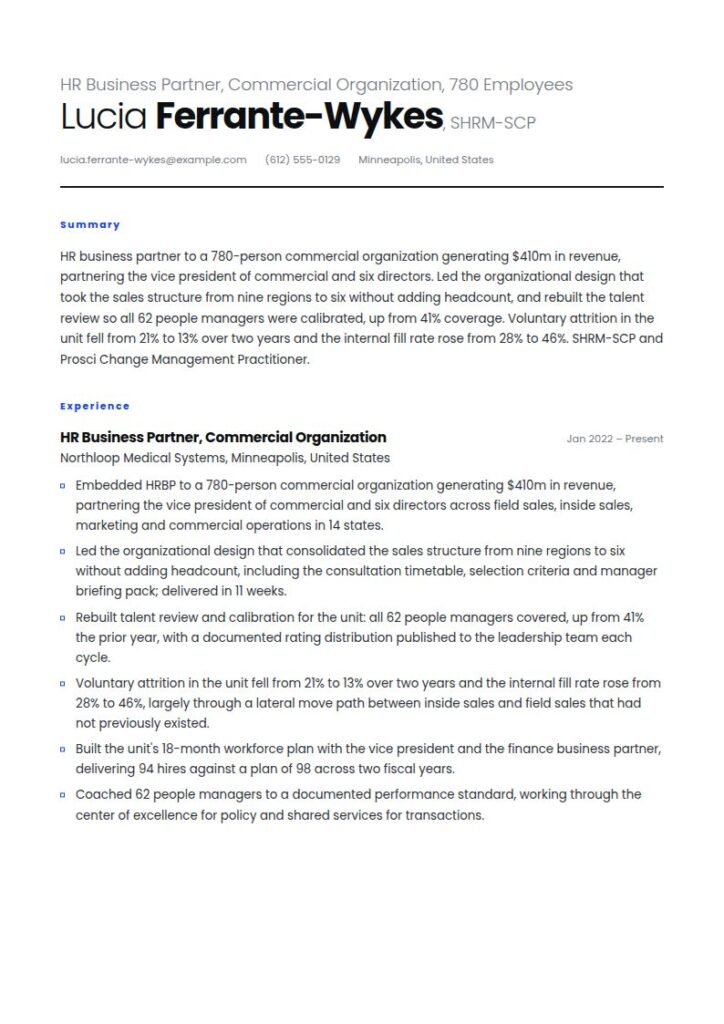
HR business partner to a 780-person commercial organization generating $410m in revenue, partnering the vice president of commercial and six directors. Led the organizational design that took the sales structure from nine regions to six without adding headcount, and rebuilt the talent review so all 62 people managers were calibrated, up from 41% coverage. Voluntary attrition in the unit fell from 21% to 13% over two years and the internal fill rate rose from 28% to 46%. SHRM-SCP and Prosci Change Management Practitioner.
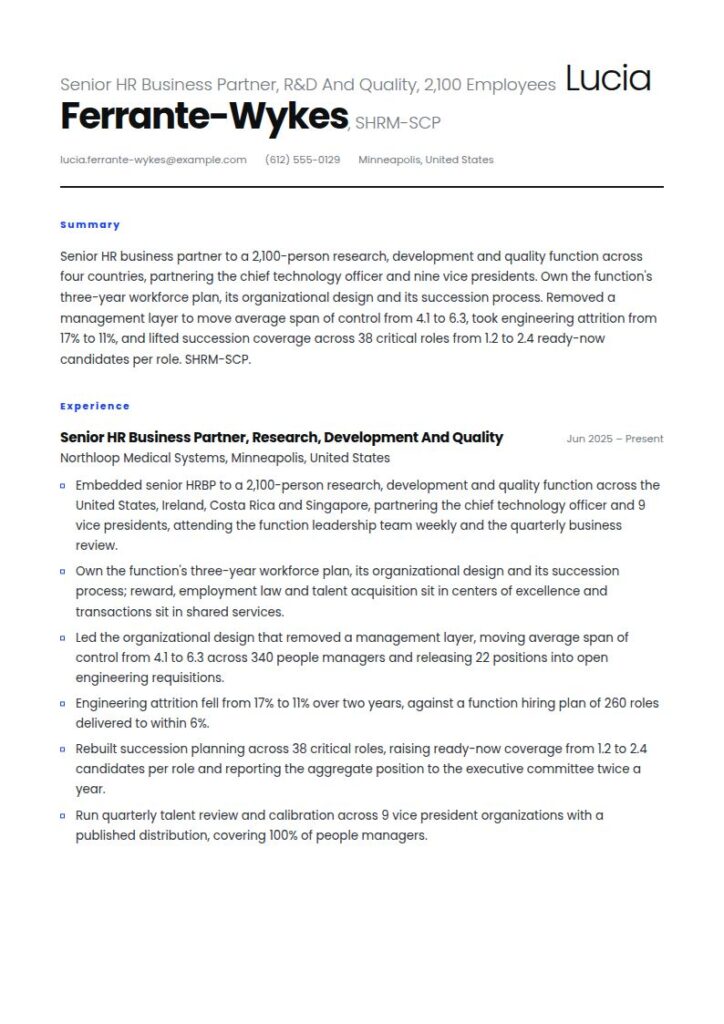
Senior HR business partner to a 2,100-person research, development and quality function across four countries, partnering the chief technology officer and nine vice presidents. Own the function's three-year workforce plan, its organizational design and its succession process. Removed a management layer to move average span of control from 4.1 to 6.3, took engineering attrition from 17% to 11%, and lifted succession coverage across 38 critical roles from 1.2 to 2.4 ready-now candidates per role. SHRM-SCP.
Right vs wrong: the same HR business partner summary, twice
| ✅ Right | ❌ Wrong |
|---|---|
| HR business partner to a 780-person commercial organization generating $410m in revenue. | Strategic HR business partner supporting multiple business units and stakeholders. |
| Partner the vice president of commercial and six directors. | Trusted adviser to senior leadership at all levels of the organization. |
| Led the organizational design that took the sales structure from nine regions to six without adding headcount. | Drove organizational effectiveness and change management initiatives. |
| Voluntary attrition fell from 21% to 13% and the internal fill rate rose from 28% to 46%. | Improved retention and talent outcomes across the business. |
The left column can be sized in four seconds. The right column is the version most HRBP resumes are written in, which is exactly why the left column stands out.
Outline your experience
Employer, client unit, unit headcount, the leader you reported into the business through, and dates. Then four to six bullets, each one an outcome in the unit's terms rather than a task in HR's.
| Instead of | Use |
|---|---|
| Partnered with business leaders on HR initiatives | Partnered the vice president of commercial and six directors across a 780-person, $410m organization |
| Supported organizational design activities | Led the design that took the sales structure from nine regions to six without adding headcount |
| Facilitated talent review sessions | Rebuilt talent review and calibration so all 62 people managers were covered, up from 41% |
| Advised managers on performance issues | Coached 62 people managers to a documented performance standard; 34 matters in the year, median 11 days to closure |
| Helped reduce attrition in the business | Voluntary attrition in the unit fell from 21% to 13% over two years |
| Worked on workforce planning | Built the unit's 18-month workforce plan and delivered 94 hires against a plan of 98 |
HR Business Partner, Commercial Organization, Northloop Medical Systems, Minneapolis, MN, January 2022 to Present
Embedded HRBP to a 780-person commercial organization generating $410m in revenue, partnering the vice president of commercial and six directors covering field sales, inside sales, marketing and commercial operations.
Led the organizational design that consolidated the sales structure from nine regions to six without adding headcount, including the consultation timetable, the selection criteria and the manager briefing pack; the change was delivered in 11 weeks.
Rebuilt talent review and calibration for the unit: all 62 people managers covered, up from 41% the prior year, with a documented rating distribution published to the leadership team each cycle.
Voluntary attrition in the unit fell from 21% to 13% over two years and the internal fill rate rose from 28% to 46%, largely by building a lateral move path between inside sales and field sales that had not previously existed.
Built the unit's 18-month workforce plan with the vice president and the finance business partner, delivering 94 hires against a plan of 98 across two fiscal years.
Coached 62 people managers to a documented performance standard, working through the center of excellence for policy and shared services for transactions.
The client unit block: the business you partner and what changed there
This is the block that separates an HRBP resume from a generalist one, and almost nobody writes it.
The reason it matters is the operating model. The HRBP role comes from the three-legged stool, the structure set out by Dave Ulrich in the 1990s that splits HR into three parts: business partners embedded in the business, centers of excellence holding deep specialism in areas such as reward, talent and employment law, and shared services handling transactions at scale. The CIPD describes it as still the most widely adopted HR operating framework globally, and cites McKinsey research finding that 48% of people leaders say their model aligns to an Ulrich-derived archetype (CIPD, 2026).
Inside that structure, the HRBP has no line authority over the business and no ownership of the specialist work. What you have is a client, a seat at their leadership table, and an argument. So the resume has to name the client.
Client unit: Commercial Organization, 780 employees, $410m revenue, four sub-functions covering field sales, inside sales, marketing and commercial operations across 14 states.
Leadership partnered: Vice President, Commercial, plus 6 directors and 62 people managers. Attend the unit leadership meeting weekly and the quarterly business review.
Operating model: three-legged stool. Reward, talent and employment law sit in centers of excellence; hiring administration, payroll and leave sit in shared services. I hold organizational design, workforce planning, talent review, manager capability and employee relations advice for the unit.
What changed: sales structure consolidated from 9 regions to 6 without added headcount; voluntary attrition 21% to 13%; internal fill rate 28% to 46%; talent review coverage 41% to 100% of people managers.
Four lines, and each one answers a question the reader would otherwise have to ask in an interview.
The unit line establishes scale in the business's own units, not in HR's. Revenue or budget matters here in a way it does not on a generalist resume, because an HRBP is measured partly on commercial literacy and quoting the unit's revenue is the cheapest proof of it available.
The leadership line establishes altitude. Partnering a vice president and six directors is a materially different job from partnering two site managers, and seniority of client is the single strongest predictor of the level you will be hired at.
The operating model line establishes boundary, and it is the one that protects you. The CIPD notes a persistent criticism of the model, which is that HRBPs often end up carrying transactional work rather than the strategic work the role was designed for. Stating what sat in shared services and centers of excellence tells the reader you understand the distinction and says which side of it you were actually on.
The change line is the only place on the page where you should use the unit's own metrics. Attrition in that unit, internal fill rate in that unit, span of control in that unit. HR-wide figures belong to a human resources manager or an HR director; an HRBP who claims them is claiming a job they did not hold.
Build a snapshot of your key skills
Twelve to sixteen entries in four labeled groups. Weight them towards advisory and design work, because transaction skills signal the wrong leg of the stool.
Advisory: Influence without authority, Executive coaching for people managers, Leadership team facilitation, Conflict and mediation, Change communication
Organization and talent: Organizational design and span of control analysis, Workforce planning, Talent review and calibration, Succession planning, Job levelling input, Restructuring consultation support
Commercial: Reading a profit and loss account, Headcount and cost modeling, Quarterly business review participation, Sales structure and territory design
Systems and data: Workday HCM, Visier or equivalent people analytics, Attrition and internal mobility analysis, Engagement survey action planning, Microsoft Excel to pivot and lookup level
"Influence without authority" belongs at the top of that list and is worth being specific about elsewhere on the page. It is the defining constraint of the role: you are accountable for people outcomes in a unit whose budget, structure and promotion decisions belong to somebody else.
List your education and certifications
Degree, then postgraduate work, then certifications with the issuing body and the year. Change management credentials carry unusual weight for this role because organizational design and restructuring sit in the job description.
Master of Arts, Human Resources and Industrial Relations, University of Minnesota Carlson School of Management, Minneapolis, MN, 2019
Bachelor of Arts, Psychology, University of Minnesota, Minneapolis, MN, 2015
SHRM Senior Certified Professional (SHRM-SCP), SHRM, 2025. SHRM requires at least three years of strategic-level HR work, or three years holding the SHRM-CP while working in a strategic role.
SHRM Certified Professional (SHRM-CP), SHRM, 2018
Prosci Change Management Practitioner, 2021
Hogan Assessment Certification, Hogan Assessment Systems, 2023
Name the issuing body every time. SHRM-CP and SHRM-SCP belong to SHRM; PHR and SPHR belong to the HR Certification Institute, which positions the PHR as its operational credential and the SPHR as its strategic one (HR Certification Institute, 2026). An HRBP applying at senior level with only an operational credential invites an obvious question.
Choose the right layout and design
Single column, 10.5 or 11 point body type, no photograph, no rating bars. The client unit block sits under the summary as a four-line labeled list. One page until you have partnered a leadership team through a reorganisation, then two.
Name the client unit, its headcount and its revenue or budget. Name the seniority of the leaders you partnered and how often you sat with them. State what sat in shared services and centers of excellence so your boundary is clear. Use the unit's own metrics, not HR-wide ones. Show influence without authority as a mechanism, not as an adjective. Name the issuing body of every credential.
Do not name an employee or a leader, describe an individual case, performance issue or exit, or reference anyone's medical information, accommodation, leave or discipline. Do not claim decisions the business made; write what you advised and what changed. Do not claim company-wide turnover figures for a unit-level role. Do not list transactional duties such as offer letters or onboarding administration. Do not write "trusted adviser" without a unit, a leader and a number behind it.
HR business partner job market and outlook
HR business partners are counted by the Bureau of Labor Statistics within human resources specialists, a large occupation growing faster than the average for all occupations.
| Measure | Value |
|---|---|
| Human resources specialist jobs, 2025 | 939,700 |
| Projected employment, 2035 | 999,700 |
| Projected change, 2025-35 | 6% (faster than average), +60,100 |
| Projected annual openings | About 73,700 |
| Typical entry-level education | Bachelor's degree |
| Median annual wage, May 2025 | $75,940 |
Source: U.S. Bureau of Labor Statistics, Occupational Outlook Handbook, 2025-35 projections and May 2025 wage data.
The occupation is large, and HRBP sits at the top of it
Human resources specialists numbered 939,700 in 2025 with about 73,700 openings projected each year, and a median annual wage of $75,940 in May 2025. The top 10 percent earned more than $128,720 and the bottom 10 percent less than $47,180 (BLS Occupational Outlook Handbook, May 2025 wage data and 2025-35 projections).
That spread matters because the occupation contains recruiters, HR generalists, benefits administrators and business partners on the same line. HRBP roles sit near the upper end of it, which means benchmarking yourself against the occupational median understates your market by a wide margin.
Setting moves it again. Median annual wages in May 2025 were $84,100 in government excluding state and local education and hospitals, $82,800 in professional, scientific and technical services, $79,270 in manufacturing, $64,130 in healthcare and social assistance and $60,550 in employment services (BLS, May 2025). Employment services and professional services each held 13% of the occupation in 2025, and they sit at opposite ends of that pay range.
Two other numbers shape the market. The step from HRBP into human resources management crosses into a different BLS occupation with a May 2025 median of $149,280 (BLS, May 2025), which is why the client unit block is worth writing carefully: it is the evidence for that move. And SHRM benchmarking puts HR staffing at an average of 1.7 HR staff per 100 employees, with the ADP Research Institute placing the workable range at 1.5 to 4.5 per 100 (both reported by SHRM, January 2024). In a lean function, the HRBP absorbs the work that has nowhere else to go, which is the practical version of the CIPD's criticism of the model.
What salary you can expect as an HR business partner
The median annual wage for human resources specialists, the occupation containing HRBPs, was $75,940 as of May 2025, with the top 10 percent above $128,720 (BLS, May 2025).
Three things move an HRBP offer inside that range, and each is something the client unit block makes visible.
Client seniority is the first and the largest. Partnering a chief technology officer and nine vice presidents is priced differently from partnering two site managers, because the advisory skill required scales with who is on the other side of the table.
Unit size and commercial weight is the second. Headcount supported matters, and revenue or budget under that unit matters more than HRBPs generally expect, because it is the proxy for consequence.
Scope of ownership is the third. An HRBP who owns organizational design and workforce planning for their unit is priced above one who executes cyclical processes inside it. The operating model line is what proves which you were, and that is precisely why it should not be left off.
Key takeaways for an HR business partner resume
- Name the client unit, its headcount and its revenue or budget in a block under the summary.
- Name the seniority of the leaders you partnered and how often you sat with them.
- State what sat in shared services and centers of excellence so your boundary is clear.
- Use the unit's own metrics, never company-wide HR figures.
- Show influence without authority as a mechanism, with an outcome attached.
- Never name an employee or a leader, or describe an individual case or exit.
- Write what you advised and what changed, not decisions the business made.
Build your HR business partner resume in 15 minutes.
Related human resource resume examples
- Human resources manager resume
- HR director resume
- Human resource generalist resume
- Human resource resume
- HR coordinator resume
- Human resources assistant resume
- Entry level HR resume
- Recruiter resume
- Technical recruiter resume
- Chief happiness officer resume
- Business manager resume
- Office manager resume
Pair it with a matching HR business partner cover letter.
HR business partner resume questions, answered
How long should an HR business partner resume be?
One page while you are an associate partner or partnering a single function. Two once you have taken a leadership team through a reorganisation, owned a workforce plan, or partnered more than one unit. The client unit block earns the second page; more bullets do not.
What is the difference between an HR business partner and an HR generalist?
Model position, not seniority. A [human resource generalist](/resume/human-resource-generalist/) covers the full range of HR activity for a population, transactions included. An HRBP sits inside the three-legged stool, embedded in one business unit, with transactions in shared services and specialism in centers of excellence. If your role carried both, say so plainly rather than picking a title that only half fits.
How do I show influence without authority on a resume?
By showing the mechanism and the result. "Built the case for consolidating nine sales regions to six, took it through the leadership team, and delivered the change in 11 weeks without adding headcount" demonstrates influence because you are describing a decision you did not have the power to make. "Trusted adviser to senior leaders" demonstrates nothing.
Can I use my business unit's commercial numbers?
Its size, yes: headcount, revenue or budget, number of sub-functions and locations. Its performance, no. Do not claim the unit's sales growth as your outcome. Claim what you owned: attrition, internal mobility, span of control, time to fill, talent review coverage, workforce plan delivery. The distinction is one an experienced HR interviewer will test.
How do I write about talent reviews and calibration without breaching confidentiality?
Coverage, process and aggregate outcome only. Number of managers calibrated, coverage rate, cycle length, whether a distribution was published. Never an individual's rating, potential assessment, development plan or exit. HRBP interviews frequently include a discretion question, and the resume is the first answer to it.
What if my company does not use the three-legged stool?
Describe the structure you actually worked in and where you sat in it. Many organizations run hybrid or centralized models, and some HRBP titles carry generalist work. Stating the real boundary is more useful than borrowing vocabulary that does not fit, because the first interview question will be about how your function was organized.