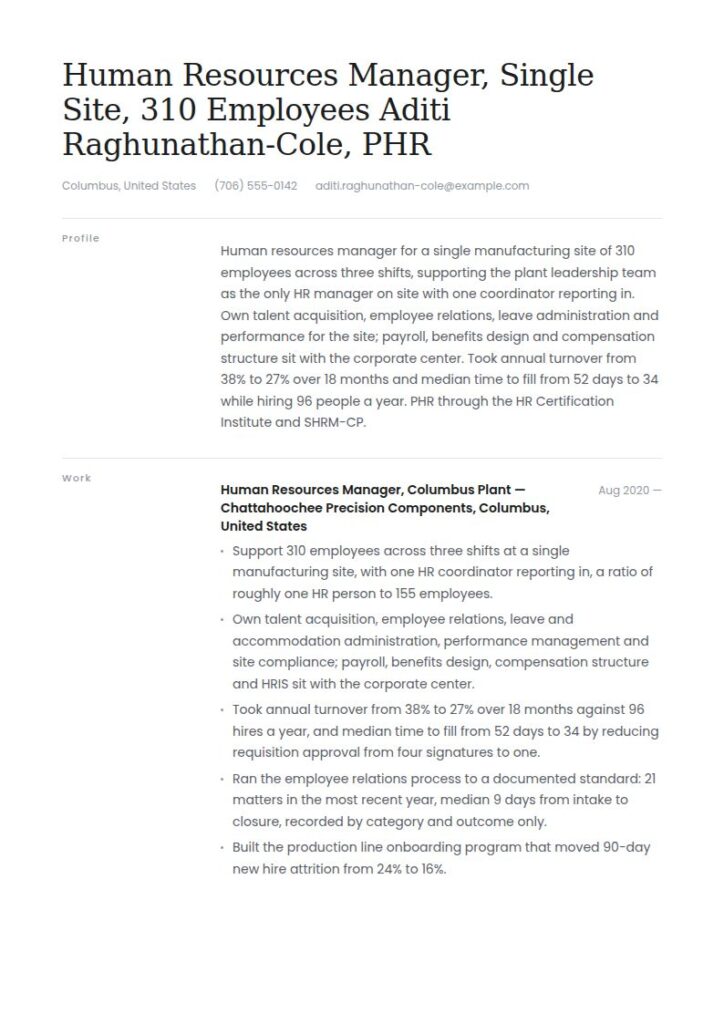
Human Resources Manager, Single Site, 310 Employees Aditi Raghunathan-Cole PHR
Human Resources Manager, Columbus Plant
[email protected] | (706) 555-0142 | Columbus, United States
Profile
Human resources manager for a single manufacturing site of 310 employees across three shifts, supporting the plant leadership team as the only HR manager on site with one coordinator reporting in. Own talent acquisition, employee relations, leave administration and performance for the site; payroll, benefits design and compensation structure sit with the corporate center. Took annual turnover from 38% to 27% over 18 months and median time to fill from 52 days to 34 while hiring 96 people a year. PHR through the HR Certification Institute and SHRM-CP.
Work Experience
08/2020 - Present, Human Resources Manager, Columbus Plant, Chattahoochee Precision Components, Columbus, United States
- Support 310 employees across three shifts at a single manufacturing site, with one HR coordinator reporting in, a ratio of roughly one HR person to 155 employees.
- Own talent acquisition, employee relations, leave and accommodation administration, performance management and site compliance; payroll, benefits design, compensation structure and HRIS sit with the corporate center.
- Took annual turnover from 38% to 27% over 18 months against 96 hires a year, and median time to fill from 52 days to 34 by reducing requisition approval from four signatures to one.
- Ran the employee relations process to a documented standard: 21 matters in the most recent year, median 9 days from intake to closure, recorded by category and outcome only.
- Built the production line onboarding program that moved 90-day new hire attrition from 24% to 16%.
06/2018 - 07/2020, Human Resources Generalist, Chattahoochee Precision Components, Columbus, United States
- Generalist support to 310 employees: hiring coordination, FMLA and state leave administration, I-9 and E-Verify, and the annual performance cycle.
- Administered open enrollment for the site, moving participation in the benefits election window from 71% to 94%.
07/2016 - 06/2018, Human Resources Coordinator, Chattahoochee Precision Components, Columbus, United States
- Owned the applicant tracking queue, pre-employment screening and new hire paperwork for roughly 80 hires a year.
Education
08/2012 - 05/2016, Bachelor of Science, Business Administration, Human Resource Management concentration, Auburn University, Auburn, United States
Coursework in employment law, compensation and benefits, and labor relations.
Skills
Talent acquisition and requisition management, 85
Employee relations process and documentation, 75
FMLA and state leave administration, 80
FLSA classification, 70
Onboarding and induction design, 80
Turnover and time to fill reporting, 75
Workday HCM and Greenhouse, 70
Languages
English, native
Hindi, native
Spanish, intermediate
Certificates
05/2019, Professional in Human Resources (PHR), HR Certification Institute
HRCI's operational and technical credential. Recertification every three years.
11/2018, SHRM Certified Professional (SHRM-CP), SHRM
Summary
A human resources manager resume is a one to two page document naming the headcount you support, the sites and states you cover, the HR team reporting to you, and the disciplines you own. This guide gives you three adaptable versions, a scope block most applicants leave out, and current Bureau of Labor Statistics pay and outlook for the occupation.
Human Resources Manager resume examples by experience level
A human resources manager resume is a one to two page document that names the population you support, the ratio you support it at, the geography that population sits in, and what moved on turnover, hiring speed and cost while you ran the function.
That is the whole screening question. A vice president of HR reading forty applications is asking whether you have run a function of roughly this size, in roughly this many locations, with roughly this much help, and whether the numbers went the right way. Everything else on the page is supporting evidence.
Resume guide for a human resources manager resume
This guide and the corresponding human resources manager resume example will cover:
- How to write a human resources manager resume, section by section
- Why headcount supported and the HR to employee ratio belong near the top
- Three adaptable summaries: first manager post, multi-site manager, regional manager
- The confidentiality rule that separates a professional HR resume from an amateur one
- What the job market looks like and what you can expect to earn
How to write a human resources manager resume
Seven sections: contact header, summary, a scope block, work experience, skills, education, and certifications. The scope block is the one that does not appear on most HR resumes and it is the one that gets read first.
The order matters because the reader is sizing you before they assess you. A manager who supported 300 people at one plant and a manager who supported 1,800 across four states are doing different jobs with the same job title, and the resume has about four seconds to say which one you are.
| Section | What it is answering | Where it goes |
|---|---|---|
| Scope block | How many people, how many sites, how much HR team, which disciplines? | Directly under the summary |
| Work experience | What moved on turnover, hiring and cost, and over what period? | Reverse chronological, one figure per bullet |
| Skills | Which systems, which laws, which HR processes? | Grouped in three or four labeled lines |
| Education and certifications | Is there a named credential and a named issuing body? | Last, with the body spelled out |
Never put a person on your resume
This is the rule that separates a professional HR resume from one that gets quietly set aside.
Do not name an employee. Do not describe an individual case. Do not reference anyone's medical information, accommodation, leave, complaint, investigation or discipline in a way that could identify them, and do not do it even in a disguised form such as "handled a complex accommodation for a senior engineer".
Describe the work by volume, process and outcome instead. "Ran the employee relations process for a 640-person population, 34 matters in the year, median 11 days to closure" tells a hiring manager everything they need and tells them nothing they should not know. The version with a story in it tells them you would do the same thing with their company's information.
Run the finished file through the free Rezoom ATS resume checker before you submit. HR functions buy the applicant tracking systems, which means your own resume gets parsed by one before a person opens it, and a figure trapped in a two-column layout does not survive the parse.
Choosing the best resume format for a human resources manager resume
Reverse chronological. The argument you are making is that your scope grew, and scope growth is a timeline. A functional format removes the timeline, which removes the argument.
One page is right for a first HR manager post. Two are earned once you have run more than one site, carried a team of your own, or held a population through a full annual cycle in more than one place.
Include your contact information
| ✅ Right | ❌ Wrong |
|---|---|
| Aditi Raghunathan-Cole, SPHR | Aditi Raghunathan-Cole |
| Human Resources Manager, Multi-Site Manufacturing, 1,850 employees | Experienced HR professional and people-focused leader |
| SPHR, HR Certification Institute; SHRM-SCP | Certified HR professional |
| (706) 555-0142, [email protected], Columbus, GA | (706) 555-0142, [email protected] |
Put the population in the title line. "Human Resources Manager" on its own forces the reader to guess your scale, and a reader with forty files does not guess, they move on.
Name the issuing body for every credential. SPHR belongs to the HR Certification Institute; SHRM-CP and SHRM-SCP belong to SHRM. They are different credentials from different bodies with different eligibility rules, and an HR reader knows that better than anyone.
Make use of a summary
Four lines: the population and its shape, your ratio and team, the disciplines you own, and one operational number with a before, an after and a period attached.
Human resources manager for a single manufacturing site of 310 employees across three shifts, supporting the plant leadership team as the only HR manager on site with one coordinator reporting in. Own talent acquisition, employee relations, leave administration and performance for the site; payroll, benefits design and compensation structure sit with the corporate center. Took annual turnover from 38% to 27% over 18 months and median time to fill from 52 days to 34 while hiring 96 people a year. PHR through the HR Certification Institute and SHRM-CP.
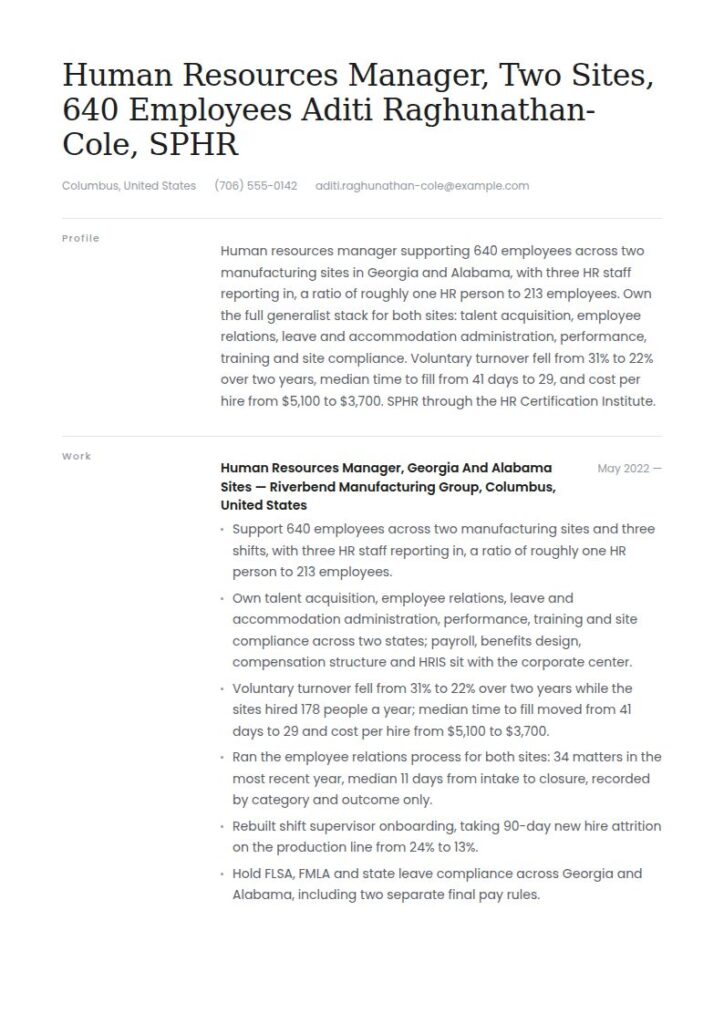
Human resources manager supporting 640 employees across two manufacturing sites in Georgia and Alabama, with three HR staff reporting in, a ratio of roughly one HR person to 213 employees. Own the full generalist stack for both sites: talent acquisition, employee relations, leave and accommodation administration, performance, training and site compliance. Voluntary turnover fell from 31% to 22% over two years, median time to fill from 41 days to 29, and cost per hire from $5,100 to $3,700. SPHR through the HR Certification Institute.
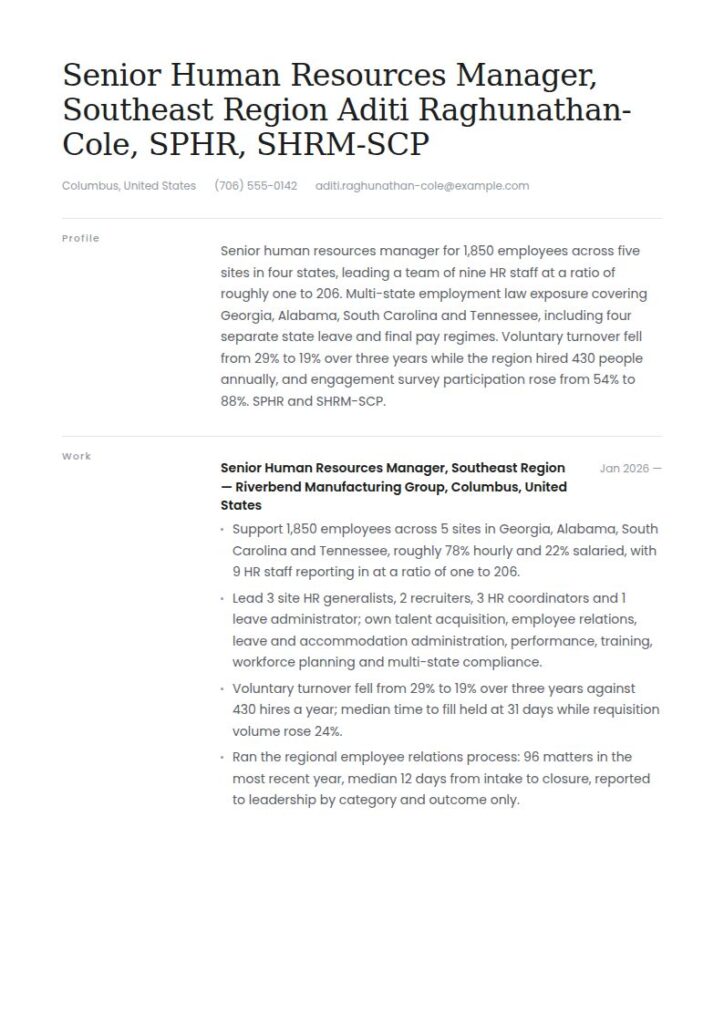
Senior human resources manager for 1,850 employees across five sites in four states, leading a team of nine HR staff at a ratio of roughly one to 206. Multi-state employment law exposure covering Georgia, Alabama, South Carolina and Tennessee, including four separate state leave and final pay regimes. Voluntary turnover fell from 29% to 19% over three years while the region hired 430 people annually, and engagement survey participation rose from 54% to 88%. SPHR and SHRM-SCP.
Right vs wrong: the same human resources manager summary, twice
| ✅ Right | ❌ Wrong |
|---|---|
| Human resources manager supporting 640 employees across two sites in Georgia and Alabama. | Experienced HR manager with a strong background in all areas of human resources. |
| Three HR staff reporting in, a ratio of roughly one HR person to 213 employees. | Manage a team and provide support to employees at multiple locations. |
| Voluntary turnover fell from 31% to 22% over two years and cost per hire from $5,100 to $3,700. | Successfully improved retention and reduced recruitment costs. |
| Own talent acquisition, employee relations, leave administration, performance and site compliance. | Responsible for the full employee lifecycle. |
The left column can be sized against an open role in four seconds. The right column has to be interviewed before anyone knows what it means, and most files never get that far.
Outline your experience
Employer, site or region, city, headcount supported, team size, and dates. Then three to five bullets. Every bullet carries a number, and the number is either a population, a rate, a duration or a cost.
| Instead of | Use |
|---|---|
| Managed all HR functions for the facility | Ran talent acquisition, employee relations, leave administration and performance for a 310-person three-shift site |
| Reduced employee turnover | Took annual turnover from 38% to 27% over 18 months, against 96 hires a year |
| Improved the recruitment process | Cut median time to fill from 52 days to 34 by moving requisition approval from four signatures to one |
| Handled employee relations issues | Ran the employee relations process for 640 employees: 34 matters in the year, median 11 days to closure |
| Ensured compliance with employment law | Held FLSA, FMLA and state leave compliance across four states, including two separate final pay rules |
| Conducted engagement surveys | Raised engagement survey participation from 54% to 88% and ran 22 manager action-planning sessions |
Human Resources Manager, Georgia and Alabama Sites, Riverbend Manufacturing Group, Columbus, GA, May 2022 to Present
Support 640 employees across two manufacturing sites and three shifts, with three HR staff reporting in, a ratio of roughly one HR person to 213 employees.
Own talent acquisition, employee relations, leave and accommodation administration, performance, training and site compliance. Payroll, benefits design, compensation structure and the HRIS sit with the corporate center.
Voluntary turnover fell from 31% to 22% over two years while the sites hired 178 people a year; median time to fill moved from 41 days to 29 and cost per hire from $5,100 to $3,700.
Ran the employee relations process to a documented standard: 34 matters in the most recent year, median 11 days from intake to closure, all recorded by category and outcome only.
Rebuilt the shift supervisor onboarding program, taking 90-day new hire attrition on the production line from 24% to 13%.
Put your scope on the page: headcount, ratio, sites and disciplines
This is the block almost nobody writes and it is the one that decides whether your file is read as a match.
An HR manager title covers a range of about ten to one in actual scale. The reader has an opening with a defined population, a defined number of locations and a defined amount of HR support, and their first job is to work out whether you have run something of that size. Give them the four numbers directly.
Population supported: 1,850 employees across 5 sites in Georgia, Alabama, South Carolina and Tennessee, 3 shifts, roughly 78% hourly and 22% salaried.
HR team: 9 reporting in, comprising 3 site HR generalists, 2 recruiters, 3 HR coordinators and 1 leave administrator. Ratio of roughly one HR person to 206 employees.
Disciplines owned: talent acquisition, employee relations, leave and accommodation administration, performance management, training and development, workforce planning, site-level policy and multi-state compliance.
Disciplines centralized at corporate: payroll, benefits design and renewal, compensation structure and job architecture, HRIS administration, immigration.
Systems: Workday HCM, Kronos time and attendance, Greenhouse applicant tracking.
Two lines in that block do disproportionate work.
The ratio is the first. SHRM's benchmarking data puts the average across US employers at 1.7 HR staff per 100 employees, and analysis by the ADP Research Institute placed the workable range for most employers at between 1.5 and 4.5 HR staff per 100 (both reported by SHRM, January 2024). The same reporting found that turnover starts to fall once there is at least one HR staff member for every 200 employees. Your ratio therefore says something honest about the job you have actually been doing. One HR person per 206 employees is a lean, well-run function. One per 400 is a firefighting job, and saying so plainly is more credible than pretending the population was the only thing that mattered.
The second is the split between what you owned and what was centralized. An HR manager in a company with shared services and centers of excellence is doing a different job from one where HR is four people and everything lands on them. Stating the boundary is the difference between a reader believing your scope and discounting it.
The geography line matters more than it looks. Sites in four states mean four bodies of state employment law on top of the federal floor: different leave entitlements, final pay deadlines, pay transparency rules and non-compete rules. Multi-state exposure is scarce, and writing "five sites" without "four states" throws it away.
Build a snapshot of your key skills
Twelve to sixteen entries in four labeled groups. Do not write one comma-separated paragraph, because the reader is scanning for their own stack and a wall of text hides it.
HR operations: Talent acquisition and requisition management, Employee relations process and case documentation, Leave and accommodation administration, Performance management cycles, Onboarding and induction design
Compliance: FLSA classification, FMLA administration, ADA interactive process, Title VII, multi-state leave and final pay rules, I-9 and E-Verify, OSHA recordkeeping coordination
Data and measurement: Turnover and retention analysis, Time to fill and cost per hire, Headcount and vacancy reporting, Engagement survey administration and action planning, Compensation benchmarking inputs
Systems: Workday HCM, Kronos, Greenhouse, ADP, Microsoft Excel to pivot and lookup level
Put classification and leave administration in the compliance group rather than the operations group, because a reader screening for risk exposure looks there first. Name the applicant tracking system and the human capital system separately: they are procured separately and a manager who has run both is worth more.
List your education and certifications
Degree first, then certifications with the issuing body, the year and the current status. Do not abbreviate the body.
Bachelor of Science, Business Administration, Human Resource Management concentration, Auburn University, Auburn, AL, 2016
Senior Professional in Human Resources (SPHR), HR Certification Institute, 2025. HRCI describes the SPHR as its strategic credential, requiring five years of professional-level HR experience with a bachelor's degree, and recertification every three years.
SHRM Certified Professional (SHRM-CP), SHRM, 2018, maintained through 2027
Professional in Human Resources (PHR), HR Certification Institute, 2019. HRCI positions the PHR as its operational and technical credential, requiring two years of professional-level HR experience with a bachelor's degree.
Multi-State Employment Law, continuing education, 2024
The eligibility rules carry information. The PHR asks for two years of professional-level HR experience with a bachelor's degree, or four without one; the SPHR asks for five with a bachelor's degree, or seven without (HR Certification Institute, 2026). The SHRM-SCP asks for at least three years of strategic-level HR work (SHRM, 2026). A reader who knows those rules reads the credential as a statement about your level, not just three letters.
Choose the right layout and design
Single column, 10.5 or 11 point body type, clear headings, no photograph, no skill rating bars. The scope block sits under the summary as a short labeled list, not a graphic.
State headcount supported, number of sites, number of states and the size of your HR team as four separate numbers. Give your HR to employee ratio and let it be whatever it is. Separate the disciplines you owned from the ones a corporate center ran. Put a rate, a duration or a cost in every experience bullet. Name the applicant tracking system and the human capital system. Spell out the issuing body of every certification.
Do not name an employee, describe an individual case, or reference anyone's medical information, accommodation, leave, complaint or discipline. Do not write "full lifecycle HR" when the four numbers would say it properly. Do not claim you owned compensation structure or benefits design if a center of excellence built them and you administered them. Do not use a two-column template for an applicant tracking system you know parses badly. Do not pad to two pages before you have run more than one site.
Human resources manager job market and outlook
A mid-sized management occupation growing slightly faster than the average for all occupations, with a hiring bar built on experience rather than education.
| Measure | Value |
|---|---|
| Human resources manager jobs, 2025 | 224,900 |
| Projected employment, 2035 | 237,400 |
| Projected change, 2025-35 | 6% (faster than average), +12,500 |
| Projected annual openings | About 16,800 |
| Typical entry-level education | Bachelor's degree |
| Work experience typically required | 5 years or more |
| Median annual wage, May 2025 | $149,280 |
Source: U.S. Bureau of Labor Statistics, Occupational Outlook Handbook, 2025-35 projections and May 2025 wage data.
The line worth reading twice is the experience requirement. The BLS Occupational Outlook Handbook lists five years or more of related work experience as typical for entry into the occupation. The credential on this resume is the population you have carried, not the degree.
Where human resources managers actually work
Employment is spread wider than most people assume. The BLS Occupational Outlook Handbook reports the largest employers of human resources managers in 2025 as professional, scientific and technical services at 15%, management of companies and enterprises at 14%, manufacturing at 9%, healthcare and social assistance at 9%, and government excluding state and local education and hospitals at 8% (BLS, 2025).
Pay tracks those settings closely. Median annual wages by industry in May 2025 were $170,590 in professional, scientific and technical services, $166,200 in management of companies and enterprises, $145,680 in manufacturing, $128,650 in government and $126,900 in healthcare and social assistance (BLS, May 2025).
The gap between the top and bottom of that list is about $43,700, which is larger than the effect of most promotions. If you are writing for a sector move, the sector is doing more work on your eventual number than the title is, and the resume should be written in the vocabulary of the sector you are moving to.
Turnover figures also need context. In July 2026 the BLS recorded 5.1 million total separations at a rate of 3.2%, of which 3.1 million were quits at a rate of 1.9% (BLS Job Openings and Labor Turnover Survey, released 1 September 2026). That is why the period attached to your number matters as much as the number.
What salary you can expect as a human resources manager
The median annual wage for human resources managers was $149,280 as of May 2025, or $71.77 an hour. The lowest 10 percent earned less than $88,200 and the highest 10 percent more than $267,810 (BLS, May 2025).
That spread of roughly $180,000 between the tenth and ninetieth percentile is the widest in the HR family, and it is almost entirely explained by three things the resume can influence.
Population supported is the first. Pay in this occupation is priced against the number of employees behind the title more than against anything else, which is why leaving headcount off the page costs real money at the offer stage.
Sector is the second: the May 2025 industry medians above show a $43,700 range on the same job title.
Scope of discipline is the third. A manager who owns compensation structure or benefits renewal on top of the generalist stack is priced differently from one who administers what a center of excellence designed. State the boundary honestly and let the recruiter price it.
Key takeaways for a human resources manager resume
- Put headcount supported, site count, state count and HR team size in a scope block under the summary.
- Give your HR to employee ratio as a number and let it be whatever it is.
- Separate the disciplines you owned from the ones a corporate center ran.
- Attach a before, an after and a period to turnover, time to fill and cost per hire.
- Never name an employee or describe an individual case; report by volume, process and outcome.
- Name the state count, because multi-state employment law exposure is scarce and priced.
- Spell out the issuing body of every certification, since HR readers know the difference.
Build your human resources manager resume in 15 minutes.
Related human resource resume examples
- HR director resume
- HR business partner resume
- Human resource generalist resume
- Human resource resume
- HR coordinator resume
- Human resources assistant resume
- Entry level HR resume
- Recruiter resume
- Technical recruiter resume
- Chief happiness officer resume
- Operations manager resume
- Office manager resume
Pair it with a matching human resources manager cover letter.
Human resources manager resume questions, answered
How long should a human resources manager resume be?
One page for a first HR manager post. Two once you have supported more than one site, carried an HR team of your own, or held a population through a full annual cycle in more than one employer. Never three. The scope block is what earns the second page, not more bullets.
What is the difference between this and an HR director resume?
Scope of decision. A human resources manager runs the function day to day for a defined population: hiring, employee relations, leave, performance, compliance. An [HR director](/resume/hr-director/) owns strategy, spend and risk, including total rewards design, organizational design and the employment law risk register, and usually sits on the leadership team. If you are writing for director roles, the numbers change from operational rates to spend, plan versus actual, and exposure.
How do I write about employee relations without breaching confidentiality?
By volume, process and outcome only. Write the number of matters, the median time to closure, the categories in aggregate, and the process standard you held. Never write a case, never write a role title specific enough to identify someone, and never reference anyone's medical information, accommodation, leave or discipline. An HR reader treats a discreet resume as a work sample and an indiscreet one as a risk.
Should I include my HR to employee ratio if it is bad?
Yes. An unfavourable ratio is a description of the job you were given, not of your performance, and it makes every other number on the page more impressive. One HR person to 400 employees with turnover falling is a stronger story than a ratio you left off because it was awkward. The only bad option is silence, which the reader fills with a guess.
Do I need SPHR or SHRM-SCP to be a human resources manager?
Neither is legally required. The BLS Occupational Outlook Handbook lists a bachelor's degree as typical entry-level education and five years or more of related experience as the usual requirement, with certification described as voluntary but common (BLS, 2025). In practice the senior credentials are used as a screening shortcut for director-track roles, and the eligibility rules mean they double as a statement about your years and your level.
What should I put on a human resources manager resume with no direct reports?
The population, the disciplines and the ratio, exactly as you would with a team. A manager of 500 employees with no HR staff underneath them is running a harder function than one of 500 with four, and the ratio line makes that visible.