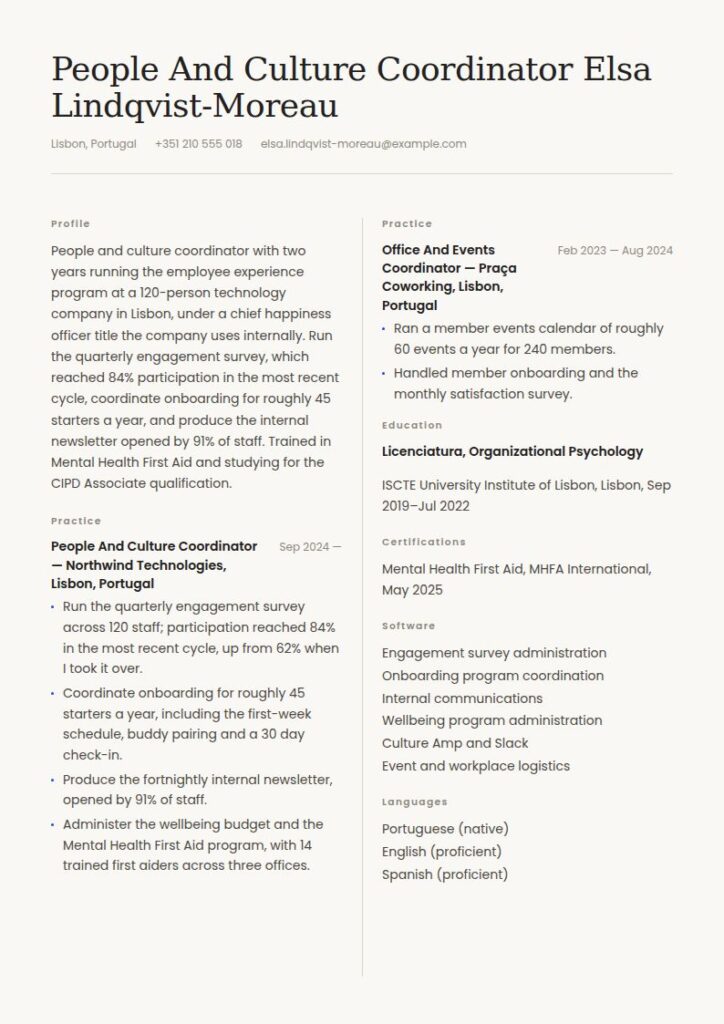
People and Culture Coordinator Elsa Lindqvist-Moreau
People and Culture Coordinator
[email protected] | +351 210 555 018 | Lisbon, Portugal
Profile
People and culture coordinator with two years running the employee experience program at a 120-person technology company in Lisbon, under a chief happiness officer title the company uses internally. Run the quarterly engagement survey, which reached 84% participation in the most recent cycle, coordinate onboarding for roughly 45 starters a year, and produce the internal newsletter opened by 91% of staff. Trained in Mental Health First Aid and studying for the CIPD Associate qualification.
Work Experience
09/2024 - Present, People and Culture Coordinator, Northwind Technologies, Lisbon, Portugal
- Run the quarterly engagement survey across 120 staff; participation reached 84% in the most recent cycle, up from 62% when I took it over.
- Coordinate onboarding for roughly 45 starters a year, including the first-week schedule, buddy pairing and a 30 day check-in.
- Produce the fortnightly internal newsletter, opened by 91% of staff.
- Administer the wellbeing budget and the Mental Health First Aid program, with 14 trained first aiders across three offices.
02/2023 - 08/2024, Office and Events Coordinator, Praça Coworking, Lisbon, Portugal
- Ran a member events calendar of roughly 60 events a year for 240 members.
- Handled member onboarding and the monthly satisfaction survey.
Education
09/2019 - 07/2022, Licenciatura, Organizational Psychology, ISCTE University Institute of Lisbon, Lisbon, Portugal
CIPD Associate qualification in progress, expected 2027.
Skills
Engagement survey administration, 75
Onboarding program coordination, 80
Internal communications, 75
Wellbeing program administration, 70
Culture Amp and Slack, 80
Event and workplace logistics, 85
Languages
Portuguese, native
English, proficient
Spanish, proficient
Certificates
05/2025, Mental Health First Aid, MHFA International
Three-year certification.
Summary
A chief happiness officer resume is a one to two page document covering engagement measurement, internal communications, onboarding, wellbeing and workplace culture, written so the work is recognized by employers who do not use the title. This guide gives you three adaptable versions, an honest account of how the title is read, and cited pay data for the closest classified occupations.
Chief Happiness Officer (CHO) resume examples by experience level
A chief happiness officer resume is a one to two page document covering engagement measurement, internal communications, onboarding, wellbeing programs and workplace culture, written so that the work survives a title most employers do not use.
Start with the awkward part, because your reader will. Chief happiness officer is not a standard job title. The Bureau of Labor Statistics Occupational Outlook Handbook has no entry for it, and the 2018 Standard Occupational Classification, which is the classification currently in use for federal occupational data, has no code for it either. Most organizations call this work employee experience, people experience, culture lead or head of people and culture. The title has real currency in startups and in parts of Europe, including Portugal, Spain, France, Belgium and the Nordics, and far less in large employers in the United States and the United Kingdom.
Some hiring managers are openly skeptical of it. They have seen the title used for a perks budget with no measurement behind it, or adopted by an organization with a culture problem it did not want to name. That scepticism is not something to argue with on a resume. It is something to answer with numbers.
Resume guide for a chief happiness officer resume
This guide and the corresponding chief happiness officer resume example will cover:
- How to write a chief happiness officer resume, section by section
- How to title yourself when the internal title will not be recognized elsewhere
- Three adaptable summaries: coordinator, manager and head of function
- Which numbers prove this work, and which ones read as atmosphere
- What the job market looks like and what you can expect to earn
How to write a chief happiness officer resume
Six sections: contact header, summary, a scope block naming the five areas you own, experience with measured outcomes, skills and systems, and education with certifications. One page for your first five years, two once you own a budget and a team.
The scope block matters more here than in almost any other people role, because the job varies enormously between organizations. In one company it is engagement surveys and internal communications. In another it is office, events and benefits. Say which.
| Section | What it is answering | Where it goes |
|---|---|---|
| Recognized title | What is this job called in my organization? | The header, with the internal title in brackets |
| Scope block | Which of the five areas did this person actually own? | Directly under the summary |
| Experience | Did anything measurable change? | Reverse chronological, a number in every bullet |
| Measurement | Do they run surveys properly, or do they run parties? | Participation rates alongside scores |
Put the recognized title first and the internal one in brackets
Write your header as "Employee Experience Manager (internal title: Chief Happiness Officer)". This is not hiding anything. It is naming the job in the language the market uses, then telling the truth about what it said on your contract.
There are two reasons. The first is mechanical: recruiters search and filter by conventional titles, and a keyword search for employee experience or people and culture will not return a document that only says chief happiness officer.
The second is tonal. A resume that leads with an unusual title is asking the reader to accept a premise before they have read any evidence. A resume that leads with a conventional title and a measured outcome has already made its case by the time the unusual title appears, at which point it reads as a detail rather than as a claim.
The exception is when you are applying to an organization that uses the title itself, which is common in startups and in some European markets. Then use it, because there it is the recognized title.
Run the finished file through the free Rezoom ATS resume checker before you submit.
Choosing the best resume format for a chief happiness officer resume
Reverse chronological, with the scope block above the first role. This work is judged on continuity: culture does not move in a quarter, and a reader wants to see two or three years in one organization with a measured trend running through them.
One page through your first five years. Two once you carry a budget, a team, or a group across multiple sites. Avoid heavily designed templates. There is a temptation in this field to make the document look like the culture you build, and it undercuts you, because the perception you are working against is that this role is decorative.
Include your contact information
| ✅ Right | ❌ Wrong |
|---|---|
| Elsa Lindqvist-Moreau | Elsa Lindqvist-Moreau |
| Employee Experience Manager (internal title: Chief Happiness Officer) | Chief Happiness Officer and culture enthusiast |
| CIPD Associate, SHRM-CP, Mental Health First Aid | Certified in making workplaces awesome |
| +351 912 555 018, [email protected], Lisbon, Portugal | +351 912 555 018, [email protected] |
Make use of a summary
Four lines: the recognized title, the scope, two measured outcomes with participation attached, and the level you report at.
People and culture coordinator with two years running the employee experience program at a 120-person technology company in Lisbon, under a chief happiness officer title the company uses internally. Run the quarterly engagement survey, which reached 84% participation in the most recent cycle, coordinate onboarding for roughly 45 starters a year, and produce the internal newsletter opened by 91% of staff. Trained in Mental Health First Aid and studying for the CIPD Associate qualification.
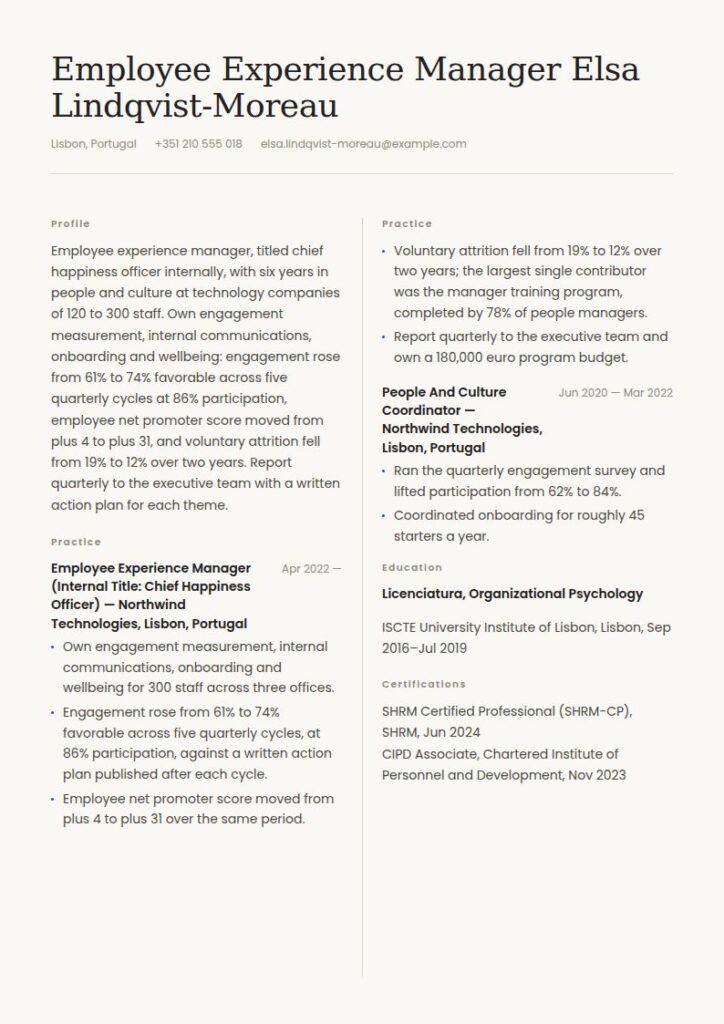
Employee experience manager, titled chief happiness officer internally, with six years in people and culture at technology companies of 120 to 300 staff. Own engagement measurement, internal communications, onboarding and wellbeing: engagement rose from 61% to 74% favorable across five quarterly cycles at 86% participation, employee net promoter score moved from plus 4 to plus 31, and voluntary attrition fell from 19% to 12% over two years. Report quarterly to the executive team with a written action plan for each theme.
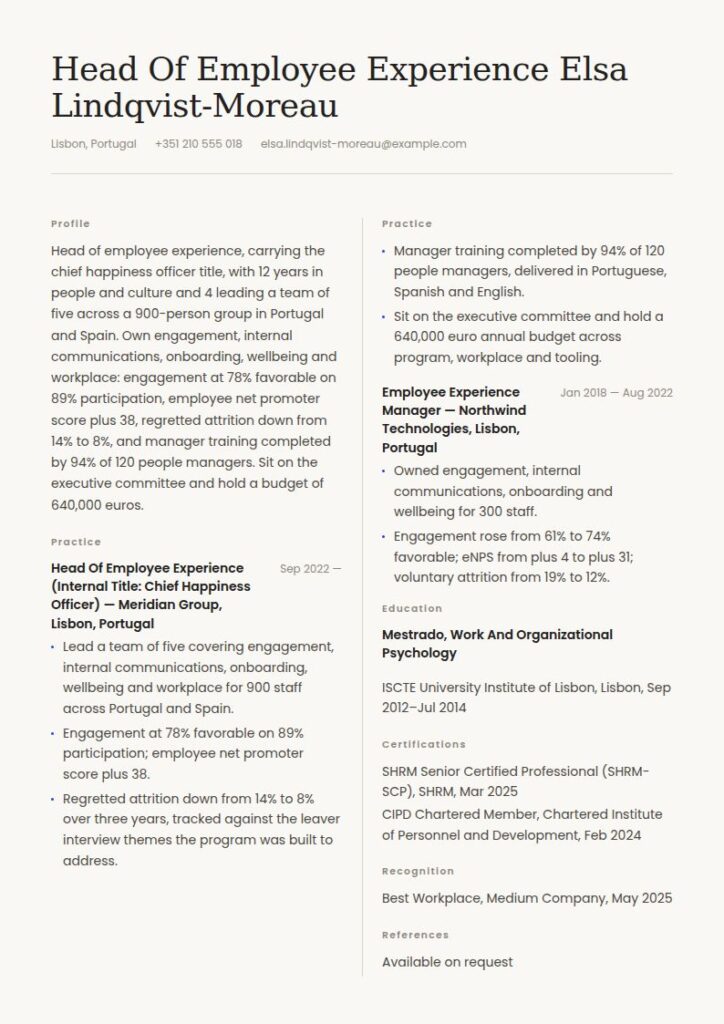
Head of employee experience, carrying the chief happiness officer title, with 12 years in people and culture and 4 leading a team of five across a 900-person group in Portugal and Spain. Own engagement, internal communications, onboarding, wellbeing and workplace: engagement at 78% favorable on 89% participation, employee net promoter score plus 38, regretted attrition down from 14% to 8%, and manager training completed by 94% of 120 people managers. Sit on the executive committee and hold a budget of 640,000 euros.
Right vs wrong: the same chief happiness officer summary, twice
| ✅ Right | ❌ Wrong |
|---|---|
| Engagement rose from 61% to 74% favorable across five quarterly cycles at 86% participation. | Created a happy, positive and inclusive workplace culture. |
| Employee net promoter score moved from plus 4 to plus 31; voluntary attrition fell from 19% to 12%. | Organized events and initiatives that employees loved. |
| Report quarterly to the executive team with a written action plan for each theme. | Champion of wellbeing, belonging and fun at work. |
The right column is the reason a skeptical hiring manager keeps reading. The left column is the reason they were skeptical.
Outline your employee experience work
Organization, headcount, sites, dates, and the scope in one line. Then three to five bullets, each carrying a number and a period of time.
| Instead of | Use |
|---|---|
| Improved employee engagement | Engagement moved from 61% to 74% favorable over five quarterly cycles, with participation held at 86% |
| Organized company events and celebrations | Replaced the annual party with quarterly team-chosen budgets; participation rose from 41% to 78% of staff |
| Launched a wellbeing program | Introduced an employee assistance program and mental health first aiders; uptake reached 14% of staff in year one against an industry pattern of under 5% |
| Improved onboarding | Rebuilt the 30-60-90 day onboarding plan; new starter satisfaction rose from 3.2 to 4.4 out of 5 and 90-day leavers fell from 11% to 3% |
| Managed internal communications | Moved the all-staff update from email to a weekly written brief read by 91% of staff, measured rather than assumed |
| Supported diversity and inclusion | Ran the inclusion index as part of the engagement survey; the gap between the highest and lowest scoring groups narrowed from 19 to 8 points |
Employee Experience Manager (internal title: Chief Happiness Officer), Vela Digital, 300 staff, Lisbon, Portugal, April 2022 to Present
Own engagement measurement, internal communications, onboarding and wellbeing for a 300-person company across two offices and a remote cohort.
Engagement moved from 61% to 74% favorable over five quarterly cycles, with survey participation held at 86% and a written action plan published for every theme.
Employee net promoter score moved from plus 4 to plus 31 over two years; voluntary attrition fell from 19% to 12% in the same period.
Rebuilt onboarding around a 30-60-90 day plan with a named buddy; 90-day leavers fell from 11% to 3% and new starter satisfaction rose from 3.2 to 4.4 out of 5.
Introduced an employee assistance program and trained 12 mental health first aiders; first-year uptake reached 14% of staff, reported only in aggregate.
Ran manager training on survey follow-up for 34 people managers, with 94% completion.
This work touches sensitive data, so the resume must not
Employee experience work sits closer to personal information than almost any other people role, which makes the confidentiality rule stricter rather than looser.
Never name or describe an identifiable employee. Never reference anyone's medical information, disability, accommodation request, leave, counseling or employee assistance use, grievance, investigation or discipline, including in stories told to illustrate a program. A wellbeing anecdote about "one team member who was struggling" is identifiable inside the organization that reads it, and it is the fastest way to lose a job you are otherwise qualified for.
Report every wellbeing or assistance figure as aggregate uptake only, never as who used what. Report engagement data by theme and by group size large enough to protect anonymity, which is the same rule your survey provider applies. Describe the work by volume, process and outcome.
The discipline is itself a qualification. A hiring manager who sees a resume that reports 14% program uptake without a single identifiable detail has learned something about how you would handle their employees' data.
The title problem, and how to name this job so it is recognized
This is the section this page exists for, because the title is the single biggest obstacle between your experience and your next role.
What the job actually covers. In most organizations that use the title, the role owns some combination of five areas. Engagement measurement: designing, running and acting on surveys, and reporting to leadership. Internal communications: the all-staff rhythm, leadership visibility, and how change is announced. Workplace and rituals: office experience, remote and hybrid practice, onboarding rituals, recognition and events. Wellbeing: employee assistance provision, mental health first aid, workload and burnout work, and benefits that touch health. Culture and inclusion work adjacent to diversity, equity and inclusion: inclusion indices, manager behavior, and psychological safety.
Almost nobody owns all five. The most common versions are engagement plus internal communications, or workplace plus events plus wellbeing. Those are different jobs with the same title, so say which one you did.
Why the title travels badly. Three reasons, and only one of them is unfair. The first is classification: there is no BLS occupation and no SOC code, so no salary benchmark, no job family and no obvious internal band. The second is search: recruiters filter on conventional titles, and yours will not appear. The third is reputation: the title has been used for roles with no measurement behind them, so a proportion of hiring managers read it as a signal of a company that bought atmosphere instead of management.
What to call yourself instead. Pick the conventional title that matches the scope you actually had, and put the internal title in brackets after it.
| If your scope was | The recognized title is usually |
|---|---|
| Engagement surveys, action planning, internal communications | Employee Experience Manager, or People Experience Manager |
| Culture, rituals, recognition, events, office | Head of Culture, or Workplace Experience Manager |
| Wellbeing, benefits, employee assistance, mental health | Wellbeing Manager, or Health and Wellbeing Lead |
| All of the above with a team and a budget | Head of Employee Experience, or Director of People and Culture |
| The whole people function including hiring and relations | Human Resources Manager, or Head of People |
Where the title is the right one to use. If you are applying to a startup, or to an employer in a market where the title is established, keep it. In those contexts it is recognized, it signals that you know the field, and swapping it for something corporate makes you look like an outsider. Read the organization's own careers page: they will tell you which language they use.
On LinkedIn, use the recognized title in the headline and the internal title in the role description. Recruiters search the headline.
Build a snapshot of your key chief happiness officer skills
Twelve to sixteen entries in four groups, weighted towards measurement rather than atmosphere.
Measurement: Engagement survey design, Action planning and follow-up, Employee net promoter score, Pulse surveys, Exit and stay interview analysis, Inclusion index reporting
Communications: All-staff communication rhythm, Leadership visibility, Change communication, Internal newsletter and intranet, Readership measurement
Programs: Onboarding design, Recognition schemes, Employee assistance provision, Mental health first aid programs, Manager training, Hybrid and remote working practice
Systems: Culture Amp, Officevibe, Workday, Personio, Slack and Microsoft Teams, Confluence, Power BI
List your education and certifications
There is no license for this work and no single qualifying degree. Psychology, organizational behavior, communications and human resources are all common routes. Certifications from named bodies are what make the file checkable.
Master of Science, Work and Organizational Psychology, ISCTE University Institute of Lisbon, Lisbon, Portugal, 2016
Licenciatura in Psychology, Universidade de Lisboa, Lisbon, Portugal, 2014
Certifications: Associate Member, Chartered Institute of Personnel and Development (CIPD), 2020. SHRM Certified Professional (SHRM-CP), Society for Human Resource Management, 2022. Mental Health First Aid instructor, 2021. Prosci Change Management Certification, 2023.
Languages: Portuguese (native), English (fluent), Swedish (fluent), Spanish (working).
Choose the right layout and design
Single column, 11 or 12 point, no photograph unless local convention expects one, and no illustration. Export to PDF.
The temptation to design this resume expressively is strong and should be resisted. The reader's question is whether you measure things, and a heavily styled document answers it in the wrong direction.
Lead with a recognized title and put the internal one in brackets. Name which of the five scope areas you owned. Give every engagement figure with its participation rate. Show a trend across at least three cycles. Report wellbeing uptake in aggregate. State the size of the population and the budget you were responsible for.
Do not use the word happiness as your only evidence. Do not report an engagement score without participation, because a 91% score on 30% participation is not a result. Do not name an employee or reference anyone's medical information, leave, complaint or discipline. Do not describe events as achievements unless you can show attendance or a follow-on measure. Do not design the document to demonstrate your creativity.
Chief happiness officer job market and outlook
There is no BLS occupation for this job, so there is no direct outlook figure, and any page that gives you one has invented it. What can be cited honestly is the outlook for the classified occupations this work is hired and paid against.
| Occupation | Jobs, 2025 | Change, 2025-35 | Annual openings | Median wage, May 2025 |
|---|---|---|---|---|
| Human resources managers | 224,900 | 6%, +12,500 | ~16,800 | $149,280 |
| Training and development managers | 50,200 | 6%, +3,200 | ~4,100 | $133,000 |
| Human resources specialists | 939,700 | 6%, +60,100 | ~73,700 | $75,940 |
| Training and development specialists | 472,500 | 11%, +51,100 | ~46,000 | $69,280 |
Source: U.S. Bureau of Labor Statistics, Occupational Outlook Handbook, 2025-35 projections and May 2025 wage data.
The problem this role exists to address is measured, even if the role is not
Gallup's State of the Global Workplace reporting, published April 2026, found global employee engagement at 20% in 2025, down from 21% in 2024 and declining for a second consecutive year. In the United States, 32% of employees were engaged in 2025, against a United States and Canada regional average of 31%.
SHRM's 2026 State of the Workplace report, published 8 January 2026 and drawn from more than 1,800 human resources professionals and more than 2,000 workers, found that 72% of human resources professionals believe workers have higher expectations of employers than in the past. The same research reported that organizations rated as highly effective at meeting workplace needs showed 91% job satisfaction, against 44% at organizations rated low on effectiveness.
Use figures like these as context for the problem, never as your own results. The distinction matters: a resume that cites Gallup's global engagement number and then gives its own measured movement is making an argument. A resume that cites Gallup and stops is borrowing credibility it has not earned.
The practical market is narrower than the title suggests. Roles are most often posted as employee experience manager, people experience lead, head of culture, internal communications and engagement manager, or wellbeing manager, and they cluster in technology, professional services and larger consumer employers. Searching only for the chief happiness officer title will show you a fraction of the openings you are qualified for.
What salary you can expect as a chief happiness officer
Because there is no classified occupation, there is no median for this title, and the only honest approach is to price the closest classified work.
In the United States, the median annual wage for human resources managers was $149,280 in May 2025, with the lowest 10 percent under $88,200 and the highest 10 percent over $267,810. Training and development managers had a median of $133,000, with a range from under $79,550 to over $233,600. Human resources specialists had a median of $75,940, and training and development specialists $69,280 (BLS Occupational Outlook Handbook, May 2025).
Where you land inside those bands depends on three things: the headcount you serve, whether you own a budget, and whether you report to the executive team or into human resources. A coordinator running surveys and communications for 120 people is priced like a specialist. A head of employee experience with a team, a six-figure budget and a seat at the executive committee is priced like a manager or a director.
Outside the United States the figures differ substantially, and local benchmarks from a national statistics office or a recognized salary survey are the ones to use. What transfers everywhere is the argument: population served, budget owned, reporting line, and measured movement in engagement, retention and uptake.
Key takeaways for a chief happiness officer resume
- Lead with a recognized title and put the internal one in brackets.
- Say which of the five scope areas you actually owned.
- Pair every engagement score with its participation rate.
- Show a trend across at least three cycles, not a single snapshot.
- Use retention, employee net promoter score and program uptake as your evidence.
- Report wellbeing data in aggregate and name no employee, ever.
- Price yourself against the closest classified occupation, since this title has none.
Build your chief happiness officer resume in 15 minutes.
Related human resource resume examples
- Human resources manager resume
- HR business partner resume
- HR director resume
- Human resource generalist resume
- HR coordinator resume
- Human resources assistant resume
- Entry level HR resume
- Human resource resume
- Recruiter resume
- Technical recruiter resume
- Payroll specialist resume
- Sales manager resume
Pair it with a matching chief happiness officer cover letter.
Chief happiness officer resume questions, answered
Is chief happiness officer a real job?
The work is real and measurable. The title is not standard. The Bureau of Labor Statistics Occupational Outlook Handbook has no entry for it and the 2018 Standard Occupational Classification has no code for it, so there is no official occupation, no benchmark salary and no projection. Most employers call the same work employee experience, people experience, culture or wellbeing. The title is more common in startups and in several European markets than in large employers in the United States.
Should I use the title on my resume at all?
Use it, but not alone. Put the recognized title first and the internal title in brackets, as in "Employee Experience Manager (internal title: Chief Happiness Officer)". That way keyword searches find you, a skeptical reader meets evidence before they meet the title, and you have not misrepresented anything. If the employer you are applying to uses the title itself, lead with it.
What metrics prove this work?
Engagement score with its participation rate, across at least three cycles. Employee net promoter score and its movement. Voluntary and regretted attrition. Program uptake, such as employee assistance usage or recognition scheme participation. Onboarding measures such as 90-day leaver rate and new starter satisfaction. Internal communication readership, measured rather than assumed. Manager training completion. Every one of them needs a period of time attached.
How do I answer a hiring manager who thinks the role is fluff?
With a trend and a cost. "Voluntary attrition fell from 19% to 12% over two years while engagement moved from 61% to 74% favorable at 86% participation" is an argument about money as well as morale. Then show the mechanism: what you changed, which managers you trained, what the action plan said. The scepticism is usually about measurement rather than about the idea, so answer the measurement question.
What qualifications help for a chief happiness officer role?
There is no license. Common backgrounds are organizational psychology, human resources, internal communications and organizational development. Named certifications carry weight because they are checkable: CIPD membership, SHRM certification, Mental Health First Aid, and change management credentials such as Prosci. Survey platform certifications are worth listing if you genuinely run the instrument rather than just read the dashboard.
What do I put on the resume if my role was mostly events and perks?
Measure what you ran. Attendance as a share of headcount, repeat participation, cost per head, and whatever moved afterwards in the engagement survey. Then be honest about scope rather than inflating it, and show the direction you are moving in: a survey you introduced, a manager training you piloted, a qualification you are studying for. A candidate with a modest scope and real numbers reads better than one claiming a function they did not own.