Elsa Lindqvist-Moreau Employee Experience Manager Lisbon, 1200-109, Portugal [email protected] · +351 210 555 018
12 September 2026
Mr. Anders Halvorsen Chief People Officer Solvang Lisbon, Portugal
Application for Head of People Experience, Solvang
Dear Mr. Halvorsen,
I am applying for the Head of People Experience post at Solvang. I am an employee experience manager, titled chief happiness officer internally, and I have spent six years owning engagement, internal communications, onboarding and wellbeing for technology companies of 120 to 300 staff.
The work I would want to bring is the measurement discipline rather than any particular program. When I took over engagement at Northwind, participation was 62% and the results were read once and filed. I moved to a quarterly cycle, published a written action plan against every theme within two weeks of each close, and reported progress to the executive team on the same schedule. Over five cycles engagement went from 61% to 74% favorable at 86% participation, employee net promoter score moved from plus 4 to plus 31, and voluntary attrition fell from 19% to 12%. The single biggest contributor was not an event or a perk, it was manager training, which 78% of people managers completed.
I read that Solvang has grown from 200 to 500 people in two years and is opening a second office. The thing that usually breaks at that point is internal communication, because what worked when everyone could hear each other stops working silently. That is where I would start, and I would want to baseline engagement before changing anything else.
I hold SHRM-CP and the CIPD Associate qualification, I work in Portuguese, English and Spanish, and I can start with two months' notice. Thank you for your time.
Sincerely, Elsa Lindqvist-Moreau
Summary
A chief happiness officer cover letter has one problem no other people role has: the title invites scepticism before the reader reaches your evidence. This guide gives you a full adaptable letter, how to handle the title in the first paragraph rather than hoping it passes, and the numbers that make the work impossible to dismiss.
Chief Happiness Officer cover letter examples by experience level
A chief happiness officer cover letter is a one-page letter that deals with the title in its first two sentences, then spends the rest proving the work with numbers.
Every other letter in this cluster can assume the reader takes the job seriously. This one cannot. Chief happiness officer is a real title, used most often in startups and in parts of the European market, and it is also a title a skeptical hiring manager reads as decoration. Pretending that is not true is the most common mistake on these applications.
Guide to a chief happiness officer cover letter
This guide and the corresponding chief happiness officer cover letter example will cover:
- How to handle the title in the opening rather than hoping it goes unnoticed
- The structure, paragraph by paragraph
- Which numbers make this work credible to a finance-minded reader
- What changes between a startup, a scale-up and a large employer
- The language that undermines an otherwise strong application
Deal with the title first
Name the title, translate it, then move on
Do not open with the internal title and hope. Do not hide it either, because it will be on your references and your payslip.
Write it as a translation in one clause: "I am an employee experience manager, titled chief happiness officer internally." That sentence does three things at once. It tells the reader what you actually do, it shows you know the title is not standard, and it signals that you think about how things land with an audience, which is most of this job.
Then never mention the title again. The rest of the letter is engagement, retention and communications work with numbers attached, and the reader should finish it thinking about the numbers rather than the name.
How to write the letter
| Paragraph | Its job | Length |
|---|---|---|
| Opening | The role, the title translation, and the population you serve | 2 to 3 sentences |
| Evidence | Engagement, eNPS or attrition movement, with the mechanism | 4 to 5 sentences |
| Fit | Something specific about their organization, and what you would do first | 3 sentences |
| Close | Certifications, languages, availability, thank you | 2 sentences |
A chief happiness officer cover letter example you can adapt
Dear Mr. Halvorsen,
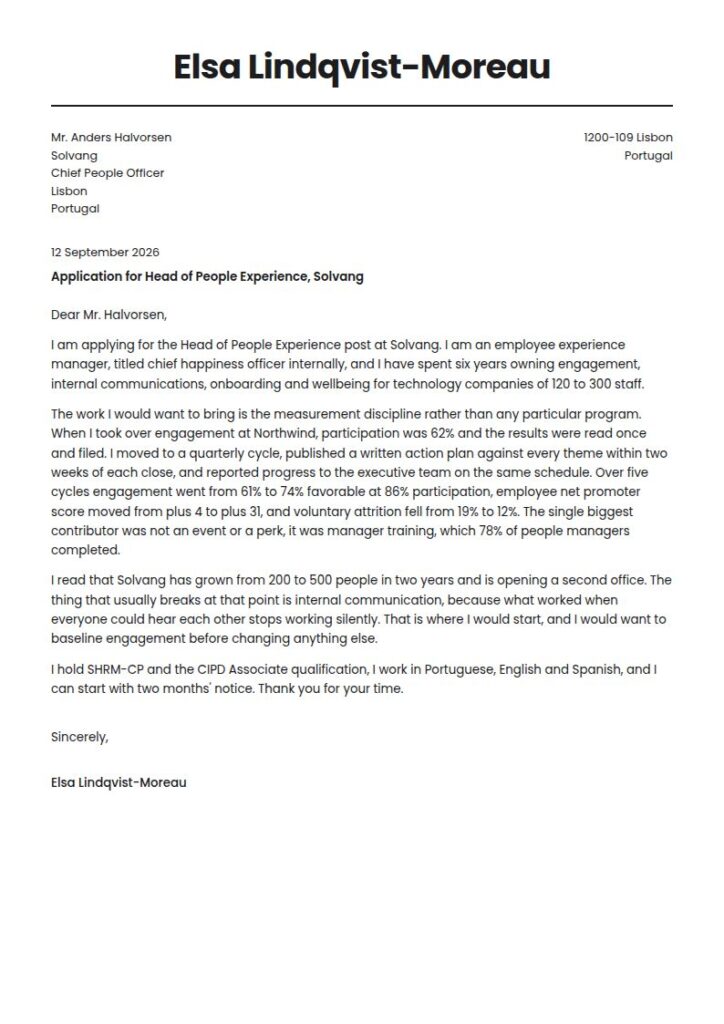
I am applying for the Head of People Experience post at Solvang. I am an employee experience manager, titled chief happiness officer internally, and I have spent six years owning engagement, internal communications, onboarding and wellbeing for technology companies of 120 to 300 staff.
The work I would want to bring is the measurement discipline rather than any particular program. When I took over engagement at Northwind, participation was 62% and the results were read once and filed. I moved to a quarterly cycle, published a written action plan against every theme within two weeks of each close, and reported progress to the executive team on the same schedule. Over five cycles engagement went from 61% to 74% favorable at 86% participation, employee net promoter score moved from plus 4 to plus 31, and voluntary attrition fell from 19% to 12%. The single biggest contributor was not an event or a perk, it was manager training, which 78% of people managers completed.
I read that Solvang has grown from 200 to 500 people in two years and is opening a second office. The thing that usually breaks at that point is internal communication, because what worked when everyone could hear each other stops working silently. That is where I would start, and I would want to baseline engagement before changing anything else.
I hold SHRM-CP and the CIPD Associate qualification, I work in Portuguese, English and Spanish, and I can start with two months' notice. Thank you for your time.
Sincerely, Elsa Lindqvist-Moreau
Openings that work
| Instead of | Use |
|---|---|
| I am passionate about creating happy workplaces where people thrive | I am an employee experience manager, titled chief happiness officer internally |
| I believe culture is the heart of every great company | Six years owning engagement, internal communications, onboarding and wellbeing for 120 to 300 staff |
| I love bringing people together and building community | Engagement went from 61% to 74% favorable at 86% participation across five quarterly cycles |
| I am a positive person who lifts everyone around me | Voluntary attrition fell from 19% to 12%, mostly through manager training |
The numbers that make this credible
A skeptical reader is not asking whether people enjoyed the program. They are asking whether anything changed.
| Measure | What to write |
|---|---|
| Engagement | Favorable score and participation rate, before and after, over a stated number of cycles |
| eNPS | The score movement, with the survey cadence |
| Attrition | Voluntary or regretted attrition, before and after, over a stated period |
| Manager enablement | Completion rate across a named number of people managers |
| Communications | Open or read rates, and reach across sites or languages |
| Onboarding | Starters a year, and a 30, 60 or 90 day measure |
| Budget | The program budget you owned |
Participation rate matters as much as the score. A 78% favorable result on 40% participation is a weaker claim than 70% on 90%, and any experienced reader knows it, so give both.
Startup, scale-up or large employer
For a startup, lead with breadth and with doing the work yourself, because there is no team. For a scale-up, lead with what breaks at their headcount: communication, onboarding at volume, first-time managers, and the loss of informal culture. For a large employer, translate the title immediately into their vocabulary, which will be employee experience, internal communications or people operations, and lead with measurement, governance and working across business units. Give participation rates alongside every score.
Do not build the letter around events, perks or office rituals; they read as the easy part of the job and they are what a sceptic expects to find. Do not claim credit for a retention number you cannot connect to something you did. Do not describe an individual employee, a case, or anything about anyone's health, leave or complaint. Do not use the word happiness more than once.
Length, format and sending it
One page, four paragraphs, 250 to 400 words. PDF, named for yourself and the post: elsa-lindqvist-moreau-people-experience-cover-letter.pdf.
Use the same figures as your resume. Our chief happiness officer resume example is written with the numbers used here, and the HR business partner resume covers the adjacent partnering route if that is where you are heading.
Key takeaways
- Translate the title in the first sentence, then stop mentioning it.
- Lead the evidence paragraph with a number and the mechanism behind it.
- Always pair a score with its participation rate.
- Attribute attrition movement to something specific you did.
- Name what usually breaks at their size, and say what you would baseline first.
- Keep events and perks out of the argument.
- Never describe an individual employee or anything about their health, leave or complaint.
Write your cover letter in 10 minutes.
Chief happiness officer cover letter questions, answered
Should I use the chief happiness officer title on my application at all?
Use it once, as a translation, and lead with the functional title the market recognizes. Hiding it is worse, because it will appear on references and in employment verification, and an unexplained gap between what you called yourself and what your employer called you is a harder conversation than the title itself.
How long should the letter be?
One page, four paragraphs, 250 to 400 words. The title translation should cost you one clause, not a paragraph of justification.
What if my engagement numbers are not good?
Give the movement and the honest reason. A score that fell during a restructure, with a clear account of what you did and what you learned, is more persuasive to a senior reader than a number with no context. What does not work is omitting numbers entirely, which reads as not having measured.
Is this a real career, or a startup fashion?
The title is unusual and not standard; the work underneath it is a real and growing function, usually called employee experience or people experience. Write to the function and the question answers itself.
Can I mention culture initiatives like offsites and socials?
In passing, once, as part of a program with a measurable purpose. Leading with them is what makes a skeptical reader dismiss the application, because those are the parts of this job that look easiest from the outside.