Colin Rasmussen Talent Acquisition Lead, Manufacturing and Skilled Trades Denver, 80205, United States [email protected] · (303) 555-0201
12 September 2026
Ms. Harriet Vandenberg Human Resources Cascade Ridge Industries Aurora, United States
Application for Senior Recruiter, Cascade Ridge Industries
Dear Ms. Vandenberg,
I am applying for the Senior Recruiter post at Cascade Ridge Industries. I carry 19 to 23 open requisitions at a time across skilled trades, frontline supervision and finance for a 2,400-employee manufacturer, and closed 147 roles last year at a 38 day median time to fill with an 89% offer acceptance rate.
The piece of that work I would want to bring is the source mix. When I arrived, 61% of hires came from job boards and the agency line was $410,000 a year. I introduced a standing 20-minute intake on every requisition, built a referral program that paid on start rather than on offer, and put two hours a day into direct outreach. Two years later referrals were 34% of hires, direct sourcing 29%, job boards 23% and agency 14%, and the agency line was $96,000. Acceptance rose from 78% to 89% over the same period, almost entirely because the pay band conversation moved into the first screen.
Your postings show second shift openings at three sites and a maintenance technician requisition that has been live since April. Aging is where I would start: I would pull requisition age by site, take the oldest two at each, and rewrite the basic qualifications before reposting, which also puts your applicant records on firmer ground as a federal contractor.
The figures above are reported from Workday Recruiting and cover the full calendar year, excluding 14 requisitions canceled before first submission. I hold the SHRM-CP and the AIRS CIR, and I can give three weeks' notice. Thank you for your time.
Sincerely, Colin Rasmussen
Summary
A recruiter cover letter is read by someone who assesses letters for a living, so it must survive the standard you apply to other people. This guide gives you a full adaptable letter built on requisition load and funnel numbers, the three figures worth putting in a letter rather than a resume, and how to write about a year when the market or the reporting was against you.
Recruiter cover letter examples by experience level
A recruiter cover letter is one page telling a hiring director how many requisitions you carried at once, what kind they were, and three numbers that came out of your funnel.
It is also the only cover letter in the market read by a professional reader of cover letters. Whatever standard you apply to candidates, apply here first: if a phrase would make you skim a candidate's letter, it will make a hiring director skim yours.
Guide to a recruiter cover letter
This guide and the corresponding recruiter cover letter example will cover:
- How to open with requisition load rather than years of experience
- Which three funnel numbers belong in a letter and which belong on the resume
- How to write about a year when the market or the reporting was against you
- The openings that work and the ones you already skim past
How to write a recruiter cover letter
| Paragraph | Its job | Length |
|---|---|---|
| Opening | The post, your concurrent load with its split, one headline number | 2 to 3 sentences |
| Evidence | One thing you built, with a before and after | 4 to 5 sentences |
| Fit | One real fact about their hiring situation, and what you would do first | 3 to 4 sentences |
| Close | Where your numbers come from, credentials, availability | 2 sentences |
Open with load, not with years
"Eight years of full cycle recruiting experience" tells a hiring director nothing about capacity. Eight years on four requisitions at a time is a different candidate from eight years on twenty-two.
Write the load and the split instead: "I carry 19 to 23 open requisitions at a time across skilled trades, frontline supervision and finance." That lets the reader place you in their own req list before the second paragraph. Follow it with one headline number, not four.
A recruiter cover letter example you can adapt
Dear Ms. Vandenberg,
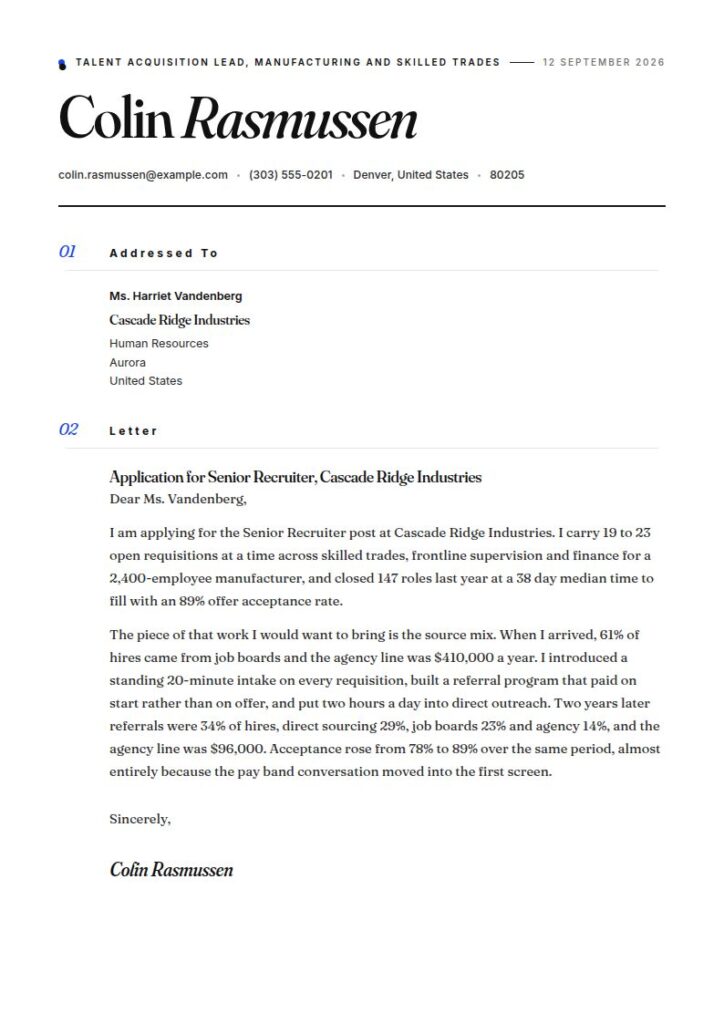
I am applying for the Senior Recruiter post at Cascade Ridge Industries. I carry 19 to 23 open requisitions at a time across skilled trades, frontline supervision and finance for a 2,400-employee manufacturer, and closed 147 roles last year at a 38 day median time to fill with an 89% offer acceptance rate.
The piece of that work I would want to bring is the source mix. When I arrived, 61% of hires came from job boards and the agency line was $410,000 a year. I introduced a standing 20-minute intake on every requisition, built a referral program that paid on start rather than on offer, and put two hours a day into direct outreach. Two years later referrals were 34% of hires, direct sourcing 29%, job boards 23% and agency 14%, and the agency line was $96,000. Acceptance rose from 78% to 89% over the same period, almost entirely because the pay band conversation moved into the first screen.
Your postings show second shift openings at three sites and a maintenance technician requisition that has been live since April. Aging is where I would start: I would pull requisition age by site, take the oldest two at each, and rewrite the basic qualifications before reposting, which also puts your applicant records on firmer ground as a federal contractor.
The figures above are reported from Workday Recruiting and cover the full calendar year, excluding 14 requisitions canceled before first submission. I hold the SHRM-CP and the AIRS CIR, and I can give three weeks' notice. Thank you for your time.
Sincerely, Colin Rasmussen
Openings that work
| Instead of | Use |
|---|---|
| I am a results-driven recruiter with a passion for connecting talent | I carry 19 to 23 open requisitions at a time across trades, supervision and finance |
| I have over eight years of full cycle recruiting experience | I closed 147 roles last year at a 38 day median time to fill |
| I consistently exceed hiring targets and build strong pipelines | Referrals went from 22% to 34% while the agency line fell from $410,000 to $96,000 |
| I would love the opportunity to join your growing team | Your maintenance technician requisition has been live since April |
You skim the left column every day. Assume the reader does too.
Which numbers belong in a letter, and which belong on the resume
Three in the letter, the rest on the resume. A letter dense with metrics reads as a dashboard printout.
| Number | Letter or resume | Why |
|---|---|---|
| Concurrent requisition load | Letter, first sentence | The capacity question the reader is actually asking |
| Time to fill | Letter, with the population attached | Meaningless without the number of roles it covers |
| Offer acceptance rate | Letter | The closest thing recruiting has to a quality measure |
| Source mix | Letter if it changed, resume if static | A movement is a story; a snapshot is a data point |
| Stage ratios | Resume | Useful, but too granular for a paragraph |
| Annual hires | Resume | Weaker than load, and the resume has room for both |
The benchmark to place yourself against
SHRM's 2026 Recruiting Executives Benchmarking report, drawn from more than 4,600 organizations, puts median time to fill at 39 calendar days for nonexecutive positions, and records that extra-large organizations saw a 67% increase in requisitions per recruiter in 2026 (SHRM, published 24 June 2026).
For pay, recruiters sit inside the human resources specialists occupation rather than having a profile of their own: median annual wage $75,940 in May 2025 and about 939,700 jobs (Bureau of Labor Statistics Occupational Outlook Handbook, page last modified 27 August 2026).
Use both as context rather than as a claim. "A 38 day median against a published market median of 39 days" is a sentence a hiring director can check, and checking is what they do.
When your numbers are messy or the market was bad
Most recruiting years are not clean: a hiring freeze, a system migration, a requisition list nobody closed out. Writing around it is worse than writing about it, because the reader has lived through the same years. Three sentences handle almost every case.
Say where the number came from. "Reported from Greenhouse" or "hand-counted from signed offer letters" beats an unattributed figure. Every hiring director has seen an ATS produce a wrong number.
Give the population and the window. "147 roles closed between January and December" is checkable. "Over 140 hires" is a rounding you did in your own favor.
Name the exclusion. "Excludes 14 requisitions canceled before first submission" makes the rest credible.
If the year itself was bad, say what you did with it. A freeze year spent rebuilding the referral program or cleaning the requisition backlog is real work, and a letter that names the freeze and then names the project reads as honest rather than thin.
Open with concurrent load and its function split. Give exactly three numbers and say where each came from. Quote one real detail from their postings, such as a requisition live for months. Say what you would do in the first month. Name your credentials with their awarding bodies.
Do not lead with years of experience. Do not round a number in your own favor. Do not report a stage ratio your system never tracked. Do not name a candidate, client or confidential search. Do not call yourself a hunter, a closer or a talent connector. Do not send one letter to both an agency and a corporate employer.
Length, format and sending it
One page, four paragraphs, 250 to 400 words. PDF unless the portal specifies otherwise, named for yourself and the post: colin-rasmussen-senior-recruiter-cover-letter.pdf.
Address a person. You can find the talent acquisition leader at almost any employer in five minutes, and failing to do so in this profession is a demonstration against interest.
Keep every figure identical across both documents. Our recruiter resume example uses the same numbers as the letter above.
Key takeaways
- Open with concurrent requisition load and its function split, not with years.
- Put exactly three numbers in the letter; leave the rest on the resume.
- Say where each figure came from: reported, or hand-counted.
- Give the population and the window, and name what you excluded.
- Quote one real detail from their own postings, such as an aging requisition.
- Say what you would do in the first month, not what you admire.
- Address a named person; in this profession the search is the point.
Write your recruiter cover letter in 10 minutes.
Recruiter cover letter questions, answered
How long should a recruiter cover letter be?
One page, four paragraphs, 250 to 400 words. Apply your own screening standard: if you would not read it end to end from a candidate, do not send it.
Do recruiters actually need a cover letter?
For agency roles, often not; the desk is sold on numbers and the call comes fast. For corporate roles it matters more, because the hire is about stakeholder management as much as sourcing, and the letter is the only place you can show how you write to a hiring manager.
What if my last year was a hiring freeze?
Name it and name what you did instead. Requisition backlog cleanup, referral program design, an ATS migration you ran: these are real work and read as such. A letter that quietly avoids a flat year invites the reader to assume something worse.
Should I include my offer acceptance rate if it is low?
Include it if you can explain it, leave it out if you cannot. A 71% acceptance rate on roles where the pay band sat below market is a story about the band, not about you, and a hiring director will recognize it. What you must not do is publish a figure you rounded upward; it is the one number a reference check tends to surface.
How do I find something real to say about their hiring?
Read their live postings, not their careers page copy. Posting dates tell you which requisitions are aging, shift patterns tell you where the pain is, and repeated reposts of one title tell you the funnel is leaking. One accurate sentence drawn from that is the part of the letter that cannot be reused on the next application.