Ravi Chandrasekaran-Boyd Technical Recruiter, Backend, Platform and Data Seattle, 98103, United States [email protected] · (206) 555-0119
11 September 2026
Mr. Owen Marsh Talent Foxglove Systems Seattle, United States
Application for Technical Recruiter, Foxglove Systems
Dear Mr. Marsh,
I am applying for the Technical Recruiter post at Foxglove Systems. I currently carry 11 open requisitions at a 600-person software company across backend Go and Java, platform and SRE, and data engineering, at mid through staff level, and I closed 42 engineering hires in two years at a median time to fill of 46 days and 89% offer acceptance.
The work I would most want to bring over is the leveling rubric. We were losing offers late, at the conversation where a candidate learned which level they had been mapped to, nine times a year. I rewrote the rubric with two engineering directors, moved the level decision into intake before any outreach went out, and put the band in the first recruiter call. Late-stage level rejections fell to two a year and offer acceptance rose to 89%. Over the same period sourced hires reached 61% of the total, at a 38% reply rate against a 12% team baseline.
Your engineering blog describes a platform team that has roughly doubled in two years, and your careers page has carried data engineering roles since the spring, which is the pattern where loop length costs more candidates than compensation does. I cut our loop from six stages to four and withdrawal during onsite scheduling fell from 22% to 7%, mostly by writing down what each stage was allowed to assess and training 34 engineers against it.
To be straightforward about the boundary: I do not assess code. My screen is a 30-minute structured conversation about scope of ownership, against criteria the hiring manager writes down, and the engineering judgment stays with your engineers. I hold the AIRS Certified Internet Recruiter credential and the AWS Cloud Practitioner certificate, taken so I could read infrastructure requisitions accurately, and I work daily in Greenhouse and LinkedIn Recruiter. I can give four weeks' notice. Thank you for your time.
Sincerely, Ravi Chandrasekaran-Boyd
Summary
A technical recruiter cover letter names the stacks and seniority levels you have filled, describes the screen you run, and says plainly what you do not claim to assess. This guide gives you a full adaptable letter, how to write into a slow tech hiring market, and the confidentiality rule that ends an application when it is broken.
Technical Recruiter cover letter examples by experience level
A technical recruiter cover letter is a one-page letter telling a talent or engineering leader which stacks and levels you have filled, how you screen, and how you work with hiring managers.
It has one extra job a general recruiting letter does not: establishing that an engineer would trust you in front of their candidates. The way to do that is not to display vocabulary. It is to be exact about what you fill and what you assess, and honest about what you leave to engineers.
Guide to a technical recruiter cover letter
This guide and the corresponding technical recruiter cover letter example will cover:
- How to structure the letter, paragraph by paragraph
- Why the stack and level inventory belongs in the first two sentences
- The sentence about technical assessment that earns credibility
- How to write into a hiring market that has been slow for years
- The confidentiality rule and the non-solicit trap
How to write a technical recruiter cover letter
| Paragraph | Its job | Length |
|---|---|---|
| Opening | The post, stacks and levels you carry, volume, one conversion number | 2 to 3 sentences |
| Evidence | One process you changed, the number before and after | 4 to 5 sentences |
| Fit | Something specific about their engineering hiring | 3 to 4 sentences |
| Close | What you assess and what you do not, tools, availability | 2 to 3 sentences |
Open with stacks and levels, in the same sentence
"Experienced technical recruiter" tells your reader nothing: the phrase covers a new graduate pipeline and a staff distributed systems search equally.
Write the inventory instead: "I carry 11 open requisitions at a 600-person software company across backend Go and Java, platform and SRE, and data engineering, at mid through staff." An engineering leader can match you against their own open roles in one read.
Level is the part most letters drop and the part that matters most. Senior and staff hiring is a different craft: the candidates are not looking, the shortlist is four people rather than forty, and the close turns on scope and equity rather than speed.
A technical recruiter cover letter example you can adapt
Dear Mr. Marsh,
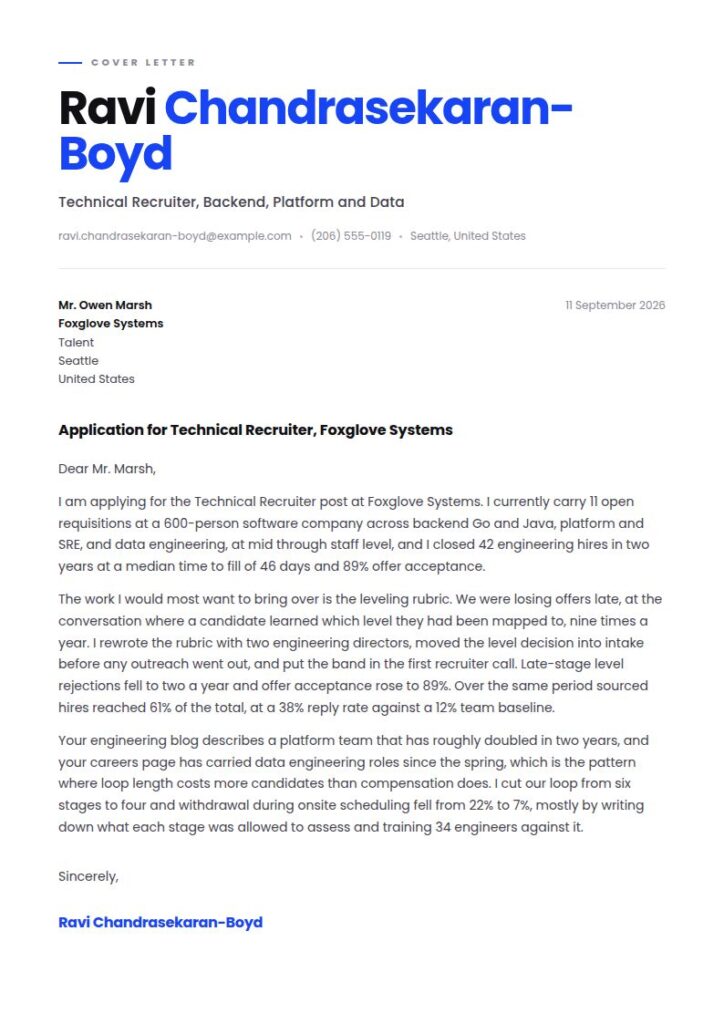
I am applying for the Technical Recruiter post at Foxglove Systems. I currently carry 11 open requisitions at a 600-person software company across backend Go and Java, platform and SRE, and data engineering, at mid through staff level, and I closed 42 engineering hires in two years at a median time to fill of 46 days and 89% offer acceptance.
The work I would most want to bring over is the leveling rubric. We were losing offers late, at the conversation where a candidate learned which level they had been mapped to, nine times a year. I rewrote the rubric with two engineering directors, moved the level decision into intake before any outreach went out, and put the band in the first recruiter call. Late-stage level rejections fell to two a year and offer acceptance rose to 89%. Over the same period sourced hires reached 61% of the total, at a 38% reply rate against a 12% team baseline.
Your engineering blog describes a platform team that has roughly doubled in two years, and your careers page has carried data engineering roles since the spring, which is the pattern where loop length costs more candidates than compensation does. I cut our loop from six stages to four and withdrawal during onsite scheduling fell from 22% to 7%, mostly by writing down what each stage was allowed to assess and training 34 engineers against it.
To be straightforward about the boundary: I do not assess code. My screen is a 30-minute structured conversation about scope of ownership, against criteria the hiring manager writes down, and the engineering judgment stays with your engineers. I hold the AIRS Certified Internet Recruiter credential and the AWS Cloud Practitioner certificate, taken so I could read infrastructure requisitions accurately, and I work daily in Greenhouse and LinkedIn Recruiter. I can give four weeks' notice. Thank you for your time.
Sincerely, Ravi Chandrasekaran-Boyd
Openings that work
| Instead of | Use |
|---|---|
| I am an experienced technical recruiter with a passion for tech | I carry 11 requisitions across backend Go and Java, platform and SRE, and data engineering, mid through staff |
| I excel at finding hard-to-find talent | Sourced hires are 61% of my total, at a 38% reply rate |
Saying what you can and cannot assess
The most credible sentence available to a technical recruiter is the one that gives something up.
Engineering leaders have read many letters implying technical assessment ability, and have interviewed the people who wrote them. A letter saying plainly "I do not assess code, and the engineering judgment stays with your engineers" removes the suspicion your reader was already forming, and invites you to describe what you do assess.
What you assess is scope. Thirty structured minutes, against written hiring manager criteria, establishing what the candidate personally owned on a recent project, what the hard part was, and what tradeoff they made. Someone who built the service answers specifically; someone adjacent to it cannot, and you do not need to write software to hear the difference.
Then say where your technical literacy came from: intake meetings, debriefs and questions asked of engineers. That is more convincing than a certificate.
Name stacks, role families and levels in the opening. Give one conversion number a talent leader can compare with their own. Describe your intake, rubric and debrief practice concretely. State the boundary on technical assessment explicitly. Name your tools by product. Mention equity fluency, because that is where technical offers are lost.
Do not imply you can evaluate technical depth or review code. Do not sprinkle technologies through the letter to signal familiarity. Do not describe engineers as ninjas, rockstars or unicorns. Do not send a letter with no numbers in it. Do not claim continuous hiring volume through 2024 and 2025 if you did not have it.
Writing into a slow tech hiring market
The occupation is growing; the postings are not
Software developers held about 1.7 million jobs in 2025, and employment of software developers, quality assurance analysts and testers is projected to grow 10 percent from 2025 to 2035, with about 106,100 openings each year over the decade (BLS Occupational Outlook Handbook, 2025-35 projections). The median annual wage for software developers was $135,980 in May 2025.
Hiring conditions have been another matter. Indeed Hiring Lab's US labor market vertical update for Q4 2025, published February 2026, called technology postings one of the weakest spots in the labor market, with several tech categories at least 30% below their pre-pandemic level.
Write into that rather than around it. A letter claiming uninterrupted volume through those years reads as untrue. A letter saying "requisition count halved, so I spent two quarters rebuilding the loop and the pipeline, and we filled 22 roles in the quarter the freeze lifted" reads as a recruiter who was useful during a downturn.
What you can and cannot say about candidates
Never name or describe an identifiable candidate or employee, and never reference anyone's medical information, disability, accommodation, leave, complaint, investigation or discipline. Your reader would be accountable for that breach, so it ends the application.
There is a second rule that bites harder here, because the impressive story is usually about hiring one person away from one company. Do not name the companies you sourced candidates out of. It invites a non-solicit clause to be read aloud in your interview.
Under EEOC regulations at 29 CFR Part 1602 employers keep personnel and employment records, including applicant records, for a year, and that data belongs to the employer. Role family, level, volume and outcome are all you need.
Length, format and sending it
One page, four paragraphs, 300 to 400 words, slightly longer than a general recruiting letter because the assessment boundary earns its space. PDF unless the portal says otherwise. Address a person; a technical recruiter who cannot find a name undercuts the pitch.
Keep the figures identical to your technical recruiter resume example, which uses the numbers written here.
Key takeaways
- Open with stacks, role families and levels in one sentence.
- Give volume plus one conversion number over a stated period.
- Describe a process you changed, with the before and after.
- State plainly that you do not assess code, then say what you do assess.
- Say where your technical literacy came from.
- Write honestly about the slow market.
- Name no candidate, no employee, and no company you sourced from.
Write your technical recruiter cover letter in 10 minutes.
Technical recruiter cover letter questions, answered
How long should a technical recruiter cover letter be?
One page, four paragraphs, 300 to 400 words. Slightly longer than a general recruiting letter, because the stack inventory and the assessment boundary both need real sentences.
Should I say I am not technical?
Say what you do and do not assess, which is more useful than either claim. "I do not assess code; my screen establishes scope of ownership against written hiring manager criteria" is precise and credible. Calling yourself non-technical undersells literacy you probably do have.
What if I have never recruited engineers before?
Lead with the closest adjacent funnel and be honest about the gap. Data, product and IT infrastructure recruiting all transfer. Then show the work done to close it: a fundamentals certificate described accurately, and a stack whose market you have started to learn.
Do engineering hiring managers read cover letters?
Often the talent leader reads it and the engineering manager hears about it, so write for both. The stack and level inventory is for the engineer; the conversion numbers and process detail are for the talent leader.
How do I write to a company whose engineering I do not know?
Read their engineering blog, careers page and open requisitions first: which teams have grown, which roles sat open longest, whether they publish their interview process. One accurate sentence about their hiring problem beats a paragraph admiring their mission.