Lucia Ferrante-Wykes HR Business Partner, SHRM-SCP Minneapolis, 55408, United States [email protected] · (612) 555-0129
11 September 2026
Mr. Emmanuel Baptiste Vice President, Human Resources Halvorsen Technologies Saint Paul, United States
Application for Senior HR Business Partner, Halvorsen Technologies
Dear Mr. Baptiste,
I am applying for the Senior HR Business Partner post supporting your technology organization. I am currently the embedded HRBP to a 780-person commercial organization generating $410m in revenue, partnering the vice president of commercial and six directors, and I sit in their leadership meeting weekly. We run a three-legged stool, so reward and employment law sit in centers of excellence and transactions in shared services; I hold organizational design, workforce planning, talent review and manager capability for the unit.
The work I would most want to bring across is the sales structure consolidation. I built the case for moving from nine regions to six, modeled the span of control and the cost, and took it through the leadership team over six weeks before anyone agreed to it. The vice president made the decision, not me, which is the part I would want to be accurate about. We delivered the change in 11 weeks without adding headcount, voluntary attrition in the unit fell from 21% to 13% over the following two years, and the internal fill rate rose from 28% to 46% once we had built a lateral path between inside sales and field sales.
Your posting describes a technology function scaling across three sites and a stated intent to flatten management layers. I have run a layer analysis and the consultation that follows it, and I would want to start with the span of control data rather than with a target, because a target set before the analysis tends to get relitigated for a year afterwards.
I hold the SHRM-SCP through SHRM and the Prosci Change Management Practitioner certification, and I can give four weeks' notice. Thank you for your time.
Sincerely, Lucia Ferrante-Wykes, SHRM-SCP
Summary
An HR business partner cover letter names the business unit you are embedded in, its size, the leaders you advise, and one thing that changed there because of an argument you made without any authority to enforce it. This guide gives you a full adaptable letter, the confidentiality rule the role is judged on, and openings that work.
HR Business Partner cover letter examples by experience level
An HR business partner cover letter is a one-page letter that names the business unit you sit inside, how big it is, who leads it, and one thing that changed there because you made an argument you had no power to enforce.
That last part is the whole test. Every applicant will say they are a trusted adviser to senior leaders. The letter that gets an interview describes a specific decision the business made, and is honest that the business made it.
Guide to an HR business partner cover letter
This guide and the corresponding HR business partner cover letter example will cover:
- How to structure the letter, paragraph by paragraph
- Why the client unit belongs in the first two sentences
- How to show influence without authority instead of claiming it
- The confidentiality rule an HRBP application is judged on
How to write an HR business partner cover letter
| Paragraph | Its job | Length |
|---|---|---|
| Opening | The post, the unit you partner now, its size and its leadership | 2 to 3 sentences |
| Evidence | One decision you argued for, the mechanism, and what changed in the unit | 4 to 5 sentences |
| Fit | Something specific about their business and the unit you would take on | 3 to 4 sentences |
| Close | Credential with its issuing body, availability, thank you | 2 sentences |
Name the client unit before you name a competency
An HRBP supporting a 200-person function and one supporting a 2,000-person division have the same title and different jobs. The reader's first question is which one you are.
Answer it immediately: "I am the embedded HRBP to a 780-person commercial organization generating $410m in revenue, partnering the vice president of commercial and six directors."
That sentence gives scale, commercial weight and client seniority. Client seniority is the strongest predictor of the level you will be hired at, so it belongs in the opening.
An HR business partner cover letter example you can adapt
Dear Mr. Baptiste,
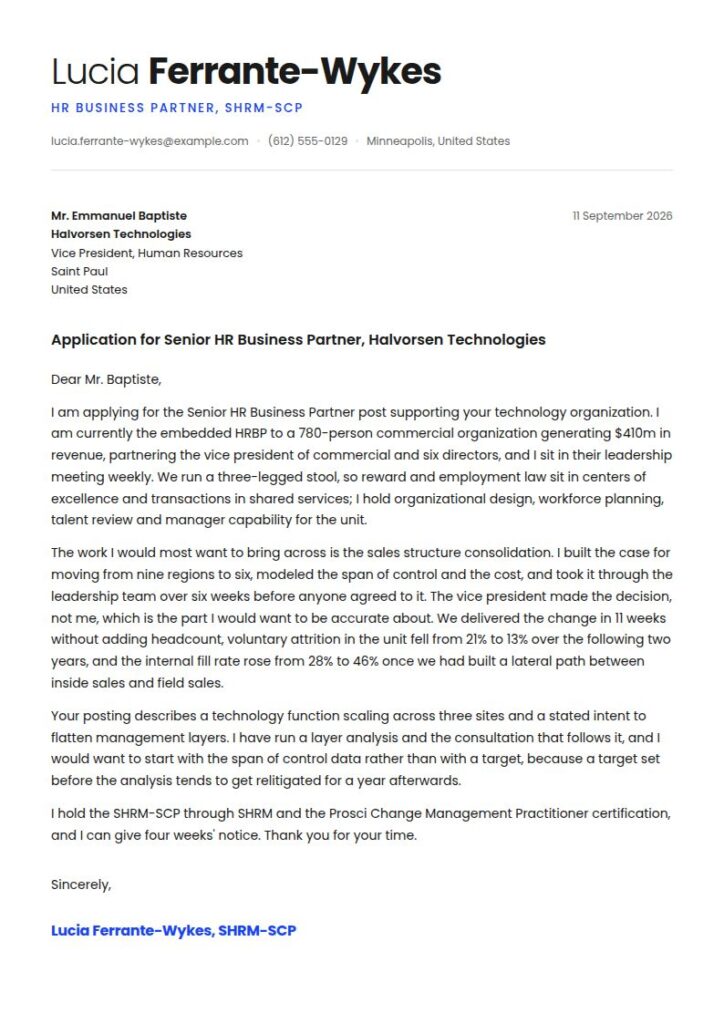
I am applying for the Senior HR Business Partner post supporting your technology organization. I am currently the embedded HRBP to a 780-person commercial organization generating $410m in revenue, partnering the vice president of commercial and six directors, and I sit in their leadership meeting weekly. We run a three-legged stool, so reward and employment law sit in centers of excellence and transactions in shared services; I hold organizational design, workforce planning, talent review and manager capability for the unit.
The work I would most want to bring across is the sales structure consolidation. I built the case for moving from nine regions to six, modeled the span of control and the cost, and took it through the leadership team over six weeks before anyone agreed to it. The vice president made the decision, not me, which is the part I would want to be accurate about. We delivered the change in 11 weeks without adding headcount, voluntary attrition in the unit fell from 21% to 13% over the following two years, and the internal fill rate rose from 28% to 46% once we had built a lateral path between inside sales and field sales.
Your posting describes a technology function scaling across three sites and a stated intent to flatten management layers. I have run a layer analysis and the consultation that follows it, and I would want to start with the span of control data rather than with a target, because a target set before the analysis tends to get relitigated for a year afterwards.
I hold the SHRM-SCP through SHRM and the Prosci Change Management Practitioner certification, and I can give four weeks' notice. Thank you for your time.
Sincerely, Lucia Ferrante-Wykes, SHRM-SCP
Openings that work
| Instead of | Use |
|---|---|
| I am a strategic HR business partner passionate about aligning people and business | I am the embedded HRBP to a 780-person commercial organization generating $410m in revenue |
| I am a trusted adviser to senior stakeholders across the organization | I partner the vice president of commercial and six directors and sit in their leadership meeting weekly |
| I have driven significant organizational change and transformation | I built the case for consolidating nine sales regions to six and delivered it in 11 weeks |
Influence without authority is a mechanism, not an adjective
You cannot claim influence. You can only describe a decision you did not have the power to make, and how you got it made.
The evidence paragraph therefore needs three parts: the analysis you did, the route you took it through, and what happened. Saying who actually decided is not a weakness. It is the detail that makes the rest credible, and experienced HR interviewers listen for it because inflated ownership is this profession's most common failure mode.
| Instead of | Use |
|---|---|
| I drove a major restructure of the sales organization | I built the case for nine regions to six, took it through the leadership team over six weeks, and the vice president approved it |
Confidentiality is the second test
An HRBP letter must never name an employee or a leader, describe an individual case, performance issue, grievance or exit, or reference anyone's medical information, accommodation, leave or discipline. A description specific enough to identify someone counts as naming them, and inside a company most descriptions are.
Write by coverage, process and aggregate outcome. "Ran quarterly talent review and calibration for 62 people managers, moving coverage from 41% to 100%" says more than any anecdote and discloses nothing. The exception is the leadership role you partnered: a job title on an organization chart is scale information, not personal information.
Where HRBP roles sit in the market
HR business partners are counted by the Bureau of Labor Statistics within human resources specialists: 939,700 jobs in 2025, projected to reach 999,700 by 2035, a rise of 6%, with about 73,700 openings a year and a median annual wage of $75,940 in May 2025 (BLS Occupational Outlook Handbook, 2025-35 projections and May 2025 wage data).
That occupation also contains recruiters, generalists and benefits administrators, which is why the spread is wide: the top 10 percent earned more than $128,720 and the bottom 10 percent less than $47,180 (BLS, May 2025). HRBP roles sit near the upper end, so the occupational median understates the market.
The role itself comes from the three-legged stool set out by Dave Ulrich in the 1990s, splitting HR into embedded business partners, centers of excellence and shared services. The CIPD describes it as still the most widely adopted HR operating framework globally, while noting the persistent criticism that HRBPs end up carrying transactional work rather than the strategic work the role was designed for (CIPD, 2026).
Name the client unit, its headcount and its revenue or budget in the opening. Name the seniority of the leaders you partner. Say what sat in shared services and centers of excellence. Describe one decision you argued for and who approved it. Use the unit's own metrics.
Do not name an employee or a leader, describe an individual case, performance issue or exit, or reference anyone's health, accommodation, leave or discipline. Do not claim decisions the business made. Do not claim company-wide HR figures for a unit-level role. Do not write "trusted adviser" without a unit, a leader and a number behind it.
Length, format and sending it
One page, four paragraphs, 300 to 420 words. PDF, named for yourself and the post: lucia-ferrante-wykes-hr-business-partner-cover-letter.pdf.
Address a named person, usually the HR director or vice president of HR. A generic salutation from someone applying to advise a leadership team is a poor first exhibit.
Use the same numbers as your resume so the two agree. Our HR business partner resume example uses the figures here.
Key takeaways
- Name the client unit, its size and its revenue or budget in the first two sentences.
- Name the seniority of the leaders you partner and how often you sit with them.
- Say what sat in shared services and centers of excellence so your boundary is clear.
- Describe one decision you argued for and name who approved it.
- Use the unit's own metrics, not company-wide HR figures.
- Never name an employee or describe an individual case, performance issue or exit.
- Name one real fact about their business and keep it to one page.
Write your HR business partner cover letter in 10 minutes.
HR business partner cover letter questions, answered
How long should an HR business partner cover letter be?
One page, four paragraphs, 300 to 420 words. It is usually read by an HR director against a large application pool, and length is not what separates the shortlist.
How is this different from an HR generalist cover letter?
Position in the operating model. A [human resource generalist](/resume/human-resource-generalist/) letter covers the full range of HR activity for a population, transactions included. An HRBP letter names one client unit, the leaders in it, and the strategic work you held while specialism sat in centers of excellence. If your role spanned both, say so rather than borrowing a structure that does not fit.
Should I name the leaders I partner?
Name their roles, never their names. "The vice president of commercial and six directors" gives the reader the altitude they are screening for without identifying anyone. A named individual in a cover letter is a discretion failure in a role built on discretion.
Can I use my business unit's revenue figure?
Yes, as scale. Unit revenue or budget is the cheapest proof of commercial literacy and is rarely confidential as a rounded figure. Do not claim the unit's revenue growth as your result. Claim what you owned: attrition, internal mobility, span of control, workforce plan delivery, talent review coverage.
What if I have never worked in a three-legged stool model?
Say what structure you did work in and where you sat in it. Many organizations run hybrid or centralized models and many HRBP titles carry generalist work. Describing the real boundary is more persuasive than adopting vocabulary that does not match your experience.