Tomasz Adeyemi-Blake HR Coordinator Candidate, aPHR Louisville, 40204, United States [email protected] · (502) 555-0123
11 September 2026
Ms. Danielle Whitfield Talent Acquisition Falls City Logistics Louisville, United States
Application for Recruiting Coordinator, Falls City Logistics
Dear Ms. Whitfield,
I am applying for the Recruiting Coordinator post at Falls City Logistics. I hold the aPHR from the HR Certification Institute, earned in 2026, and although I have never held an HR title, I have run the hourly hiring process for a 46-employee location for the past four years: posting, screening, phone interviews, interview scheduling and the onboarding paperwork through to the first day.
The volume is the part I would ask you to weigh. I screen roughly 180 applicants a year and conduct about 90 in-person interviews, and last year I moved average time from application to first interview from 11 days to 4 by putting screening into a fixed twice-weekly block rather than fitting it around the shift. I completed I-9 Section 1 and Section 2 inside the federal deadlines on all 34 hires I onboarded, and I run weekly Workday timecard exception reports before payroll close.
Falls City runs warehouse, driver and corporate requisitions out of one small talent team, which is the same mix of urgent hourly hiring and slower salaried hiring I already work in, just at a larger scale. I would expect the first three months to be about learning Greenhouse and your requisition rhythm rather than learning what a phone screen is.
My aPHR is current through 2029 and I have booked the SHRM-CP for March 2027. I can give four weeks' notice. Thank you for reading.
Sincerely, Tomasz Adeyemi-Blake, aPHR
Summary
An entry level HR cover letter has one job: explain in the first paragraph why someone with no HR title is a sensible hire for this specific opening. This guide gives you a full adaptable letter, the openings that work, how to write about people work without breaching confidentiality, and what changes between an agency application and an internal transfer.
Entry Level HR cover letter examples by experience level
An entry level HR cover letter is a one page letter that answers the question the resume raises: why should a function that handles pay, immigration paperwork and terminations hire someone who has never held an HR title?
It is a fair question with a good answer, but only if you give it. The answer is never enthusiasm. It is that you have already been doing a recognizable slice of HR work somewhere else, at a volume you can name, and that you earned a credential before anyone asked you to.
Guide to an entry level HR cover letter
This guide and the corresponding entry level HR cover letter example will cover:
- How to open when you have no HR title
- Which of the six entry doors you are writing for, and how the letter changes
- What transfers from retail, customer service and administration
- How to describe people work without breaching confidentiality
- The closing lines that get a first HR interview
How to write an entry level HR cover letter
| Paragraph | Its job | Length |
|---|---|---|
| Opening | The exact post, the door, and your credential | 2 to 3 sentences |
| Evidence | One volume, one before and after, one system | 4 to 5 sentences |
| Fit | Why this employer, and what you already know about the work | 3 to 4 sentences |
| Close | Availability, credential status, thank you | 2 sentences |
Name the door in the first sentence
There are six routes into HR that people actually use: recruiting coordinator, HR assistant, benefits administration, HRIS or payroll support, agency recruiting, and internal transfer. Each one is hired against a different instinct.
A recruiting coordinator posting is hired on speed and calendar control. An HR assistant posting is hired on accuracy and paperwork. A benefits posting is hired on deadline tolerance. An HRIS posting is hired on spreadsheets.
So the first sentence should tell the reader which one you are applying for and why your history matches it. "I am applying for the Recruiting Coordinator post, and I have spent four years screening around 180 hourly applicants a year" beats three lines about your interest in people.
An entry level HR cover letter example you can adapt
Dear Ms. Whitfield,
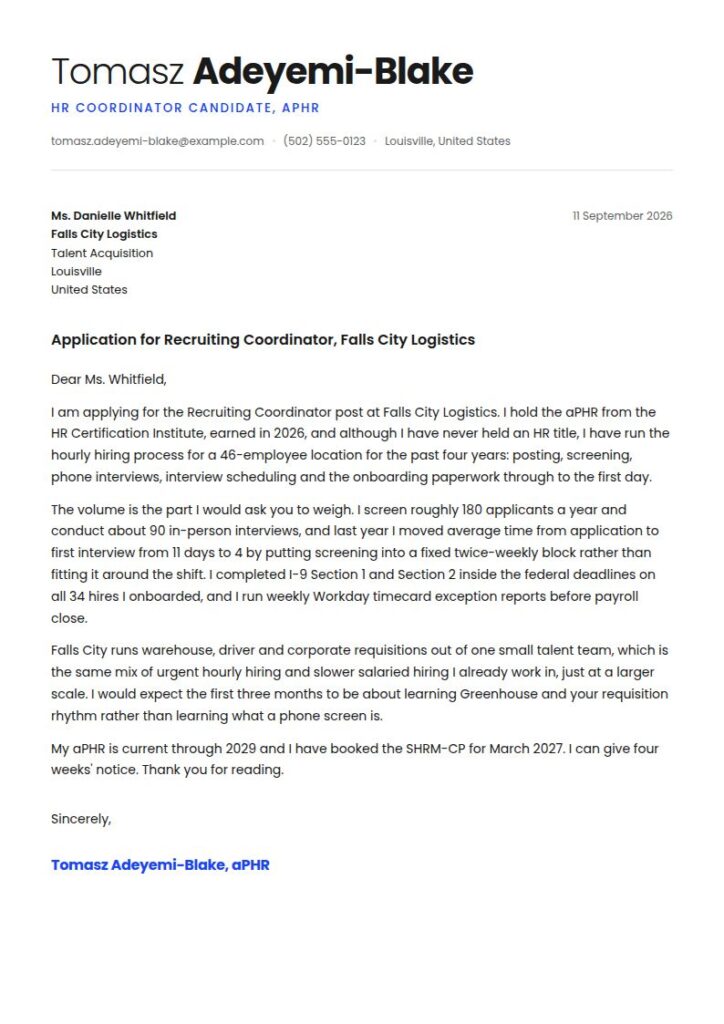
I am applying for the Recruiting Coordinator post at Falls City Logistics. I hold the aPHR from the HR Certification Institute, earned in 2026, and although I have never held an HR title, I have run the hourly hiring process for a 46-employee location for the past four years: posting, screening, phone interviews, interview scheduling and the onboarding paperwork through to the first day.
The volume is the part I would ask you to weigh. I screen roughly 180 applicants a year and conduct about 90 in-person interviews, and last year I moved average time from application to first interview from 11 days to 4 by putting screening into a fixed twice-weekly block rather than fitting it around the shift. I completed I-9 Section 1 and Section 2 inside the federal deadlines on all 34 hires I onboarded, and I run weekly Workday timecard exception reports before payroll close.
Falls City runs warehouse, driver and corporate requisitions out of one small talent team, which is the same mix of urgent hourly hiring and slower salaried hiring I already work in, just at a larger scale. I would expect the first three months to be about learning Greenhouse and your requisition rhythm rather than learning what a phone screen is.
My aPHR is current through 2029 and I have booked the SHRM-CP for March 2027. I can give four weeks' notice. Thank you for reading.
Openings that work, and one that does not
The weakest opening on an entry level HR letter is a statement of interest. The strongest is a statement of what you have already run.
| Instead of | Use |
|---|---|
| I am writing to express my interest in the HR Coordinator position | I am applying for the Recruiting Coordinator post, and I hold the aPHR |
| I am passionate about helping people reach their potential | I have run the hourly hiring process for a 46-employee location for four years |
| I am a recent graduate eager to begin a career in human resources | My capstone built salary bands for 14 job families from published survey data |
| I believe I would be a great fit for your team | You run warehouse and corporate requisitions out of one small talent team, which is the mix I already work in |
How to describe people work without breaching confidentiality
This matters more in an HR application than anywhere else, because the reader is assessing your judgment about exactly this while they read.
Never name an employee, describe an individual case, or reference anyone's medical information, accommodation, leave, complaint or discipline. Not in the letter, not in the resume, not in the interview story you are planning.
The reason is not politeness. Under the Americans with Disabilities Act, information from medical examinations and disability-related inquiries "must be kept confidential, and maintained in separate medical files" (U.S. Equal Employment Opportunity Commission, The ADA: Your Responsibilities as an Employer). An applicant who opens with a story about an employee they helped has told the reader their instinct is to talk about cases. Write by volume, process and outcome instead.
Name the post and the door in the first sentence. Give one volume, one before and after, and one named system. Say what you know about this employer's hiring mix. State your credential and its status honestly. Keep it to one page and four paragraphs.
Do not name an employee or describe a case, even favorably. Do not open with an expression of interest. Do not apologize for having no HR experience; state what you did instead. Do not claim a credential you have only registered for. Do not send the same letter to an agency and an in-house team; they are hiring for different things.
Agency, in-house and internal transfer: three different letters
An agency recruiting letter is read for resilience and appetite. Employment services accounts for 13% of all human resources specialist jobs (BLS Occupational Outlook Handbook, May 2025 data), so this is a large, permanently open door, and the letter should carry call volume, targets you have hit, and a plain statement that you understand the first year is hard.
An in-house letter is read for fit with a specific team and system. Name the HRIS or ATS if the posting does.
An internal transfer letter is a different document again. You already have the references; what you need is evidence of HR-adjacent work inside the building. Name the onboarding buddy program, the engagement survey committee, the site safety team, then ask directly for the move.
The occupation itself does not require experience
For human resources specialists, the Bureau of Labor Statistics lists typical entry-level education as a bachelor's degree, work experience in a related occupation as none, and typical on-the-job training as none (BLS Occupational Outlook Handbook, 2025-35 edition, published 27 August 2026).
The occupation is also growing: 939,700 jobs in 2025, projected to rise 6 percent by 2035, with about 73,700 openings a year on average (BLS Occupational Outlook Handbook, 2025-35 projections).
When a posting for an entry level title asks for two years of HR experience, that is the employer's filter rather than a standard of the field. A letter that names a door, a volume and a credential is arguing directly against that filter, and it is a reasonable argument to make.
Length, format and sending it
One page. Four paragraphs. Plain business format with your contact details at the top, the date, and the reader's name where you can find it.
Address it to a person where you can find one; a named greeting signals the research habit the job itself requires. "Dear Hiring Manager" is fine and "To Whom It May Concern" is not. Send it as a PDF unless the portal asks for Word.
Key takeaways for an entry level HR cover letter
- Name the post and the door in the first sentence, then the credential.
- Give one volume, one before and after, and one named system.
- Translate retail, service or admin work into HR terms without inventing anything.
- Never name an employee or describe a case; it is the fastest way to lose an HR application.
- Write a different letter for an agency, an in-house team and an internal transfer.
- State credential status honestly, including exams you have booked but not sat.
Pair it with a matching entry level HR resume, and see the next two steps in the human resources assistant and HR coordinator guides.
Build your entry level HR cover letter in 15 minutes.
Entry level HR cover letter questions, answered
Do I need a cover letter for an entry level HR job?
Yes, more than in most fields. Your resume raises an obvious objection, that you have no HR title, and the letter is the only place you answer it before someone decides. HR teams also read letters more carefully than other functions do, because writing is a large part of the job.
How do I explain having no HR experience?
Do not explain it, replace it. Name the door you are applying through, then describe the HR work you have already been doing under a different job title, with a volume attached. Hourly hiring, onboarding paperwork, scheduling to a labor budget and timekeeping corrections are HR work whoever does them.
Should I mention a certification I have not passed yet?
Yes, with its real status. "SHRM-CP, exam booked for March 2027" is honest and it shows commitment. Writing SHRM-CP after your name before you hold it is a misrepresentation that a certification lookup will expose in under a minute.
How long should an entry level HR cover letter be?
One page, four paragraphs, roughly 250 to 350 words. A longer letter in this field usually means padding around the missing experience rather than answering the question.
What should I never put in an HR cover letter?
Anything that identifies an employee or touches someone's medical information, accommodation, leave, complaint or discipline. Also avoid describing conflicts you resolved between named parties, however anonymized you think you have made it. Volume, process and outcome only.