Technical Recruiter, Backend and Frontend Ravi Chandrasekaran-Boyd
Technical Recruiter
[email protected] | (206) 555-0119 | Seattle, United States
Profile
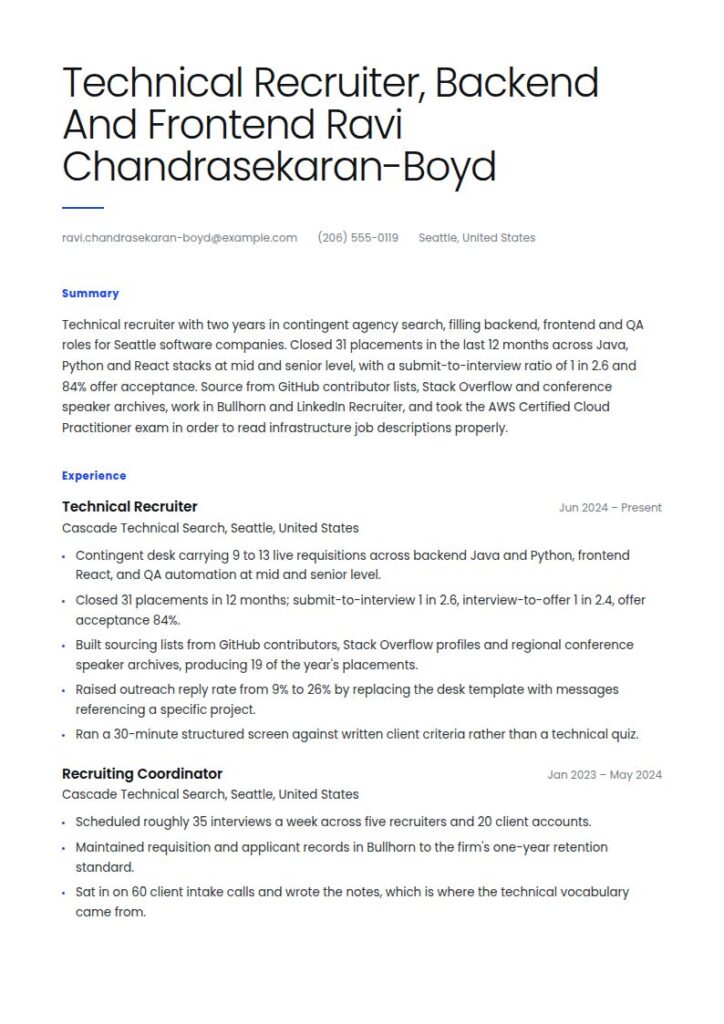
Technical recruiter with two years in contingent agency search, filling backend, frontend and QA roles for Seattle software companies. Closed 31 placements in the last 12 months across Java, Python and React stacks at mid and senior level, with a submit-to-interview ratio of 1 in 2.6 and 84% offer acceptance. Source from GitHub contributor lists, Stack Overflow and conference speaker archives, work in Bullhorn and LinkedIn Recruiter, and took the AWS Certified Cloud Practitioner exam in order to read infrastructure job descriptions properly.
Work Experience
06/2024 - Present, Technical Recruiter, Cascade Technical Search, Seattle, United States
- Contingent desk carrying 9 to 13 live requisitions across backend Java and Python, frontend React, and QA automation at mid and senior level.
- Closed 31 placements in 12 months; submit-to-interview 1 in 2.6, interview-to-offer 1 in 2.4, offer acceptance 84%.
- Built sourcing lists from GitHub contributors, Stack Overflow profiles and regional conference speaker archives, producing 19 of the year's placements.
- Raised outreach reply rate from 9% to 26% by replacing the desk template with messages referencing a specific project.
- Ran a 30-minute structured screen against written client criteria rather than a technical quiz.
01/2023 - 05/2024, Recruiting Coordinator, Cascade Technical Search, Seattle, United States
- Scheduled roughly 35 interviews a week across five recruiters and 20 client accounts.
- Maintained requisition and applicant records in Bullhorn to the firm's one-year retention standard.
- Sat in on 60 client intake calls and wrote the notes, which is where the technical vocabulary came from.
Education
09/2018 - 06/2022, Bachelor of Arts, Economics, University of Washington, Seattle, United States
Minor in Informatics. Worked part time in university IT support throughout the degree.
Skills
GitHub and open source contributor sourcing, 75
Boolean and x-ray search, 75
Structured recruiter screens, 70
Bullhorn ATS and CRM, 85
LinkedIn Recruiter, 85
Reading engineering job descriptions critically, 70
Interview scheduling and coordination, 90
Languages
English, native
Tamil, intermediate
Certificates
02/2024, AWS Certified Cloud Practitioner, Amazon Web Services, AWS-CCP-2024-88214
Taken to read infrastructure and platform requisitions accurately, not as an engineering credential.
Summary
A technical recruiter resume is a one to two page document naming the stacks and seniority levels you have filled, how you screen technically without being an engineer, and how you work with hiring managers. This guide gives you three adaptable versions, the credibility test that decides these interviews, and current Bureau of Labor Statistics pay and outlook.
Technical Recruiter resume examples by experience level
A technical recruiter resume is a one to two page document naming the stacks and seniority levels you have actually filled, the way you screen candidates technically, and how you work with engineering hiring managers.
A general recruiter resume is judged on the funnel. A technical recruiter resume is judged on something narrower: whether an engineering leader would let you represent their team. That is a credibility test, and it is demonstrable rather than a matter of tone. You prove it with a role inventory, a screen you can describe, and evidence that engineers have worked with you willingly.
Resume guide for a technical recruiter resume
This guide and the corresponding technical recruiter resume example will cover:
- How to write a technical recruiter resume, section by section
- Naming the stacks, role families and levels you have filled
- Three adaptable summaries: agency, in-house and recruiting lead
- What a good technical screen actually is, and what it is not
- What the job market looks like and what you can expect to earn
How to write a technical recruiter resume
Six sections: contact header, summary, a role and stack inventory, engineering recruiting experience, skills and systems, and education with certifications. One page for your first five years, two once you have led a team or rebuilt a hiring process.
The inventory is the section that does not appear on a general recruiter resume, and it is the one an engineering director reads first.
| Section | What it is answering | Where it goes |
|---|---|---|
| Role and stack inventory | Which of my open roles has this person filled before? | Directly under the summary |
| Recruiting experience | Did the funnel produce hires, and at what level? | Reverse chronological, numbers in every bullet |
| Process | Can they run an intake and a debrief that engineers respect? | Inside the experience bullets |
| Systems and sourcing | Where do they find engineers, and in which tools? | Skills block, named products |
Name the level, not just the language
"Filled software engineering roles" is worth almost nothing. The same words cover a new graduate requisition that closed in eleven days and a staff distributed systems search that ran for seven months.
Write role family, stack and level together: "backend Go and Java at mid through staff", "platform and SRE with Kubernetes and Terraform", "data engineering on Spark and Airflow", "iOS at senior", "two engineering manager searches".
Levels matter more than stacks in this job. Filling senior and staff roles is a different craft from filling new graduate pipelines, because the candidates are not looking, the shortlist is four people rather than forty, and the close depends on equity and scope rather than on speed.
Run the finished file through the free Rezoom ATS resume checker before you submit.
Choosing the best resume format for a technical recruiter resume
Reverse chronological, with the role inventory sitting above the first job. Engineering organizations read for pattern match, and the timeline tells them whether you have been near their kind of company.
One page through your first five years. Two pages once you have managed recruiters, owned an engineering hiring plan, or rebuilt an interview loop. Keep company context on every line: a 40-person startup and a 6,000-person platform company are not the same recruiting job.
Include your contact information
| ✅ Right | ❌ Wrong |
|---|---|
| Ravi Chandrasekaran-Boyd | Ravi Chandrasekaran-Boyd |
| Technical Recruiter, Backend, Platform and Data | Tech recruiting ninja who loves startups |
| AIRS Certified Internet Recruiter, AWS Certified Cloud Practitioner | Familiar with technical concepts |
| (206) 555-0119, [email protected], Seattle, WA | (206) 555-0119, [email protected] |
The LinkedIn URL is required here rather than optional, and so is a public profile that does not read as a template. Engineers check. An outreach message from someone whose own profile is three lines long is the message they screenshot.
Make use of a summary
Four lines: what you fill, at what level, the volume and one conversion number, and how you work with hiring managers.
Technical recruiter with two years in contingent agency search, filling backend, frontend and QA roles for Seattle software companies. Closed 31 placements in the last 12 months across Java, Python and React stacks at mid and senior level, with a submit-to-interview ratio of 1 in 2.6 and 84% offer acceptance. Source from GitHub contributor lists, Stack Overflow and conference speaker archives, work in Bullhorn and LinkedIn Recruiter, and took the AWS Certified Cloud Practitioner exam in order to read infrastructure job descriptions properly.
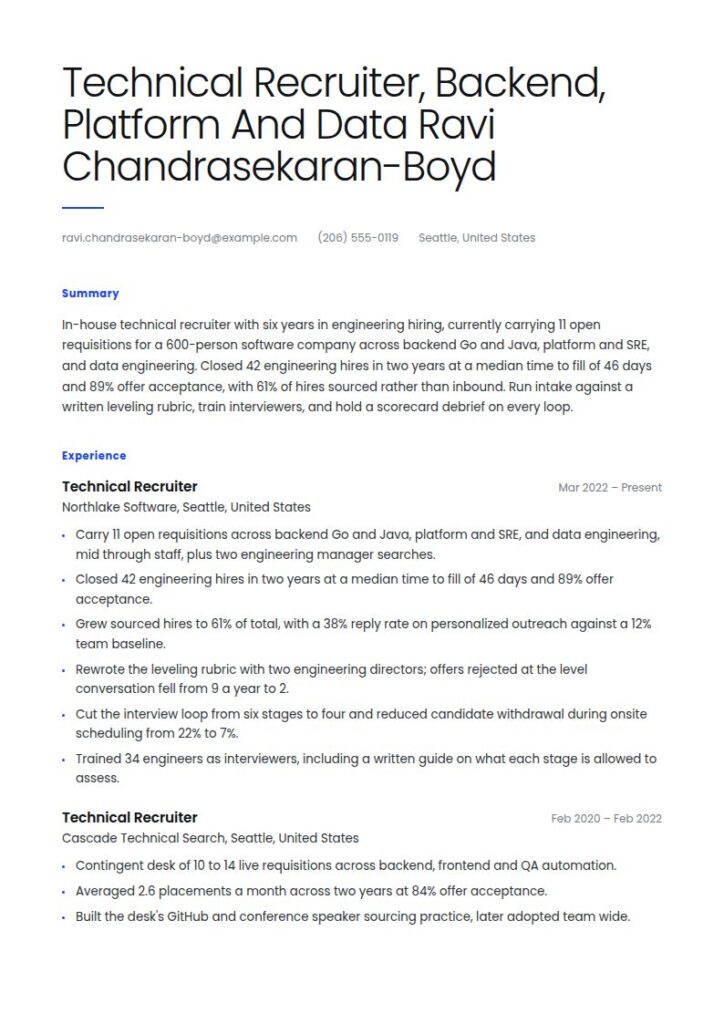
In-house technical recruiter with six years in engineering hiring, currently carrying 11 open requisitions for a 600-person software company across backend Go and Java, platform and SRE, and data engineering. Closed 42 engineering hires in two years at a median time to fill of 46 days and 89% offer acceptance, with 61% of hires sourced rather than inbound. Run intake against a written leveling rubric, train interviewers, and hold a scorecard debrief on every loop.
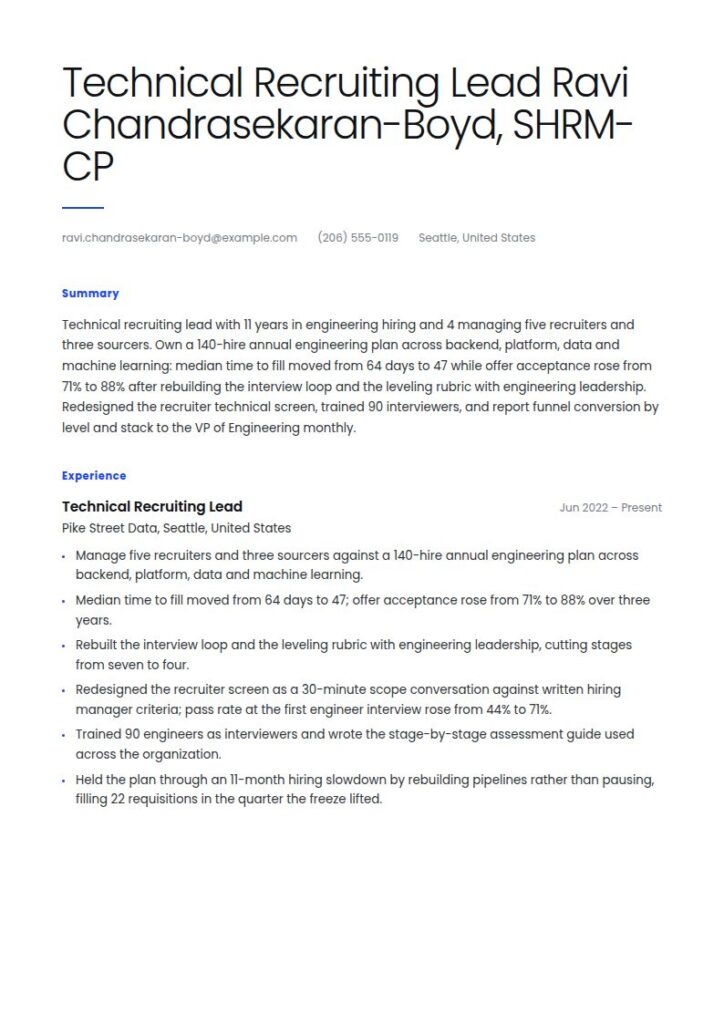
Technical recruiting lead with 11 years in engineering hiring and 4 managing five recruiters and three sourcers. Own a 140-hire annual engineering plan across backend, platform, data and machine learning: median time to fill moved from 64 days to 47 while offer acceptance rose from 71% to 88% after rebuilding the interview loop and the leveling rubric with engineering leadership. Redesigned the recruiter technical screen, trained 90 interviewers, and report funnel conversion by level and stack to the VP of Engineering monthly.
Right vs wrong: the same technical recruiter summary, twice
| ✅ Right | ❌ Wrong |
|---|---|
| Carrying 11 requisitions across backend Go and Java, platform and SRE, and data engineering. | Experienced technical recruiter with knowledge of a wide range of technologies. |
| 42 engineering hires in two years, median time to fill 46 days, 89% offer acceptance. | Successfully filled many hard-to-fill technical positions. |
| Run intake against a written leveling rubric and a scorecard debrief on every loop. | Strong partnership skills with hiring managers and stakeholders. |
The left column is checkable by anyone who has run an engineering loop. The right column is what an engineering director has learned to ignore.
Outline your technical recruiting experience
Employer, what the company builds, headcount, city, dates. Then three to five bullets, each with a number and a period.
| Instead of | Use |
|---|---|
| Recruited for various technical roles | Carried 11 requisitions across backend Go and Java, platform and SRE, and data engineering; 42 hires in two years |
| Sourced passive candidates on LinkedIn | Grew sourced hires to 61% of total, with a 38% reply rate on personalized outreach against a 12% team baseline |
| Partnered with engineering leadership | Rewrote the leveling rubric with two engineering directors, cutting offers rejected at the level conversation from 9 a year to 2 |
| Improved the interview process | Cut the loop from six interviews to four and dropped candidate withdrawal during onsite scheduling from 22% to 7% |
| Screened technical candidates | Ran a 30-minute structured screen against hiring manager written criteria; 71% of screened candidates passed the first engineer interview |
| Negotiated offers | Closed 89% of offers by mapping level, base, bonus and equity against the candidate's current grant and remaining vest |
Technical Recruiter, Northlake Software, 600-person B2B analytics company, Seattle, WA, March 2022 to Present
Carry 11 open requisitions across backend Go and Java, platform and SRE, and data engineering, at mid through staff level plus two engineering manager searches.
Closed 42 engineering hires in two years at a median time to fill of 46 days and 89% offer acceptance.
Grew sourced hires to 61% of total, with a 38% reply rate on personalized outreach against a 12% team baseline.
Rewrote the leveling rubric with two engineering directors; offers rejected at the level conversation fell from 9 a year to 2.
Cut the interview loop from six stages to four and reduced candidate withdrawal during onsite scheduling from 22% to 7%.
Trained 34 engineers as interviewers, including a written guide on what each stage is allowed to assess.
A recruiting resume names no candidate, no employee and no source company
Say it plainly, because in technical recruiting the temptation is sharper: the impressive story is usually about a specific person you hired away from a specific company.
Never name or describe an identifiable candidate or employee. Never reference anyone's medical information, disability, accommodation request, leave, complaint, investigation or discipline, even in terms general enough to seem safe. Do not quote from an interview or a debrief.
Do not name the companies you sourced candidates out of. "Built a pipeline out of three named cloud providers" is the line that gets a non-solicit clause read aloud in your next interview, and it tells the company reading it exactly how you will describe them later. Write the role family, the level and the volume instead.
Employers keep personnel and employment records, including applicant records, for one year under EEOC regulations at 29 CFR Part 1602. That data belongs to the employer. Describing your work by volume, process and outcome costs you nothing and still leaves you more specific than most files in the stack.
Prove technical credibility without pretending to be an engineer
This is the section the job is decided on, and the failure mode runs in both directions. Recruiters who claim technical assessment skill they do not have get caught in the first interview. Recruiters who treat the technology as somebody else's problem never get past the screen.
The honest position is the strong one: you are not assessing code, and nobody wants you to. An engineer's competence at writing software is established by engineers, in the loop, against a rubric. Your job is everything around that judgment, and doing it well requires real technical literacy without requiring you to be able to review a pull request.
What a recruiter technical screen actually is. Thirty minutes, structured, against criteria the hiring manager wrote down. Its purpose is to establish scope of ownership, not depth of knowledge. The productive questions are about what the candidate personally owned on one recent project, what the hard part was, what tradeoff they made and why, what they would do differently, and who else was involved. A candidate who built the service can answer all five in specific terms. A candidate who was adjacent to it cannot, and the difference is audible to a non-engineer.
The unproductive questions are the ones that sound technical: asking someone to define a REST API, or whether they "know" Kubernetes. Those test vocabulary, the one thing a candidate can trivially prepare, and they are how you lose credibility with engineers, who can tell within a sentence whether you understood the answer.
Where your technical literacy is genuinely needed. Reading a job description and knowing which parts are real requirements. Knowing that a Go backend engineer and a Java backend engineer are usually interchangeable while a frontend engineer and an iOS engineer are usually not. Knowing that "full stack" at a fifty-person company and at a large platform company mean different jobs. Knowing why a candidate with eight years at one company might be leveled lower than one with four across three. That knowledge comes from intake meetings and debriefs, not from a bootcamp.
Working with hiring managers. This is what in-house teams buy. Intake as a structured meeting with a written output: must-haves separated from nice-to-haves, the level agreed against a rubric, the compensation band confirmed before the first outreach, and the loop designed rather than assembled. Then interviewer training, a scorecard per stage that says what that stage is allowed to assess, and a debrief that reaches a decision instead of averaging opinions.
Sourcing beyond the inbound queue. Engineers at the levels you are hiring for are not applying. Developer-specific channels are where the work happens: GitHub contributor and organization lists, open source maintainers, conference speaker archives and accepted-talk lists, Stack Overflow profiles, technical blogs, arXiv authors for machine learning roles, community Slack and Discord servers where lurking politely is the norm, and meetup organizers. LinkedIn Recruiter remains the backbone, but a Boolean string is not a strategy.
Outreach quality is measurable and worth putting on the page. Reply rate on personalized outreach against your team's baseline is the most persuasive sourcing number a technical recruiter can show.
Compensation and equity. Technical offers are where recruiters lose candidates, and it is usually a knowledge failure. You should be able to explain, without the finance team, the difference between restricted stock units and options, what a strike price is, how a four-year vest with a one-year cliff works, what a refresh grant does, why a private company's 409A valuation is not the preferred share price, and what dilution means for a number written in dollars. You should know your bands and where your target sits in them, and you should know what pay transparency laws in your state require you to post.
Filled, mid to staff: Backend (Go, Java, Python), Platform and SRE (Kubernetes, Terraform, AWS), Data engineering (Spark, Airflow, dbt), Frontend (React, TypeScript)
Filled, leadership: Two engineering manager searches, one data platform lead
Filled, early career: New graduate backend cohort, 14 hires across two intakes
Not yet filled: Machine learning research, embedded, security engineering
That last line is the one that builds trust. A recruiter who states what they have not filled is a recruiter an engineering director believes about the rest.
Build a snapshot of your key technical recruiter skills
Twelve to sixteen entries in four groups, with products named.
Engineering hiring: Structured recruiter screens, Levelling rubric design, Interview loop design, Interviewer training and calibration, Scorecard debriefs, Offer and equity negotiation
Sourcing: GitHub and open source contributor search, Conference speaker and CFP archives, Stack Overflow and technical blogs, Boolean and x-ray search, Community Slack and Discord, Talent pool and pipeline mapping
Technical literacy: Backend and distributed systems vocabulary, Cloud and container basics, Data pipeline concepts, Reading engineering job descriptions critically
Systems: Greenhouse, Ashby, Lever, Bullhorn, LinkedIn Recruiter, Gem, HackerRank, CodeSignal
List your education and certifications
A bachelor's degree is the typical entry-level requirement for human resources specialists according to the BLS Occupational Outlook Handbook, and the field it is in matters little. What helps in technical recruiting is a checkable technical credential taken honestly, as literacy rather than as a claim of engineering skill.
Bachelor of Arts, Economics, University of Washington, Seattle, WA, 2019
Certifications: Certified Internet Recruiter (CIR), AIRS, 2022. AWS Certified Cloud Practitioner, Amazon Web Services, 2023, taken to read infrastructure requisitions accurately. SHRM Certified Professional (SHRM-CP), Society for Human Resource Management, 2024.
Training: Structured interviewing and scorecard design, internal certification (2023). Greenhouse administrator training (2024).
Name the cloud practitioner credential for what it is. Describing an entry-level cloud certificate as technical expertise is the overclaim engineers are watching for.
Choose the right layout and design
Single column, 11 or 12 point, no photograph, no skill rating bars, no logos. Export as PDF. Keep the role inventory as plain text lines rather than a graphic, because it is the part most likely to be read on a phone.
Name stacks, role families and levels together. State what you have not filled. Give reply rate on outreach against a baseline. Describe your intake and debrief practice in concrete terms. Name your ATS and sourcing tools by product. Explain your equity fluency in a line, because it closes offers.
Do not claim you can assess code or evaluate technical depth. Do not list programming languages under your own skills as though you write them. Do not name a candidate, an employee or the companies you sourced from. Do not use "ninja", "rockstar" or "guru" about engineers or yourself. Do not pad a thin inventory with technologies you have heard of.
Technical recruiter job market and outlook
Technical recruiters are counted by the BLS within human resources specialists, but the market they work in is the engineering market, and those two are moving differently.
| Measure | Value |
|---|---|
| Human resources specialist jobs, 2025 | 939,700 |
| Projected change, 2025-35 | 6% (faster than average), +60,100 |
| Projected annual openings | ~73,700 |
| Typical entry-level education | Bachelor's degree |
| Median annual wage, May 2025 | $75,940 |
Source: U.S. Bureau of Labor Statistics, Occupational Outlook Handbook, 2025-35 projections and May 2025 wage data.
The market you recruit into is large and currently hard
Software developers held about 1.7 million jobs in 2025, and employment of software developers, quality assurance analysts and testers is projected to grow 10 percent from 2025 to 2035, with about 106,100 openings projected each year over the decade (BLS Occupational Outlook Handbook, 2025-35 projections). The median annual wage for software developers was $135,980 in May 2025.
That is a growing occupation. Hiring conditions, however, have been weak for several years. Indeed Hiring Lab's quarterly US labor market vertical update for Q4 2025, published February 2026, described technology job postings as one of the weakest spots in the labor market, with several tech categories at least 30% below their pre-pandemic level and software development wage growth at 2.1% year over year.
Be honest about this on your resume rather than silent. A technical recruiter whose requisition count fell in 2024 and 2025 was living through the market, not failing in it. What reads badly is a summary implying uninterrupted volume. What reads well is scope: fewer requisitions, harder ones, higher acceptance, or a period spent rebuilding a process while hiring was paused.
Where human resources specialists sit:
| Setting | Share of employment | Median annual wage (May 2025) |
|---|---|---|
| Professional, scientific and technical services | 13% | $82,800 |
| Employment services | 13% | $60,550 |
| Healthcare and social assistance | 11% | $64,130 |
| Government, excluding education and hospitals | 10% | $84,100 |
| Manufacturing | 7% | $79,270 |
Source: U.S. Bureau of Labor Statistics, Occupational Outlook Handbook, May 2025.
What salary you can expect as a technical recruiter
The median annual wage for human resources specialists, the BLS category containing technical recruiters, was $75,940 in May 2025, with the lowest 10 percent under $47,180 and the highest 10 percent over $128,720 (BLS Occupational Outlook Handbook, May 2025).
Technical recruiters generally sit in the upper half of that range, and the industry table is the reason: professional, scientific and technical services, which contains most software employers, pays a median of $82,800 against $60,550 in employment services (BLS, May 2025). Agency technical recruiters earn a lower base with commission on top, so their total varies more than published medians suggest.
In-house technical recruiting at product companies often adds equity, which the BLS wage series does not capture at all. Treat published medians as the floor of the conversation rather than the whole of it, and negotiate on evidence: hires by level, time to fill, offer acceptance, and sourced share of hires.
Key takeaways for a technical recruiter resume
- Lead with the role and stack inventory, including seniority levels.
- Say what you have not filled, because it makes the rest believable.
- Describe your technical screen as structured and scope-focused, not as assessment.
- Show hiring manager process: intake, leveling rubric, loop design, debrief.
- Give outreach reply rate against a baseline, which is the best sourcing proof.
- Show equity fluency in one line, since that is where offers are lost.
- Name no candidate, no employee, and none of the companies you sourced from.
Build your technical recruiter resume in 15 minutes.
Related human resource resume examples
- Recruiter resume
- Human resources manager resume
- HR business partner resume
- HR director resume
- Human resource generalist resume
- HR coordinator resume
- Human resources assistant resume
- Entry level HR resume
- Human resource resume
- Chief happiness officer resume
- Payroll specialist resume
- Sales manager resume
Pair it with a matching technical recruiter cover letter.
Technical recruiter resume questions, answered
Do I need a technical background to be a technical recruiter?
No, and claiming one you do not have is the fastest way to lose an engineering audience. What you need is literacy: enough vocabulary and architecture sense to read a job description critically, ask a scope question and understand the answer. Most strong technical recruiters built that from intake meetings and debriefs rather than from a course.
What should a technical recruiter put on a resume instead of coding skills?
The role and stack inventory, with levels. The structure of your recruiter screen. Your intake and debrief practice. Outreach reply rate against a baseline. Offer acceptance and where offers were lost. Interviewer training numbers. These are the things an engineering director cannot get from any other candidate.
Should I list programming languages on a technical recruiter resume?
List them as role families you have filled, not as personal skills. "Filled backend Go and Java at mid through staff" is accurate and useful. A skills section containing Python next to your own name suggests you write it, and the first engineer to notice will mention it in the debrief.
How do I show results when tech hiring has been slow?
Change the measure. Requisition count is out of your control; conversion, acceptance and process are not. Show harder searches closed, acceptance rate held or improved, loops rebuilt, interviewer training delivered, or a pipeline built during a freeze that filled requisitions the moment it lifted. Indeed Hiring Lab's Q4 2025 vertical update, published February 2026, found tech postings among the weakest in the labor market, so your reader already knows the context.
Is a technical certification worth taking as a recruiter?
An entry-level cloud or fundamentals certificate is worth the week it takes, on one condition: describe it accurately. Listed as "taken to read infrastructure requisitions accurately" it reads as diligence. Listed under technical expertise it reads as an overclaim.
How is a technical recruiter resume different from a recruiter resume?
A recruiter resume is judged on the funnel: load, speed, conversion, acceptance. A technical recruiter resume is judged on that plus credibility with engineers, evidenced by the stack and level inventory, the screen you can describe, the loop you helped design, and your fluency with equity. Write both halves.