Desired Salary on a Job Application: What to Type in the Box
What to put for desired salary on a job application: number or range, what to do when the box takes only digits, how to research pay, and scripts to copy.

On this pageWhat should you put for desired salary on a job application?
- What should you put for desired salary on a job application?
- What if the field is required and only takes numbers?
- How do you research the right salary number?
- Do pay transparency laws change your answer?
- Can employers ask for your salary history instead?
- What should you say if they push back on your number?
- How do you make the rest of your application count?
- FAQ
- Sources
For the desired salary on a job application, give a researched range that starts near your real target, such as "$90,000 to $100,000." If the box takes only digits, type one real number from the top half of the posted range, never 0 or 999999. Many states now make employers post a pay range, so start there, then check BLS wage data for your role and area.
For the desired salary on a job application, type a short range based on research, such as "$90,000 to $100,000." If the box takes only digits, enter one real number. Never type 0 or 999999.
That is the short answer. But the best entry depends on the field type, the posted range and your state. This guide gives you the exact words for each case.
Quick answers by situation
| Your situation | What to put | Example line |
|---|---|---|
| Text box, pay range posted | A range in the top half of the posted range | "$92,000 to $100,000" |
| Text box, no range posted | A researched range about $10,000 wide | "$85,000 to $95,000, based on the full package" |
| Numbers only, field required | One real number near your target | 95000 |
| Optional field, you want to wait | A short note, or leave it blank | "Open to discussing based on the role" |
| Form asks for current salary | Your target pay, not your history | "Seeking $95,000 to $105,000" |
| Hourly role | An hourly rate, not a yearly figure | "$24 to $27 per hour" |
What should you put for desired salary on a job application?
Put a researched range that starts at or just below the number you really want. A range of about $10,000 gives the recruiter room without selling yourself short. If the employer posted a range, aim for its top half. Use "negotiable" only when the field is optional and you have no data yet.
Recruiters use this field to check fit with the budget. So a blank or vague answer does not protect you much. It just moves the question to the phone screen.
Number, range or "negotiable"?
Each format sends a different signal. Here is how they compare when the box takes free text.
| What you type | How it reads | Best for |
|---|---|---|
| A range, "$85,000 to $95,000" | Flexible, researched | Most text fields |
| One number, "92000" | Clear, but fixed | Numbers-only fields |
| "Negotiable" or "Open" | Polite, but vague | Optional fields with no posted range |
| Blank | Skipped | Optional fields only |
| 0, 1 or 999999 | Careless or evasive | Never |
Why a range works better than "negotiable"
A range shows you did the math. Also, the employer tends to anchor on the low end, so set that low end at a number you would accept.
"Negotiable" alone tells the recruiter nothing. If you want to stay open, add a range next to it.
Desired salary: $85,000 to $95,000, depending on the full benefits package
What if the field is required and only takes numbers?
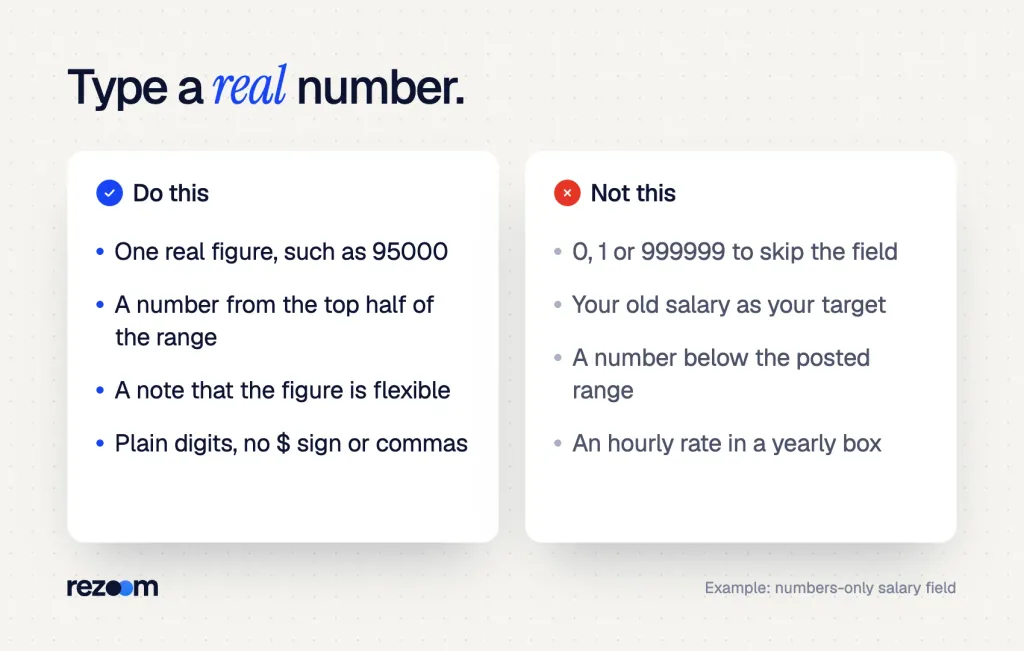
Enter one real number, not 0, 1 or 999999. Pick a figure from the top half of the posted range, or from your research if no range exists. Then use any comments box or your cover letter to say the number is flexible. A real number reads as honest, while a fake one reads as a dodge.
Many forms force a number before you can submit. Older advice says to type "000" or "999" to get past it. But a recruiter may read that as careless, and you lose a chance to anchor high.
How to pick the one number
Start with the posted range, if there is one. Then pick a figure in its top half that you would gladly accept. With no posted range, use the middle of your research range.
Drop the dollar sign and commas if the form rejects them. Most numeric boxes want plain digits, such as 95000.
Desired salary: 95000 Comments: This figure is flexible. I am open to discussing the full package, including bonus and benefits.
Hourly or yearly?
Match the unit the form asks for. If the job pays by the hour, type an hourly rate, such as 26. If the form does not say, look at how the posting lists pay and use the same unit.
A figure like 94500 can read as more researched than 95000. Use it only if your data backs it up. If not, a round number is fine.
Do
- Type a real number you would accept.
- Match hourly or yearly to the posting.
- Explain flexibility in a comments box.
Don’t
- Type 0, 1 or 999999 to skip the field.
- Enter your old salary as your target.
- Go below the posted range.
How do you research the right salary number?
Start with the employer's posted range, then check BLS wage data for your job and area. Compare a few similar postings, and adjust for your experience. Your target should sit where your skills place you in that spread. Write down the source, so you can explain your number if a recruiter asks.
Good research turns a guess into a number you can defend. So spend 15 minutes on it before you apply.
- Read the postingLook for a pay range in the ad. Many states now require one.
- Check BLS dataOpen the BLS wage data for your job title and state or metro area.
- Compare 3 postingsFind similar roles near you and note their ranges.
- Place yourselfMove toward the top if you have more years, rare skills or a hard-to-fill role.
- Set your rangePick a range about $10,000 wide that starts near your real target.
Use BLS wage data as your base
The Bureau of Labor Statistics runs the Occupational Employment and Wage Statistics program2, which publishes wages by job and area. Its data is free and updated each year.
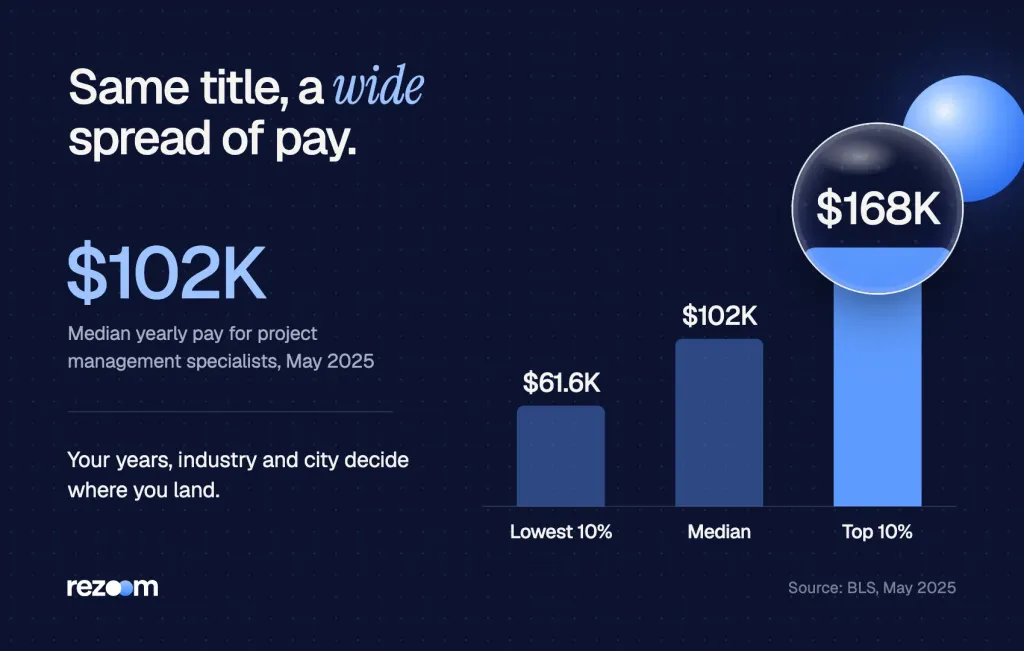
Here is one example. The BLS puts the median pay for project management specialists at $102,3201 in May 2025. The lowest 10% earned less than $61,580, and the top 10% earned more than $167,970.
That spread is wide. So your years, industry and city decide where you land, not just your title.
Back your number with your resume
Your target must match what your resume shows. If you aim for the top of the range, your bullets need results to back it. Browse our business and management resume examples for ideas, then study our project manager resume example, which leads with budgets, timelines and team size.
Project manager resume example
See how a project manager resume puts budget, scope and delivery results up front to support a higher salary ask.
Do pay transparency laws change your answer?
Yes, they make it easier. Several states now require employers to post a pay range in job ads, including Colorado, California, Washington, New York and Illinois. If the ad shows a range, base your desired salary on it. Aim for the top half if you meet most of the listed requirements.
A posted range is the best data you can get. It comes from the employer, and the law asks them to post it in good faith.
What the laws require
Here is what each state's official source says. Rules change, so check your state's labor department before you rely on one.
| State | Who must post pay | What the posting must show |
|---|---|---|
| Colorado | Employers under the state's equal pay law | Pay rate or range, bonuses and benefits |
| California | Employers with 15 or more employees | A good faith salary or hourly range |
| Washington | Employers with 15 or more employees | Wage scale or salary range, plus benefits |
| New York | Employers with 4 or more employees | A good faith salary or salary range |
| Illinois | Employers with 15 or more employees | Pay scale and benefits |
Colorado and California
Colorado's labor department says a posted range must run from the lowest to the highest pay the employer "actually believes it might pay"3. It also bars open-ended ranges such as "$30,000 and up."
California's Labor Code section 432.34 requires employers with 15 or more employees to include the pay scale in any job posting. The law defines pay scale as a good faith estimate of the range.
Washington, New York and Illinois
Washington's labor department says covered postings must list a wage scale or salary range, plus benefits and other pay5. New York's law took effect in September 2023 and covers employers with 4 or more employees6.
Illinois joined on January 1, 2025. Its labor department says employers with 15 or more employees must include pay scale and benefits7 in job postings.
Desired salary: $[number in the top half of the posted range] to $[top of the posted range]
Comments: Based on the posted range and my [number] years of [skill], I am targeting the upper half.
Free ATS score, the text the software extracts and your missing keywords. No sign-up.
Can employers ask for your salary history instead?
It depends on your state. Some states, such as California, bar employers from seeking your salary history. But the same California law lets employers ask what pay you expect. So a desired salary field is legal there, and you should answer it with your target, not your past pay.
Desired salary and salary history are two different questions. One asks what you want. The other asks what you made.
What California's law says
California's law says an employer "shall not" seek an applicant's salary history. But it keeps the door open for the other question.
Nothing in this section shall prohibit an employer from asking an applicant about the applicant's salary expectation
California Labor Code section 432.3(j)
So if a form asks for your current salary, you can answer with your target instead. That keeps your old pay from capping your new one.
Current salary: I prefer to focus on this role. My target range is $95,000 to $105,000.
If you plan a big jump, our guide on a good salary increase when changing jobs shows how to size your ask.
A good salary increase when changing jobs is 10 to 15%, or 20% for a level change. See the 2026 average (about 4.4%), why figures differ and how to ask.
What should you say if they push back on your number?
Restate your range, give one reason tied to your skills or market data, and ask about the full package. If their budget sits lower, ask where the range tops out and what would move you there. Do not drop your number on the spot. Say you need time to think it over.
Push back on the form usually comes later, on the phone screen. So plan your answer before the call.
Recruiter: "You put $95,000 to $105,000. Our budget is closer to $88,000."
"Thanks for sharing that. I based my range on the posted pay and BLS data for this area."
Recruiter: "Is there any flex on your side?"
"There may be. Can you tell me about the bonus, benefits and review cycle? Then I can give you a clear answer."
What to say if they push back
- Restate the range: "My target is $95,000 to $105,000."
- Give one reason: "I based it on the posted range and BLS data."
- Ask about the package: "What do the bonus and benefits look like?"
- Ask for time: "Let me think it over and get back to you tomorrow."
Our salary expectations answer guide covers the spoken version in more depth. You can also practice salary questions in an AI mock interview before the real call.
Around 60% of postings now publish a range, which makes deflecting obsolete. The salary expectations answer that anchors high without pricing you out.
Save your desired salary in a job tracker for each application. If the recruiter quotes your form back to you, your answer should match it.
How do you make the rest of your application count?
A sound desired salary keeps you in the running, but your resume and cover letter win the interview. Fill each field honestly, keep your answers consistent, and tailor your documents to the posting. Then the number you typed looks earned, not hopeful.
The desired salary on a job application is one field. Other fields matter too, so fill them with the same care.
Use your legal name on the job application form, and answer the reason for leaving on a job application field honestly. Our guide to the earliest start date on a job application covers the field that often sits next to pay.
If the form has a cover letter box, use it to explain your range. Our business cover letter examples show how to tie results to the role without sounding pushy.
Before you hit submit
Before you submit the application
Practice out loud with an AI voice coach.
Frequently asked questions
Should I put a range or one number for desired salary?
Put a range if the field takes text. A range about $10,000 wide works well. If the box takes only digits, type one real number near your target.
Is it OK to write "negotiable" for desired salary?
Yes, if the field is optional. But "negotiable" alone gives the recruiter nothing to work with, so add a range when you can.
What do I put if the desired salary field only accepts numbers?
Type one real number from the top half of the posted range or your research. Skip the dollar sign and commas, and avoid 0 or 999999.
Can I leave desired salary blank on a job application?
You can if the field is optional. If the form will not submit without it, enter a real number instead of a placeholder.
How do I find out what salary to ask for?
Check the posted range first. Then look up your job in BLS wage data for your area and compare a few similar postings.
Can an employer ask for my current salary?
It depends on your state. California bars employers from seeking salary history, but it still lets them ask about your salary expectations.
Sources
We opened and read each page below. The small numbers in the text point here. Pages that carry no publication date show n.d.
- U.S. Bureau of Labor Statistics2025
Median pay for project management specialists was $102,320 in May 2025, with the lowest 10 percent under $61,580 and the top 10 percent over $167,970
- U.S. Bureau of Labor Statisticsn.d.
The Occupational Employment and Wage Statistics program publishes wage estimates by occupation and area
- Colorado Department of Labor and Employment2023
Colorado job postings must show the pay rate or range, bonuses and benefits, and ranges cannot be open-ended
- California Labor Code via Public.Lawn.d.
California employers with 15 or more employees must post a pay scale and may ask about salary expectations but not salary history
- Washington State Department of Labor and Industriesn.d.
Washington employers with 15 or more employees must post a wage scale or salary range plus benefits
- New York State Department of Labor2023
New York employers with 4 or more employees must include a good faith salary or salary range in job postings
- Illinois Department of Labor2025
Illinois employers with 15 or more employees must include pay scale and benefits in job postings from January 1, 2025
Mohammad has spent more than ten years designing consumer products and leads product at Rezoom, deciding what gets built and what gets left out. His guides cover the whole job search, from resume sections and cover letters to interview answers and career moves.
Goodi, M. (2026, November 6). Desired Salary on a Job Application: What to Type in the Box. Rezoom. https://rezoom.io/desired-salary-on-job-application/