

Summary
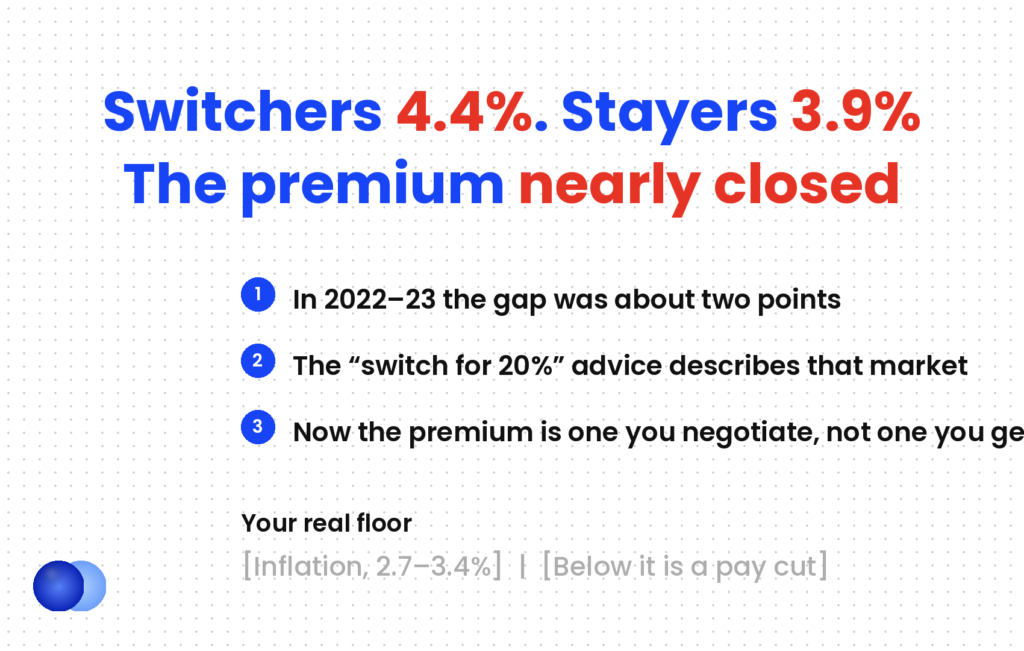
Published figures for the pay bump from changing jobs range from 4% to 40%, because they measure different populations and different years. The Atlanta Fed's tracker shows the switcher premium has nearly closed — 4.4% against 3.9% for people who stayed, down from a two-point gap in 2022. A good increase now starts at beating inflation and is earned by negotiation rather than by the act of moving.
Ask what counts as a good salary increase changing jobs and you get numbers that cannot all be true. Zippia says 14.8%. Bank of America says around 4%. Calculator sites say the real benchmark is 20 to 40%.
That spread is not noise. In fact, two things explain it: the figures measure different populations, and the most-quoted ones describe a market that no longer exists.
The Atlanta Fed's Wage Growth Tracker is the cleanest read, and it says the switching premium has nearly closed.
Has the job-switching premium disappeared?
Almost. For much of 2022 and 2023, people who changed jobs saw median wage growth roughly 2 percentage points above those who stayed. In the most recent reading that gap is 4.4% against 3.9% — about half a point, and the narrowest margin in years.
| Period | Job switchers | Job stayers | Gap |
|---|---|---|---|
| 2022–2023 | Elevated | Lower | ~2 points |
| Latest reading | 4.4% | 3.9% | ~0.5 points |
In practice, the mechanism behind the collapse: wage growth for switchers cooled sharply through 2025, while raises for people who stayed declined more gradually. The two lines converged from above rather than from below.
This matters because almost every piece of advice on this topic dates from the two-point era. "Switch jobs for a 20% raise" was reasonable guidance in 2022. As a description of the current market it is roughly three years out of date.
Why do the published numbers disagree so much?
They measure different things. The Atlanta Fed tracks median wage growth across everyone who changed jobs, including lateral and downward moves. The 14.8% and 20-to-40% figures describe negotiated offers for people who moved deliberately for money — a self-selected group at the top of the distribution.
One number gets used to answer three different questions:
"What does the average job changer get?" — a population statistic, currently around 4.4%, including people who moved for location, for a shorter commute, or out of a job they had to leave.
"How much do people who move for money get?" — a much smaller, self-selected group, where double-digit increases are common.
"Where should I aim?" — a negotiation question, which is not the same as either average.
So what counts as a good salary increase changing jobs depends on which of those you are actually asking. If you are moving deliberately, the population median is the wrong benchmark — you are not in that population.
Your real baseline is inflation, not the average
Any increase below the inflation rate is a pay cut in real terms, however good the percentage looks. With CPI running in the 2.7% to 3.4% range in 2026, a 3% raise is roughly flat and a 2% raise is a reduction. Before comparing your offer to anyone else's benchmark, check it against that floor — it is the only number that tells you whether you are moving forward at all.
What counts as a good increase?
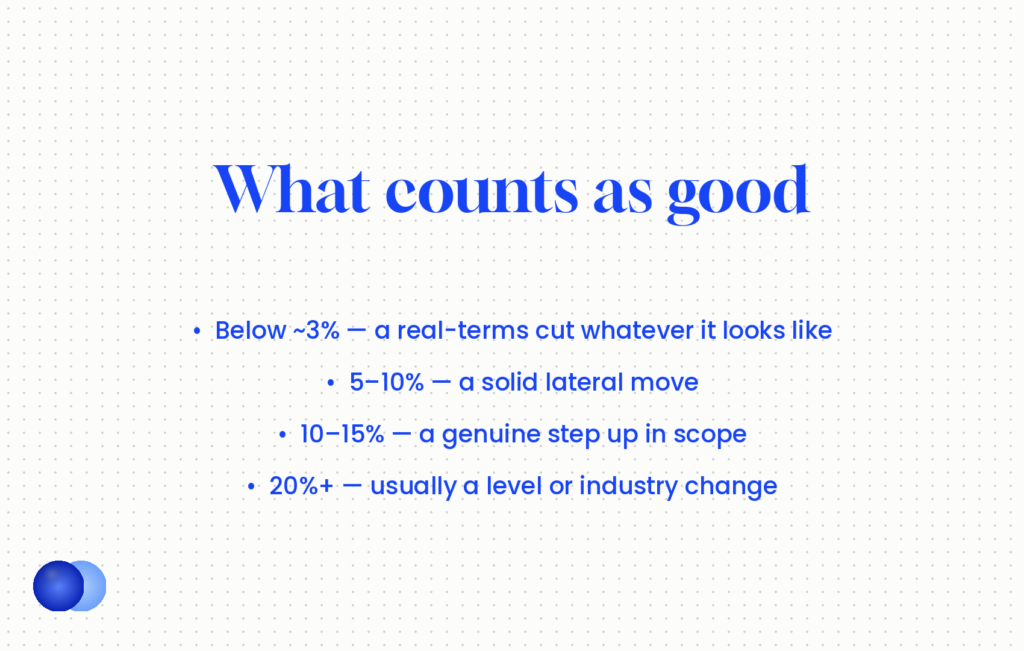
Above inflation at minimum, 10 to 15% for a genuine step up in scope, and 20% or more when you are also changing level or industry. Below about 5%, the move needs a reason other than money, because switching carries real costs the percentage does not show.
| Increase | What it means |
|---|---|
| Below inflation (~3%) | A real-terms pay cut regardless of the headline |
| 3–5% | Roughly what staying would have produced |
| 5–10% | A solid lateral move |
| 10–15% | A genuine step up in scope or responsibility |
| 20%+ | Usually a level change, an industry change, or scarce skills |
The rows below 5% deserve a note. After all, changing jobs is not free — you lose accrued goodwill, tenure toward vesting, knowledge of where everything is, and the benefit of the doubt that comes with a track record. A move that produces 4% has to be worth something other than the money.
Does it vary by industry?
Substantially. Technology and healthcare see the largest switching increases, often in the 10 to 25% range. Retail and hospitality see the smallest, and hospitality has at times shown negative average wage growth for switchers. Age matters too — the 25 to 34 band sees the highest increases.
| Sector | Typical switching increase |
|---|---|
| Information technology | 15–25% |
| Healthcare | 10–20% |
| Financial services, consulting | 10–20% |
| Resources and mining | Around 12% |
| Retail | 3–7% |
| Leisure and hospitality | Lowest; has run negative |
Broadly, two other patterns worth knowing:
Age. The 25 to 34 band sees the highest average increases, at around 9.8%. Early-career moves compound more because the base is lower and the jump in responsibility is larger.
Company size. Similarly, employers with over 1,000 people tend to offer larger increases than smaller ones, at around 6.9% on average.
Should you switch for the money?
With a narrower premium, the case for moving on pay alone is weaker than it was. Your current employer may match or partially match a genuine offer, and the gap between what they will pay to keep you and what a new employer pays to attract you has narrowed along with the market.
An honest assessment of what a good salary increase changing jobs is worth, given where the numbers sit.
When switchers beat stayers by two points, moving was a reliable financial strategy on its own. At half a point, it is not — the costs of moving have not changed while the benefit has shrunk.
Three implications:
A counter-offer is more viable than it used to be. Some employers negotiate when presented with a real external offer, and against a 4.4% market that counter does not have to be enormous to compete. The counter offer letter covers the separate question of whether accepting one is wise.
Where the premium comes from now
Negotiation matters more than the move. The difference between a 4% offer and a 14% offer is usually negotiation rather than market — and the counter-math explains why asking for your target reliably lands you below it.
Non-pay reasons carry more weight now. Scope, manager, trajectory, remote arrangement. When the financial case is half a point, the other reasons decide it.
Offer A: 8% increase, same level, same scope, longer commute.
Offer B: 8% increase, one level up, owning a function rather than a workstream, with the title that makes the next move easier.
Identical on the number. Offer B also resets the base your next increase calculates from, and the title changes which roles you can credibly apply for. The percentage is one input; what it does to your next two moves is another.
Compare total compensation rather than base. A 6% base increase with a signing bonus, better equity and a shorter vesting cliff can beat a 12% base increase without them.
Anchor on the 20% figure from a 2022 article. Quoting a benchmark from the Great Resignation to a 2026 recruiter reads as out of touch with the market you are both in.
How do you get a larger increase?
By negotiating the specific offer rather than relying on the market. Roughly 85% of candidates who counter receive at least some of what they ask for, and that is where a double-digit increase actually comes from now.
Finally, the market will not hand you a premium any more. The negotiation might.
Know the band before you talk numbers. Around 60% of postings publish a range, which is the anchor you work from — the salary expectations answer covers what to do with it, including why naming the midpoint is the most expensive mistake available.
Counter the written offer. This is where double-digit increases now come from. Analysis of countering behaviour finds most people who ask receive something.
Target the top third of the band. Employers budget to the midpoint expecting negotiation, so the midpoint is their opening rather than their limit.
Look at the whole package. Signing bonus, review date, equity, leave. When base is capped, these are where the movement is.
Wage growth for job switchers was about 4.4%, compared with 3.9% for job stayers — a much slimmer margin than in 2022 or 2023.
None of this argues against moving. It argues against moving purely on the assumption that the market pays a premium for movement, because right now it barely does. The premium you get will be the one you negotiate.
Frequently asked questions
What is a good salary increase when changing jobs?
Above inflation at minimum, 10 to 15% for a genuine step up in scope, and 20% or more when you also change level or industry. Below 5%, the move needs a reason beyond money.
What is the average salary increase when changing jobs in 2026?
The Atlanta Fed's tracker puts wage growth for job switchers at about 4.4%, against 3.9% for those who stayed — a gap of roughly half a percentage point.
Why do published figures range from 4% to 40%?
They measure different groups. The 4% figures track everyone who changed jobs, including lateral moves. The double-digit figures describe negotiated offers for people who moved deliberately for money.
Is switching jobs still the fastest way to raise your salary?
Less reliably than in 2022, when switchers beat stayers by roughly two percentage points. That gap has narrowed to about half a point while the costs of moving are unchanged.
Which industries pay the biggest increases for switching?
Technology at 15 to 25% and healthcare at 10 to 20% lead. Retail sits at 3 to 7%, and leisure and hospitality has at times shown negative average wage growth for switchers.
Is a 10% raise good when changing jobs?
Yes, in most sectors. It is well above the current market average and usually reflects a genuine increase in scope rather than a lateral move.
Should I accept a counter-offer to stay instead?
It is more financially viable than it was, since your employer does not have to beat much to compete. Whether to accept is a separate question about why you were leaving.
How do I get a bigger increase than the average?
By countering the written offer. Most people who counter receive at least part of what they ask for, and that negotiation is now where double-digit increases come from rather than from the market itself.



Comments