
Summary
You do not need to volunteer that you used AI to polish a resume or cover letter, any more than you would credit a spell-checker. You must follow any rule the employer states, answer a direct question honestly, and never use AI live in an interview unless invited. Anthropic, the best-known employer to ban AI in applications, replaced that ban in 2025 with "draft it yourself, then refine" — which is the right default for everyone.
Using AI in job applications is no longer the exception, and the question most candidates now ask is not whether to use it but whether to confess it. My position is simple and, I think, defensible: you owe the employer a truthful answer to the question they ask, not a confession to a question they did not.
The best evidence for that position comes from the most famous AI ban in hiring. In early 2025, Anthropic told applicants not to use AI assistants at all and made them tick a box agreeing. By July 2025 it had replaced the ban with candidate guidance that invites applicants to draft their own material and then refine it with Claude, while keeping live interviews AI-free.
So the rule has a shape, and it is not "AI good" or "AI bad". The stage of the process decides what is fair, and the employer's own words decide what you disclose. Below is how to read both when using AI in job applications, with the real examples that exist rather than the rumours that circulate.
Should you disclose using AI in job applications?
Not unprompted, for editing and polish. Disclose when a form, posting or interviewer asks, and answer truthfully. Using AI in job applications becomes a problem when you break a stated rule, let the tool claim things you cannot defend, or use it live in an interview where the employer is testing you in real time.
Think about what you already do without disclosure. A friend proofreads your cover letter. A careers adviser rewrites your summary. Grammarly flags a clumsy sentence. Nobody adds "edited with help" to the footer, because the application represents your experience and your judgement about what to include, not a claim that you typed every word alone.
AI editing sits in the same category, with one condition: the facts, the examples and the numbers must be yours. The moment the tool invents a metric, inflates a title or describes a project you never ran, the problem stops being disclosure. It becomes misrepresentation, and no footnote fixes that.
Why "disclose everything" is the wrong default
Volunteering "I used ChatGPT to write this" invites the reader to discount the whole document and answers a question they may never have asked. A recruiter judges specificity and evidence, and a disclaimer changes neither. The one exception is an explicit request: when a form asks, you are signing a statement, so you declare it accurately.
What do employers actually say about AI in applications?
Very few publish a rule, and the best-known ones draw the same line. Anthropic now asks candidates to write a first draft themselves and refine it with AI, but bans AI in live interviews. Goldman Sachs told campus recruits that ChatGPT and even Google search are off-limits during interviews.
Most employers say nothing, which is why the few that do attract so much attention. Two examples are well documented.
Anthropic, 2025. Early in 2025 its postings read: "please do not use AI assistants during the application process," followed by a Yes/No acknowledgement, as ITPro reported at the time. In July 2025, Fortune reported that the company had replaced the ban with stage-by-stage guidance. The company noted that it already uses Claude for its own job descriptions and interview questions.
Goldman Sachs. The bank emailed campus candidates that it "prohibits the use of any external sources, including ChatGPT or Google search engine, during the interview process," according to reporting by eFinancialCareers that a spokesperson confirmed to Fortune. Note the scope: the interview, not the resume.
| Employer | Stage | Stated rule | Source |
|---|---|---|---|
| Anthropic (early 2025) | Whole application | No AI assistants; Yes/No acknowledgement | ITPro, Feb 2025 |
| Anthropic (since July 2025) | Resume, cover letter, answers | Draft yourself, then refine with Claude | Anthropic candidate guidance |
| Anthropic (since July 2025) | Take-home assessments | No AI unless explicitly permitted | Anthropic candidate guidance |
| Anthropic (since July 2025) | Live interviews | No AI unless otherwise stated | Anthropic candidate guidance |
| Goldman Sachs | Campus interviews | No ChatGPT or Google search | Fortune / eFinancialCareers |
Read that table from top to bottom and a pattern appears. Written materials drift towards "refine, don't replace". Live and assessed stages stay closed. That is the line I recommend you apply wherever an employer says nothing.
Can recruiters tell you used AI anyway?
Not reliably. Most recruiters say they can spot AI writing, but they fail when tested blind. What they catch is genericness: interchangeable phrasing, no numbers, no link to this employer. Disclosure does not fix a generic application, and specificity makes the question irrelevant.
Surveys keep reporting that recruiters feel confident: in the figures collected in our guide, around 74% of hiring managers claim they can detect AI use, yet 82% of 1,000 recruiters failed a blind test — a gap we unpack in can employers detect an AI resume.
What recruiters notice is the pattern careless AI use produces: "results-driven professional with a passion for innovation" reads as machine output whoever wrote it. The penalty lands on genericness, not authorship. Declaring AI use on a generic letter makes it no less generic, and a candidate using AI in job applications who stays specific never raises the question.
The strongest evidence that polish alone is harmless comes from a field experiment. Researchers publishing in Management Science gave algorithmic writing help to a random subset of nearly half a million jobseekers on an online labour market. The treated group saw an 8% increase in the probability of being hired, and the authors found no evidence that employers felt less satisfied with the people they took on.
Better writing, the authors argue, is not a fake signal of ability; it helps employers see the ability that already exists. That is the case for AI as an editor and against AI as an author.
Please create your first draft yourself, then use Claude to refine it. We want to see your real experience, but Claude can polish how you communicate about your work.
Where is using AI in job applications fair, and where is it cheating?
It is fair when the tool edits material you supplied: your facts, your examples, your reasons for wanting the job. It is cheating when it answers a test of your own ability, such as a live interview, an assessment or a question the employer says you must answer unaided.
The distinction that holds across every policy I found is what the step measures. A resume measures your record, so clearer presentation helps the employer. A live interview measures how you think under pressure, and a tool whispering answers defeats it.
| Stage | What it measures | AI use I would defend | Disclose? |
|---|---|---|---|
| Resume | Your record | Tightening bullets you wrote; checking keywords | Only if asked |
| Cover letter | Fit and motivation | Editing a draft built on your evidence | Only if asked |
| Written form answers | Your reasoning | Proofreading only | Yes, if the form asks |
| Take-home assessment | Your skill | Only if the brief permits it | Follow the brief |
| Live or video interview | Your thinking in real time | Preparation beforehand only | Never use it live |
For the written stages, ChatGPT resume prompts that start from your real bullets produce defensible output; prompts built on a job title alone produce the generic resume every recruiter has already read.
Keep a source file for every claim
Before you let any tool touch your application, write a plain list of your real numbers, dates, tools and outcomes. Paste that list into the prompt and tell the model to use only those facts. Afterwards, check every sentence in the output against the list and delete anything without a match. That one habit turns the disclosure question into a formality, because nothing in the document needs defending.
What should you do when the form asks directly?
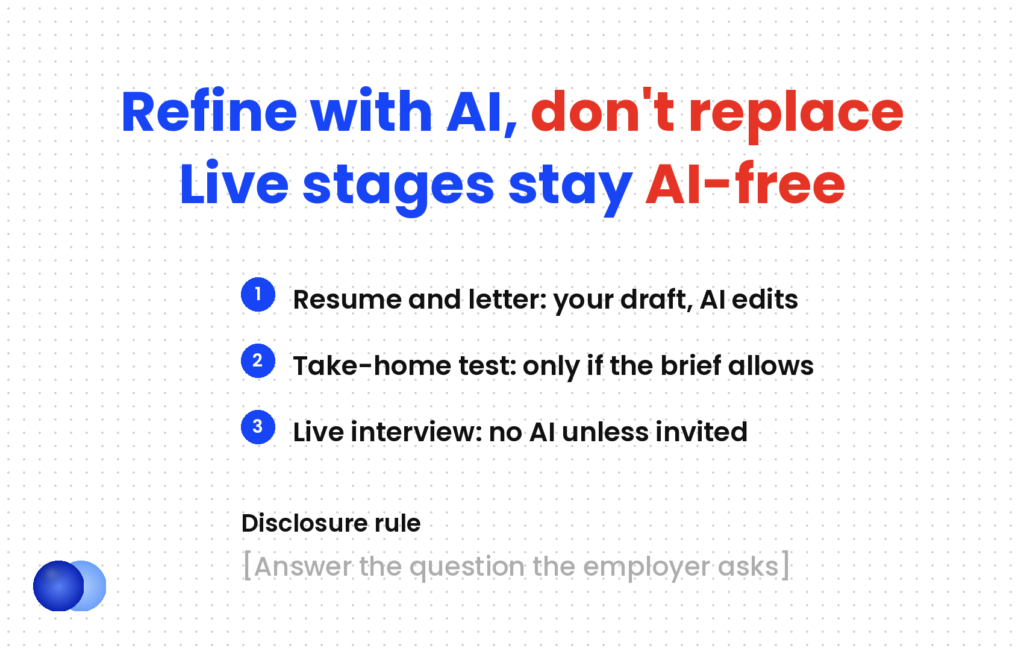
Answer exactly the question on the form, truthfully and briefly. If it asks whether you used AI at all, say yes and say how. If it forbids AI and you already used it, rewrite the material yourself before submitting rather than ticking a box you cannot honestly tick.
Read the wording. "Did you use AI assistants to write this application?" differs from "Did you use AI at any stage?". Answer the one you face.
Answer with scope. "I drafted my answers myself and used an AI tool to check grammar and tighten the wording" is truthful, specific and unlikely to hurt you.
Never tick falsely. An offer can be withdrawn after you sign it, and a false declaration discovered later is the kind of thing that triggers that. A strict rule is a reason to rewrite, or not to apply, not a reason to lie.
Form question: "Did you use AI tools in preparing this application? If so, how?"
Evasive: "No." (The candidate ran the whole cover letter through a chatbot and pasted the result.)
Defensible: "Yes. I wrote the cover letter and the answers myself, then used an AI tool to shorten the letter from 520 to 360 words and check the grammar. All examples and figures are my own."
The second costs nothing and survives a follow-up question. The first fails the moment anyone asks the candidate to talk through their own letter.
Should you mention AI skills instead of hiding AI use?
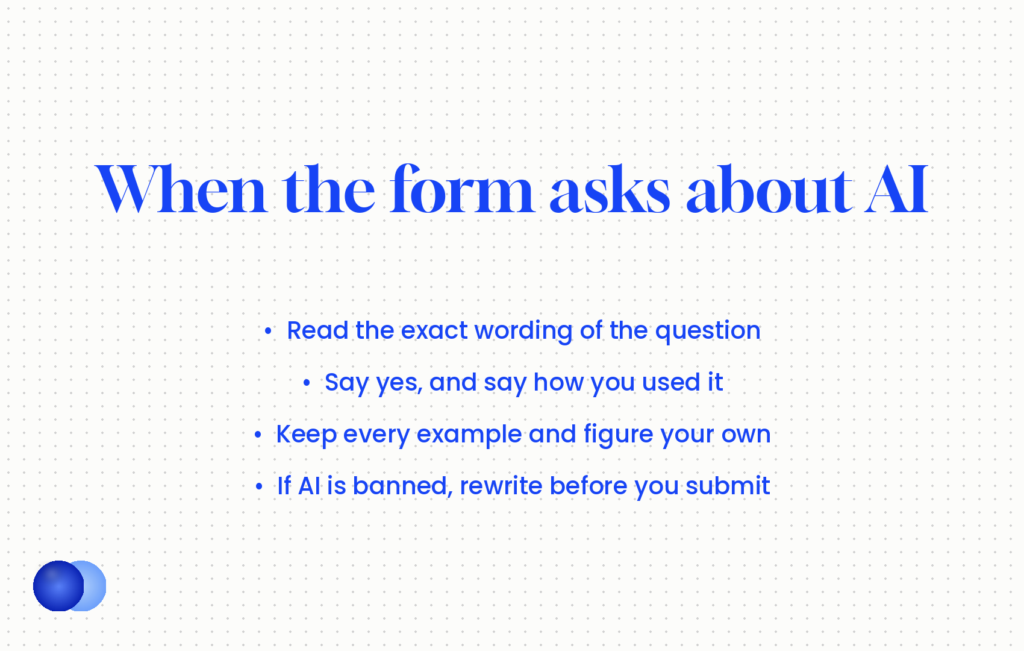
Often, yes, when the role values it. Employers increasingly use AI themselves and want staff who use it well. Describing a concrete result you achieved with AI tools is evidence; apologising for using them to write your application is not.
Most disclosure advice misses this. The employers that police AI in interviews want people who use it well on the job; Anthropic's original ban sat beside a line encouraging staff to use AI "to help them work faster and more effectively".
The employer side has its own transparency gap. Resume Genius's 2026 survey of 1,500 US hiring managers found only 35% say their company always discloses when AI evaluates candidates, and 26% disclose only sometimes. The same vendor survey reports that 58% have received AI-generated resumes or cover letters and 82% worry about candidates using AI in applications.
That asymmetry is context, not a licence to hide anything. Neither side discloses by default, and the fair standard for both is honesty when asked. If your AI skill is relevant, put it in a resume bullet with a measurable result, not in an apology.
Write the first draft from your own facts, use AI to edit it, and answer any AI declaration on a form truthfully and with scope.
Use an AI tool during a live or video interview, or submit a letter the tool wrote from a job title alone and hope nobody asks.
How should you use AI in your next application?
Draft first, then edit with AI, then check every claim against your own record. Follow any rule the employer states, answer declarations truthfully, and keep AI out of live interviews. That standard satisfies every published employer policy I could find, including the strictest.
Here is a workflow for using AI in job applications that I would defend in front of any hiring manager.
1. Read the posting for an AI rule. Look in the posting, the application form and any assessment brief. If one exists, it overrides everything below.
2. Write the draft yourself. Rough is fine, as long as the facts and reasons come from you.
3. Edit with AI. Shorten, restructure, fix grammar, match keywords. An AI cover letter generator works best on this footing, as an editor with your evidence in hand.
4. Check against your source file. Delete anything you could not explain in an interview.
5. Prepare with AI, then close the tab. For recorded formats, our guide to the AI video interview covers what the platforms assess.
One limit is worth admitting. Policies change quickly, most employers publish nothing, and some hiring managers will distrust AI-polished writing whatever the evidence says. No rule protects you from one reader's prejudice. This approach guarantees only that you never have to retract anything.
Frequently asked questions
Do I have to disclose that I used AI on my resume?
Not unless the employer asks. Editing help from AI sits in the same category as a proofreader or careers adviser. If a form or posting asks you to declare AI use, answer truthfully and describe how you used it.
Can employers tell if I used AI in my job application?
Not reliably. Most recruiters claim they can, but they fail blind tests. They do notice generic phrasing and letters that could go to any company.
Did Anthropic ban AI in job applications?
It did in early 2025, asking candidates to confirm they had not used AI assistants. In July 2025 it replaced the ban with guidance to draft material yourself, refine it with Claude, and avoid AI in live interviews and most assessments.
Is using AI in an interview cheating?
In a live interview, yes, unless the employer invites it. Goldman Sachs told campus candidates it prohibits ChatGPT and even Google search during interviews. Using AI to prepare beforehand is fine and widely encouraged.
What if a form asks whether I used AI and I did?
Say yes and give the scope, for example that you wrote the draft yourself and used a tool for grammar and length. If the form forbids AI entirely, rewrite the material yourself before you submit.
Does AI writing help actually improve my chances?
One large field experiment says it can. Jobseekers given algorithmic writing help on an online labour market were 8% more likely to be hired, with no sign that employers were less satisfied afterwards.
Should I put AI skills on my resume?
Yes, if the role values them and you can show a measurable result. A vague "proficient in ChatGPT" line proves nothing.
Is it dishonest to use AI without telling anyone?
Not for editing your own material. Using AI in job applications becomes dishonest when the tool invents claims you cannot support, when you break a stated rule, or when you answer an AI declaration falsely.


Comments