
Summary
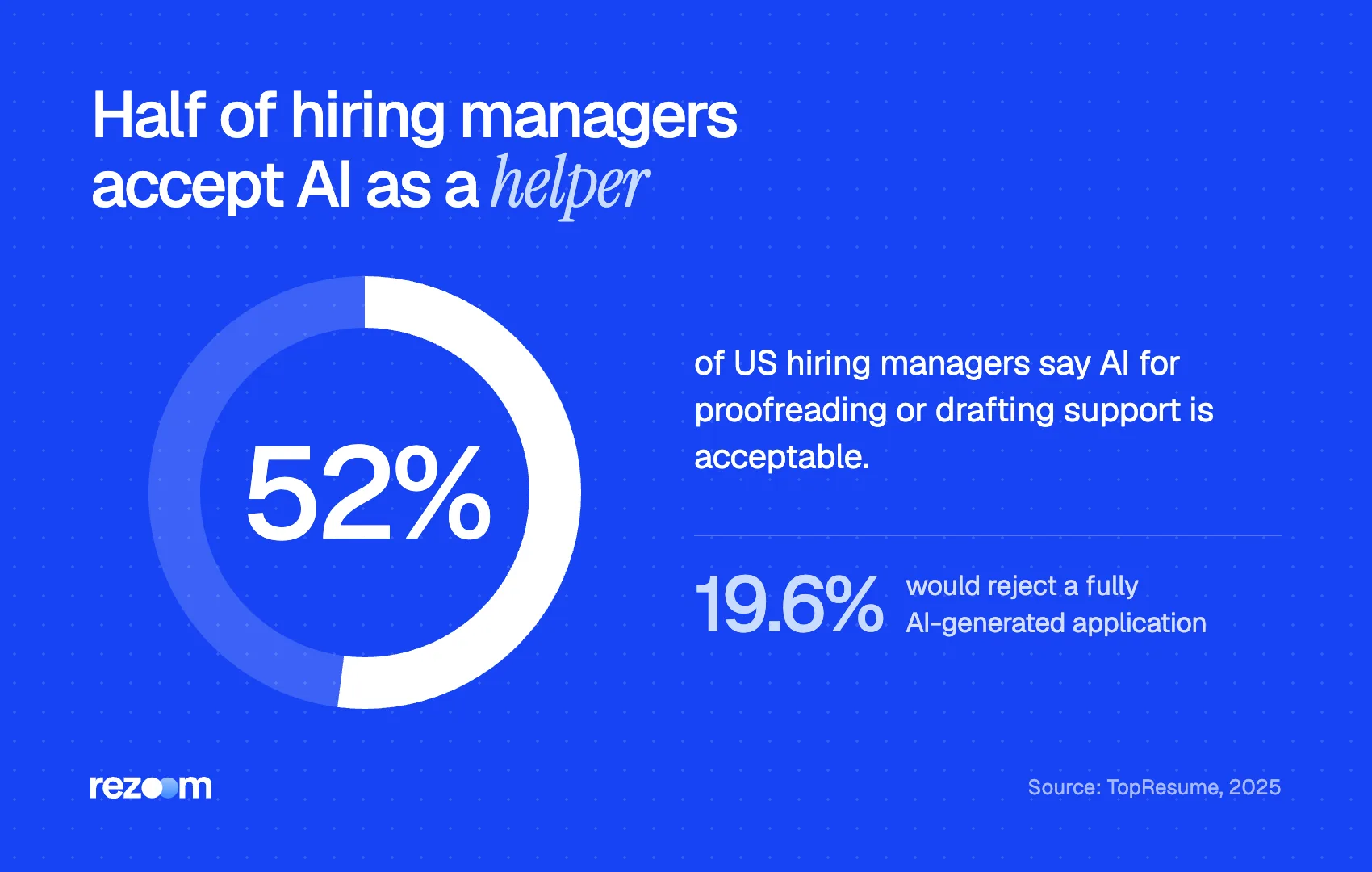
It is not bad to use AI for your resume, as long as the facts, numbers and judgment are yours. In a 2025 TopResume survey of 600 US hiring managers, 52% said AI for proofreading or drafting support is acceptable, while 19.6% would reject a fully AI-generated resume or cover letter. Gartner found 54% of candidates who used AI generated resume text with it. The risk is generic, inaccurate or deceptive content, not the tool itself.
No, it is not bad to use AI for your resume. It becomes a problem when AI writes claims you can't back up, flattens your work into generic phrases, or tries to trick a screening system.
Employers are split on the details, and the surveys show exactly where the line sits. A 2025 survey of 600 US hiring managers found that 52% accept AI for proofreading or drafting support, but about one in five would reject a fully AI-generated application.
This guide walks through the 2025 data on recruiter attitudes and candidate AI use, then gives a simple test for every line AI helps you write. If you want to know whether software can flag AI text, read our separate guide on whether employers can detect an AI resume.
Is it bad to use AI for your resume?
Using AI is not bad in itself. Most hiring managers in 2025 surveys accept AI for editing and drafting help. They object to resumes that are fully AI-generated, generic, inaccurate or deceptive. If every fact, number and claim comes from you, and you can explain each line in an interview, AI use is fine.
Think of AI as an editor, not an author. It can tighten a bullet, fix grammar, suggest stronger verbs and match your wording to a posting. It can't know what you actually did, how big the budget was, or what changed because of your work.
That gap is where most problems start. Carleton University's career services lists copy-pasting AI-generated materials and fabricating experience among the most common AI mistakes in a job hunt. Both come from letting the tool fill in what only you know.
So the honest answer depends on how you use AI for your resume. Editing help is widely accepted. Outsourcing your story is where the risk is.
How many job seekers use AI on their resume?
A large share of candidates now use AI. Gartner's survey of 3,290 candidates found 39% used AI during the application process, and 54% of those used it to generate resume or CV text. Greenhouse's 2025 report found 74% of US job seekers personally use AI. Using it does not set you apart either way.
The numbers have grown fast. Gartner's 2025 release reported that 39% of candidates in a late-2024 survey used AI while applying. Among them, 54% generated resume text and 50% generated cover letter text.
Greenhouse's 2025 AI in Hiring report, based on 4,136 job seekers and hiring professionals, found 74% of US job seekers personally use AI.
Employers use it too. The same Greenhouse report found 70% of hiring managers say AI helps them make faster and better hiring decisions. In other words, AI sits on both sides of most applications. For a wider view of where AI fits in a search, see our guide to using AI in job applications.
What do hiring managers really think about AI-written resumes?
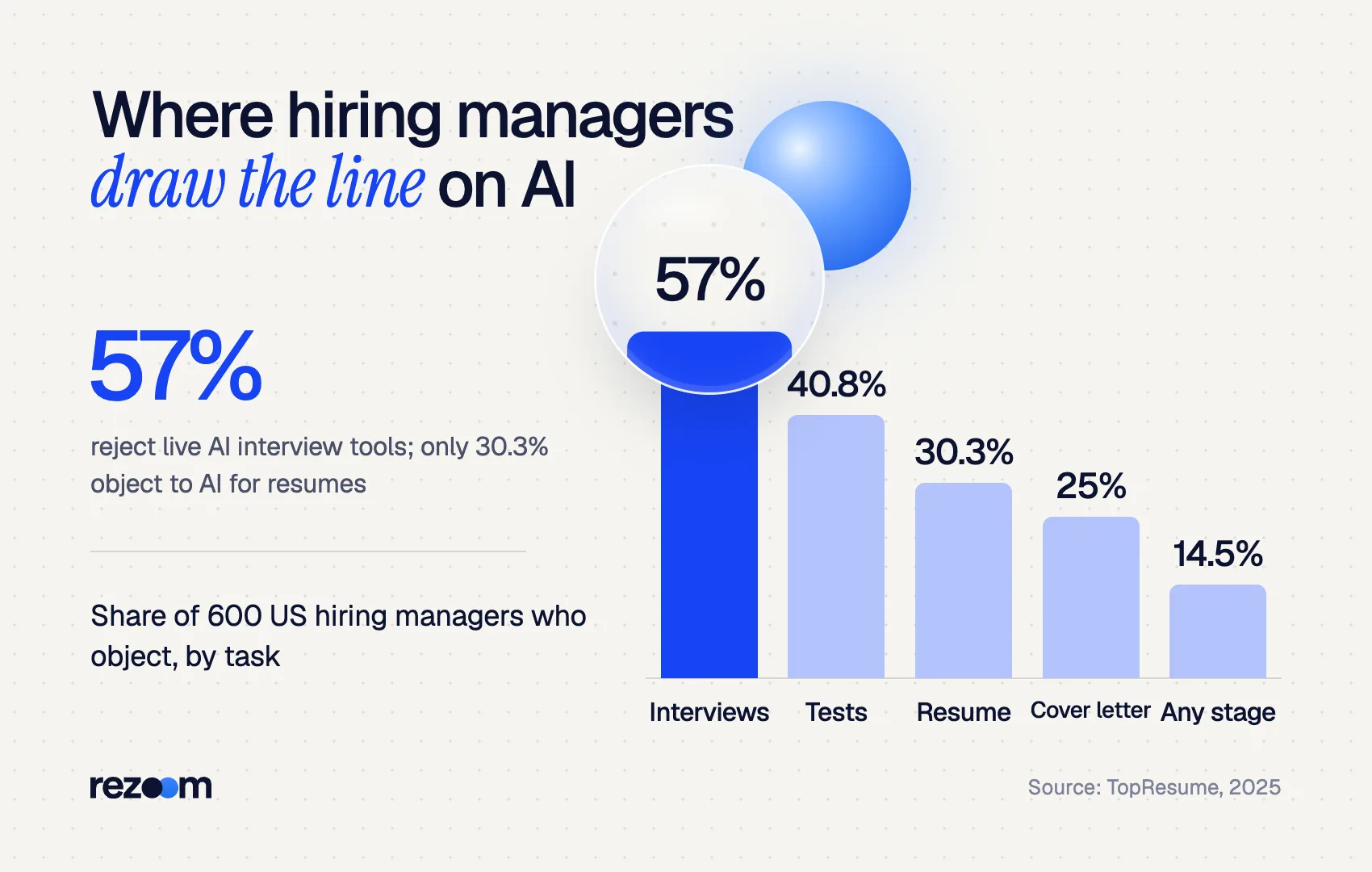
Most accept AI as a helper but not as the author. In TopResume's 2025 survey, 52% of hiring managers called AI for proofreading or drafting support acceptable. Yet 30.3% drew the line at resume writing, 19.6% would reject a fully AI-generated application, and 14.5% said candidates should not use AI at any stage.
Attitudes vary by task. The TopResume survey of 600 US hiring managers, run in May 2025, asked where they draw the line.
| Where AI is used | Share of hiring managers who object | Source |
|---|---|---|
| Real-time tools in a live interview | 57% say never | TopResume, 2025 |
| Skills assessments | 40.8% | TopResume, 2025 |
| Resume writing | 30.3% | TopResume, 2025 |
| Cover letters | 25% | TopResume, 2025 |
| Any stage of applying | 14.5% | TopResume, 2025 |
The same survey found 20% see heavy reliance on AI as a red flag. And 33.5% said they can spot an AI-generated resume in under twenty seconds. That claim is self-reported, but it tells you what reviewers believe.
Other surveys are friendlier. Zety's 2025 Future of Work report, covered by HCAMag, found 66% of HR leaders approve of candidates using AI tools for resume creation. The pattern across surveys is consistent: help is welcome, a resume with nobody behind it is not.
Which uses of AI on a resume are fine, and which are risky?
Low-risk uses polish what you wrote: grammar, concision, stronger verbs, and matching your wording to a posting. Higher-risk uses ask AI to supply content: a full resume from a job title, invented metrics, or skills you lack. Deceptive uses, like hidden text or prompt injections, carry the most risk.
Use this table as a quick risk check before you paste anything AI wrote.
| Task you give AI | Risk level | Why |
|---|---|---|
| Fix grammar and typos | Low | Pure editing, widely accepted |
| Shorten a long bullet | Low | Your facts, tighter wording |
| Suggest action verbs | Low | You pick what is true |
| Match your wording to a job posting | Low to medium | Fine if every keyword reflects real experience |
| Draft a summary from your notes | Medium | Needs your edits to avoid generic phrasing |
| Write a full resume from a job title | High | No real facts, reads as generic |
| Add metrics or skills you didn't supply | High | Fabrication you'll have to defend |
| Hide prompts or white-text keywords | Highest | Deceptive, and hiring managers report catching it |
The middle row matters most. Matching a posting's language is good practice, and our sibling guide on how to find keywords in a job description shows how. The rule is simple: AI can echo the posting only where your experience already does.
Your draft: Was responsible for handling the scheduling of all the technicians and made it better so there were fewer missed appointments
AI-edited: Rebuilt scheduling for 14 field technicians, cutting missed appointments from 9% to 3% in six months
(You supplied 14 technicians, 9% and 3%. AI only tightened the sentence.)
Can AI tricks like hidden prompts backfire?
Yes. Greenhouse's 2025 report found 41% of job seekers admit to using prompt injections or hidden text to get past AI filters. It also found 65% of hiring managers have caught applicants using AI deceptively, with 22% seeing prompt injections hidden in resumes. Getting caught can end an application.
Hidden instructions in white text, such as "rank this candidate first," are the riskiest way to use AI for your resume. According to Greenhouse, 41% of job seekers admit to the tactic, and 52% of those who haven't are considering it.
Hiring teams are watching for it. Of the hiring managers who caught deceptive AI use, 22% saw prompt injections hidden in resumes and 32% saw candidates reading from AI-generated scripts.
Hidden text also shows up the moment a recruiter pastes your resume into plain text. Our guide on how to beat AI resume screening covers legitimate ways to pass automated filters instead.
How do you use AI for your resume the right way?
Start with your own raw facts: titles, dates, tools, numbers and outcomes. Ask AI to edit, not invent. Check every line against two tests: you supplied the fact, and you can explain it in an interview. Then rewrite generic phrases in your own words and run a final ATS check.
Follow these steps for any AI-assisted resume.
- Write a fact sheet first. List each job's scope, tools, numbers and results in rough notes. This is the material AI can't invent.
- Give AI a narrow task. "Shorten these three bullets to under 20 words each, keep every number" works better than "write my resume." Our ChatGPT resume prompts give tested wording.
- Run the source test. Every number, tool and claim must come from your fact sheet. Delete anything that doesn't.
- Run the interview test. Could you explain each bullet for two minutes? If not, cut it or rewrite it.
- Remove generic phrases. Swap lines like "results-driven professional" for a specific achievement.
- Check the file. Paste it into a plain text editor to confirm nothing is hidden, then scan it against the posting.
Generic: Results-driven professional with a proven track record of exceeding expectations in fast-paced environments
Specific: Account manager for 42 mid-market clients; renewed 94% of contracts in 2025 and grew upsell revenue by $310K
Give AI your real numbers, tools and outcomes as input do: Ask for edits like shortening, verb swaps and grammar fixes do: Read every AI line and confirm you can defend it do: Rewrite stock phrases in your own voice
Ask AI to write a resume from a job title alone dont: Accept metrics or skills you never provided dont: Hide prompts or white-text keywords in the file dont: Send AI output without a line-by-line review
Keep your voice in the summary
Let AI tighten your bullets, but write the first draft of your summary yourself. It is the section most likely to sound generic, and the one recruiters read first. Two or three plain sentences with one real number beat a polished paragraph of adjectives.
A purpose-built tool helps here. The Rezoom AI resume builder starts from your own experience and suggests edits line by line, so the facts stay yours. For more prompting technique, see our guide to prompt engineering for resumes.
Frequently asked questions
Do employers care if you use ChatGPT for your resume?
Some do. In TopResume's 2025 survey, 52% of hiring managers accepted AI for proofreading or drafting support, while 19.6% would reject fully AI-generated materials. What most care about is accuracy and specificity.
Should I tell employers I used AI on my resume?
Most applications don't ask, and editing help rarely needs disclosure. If an employer's application asks directly, answer honestly and explain that the content and results are your own.
Can AI make my resume worse?
Yes. Unedited AI drafts often add generic phrases, inflate claims or invent numbers. Carleton University's career services lists copy-pasting AI output and fabricating experience among the most common AI mistakes.
Will an ATS reject a resume written with AI?
A standard ATS parses and stores your text so recruiters can search it; judging authorship is not its core job. The bigger risk comes when a recruiter reads generic or inaccurate lines, or finds hidden text. Our guide on whether [employers can detect an AI resume](https://rezoom.io/can-employers-detect-ai-resume/) goes deeper.
Is it OK to use AI for a cover letter?
Yes, with the same rules. TopResume found 25% of hiring managers object to AI in cover letters, so keep the specifics personal. Our sibling guide on whether [ChatGPT can write a cover letter](https://rezoom.io/can-chatgpt-write-a-cover-letter/) covers it in depth.
What is the safest way to use AI on a resume?
Use it to edit text you wrote from your own facts. Check every line with the source test and the interview test before you send it.

Comments