Summary
Yes, ChatGPT can write a cover letter in seconds, and it handles structure, tone and grammar well. It fails on the parts that win interviews: specific proof, real reasons for wanting the job, and facts it has not been given, which it may invent. In an Insight Global survey, 88% of hiring managers said they can tell when candidates use AI. Use ChatGPT for the first draft, then replace every generic line with your own evidence.
Yes, ChatGPT can write a cover letter, and a decent one, in under a minute. But if you let ChatGPT write a cover letter from a job title alone, you get a polite, generic page that could belong to any applicant.
The tool is good at structure, tone and clean sentences. It is weak at the things a hiring manager reads for: proof that you have done this work, and a believable reason you want this job. It can also state facts about you that are not true.
This guide covers what ChatGPT does well, where it breaks, what hiring manager surveys actually say, and a five-step workflow that turns an AI draft into a letter that sounds like you. For the copy-ready prompts themselves, see our ChatGPT cover letter prompts guide.
Can ChatGPT write a cover letter that gets you hired?
ChatGPT can write a cover letter that is well organized and error-free, but a raw draft rarely gets you hired on its own. Hiring managers read cover letters for specific evidence and genuine motivation. ChatGPT supplies neither unless you give them to it, so the letter only works after you add your own details.
Think of the output as a scaffold. It gives you an opening, a body that links your background to the role, and a closing with a call to action. That is the standard shape covered in our guide on how to write a cover letter.
What it cannot do is know you. OpenAI's own help center tells users to "use ChatGPT as a first draft, not a final source". That advice applies doubly to a document that describes your career.
Cover letters still get read, too. Novorésumé's survey of HR professionals found that about 60% read cover letters, and 77.1% of HR managers do. A weak AI letter is not invisible. It is a page someone reads and judges.
What does ChatGPT do well in a cover letter?
ChatGPT is strong at the mechanical parts of a cover letter: a clear three-part structure, a professional tone, clean grammar, a length you specify, and matching the vocabulary of the job posting. It is also useful for brainstorming which of your experiences fit a role and for tightening a draft you already wrote.
Used well, it saves real time. These are the jobs it handles reliably:
- Structure. It produces a clean opening, body and close without prompting.
- Tone matching. Ask for "warm but direct" or "formal for a law firm" and it adjusts.
- Length control. It cuts a 500-word draft to 300 words faster than you can.
- Keyword alignment. It mirrors the language of a pasted job post.
- Editing your own draft. It spots repetition, passive voice and weak verbs.
The last use is the safest. When the facts come from you and ChatGPT only edits, you keep the substance and gain the polish. That matches how most hiring managers draw the line, as the survey section below shows.
Where does a ChatGPT cover letter fail?
A ChatGPT cover letter fails in three ways. It is generic, because it fills gaps with phrases any candidate could use. It can invent facts, such as metrics or skills you never gave it. And it can confuse the job's requirements with your experience, claiming you already have qualifications that came from the posting.
1. It sounds like everyone else. Without your details, the model reaches for safe phrases: "I am excited to apply," "proven track record," "passionate about." Our list of cover letter mistakes covers why these openers waste the first line.
2. It invents facts. OpenAI says the model can produce "incorrect definitions, dates, or facts" and may sound confident even when it is wrong. In a cover letter, that looks like a made-up percentage, a software tool you never used, or a project you did not lead.
3. It borrows the job post's requirements as your experience. A Zapier writer testing the method found that ChatGPT would sometimes mistake the qualifications listed in the posting for actual work experience. If the posting asks for SQL, your letter may suddenly say you are "highly skilled in SQL."
The third failure is the most dangerous. An interviewer will ask about anything in your letter. A claim you cannot back up ends the conversation faster than a plain letter would.
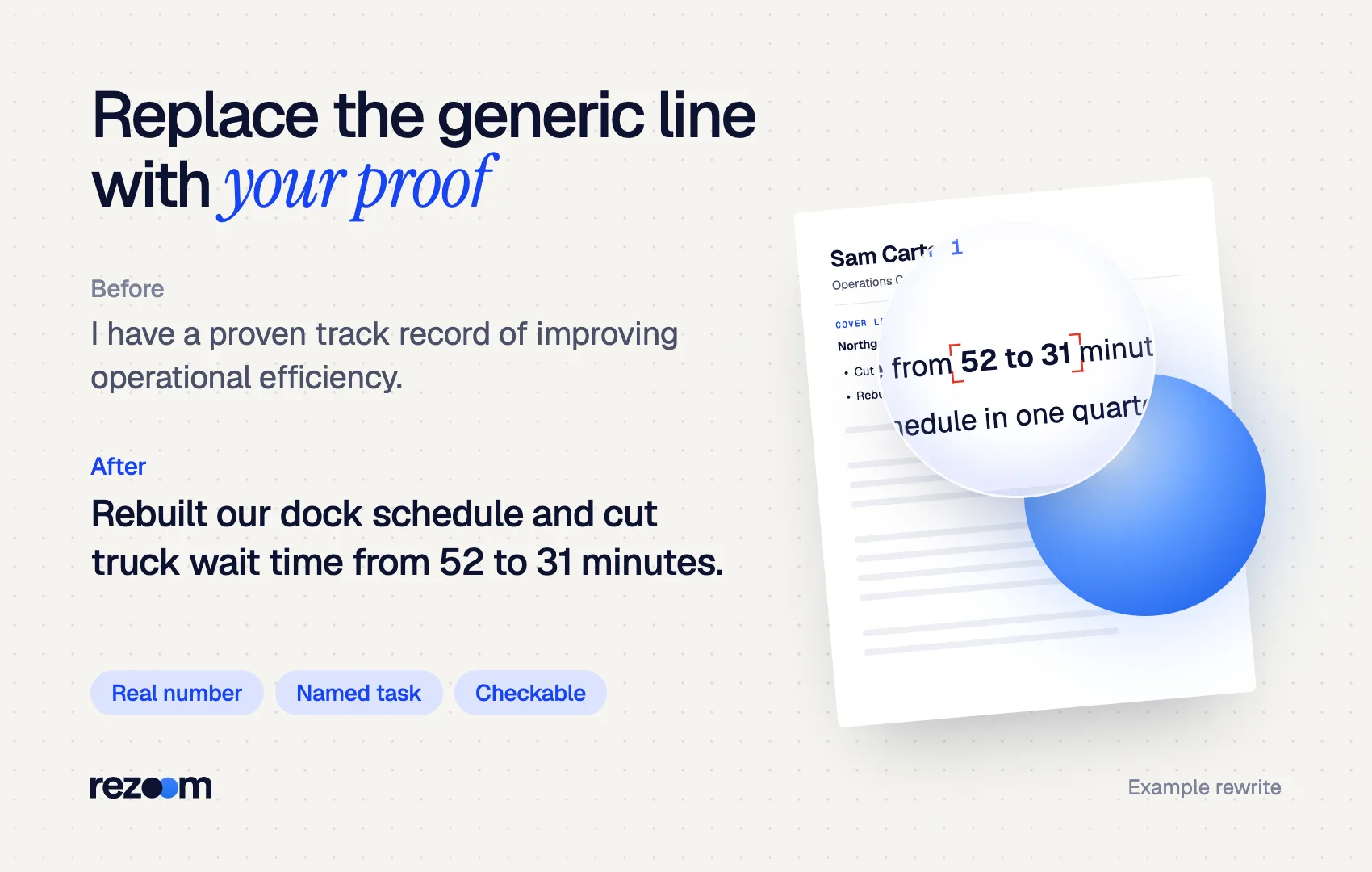
ChatGPT draft: I have a proven track record of improving operational efficiency and am passionate about driving results.
Edited: At Northgate Logistics, I rebuilt our dock schedule and cut average truck wait time from 52 to 31 minutes in one quarter.
What do hiring managers say when ChatGPT writes a cover letter?
Surveys show most hiring managers accept light AI help but dislike letters that read as fully machine-written. In Insight Global's survey, 88% said they can tell when candidates use AI. TopResume found 19.6% would reject a candidate over an AI-generated resume or cover letter, while 52% accept AI for drafting support.
The data does not say "never use AI." It says the line is between help and replacement.
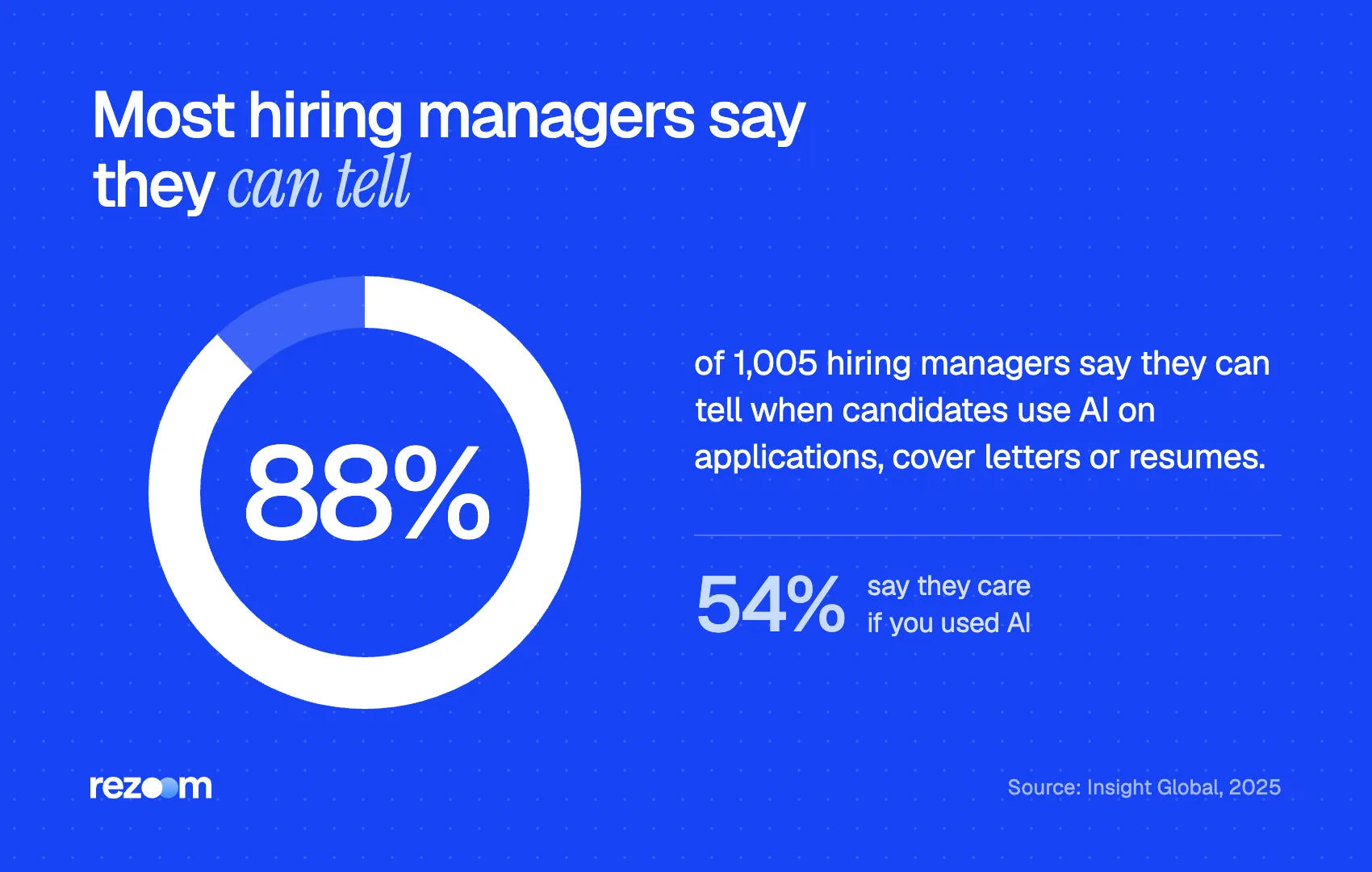
Insight Global surveyed 1,005 hiring managers. 88% said they can tell when candidates use AI on applications, cover letters or resumes, and 54% said they care. Among those who care, 24% read it as a lack of effort and 17% say it feels impersonal. Another 36% see it as a sign of AI skill.
TopResume's May 2025 survey of 600 hiring managers found that 19.6% would reject a candidate with an AI-generated resume or cover letter. Just over half, 52%, accept AI for proofreading or drafting support. Only 14.5% think candidates should not use AI at any stage.
Resume Genius found 47% of hiring managers have seen AI-generated resumes or cover letters, and 58% are concerned about AI-generated applications.
| Survey | Who was asked | Key finding |
|---|---|---|
| Insight Global, 2025 | 1,005 hiring managers | 88% say they can tell when AI was used; 54% care |
| TopResume, 2025 | 600 hiring managers | 19.6% would reject an AI-generated resume or cover letter; 52% accept AI drafting help |
| Resume Genius, 2025 | 1,000 hiring managers | 47% have seen AI-generated resumes or cover letters; 58% concerned |
| Novorésumé, 2026 | 1,000 job seekers | 32.4% have sent a letter written almost entirely by AI with little or no editing |
That last row explains the reaction. Novorésumé found 32.4% of job seekers have submitted a cover letter written almost entirely by AI, with little or no editing. Hiring managers see a lot of identical letters. Yours needs to read differently. If you worry about detection tools specifically, our AI detector for cover letters guide covers how they work.
How do you make a ChatGPT cover letter yours?
Give ChatGPT real inputs, then edit like a skeptic. Paste the job post and your resume, add two short proof stories and your real reason for applying, ask for a draft under 350 words, then fact-check every claim, replace generic phrases with specifics, and read it aloud in your own voice.
This five-step workflow keeps the speed and removes the risks.
- Gather inputs first. Copy the full job post, your current resume and two short stories with numbers. The University of Redlands career office advises pasting your resume content without your contact information.
- Add your motivation. Write one honest sentence on why this company. ChatGPT cannot guess it, and it is the line hiring managers remember.
- Ask for a constrained draft. Specify length, tone and which two stories to use. Our ChatGPT cover letter prompts give you the exact wording.
- Fact-check line by line. Highlight every number, tool and claim. Delete anything you did not supply or cannot discuss in an interview.
- Rewrite the first and last paragraphs yourself. These carry the most voice. Our guide on how to start a cover letter has opening lines that avoid the AI pattern.
Your posting for an Operations Coordinator mentions reducing dock delays. That is the problem I spent last year solving at Northgate Logistics, where I cut average truck wait time from 52 to 31 minutes. I would like to bring that same scheduling work to your Reno distribution center.
Paste the full job post and your own resume text do: Supply the numbers and stories you want used do: Fact-check every metric, tool and title in the draft do: Rewrite the opening and closing in your own words
Ask for a letter from the job title alone dont: Paste your phone number, address or other private data dont: Keep skills the model copied from the job requirements dont: Send the first draft unedited
Run the swap test
Swap the company name in your letter for a competitor's. If every sentence still works, the letter is too generic. Each paragraph should contain at least one detail that only fits this employer or only fits you.
When should you use an AI cover letter generator instead of ChatGPT?
Use ChatGPT when you want control and are willing to write detailed prompts and edit heavily. Use a dedicated AI cover letter generator when you want the draft built from your saved resume and the job post automatically. Either way, the facts must come from you, and the final edit is yours.
ChatGPT is a general tool. It does not know your resume unless you paste it into the chat. A purpose-built tool keeps your resume on file and formats the letter for you.
| Option | Best for | Main risk |
|---|---|---|
| ChatGPT with your own prompts | Full control over angle and tone | Generic or invented details if inputs are thin |
| AI cover letter generator | Speed across many applications | Same risk, so still edit every draft |
| Writing it yourself, AI for edits | Your top-choice jobs | Takes longer |
For your top three applications, write the draft yourself and use AI only for edits. For the rest, you can let ChatGPT write a cover letter draft and run the five-step edit, or let a generator save you hours. Our AI cover letter generator guide explains how that works. Rezoom's AI resume builder creates a matching letter from the resume you have already tailored, so the facts stay consistent.
If you are still deciding how much AI is acceptable overall, see is it bad to use AI for your resume.
Frequently asked questions
Is it OK to let ChatGPT write a cover letter?
Yes, as long as the facts are yours and you edit the draft. TopResume found 52% of hiring managers accept AI for drafting support, while about one in five would reject a fully AI-generated letter.
Can employers tell if ChatGPT wrote my cover letter?
Many believe they can. In Insight Global's survey, 88% of hiring managers said they can tell when candidates use AI. Generic phrases and missing specifics are the usual giveaway.
Will ChatGPT make up experience in my cover letter?
It can. OpenAI warns the model can produce incorrect facts with confidence, and it may treat job requirements as your skills. Check every claim before sending.
Is ChatGPT free for writing cover letters?
The free ChatGPT plan can draft and edit cover letters. The quality depends far more on the inputs you give it than on the plan you use.
How long should a ChatGPT cover letter be?
Ask for under 350 words, or three to four short paragraphs. ChatGPT tends to run long without a word limit.
Should I tell the employer I used ChatGPT?
You do not need to unless the application asks. If it does, answer honestly and describe how you used it, such as for editing.

Comments