

Summary
Your job title on a resume should match your official title, but you can clarify it. If your company uses an internal or unusual title, list the official one with the industry-standard equivalent in parentheses, such as "Analyst II (Financial Analyst)". Never raise your level: a Coordinator cannot become a Manager. Employment verification services report your official title, so any change must be one your employer would recognize as the same job.
Your job title on a resume should be your official title, the one HR has on file. When that title is vague, internal or misleading, you can add a clearer industry-standard title in parentheses, as in "Associate III (Marketing Analyst)". What you cannot do is raise your level.
That is the short answer to the resume job title vs actual title question. The longer answer depends on why your title is off and how far you want to change it.
This guide gives a simple decision rule, four copy-ready formats, and the verification facts that make the rule matter.
Does your job title on a resume matter to recruiters?
Yes, more than any other single line. In the Ladders eye-tracking study, recruiters spent more time on job titles than on any other resume element. Jobscan's analysis of 2.5 million applications found that a title matching the job listing came with an interview rate 10.6 times higher.
Recruiters read titles first. The Ladders 2018 eye-tracking study reported that recruiters spent more time focusing on job titles than on any other element of the resume. They scanned the left side of the page and picked out titles before reading anything else.
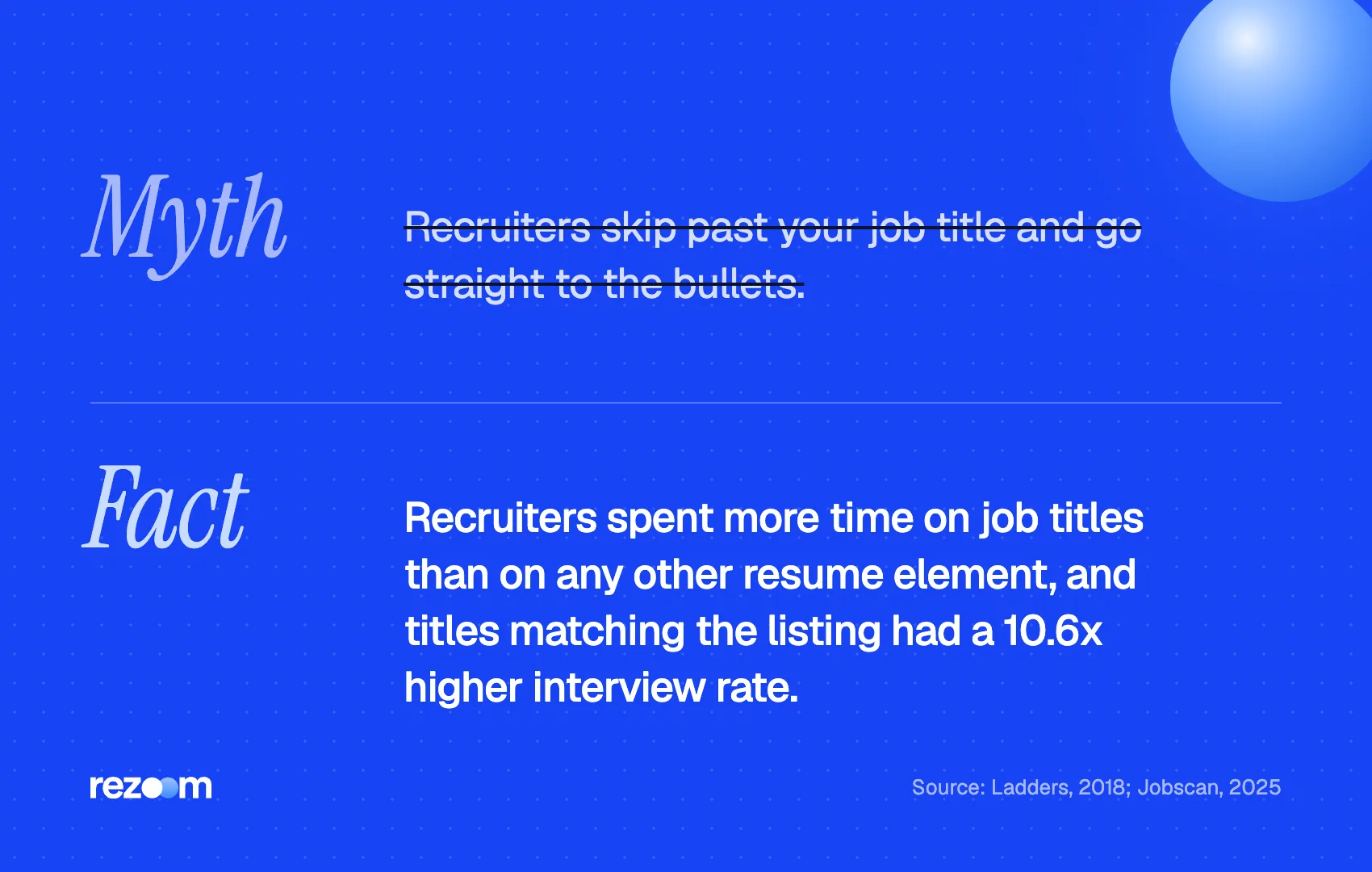
Software reads them too. Jobscan's 2025 study of more than 2.5 million job applications found that candidates whose resume titles matched the target title had an interview rate 10.6 times higher than those who did not.
That is a correlation, not proof that renaming yourself works. Still, it explains the temptation. If your official title is "Happiness Hero" and you apply for customer support roles, recruiters searching for "Customer Support Representative" may never find you. Our guide to resume keywords covers how searches match terms.
Can your job title on a resume differ from your actual title?
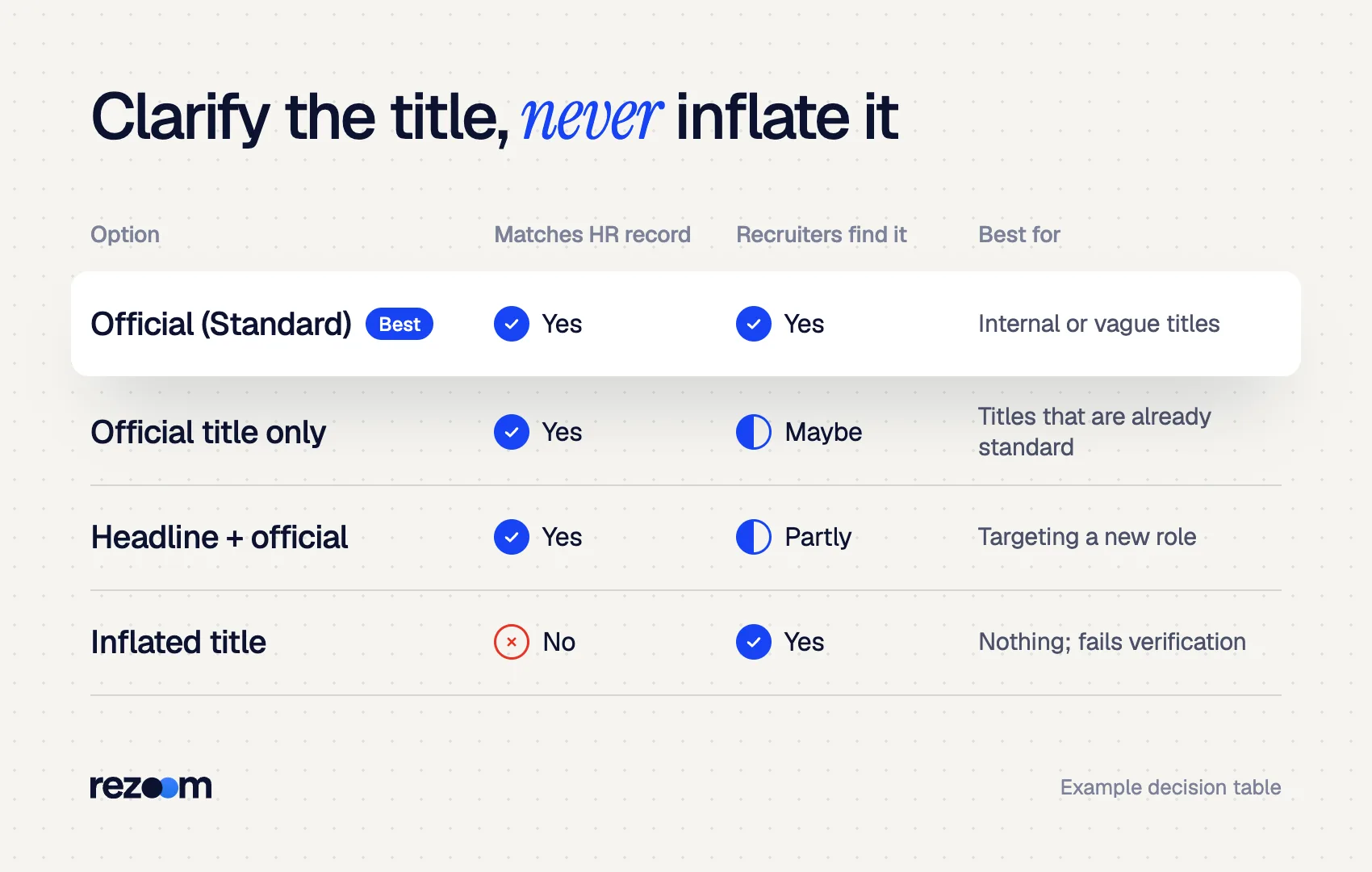
It can be clarified, not replaced with a bigger one. You may translate an internal or vague title into the standard name for the same work, ideally keeping the official title too. You may not claim a higher level, a different function or a title you never held.
Alison Green of Ask a Manager answered this exact question in 2025. Her advice: you want to avoid a prospective employer verifying your title during a reference or background check and finding it is wrong. Her fix is to list both titles, with one in parentheses.
She also drew the line clearly. A descriptive title must match the work you did, and it cannot invent a promotion. If you were a Coordinator, you cannot list Director, even if you felt you worked at that level.
Use this decision rule. Ask: would your manager read the clarified title and say, "Yes, that is the same job"? If yes, it is a translation. If they would say "that is a step up," it is inflation.
| Situation | Official title | What to write | Safe? |
|---|---|---|---|
| Internal or quirky title | Happiness Hero | Happiness Hero (Customer Support Representative) | Yes |
| Vague level-only title | Associate III | Associate III (Marketing Analyst) | Yes |
| Title lags real duties, same level | Administrative Assistant | Administrative Assistant (Office Coordinator) | Yes, if accurate |
| Wanting a higher level | Team Lead | Manager | No |
| Changing function | Sales Associate | Marketing Specialist | No |
Why does your actual title matter in background checks?
Employment verification reports your official title. Services such as The Work Number give verifiers your job title, hire date and end date straight from payroll records. If your job title on a resume differs from that record without explanation, it can look like a false statement.
Many large employers outsource verification. Penn State, for example, uses The Work Number, which gives verifiers the employee's job title, most recent hire date and termination date, along with total time with the company.
So the checker sees your HR title, not the one you chose. If they differ, the parentheses format protects you. The official title is on the page, so the record matches, and the clarifier explains the work.
Dates get checked the same way. Keep your employment dates exact and consistent; today's guide on how to write dates on a resume shows the right format.
How do you format your job title on a resume when it differs?
Put the official title first and the clearer title in parentheses: "Analyst II (Financial Analyst)". You can reverse the order if the standard title is far more searchable. Either way, both titles appear, the record matches, and your bullets prove the clarified title is accurate.
Ask a Manager suggests both orders, official first or descriptive first, as long as both appear. AgHires, an agricultural recruiting firm, recommends the same idea, listing the official title with the industry-standard equivalent in parentheses so recruiter database searches find you.
Associate III (Marketing Analyst) | Lumen Retail Group Mar 2022 – Present
Customer Support Representative (official title: Happiness Hero) | Kiteline Apps Jan 2021 – Feb 2022
Member of Technical Staff (Backend Software Engineer) | Orbit Systems Jun 2019 – Dec 2020
Program Specialist | Eastside Youth Alliance Led the youth employment program: hired and supervised 4 seasonal staff
The fourth line shows a different approach. When the scope is bigger than the title suggests, keep the title and let the first bullet carry the weight. Our guide to writing work experience on a resume covers bullet structure.
Can you add a headline instead of changing your job title on a resume?
Yes, and it is often the cleanest fix. A headline under your name, such as "Customer Success Manager | SaaS Onboarding", tells recruiters what you do now and what you want next. Your experience section can then keep your official titles untouched.
SUNY Canton's career blog makes this point in 2026: you can add a title right under your name, just like a LinkedIn headline. It positions you for the target role without altering employment records.
The same article sets three conditions for any title framing: you actually did the work, you can back it with examples, and your manager would confirm the scope. That mirrors the decision rule above.
JORDAN LEE Customer Success Manager | SaaS Onboarding and Retention
EXPERIENCE Client Experience Specialist II (Customer Success) | Brightway Software Apr 2022 – Present - Owned onboarding for 40 mid-market accounts with 96% first-year renewal
For more headline wording, see our resume headline guide and the resume header layout.
What are the risks of inflating your job title on a resume?
A failed verification, a rescinded offer or a later firing. Verification reports the official title, so an inflated one is easy to catch. Recruiters also compare titles with bullets: "Manager" with no team, budget or direct reports reads as a mismatch even before any check.
Inflation also fails the human read. Recruiterflow notes that a parser can extract "Vice President" perfectly and still tell a recruiter little, because a VP at a bank and a VP at a twelve-person startup are different jobs. Readers judge scope from your bullets, not the label.
So a modest title with strong, quantified bullets beats a big title with thin ones. Our list of resume red flags covers other mismatches recruiters spot.
Keep your official title on the page do: Add the industry-standard title in parentheses do: Use a headline to target the role you want do: Back the clarified title with matching bullets
Raise your level, such as Lead to Manager dont: Switch functions, such as Sales to Marketing dont: Drop the official title when it differs a lot dont: Use a title your manager would not recognize
Check your title against your offer letter
Before you edit, find the title on your offer letter, pay stub or HR portal. That is what verification will show. If it changed after a promotion or reorganization, list each title with its own dates rather than only the latest one.
If you have held several titles at one employer, our guide to showing a promotion on your resume shows the layout. For tailoring titles and keywords to each posting, the Rezoom AI resume builder suggests standard title wording and checks it against the job description, while keeping your official title in place.

Frequently asked questions
Can I change my job title on my resume if it was wrong?
You can clarify it, not upgrade it. Keep the official title and add the accurate industry-standard title in parentheses, so it still matches employment verification.
Do employers verify job titles?
Often, yes. Verification services such as The Work Number report your job title along with hire and end dates, and reference checks may confirm it too.
What if my job title does not reflect my duties?
List the official title, then let your first bullets show the real scope. If the duties match a standard title at the same level, add it in parentheses.
Should I use my internal title or a generic one?
Use both. The internal title keeps the record accurate, and the generic title helps recruiters and applicant tracking systems find you.
Is it lying to put a different job title on a resume?
It is if the new title claims a higher level or different function. Translating an unusual title into the standard name for the same job, while showing the official one, is not.
How do I list a job title on LinkedIn vs my resume?
Keep them consistent. Recruiters often compare the two, so use the same official title, with the same clarifier if you add one.



Comments