

Summary
To show a promotion on a resume, list the company once, then stack each job title underneath in reverse-chronological order, each with its own start and end dates. Give the current role the most bullets and let the older role keep one to three. Resume parsers store every title as a separate position with its own dates, so a missing date range can blur your progression. Add one bullet that explains why you were promoted.
List the company once, then stack each title beneath it with its own dates, newest first. That is the core of how to show a promotion on resume. A reader sees one employer, a rising title, and clear time in each role.
The format you choose depends on how much your job changed. This guide gives you a decision rule for three formats and copy-ready examples. It also covers the cases most guides skip, like promotions without a new title and roles you held for only a few months.
How do you show a promotion on a resume?
Write the company name, location, and total dates once. Below it, list each job title in reverse-chronological order with its own date range. Put your strongest bullets under the current title and one to three bullets under earlier titles. Add a bullet that explains the promotion, such as "Promoted after 14 months for leading the CRM migration."
Promotions are common, and hiring managers look for them. A LinkedIn study of 32 million profiles, reported by SHRM, found that employees promoted within three years had a 70% chance of staying, versus 45% for those with no internal move. Employers read a promotion as proof that someone else already bet on you.
Your job is to make that proof visible in a quick scan. Three elements do the work:
- One company header. It shows loyalty and avoids looking like two separate jobs.
- Each title with its own dates. It shows how fast you moved up.
- A promotion bullet. It shows why you moved up.
Brightline Logistics | Columbus, OH | Mar 2022 – Present Operations Manager | Jun 2024 – Present - Lead a 22-person warehouse team across two shifts, cutting overtime costs 18% in year one - Redesigned pick-path routing, raising order accuracy from 96.1% to 99.2% - Promoted from Operations Supervisor after launching the site's first cycle-count program
Operations Supervisor | Mar 2022 – May 2024 - Supervised 9 associates and trained 14 new hires on WMS workflows - Reduced dock-to-stock time 30% by rebuilding the receiving schedule
For the rest of the section around this entry, see our guide to writing work experience on a resume.
Which promotion format should you use?
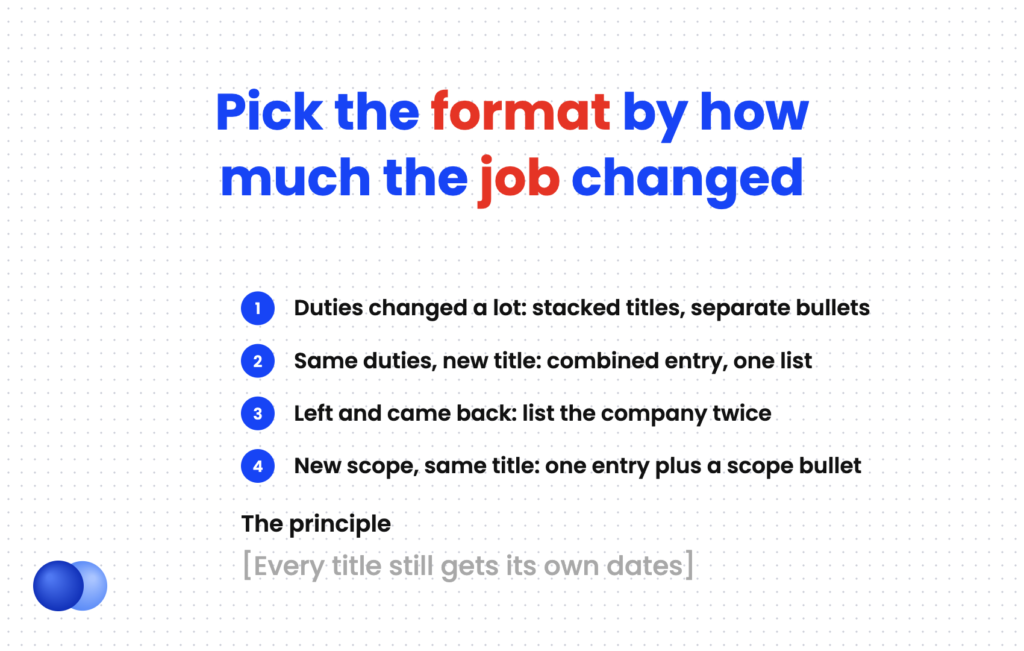
Use stacked titles with separate bullets when your duties changed meaningfully. Use a combined entry with one bullet list when duties stayed similar and only the title changed. List the company twice only if you left and came back. Every format still gives each title its own dates.
Most guides describe the formats but leave the choice to you. This table turns it into a rule.
| Situation | Best format | Bullets | Dates |
|---|---|---|---|
| Duties changed a lot (new team, budget, or scope) | Stacked titles, separate bullets | 3–6 current, 1–3 earlier | Each title |
| Same duties, higher title | Combined entry, one bullet list | 3–6 total | Each title on one line |
| Three or more promotions at one company | Stacked, older titles compressed | Bullets only on top 2 titles | Each title |
| Left, then returned at a higher level | Company listed twice | Normal for each entry | Each stint |
| Expanded duties, no title change | Single entry | One bullet names the expansion | Single range |
The combined entry saves space when the job barely changed. It puts both titles on consecutive lines and shares one bullet list.
Northfield Health System | Denver, CO
Senior Billing Specialist | Jan 2025 – Present
Billing Specialist | Aug 2022 – Dec 2024
- Process 350+ commercial and Medicare claims weekly with a 97% first-pass acceptance rate
- Cut average A/R days from 48 to 36 by prioritizing high-dollar denials
- Promoted to Senior after training four new specialists on payer rules
Career services offices teach the same two options. Pitzer College's guide says to list both titles under the same organization "with their own dates and bullet points," or list the earlier title briefly and focus on the higher role.
Why does every job title need its own dates?
Applicant tracking systems store each position as its own record, with a title, employer, start date, and end date. If a title has no dates, the parser may guess, merge it, or drop it. Separate dates also show recruiters how fast you were promoted, which is the most persuasive part of the entry.
This is the detail most promotion guides miss. Textkernel's parser documentation shows that each job in its employment history is a separate object with its own JobTitle, StartDate, and EndDate. Positions are not grouped by employer.
In practice, a title with no dates hands the parser a problem. It may attach the full date range to the wrong title or lose the earlier role. Either way, the ATS profile a recruiter searches may not show your progression. Our explainer on how ATS works covers parsing in more depth.
Dates also carry meaning on their own. BLS data shows median tenure with a current employer was 3.9 years in January 2024, and only 2.7 years for workers ages 25 to 34. Two titles inside that window tell a clear story of fast growth.
Use one date format everywhere
Pick "Jun 2024" or "06/2024" and use it for every title, company, and school on the page. Keep the company-level range equal to the earliest start date through the latest end date. Mismatched ranges look like errors to a human reader and can confuse a parser.
How do you write bullet points that prove the promotion?
Put your biggest results under the current title and keep the earlier title's bullets focused on what earned the promotion. Add one bullet that names the promotion and its reason, with a number where possible. Avoid repeating the same duties under both titles.
Titles show that you moved up. Bullets show why. The strongest promotion bullet has three parts: the promotion, the timeline, and the cause.
- "Promoted to Team Lead within 11 months, ahead of the standard 18-month track"
- "Selected from 12 analysts for promotion after automating monthly close reporting"
- "Promoted to Account Manager after growing assigned territory revenue 24%"
Only claim a standard timeline or a candidate pool if you can back it up in an interview. Start each bullet with a strong verb; our list of 500 powerful action verbs helps you avoid repeating "managed."
Scope words make the jump obvious. Compare team size, budget, territory, or number of accounts across the two titles. "Supervised 9 associates" followed by "Lead a 22-person team" needs no explanation.
How do you show multiple promotions at the same company?
Stack all titles under one company header, each with dates, newest first. Give full bullets to the two most recent titles and list older titles as single lines. If the oldest roles are more than 10 to 15 years back, you can fold them into one line such as "Earlier roles: Analyst, Associate."
Four or five titles at one employer is a strong signal, but it can swallow half a page. Compress from the bottom up.
Crestview Bank | Charlotte, NC | Jul 2015 – Present Vice President, Commercial Lending | Feb 2023 – Present - Manage a $310M loan portfolio across 45 middle-market clients with zero charge-offs since 2023 - Built a new treasury cross-sell program that added $2.1M in annual fee revenue
Assistant Vice President | Mar 2019 – Jan 2023 - Closed $85M in new commercial loans; promoted after leading the SBA lending pilot
Credit Analyst | Jul 2015 – Feb 2019
The oldest title keeps its dates but loses its bullets. That keeps the timeline intact for parsers and readers. For more on trimming older roles, see how far back a resume should go.
How do you show a lateral move, a promotion without a new title, or a return?
Treat a lateral move like a promotion format: one company header, both titles, separate dates. For a promotion without a title change, keep one entry and add a bullet naming the expanded scope. If you left and came back, list the employer twice so the gap is honest.
Internal moves are becoming more common. LinkedIn research reported by HR Dive found internal mobility rose 30% from 2021 to early 2024. Each type needs slightly different handling.
Lateral move. Stack the titles as you would a promotion. Let the bullets show new skills rather than a higher level. "Moved from Sales Operations to Product Marketing to lead launch analytics" says why the move made sense.
Promotion in place. If your duties grew but your title did not, keep one entry. Add a bullet like "Took on vendor management for 6 suppliers in 2025, a scope normally held by a manager." Do not invent a title.
Boomerang return. If you left and came back, list the company twice, once per stint, in reverse-chronological order. This keeps the dates accurate and avoids hiding the time away. If the gap needs context, our guide on explaining an employment gap shows you how to address it.
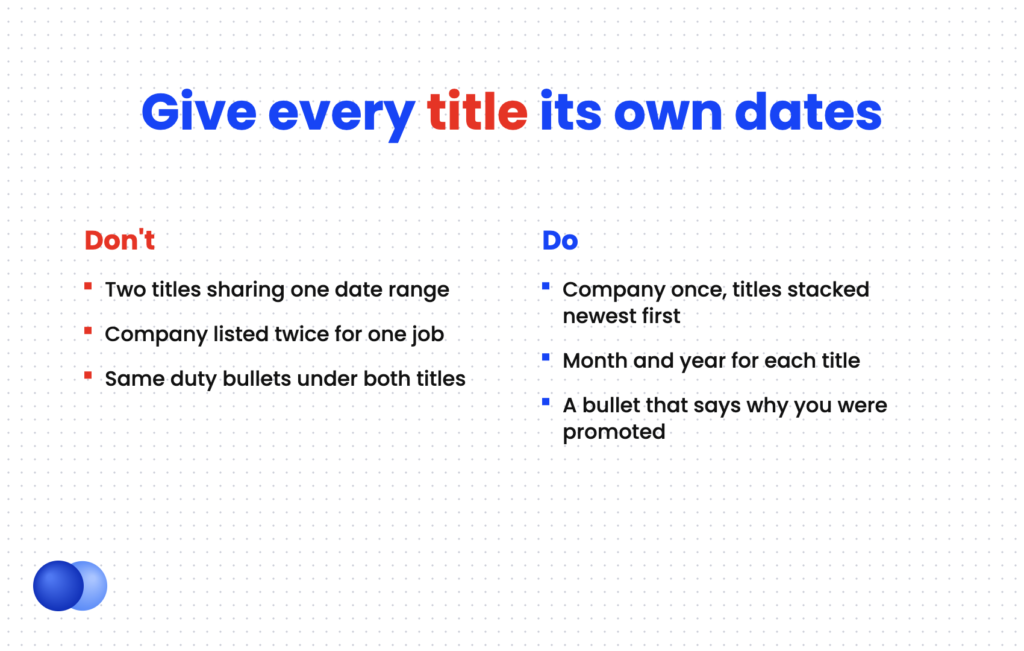
List the company once and stack titles newest first do: Give every title its own month-and-year date range do: Add one bullet that states why you were promoted do: Show scope growth with team size, budget, or accounts
Put two titles on one line with a single date range and no breakdown dont: Repeat the same duty bullets under both titles dont: List the company twice for a continuous job dont: Use your future or informal title before it is official

Want this layout done for you? The Rezoom AI resume builder stacks multiple titles under one employer and keeps every date range consistent.
Frequently asked questions
Should I list a promotion as a separate job on my resume?
Not as a separate employer. List the company once and put each title under it with its own dates. Only list the company twice if you left and later returned.
How do I show a promotion if I was in the new role for only a few months?
List it anyway, with its dates. A short current role still shows upward movement. Give it two or three bullets and let the earlier role carry more of the results.
Do I need to write "promoted" on my resume?
It helps. The stacked titles imply the promotion, but a bullet like "Promoted to Supervisor after 10 months" removes any doubt and adds the reason.
How do I show a promotion on my resume if my title did not change?
Keep a single entry and describe the new scope in a bullet, such as a larger team, budget, or client list. Use your official title, not an informal one.
Where do I mention a promotion in my resume summary?
Add it only if it is one of your strongest selling points. A short phrase works: "Operations manager promoted twice in four years at a national 3PL."
Should the company dates or the title dates come first?
Put the total company range next to the company name and each title's range next to that title. Readers see total tenure and pace at once.



Comments