
Summary
Use present tense for work that is still happening and past tense for work that is finished. That means present tense for your current job's ongoing duties and your summary, and past tense for previous jobs, completed projects, and finished achievements, even at your current job. Decide bullet by bullet with one question: is this still happening? Keep the tense consistent within each group of bullets, and switch a job to past tense on your last day.
Should you use past or present tense on a resume? Use present tense for anything still happening, such as your current duties, and past tense for anything finished, including completed wins at your current job. That one rule settles almost every case.
Most guides split the resume by job: current job in present, old jobs in past. That shortcut breaks down inside your current role, where some work is ongoing and some is done.
This guide gives you a bullet-level test, a section-by-section table, and examples you can copy.
Should a resume be in past or present tense?
A resume uses both. Write your current job's ongoing duties and your summary in present tense. Write previous jobs, finished projects, and completed achievements in past tense. Most of a typical resume ends up in past tense, because most of the work it describes is already done.
Career centers answer the past or present tense on a resume question with the same basic split. Purdue OWL puts it simply: verbs should be past tense for previous jobs and present tense for jobs you currently hold. Its example: "Ran point of sales register" for an old job, and "Run point of sales register" for a current one.
UC Davis gives the same advice and frames it as consistency: use past tense for roles completed and present tense for positions you currently hold.
Both tenses drop the pronoun. Harvard's resume guide lists personal pronouns such as "I" or "We" under what not to do. So you write "Manage a team of six," not "I manage a team of six."
How do you choose past or present tense for each bullet?
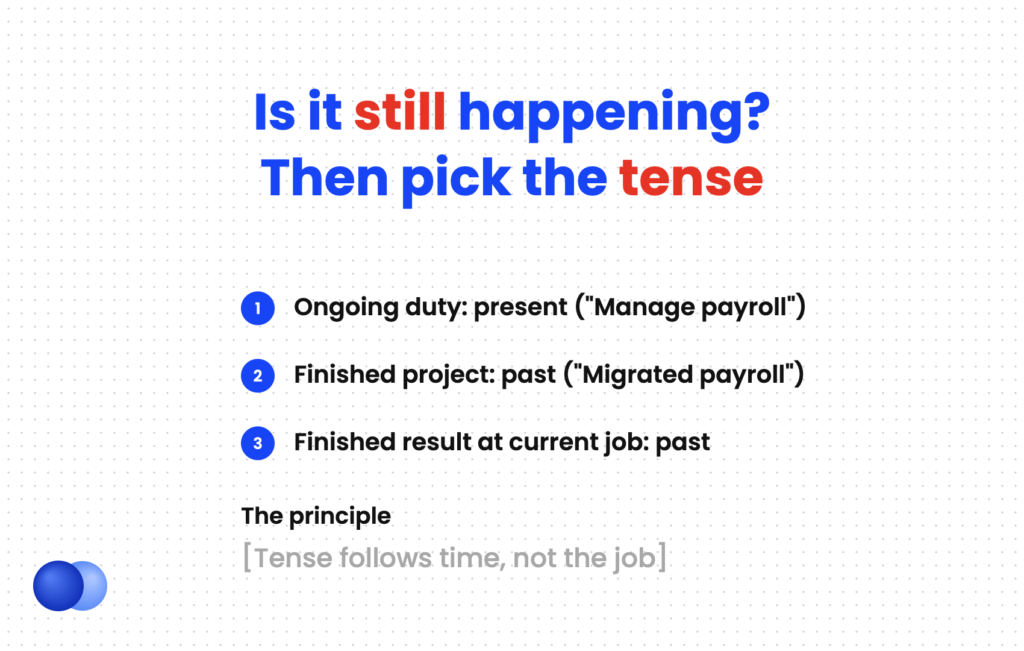
Ask one question per bullet: is this still happening? If you still do the task, use present tense, such as "Manage" or "Train." If the task, project, or result is finished, use past tense, such as "Launched" or "Cut," even when it happened at your current job.
Here is where the job-level rule falls short. Say you still manage payroll but you finished a system migration last spring. Both belong under your current job, but they happened in different time frames.
Purdue OWL flags this exact exception. Past accomplishments at a current job, such as an award, stay in past tense even though the job is current.
Use the still-happening test:
- Ongoing duty: present tense. "Process biweekly payroll for 240 employees."
- Finished project: past tense. "Migrated payroll to a new HR system in 8 weeks."
- Finished result: past tense. "Reduced payroll errors 30% in 2025."
- Ongoing result: present tense, if it is truly continuing. "Maintain a 99% on-time filing rate."
Payroll Specialist | Brightline Health | Mar 2023 – Present
- Process biweekly payroll for 240 employees across 3 states
- Answer 30+ weekly employee questions on pay, tax withholding, and benefits
- Migrated payroll to a new HR system in 8 weeks with zero missed pay dates
- Reduced payroll correction requests 30% in 2025 by adding a pre-run audit checklist
Notice the order. Present-tense duties come first, then past-tense achievements. Grouping them this way keeps the entry easy to scan.
Which resume sections use past or present tense?
Your summary and current job duties use present tense. Previous jobs, completed education, finished projects, and past volunteer roles use past tense. Ongoing projects, current volunteer roles, and memberships use present tense. Skills, certifications, and education entries are usually written as nouns and need no verb at all.
Deciding past or present tense on a resume works the same way in every section, but some sections have no verbs to worry about. A related wording question in those same sections is whether to use “I” on a resume.
| Resume section | Tense | Example |
|---|---|---|
| Summary or headline | Present | "Payroll specialist who manages multistate payroll" |
| Current job: ongoing duties | Present | "Manage vendor contracts worth $2M" |
| Current job: finished results | Past | "Negotiated a 12% vendor discount in 2025" |
| Previous jobs | Past | "Managed vendor contracts worth $2M" |
| Ongoing project or freelance work | Present | "Build and maintain a Shopify store" |
| Finished project | Past | "Built a budgeting app used by 50 students" |
| Current volunteer role | Present | "Tutor two middle school students weekly" |
| Education and certifications | No verb | "B.S. Accounting, May 2026" |
| Skills | No verb | "Excel, ADP Workforce Now, QuickBooks" |
Your summary describes who you are now, so it stays in present tense. Our resume summary guide shows how to open with a present-tense line and then point to past results.
Education is simpler still. Degrees and certifications are listed as nouns. If you haven't graduated, use an expected date rather than changing tense.
What tense do you use when a job is ending or just ended?
Switch a job to past tense on your last day. Until then, it is your current job and stays in present tense. After a layoff, a resignation, or a contract end, update the end date and change every verb in that entry to past tense.
This is the edit people most often forget. A laid-off candidate may apply for weeks with a resume that still says "Manage" and "Present."
That mismatch is easy to spot. In The Ladders' eye-tracking study, recruiters focused on job titles more than any other element, and the dates sit right beside them. An end date paired with present-tense verbs looks careless.
If you were recently let go, see our guide to a resume after being laid off for how to present that final role.
The same rule applies within a company. When you move up, your previous title's bullets become past tense. Our guide on how to show a promotion on a resume shows the layout.
Before (still employed): Customer Success Manager | Clearpath Software | Jan 2022 – Present - Manage a book of 45 mid-market accounts worth $3.1M in annual revenue
After (job ended): Customer Success Manager | Clearpath Software | Jan 2022 – Aug 2026 - Managed a book of 45 mid-market accounts worth $3.1M in annual revenue
Does verb tense affect ATS keyword matching?
Mostly no. Modern applicant tracking systems recognize word variations, so "managed," "manage," and "manager" can match the same search. The keywords that matter most are usually nouns, such as tools, skills, and certifications, which do not change with tense.
Some candidates worry that "managed" won't match a posting that says "manage." That fear is mostly outdated. Jobscan, an ATS optimization vendor, explains that modern systems have evolved to recognize variations of a word. A recruiter searching "management" can also find "managed" or "manager."
So choose tense by accuracy, not by the posting's wording. Put your effort into matching the nouns instead: software names, methods, licenses, and skills. Our resume keywords guide explains how to find them.
Proofread tense in one pass
Read only the first word of every bullet, top to bottom. Each current-job duty should look like "Manage," and each finished item should look like "Managed." This two-minute scan catches the tense slips a normal read-through misses, especially after you copy bullets from an old resume.
What tense mistakes should you avoid on a resume?
The biggest mistakes are mixing tenses within one bullet, leaving a finished job in present tense, writing finished achievements in present tense, using "-ing" phrases or "Responsible for" instead of action verbs, and adding pronouns. Each one makes a resume harder to scan and less precise.
Most tense errors come from editing an old resume instead of rewriting it. Watch for these patterns.
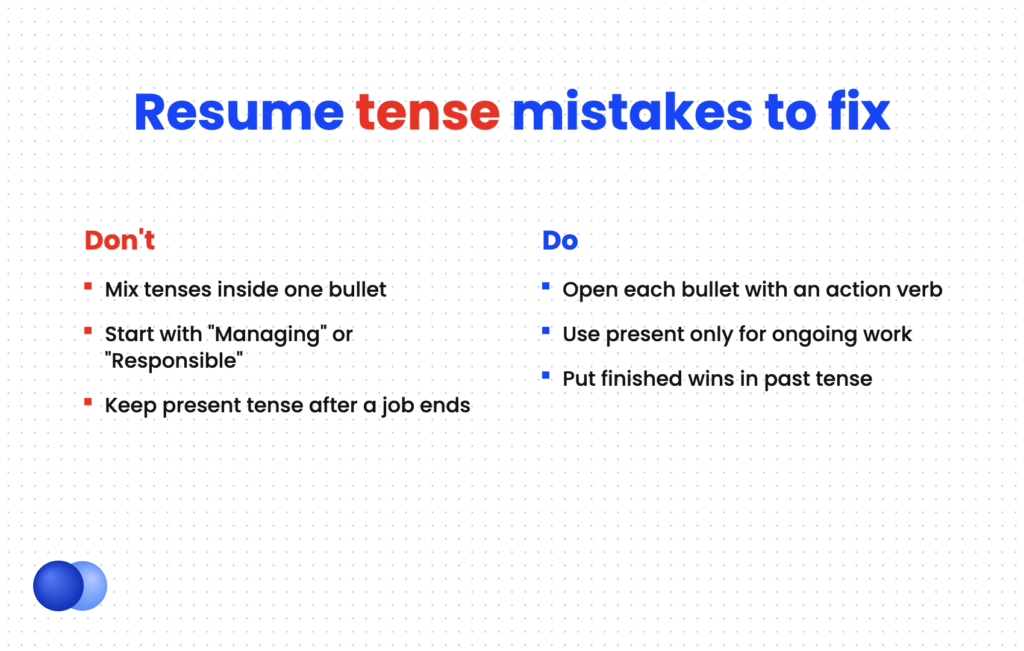
Start each bullet with a strong action verb do: Use present tense only for work still happening do: Put finished wins at your current job in past tense do: List present-tense duties before past-tense results
Mix tenses inside one bullet dont: Start bullets with "Managing" or "Responsible for" dont: Keep present tense after a job ends dont: Write "I" or "We" at the start of bullets
The "-ing" habit is common. "Managing social media accounts" reads like a fragment and hides whether the work is current. "Manage" or "Managed" answers that instantly. Pick sharper verbs from our list of 500 powerful action verbs.
For more on building strong entries, see our guide to writing work experience on a resume. If you're still deciding which roles belong on the page at all, our sibling article on how many jobs you should list on a resume gives a keep-or-cut test.
Once your tenses are consistent, run your resume through Rezoom's ATS resume checker to confirm your keywords and formatting read cleanly.
Frequently asked questions
Should my current job be in present tense?
Yes, for duties you still perform. Put finished projects and completed achievements at your current job in past tense.
Can you mix past and present tense on a resume?
Yes. Most resumes use both. Keep one tense per bullet, and group present-tense duties before past-tense results within the same job.
What tense should a resume summary be in?
Present tense. The summary describes your current skills and experience, though it can mention past results.
Is past tense better for a resume?
Past tense is not better, just more common. Most resume content describes finished work. Use present tense only when the work is ongoing.
What tense do I use for a job I was laid off from?
Past tense, starting on your last day. Update the end date at the same time.
Should volunteer work be in past or present tense?
Use present tense for a volunteer role you still hold, and past tense for one you have finished.



Comments