

Summary
You should not use "I" in resume bullet points. The standard US convention is implied first person: you write about yourself, but you drop the pronoun and start each line with an action verb. Career centers at Harvard, Princeton, UNC and UConn all tell students to leave out "I," "my" and "we." First person is acceptable in a few narrow places, such as a short summary for a senior or creative role, and it belongs in your cover letter and LinkedIn About section.
No, you should not use I on a resume in your bullet points or skills. Write in implied first person instead: the resume is clearly about you, so drop the pronoun and open each line with a strong verb.
So should you use I on a resume anywhere? Rarely. A one-line summary for an executive, founder or creative role can carry it. Your cover letter and LinkedIn profile should use it. Everything else reads cleaner without it.
This guide gives you a section-by-section rule, copy-ready rewrites, and the pronoun traps most advice skips, like "we" and third person.
Should you use I on a resume at all?
In most cases, no. US resumes use implied first person: you describe your own work without writing "I," "me" or "my." Each bullet starts with an action verb, such as "Led" or "Built." The main exceptions are a short summary for senior or creative roles, and documents written as prose, like cover letters.
The rule is not about modesty. It is about format. A resume is a scannable record, not a letter, so every word has to earn its space.
Major career centers are unusually unanimous here. Harvard's Mignone Center for Career Success lists "use personal pronouns (such as I or We)" under its resume don'ts. Princeton's resume guide says to "avoid pronouns (I, we) and minimize the use of articles."
UNC's career center goes one step further. It tells students to eliminate personal pronouns and complete sentences in bullets entirely. UConn's bullet-writing guide adds "we" to the list and says to begin with action verbs instead.
There is a minority view. Career writer Liz Ryan argued in Forbes for a conversational, "human-voiced" resume that uses "I" throughout. That style can work when you hand a resume straight to a hiring manager who already likes you. For applications that go through a portal, recruiters and software expect the standard format.
Why do recruiters expect resumes without pronouns?
Recruiters skim fast. The Ladders eye-tracking study found an initial resume scan lasts about 7.4 seconds, and the best-performing resumes used short, declarative lines. Starting every bullet with "I" pushes the useful word, the verb, into second place and repeats the same letter down the page.
Speed is the main reason. In its 2018 eye-tracking study, Ladders found recruiters spent an average of 7.4 seconds on the first screen. Resumes that performed well used simple layouts and short declarative sentences. Weak ones had long sentences and cramped text.
Pronouns work against that scan in three ways:
- They bury the verb. "I managed" makes the reader's eye land on "I." "Managed" gets them to the skill immediately.
- They repeat. Ten bullets that start with "I" create a column of identical letters on the left edge, exactly where readers look first.
- They add length. Dropping "I," "my" and extra articles often saves a line per job, which matters on a one-page resume.
There is also a signal effect. Hiring managers see thousands of resumes in the standard style. A page full of "I" can read as inexperienced, even when the content is strong.
Where can you use I on a resume, section by section?
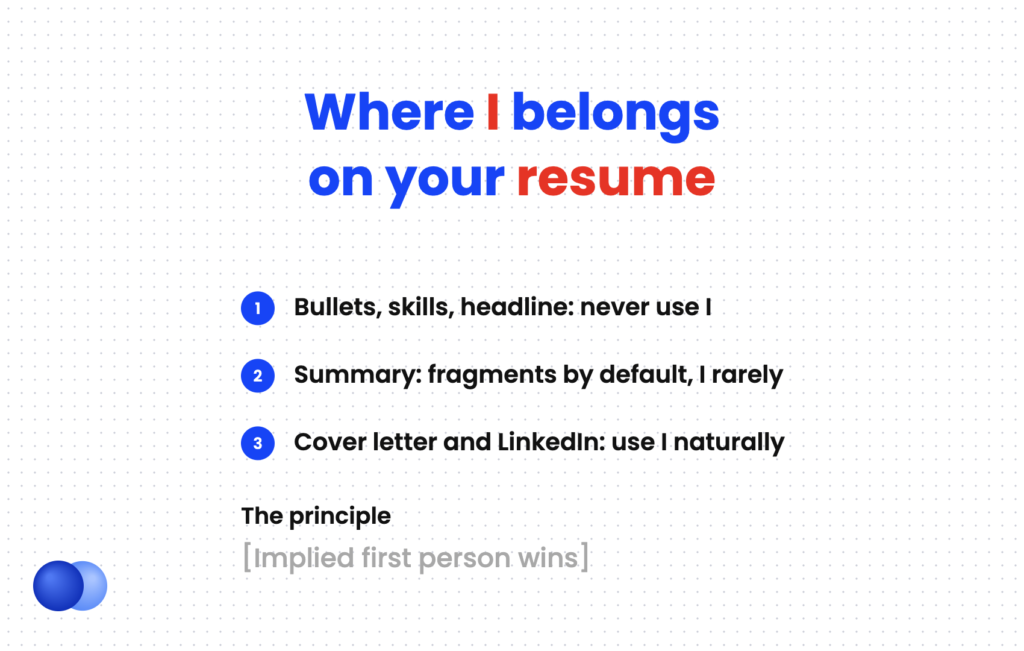
Leave "I" out of bullets, skills, education, headers and headlines. A summary can use it only if written as full sentences for a senior, founder or creative role, and even then, fragments are safer. Cover letters, LinkedIn About sections and personal statements should use "I" naturally.
Use this table as your quick rule. It covers every part of a standard US resume and the documents that travel with it.
| Section | Use "I"? | What to write instead |
|---|---|---|
| Header and headline | No | Job title as a label: "Senior Data Analyst" |
| Summary | Rarely | Fragments: "Data analyst with 6 years in retail pricing" |
| Work experience bullets | No | Action verb first: "Built a pricing model that…" |
| Skills section | No | Plain list or grouped keywords |
| Education, projects, volunteering | No | Same bullet style as work experience |
| Cover letter | Yes | Natural first person, used with variety |
| LinkedIn About | Yes | Conversational first person |
The summary is the gray zone. Most summaries are written as fragments, and that is the safer default. If you want a warmer voice, one sentence with "I" is acceptable, but do not mix styles. Our resume summary guide shows both versions.
Fragment style (default for most roles): Operations manager with 8 years in 3PL warehousing. Cut order-to-ship time 22% across two sites. Lean Six Sigma Green Belt.
First-person style (senior, founder or creative roles only): I build warehouse teams that ship faster without adding headcount. Over 8 years in 3PL operations, I have cut order-to-ship time 22% across two sites.
How do you remove I from resume bullet points?
Delete the pronoun, then start with the strongest verb in the sentence. Change "I was responsible for" to a specific verb such as "Managed" or "Ran." Cut articles where meaning stays clear, keep one tense per role, and end with the result so every bullet reads as verb, action, outcome.
Rewriting is mechanical once you see the pattern. Follow these four steps for every bullet.
- Delete "I," "my" and "me." "I trained my team" becomes "Trained team."
- Swap weak openers for a real verb. "Responsible for," "helped with" and "worked on" say little. Pick the verb that names what you did. Our list of 500 action verbs helps here.
- Add the scope or result. "Trained team" becomes "Trained 12 new support agents, cutting ramp-up time from 6 weeks to 4."
- Fix the tense. Current job in present tense, past jobs in past tense. Princeton's guide states the same rule, and our guide to past or present tense on a resume covers the edge cases.
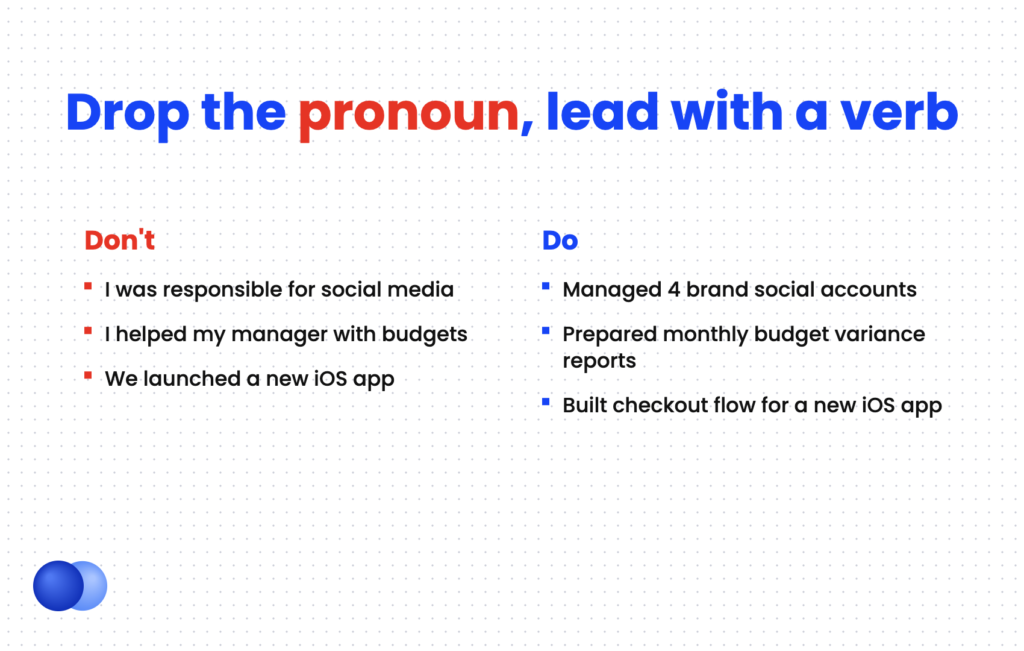
Before: I was responsible for managing our social media accounts and I grew our followers. After: Managed 4 brand social accounts, growing Instagram followers from 8K to 21K in 10 months.
Before: I helped my manager with the monthly budget reports. After: Prepared monthly budget variance reports for a $3.2M department, flagging overspend within 5 days of close.
Before: My main job was answering customer questions over chat. After: Resolved 60+ customer chats per shift with a 94% satisfaction score.
Notice that removing "I" was only the first move. The bigger gain came from replacing a duty with an outcome. For more on that shift, see duties vs. accomplishments on a resume, and for a full walkthrough, read how to write resume bullet points.
What about we, my, and third person?
Drop "we" as well as "I." It hides your personal contribution, and recruiters need to know what you did. Avoid "my" and "our" for the same reason. Never switch to third person, such as "Jordan led," because it reads as awkward and distant. Implied first person solves all three problems.
Most guides stop at "I," but three other pronoun habits cause bigger problems.
"We" hides your role. "We launched a new app" leaves the reader guessing whether you wrote the code or attended the launch party. Name your part: "Built the checkout flow for a new iOS app used by 40K monthly customers." If the result was a team effort, say so honestly: "Co-led," "Partnered with design to," or "One of 3 engineers who."
"My" and "our" add clutter. "Managed my team's budget" works fine as "Managed team budget of $450K."
Third person reads as strange. Some people overcorrect with "Maria increased sales 18%." Resumes are not bios. Third person belongs on a speaker page or company website, not in your experience section.
Start each bullet with a specific action verb. do: Name your personal contribution inside team projects. do: Keep one voice across the whole resume. do: Use first person naturally in your cover letter.
Open bullets with "I," "my," or "we." dont: Write about yourself in third person. dont: Mix a first-person summary with third-person bullets. dont: Leave vague openers like "Responsible for."
When does first person actually work?
First person works in documents written as prose: cover letters, LinkedIn About sections, personal statements and bios on a portfolio site. On the resume itself, it can appear in a one- or two-sentence summary for executives, founders and creative professionals, as long as every bullet still uses implied first person.
There are four legitimate places for "I" in a job search.
Your cover letter. A cover letter is a letter, so first person is expected. Vary your sentence openings so not every line starts with "I." Our cover letter format guide shows the structure.
Your LinkedIn About section. LinkedIn is conversational by design. First person makes it sound like a person, not a list. See our LinkedIn summary examples.
A senior or creative summary. Executives, founders and creative leads often use one first-person sentence to set a point of view. Keep it to the summary only.
A direct referral. If a contact is handing your resume to a manager personally, a warmer voice is lower risk. Even then, keep bullets in the standard format.
The consistency test
Read only the first word of every line on your resume. If you see any "I," "My" or "We," rewrite that line. If you see the same verb three times in a row, vary it. This 30-second check catches most voice problems before a recruiter does.

Once your bullets are pronoun-free, build or clean up the full resume in the Rezoom AI resume builder, which drafts bullets in implied first person by default.
Frequently asked questions
Is it unprofessional to use I in a resume?
In bullet points, it reads as nonstandard and wastes space, so most recruiters see it as a small mistake. It is not disqualifying on its own, but it signals unfamiliarity with resume conventions.
Can I use "I" in my resume summary?
You can, but only in full sentences and preferably for senior, founder or creative roles. For most job seekers, a fragment-style summary is safer and shorter.
What point of view should a resume be written in?
Implied first person. You write about your own actions but leave out the pronoun, so bullets start with verbs like "Led," "Built" or "Reduced."
Should I use "we" when describing team projects?
No. Replace "we" with your specific role, using verbs like "Co-led," "Built" or "Partnered with." If the result was a team effort, you can still say so without a pronoun.
Do ATS systems penalize the word "I"?
No evidence shows that applicant tracking systems reject resumes for using "I." The cost is human: extra words, a buried verb, and a less professional read in a fast scan.
Is it okay to use "I" in a CV?
In the US, academic CVs follow the same convention and leave out pronouns in entries. Research statements and teaching statements that accompany a CV are written in first person.



Comments