

Summary
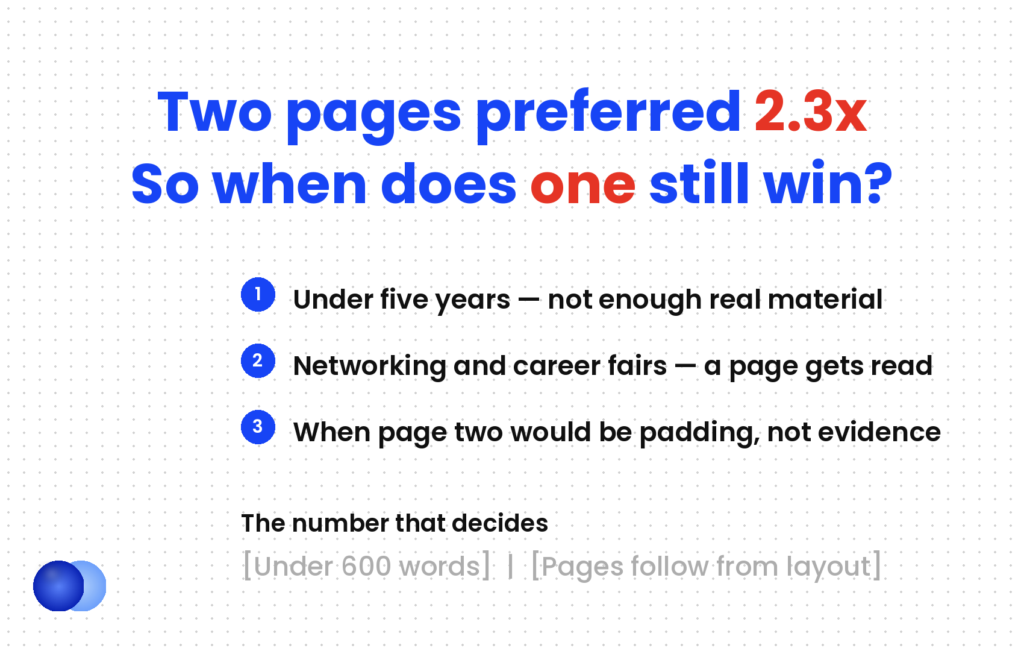
The one-page rule lost its universal status. ResumeGo's study of 482 recruiters reviewing 7,712 resumes found two-page versions preferred 2.3 times more often. One page still wins in four specific situations — under five years of experience, networking, high-volume screening, and anywhere the second page would carry padding rather than evidence.
The one page resume used to be universal advice. It is not any more, and the evidence against it is unusually strong.
ResumeGo ran a hiring simulation with 482 recruiters reviewing 7,712 resumes. Recruiters preferred two-page versions 2.3 times more often — and even for entry-level openings, employers chose two pages 1.4 times as often.
So the useful question is no longer whether your resume should be one page. It is: in which situations does a one page resume still win? There are four, and they are specific.
When is a one page resume the right choice?
Four situations — under five years of experience, networking and career fairs, high-volume or hourly screening, and any case where the second page would hold padding rather than evidence. Outside those, a well-built two pages usually performs better.
| Situation | Why one page wins |
|---|---|
| Under 5 years of experience | Rarely enough real material for two pages |
| Networking, career fairs, handing it over | A physical page gets read; two get skimmed |
| High-volume hourly or retail screening | Reviewers move fast and scan for eligibility |
| A second page that would be padding | A half-empty page two reads worse than none |
| Startups that explicitly prize brevity | Cultural signal, and they usually say so |
Note what is absent from that list: seniority, or a general belief that recruiters will not read further. Zippia and ResumeGenius surveyed 500+ hiring managers and found the preference splits at experience level rather than at page count — under ten years leans one page, over ten leans two.
Does the one-page rule still apply at all?
To early-career candidates, yes. To experienced professionals, no — and limiting yourself to one page past about ten years actively costs you. Around 17% of hiring managers still treat anything over one page as a negative, which is a real minority rather than a majority.
In practice, three findings together explain the confusion:
The strongest experimental evidence favours two pages. Two-page resumes scored 21% higher on recruiter ratings and held attention for four minutes against two minutes twenty-four seconds.
A meaningful minority disagrees. 17% of hiring managers treat more than one page as a deal-breaker. That is one reader in six — worth knowing, not decisive.
The old rule had a physical cause. It made sense when resumes arrived by fax and stacked up on a desk. Digital files parsed by software and read on screens carry no equivalent cost for a second page.
A half-empty second page is the worst outcome
If your content runs to one page and four lines, cut the four lines rather than spilling onto a second page. A page two holding three bullets and a certifications heading reads as padding, and padding is exactly what recruiters penalise. The choice is a full one page or a full two — never one and a bit.
How do you cut to one page without losing evidence?
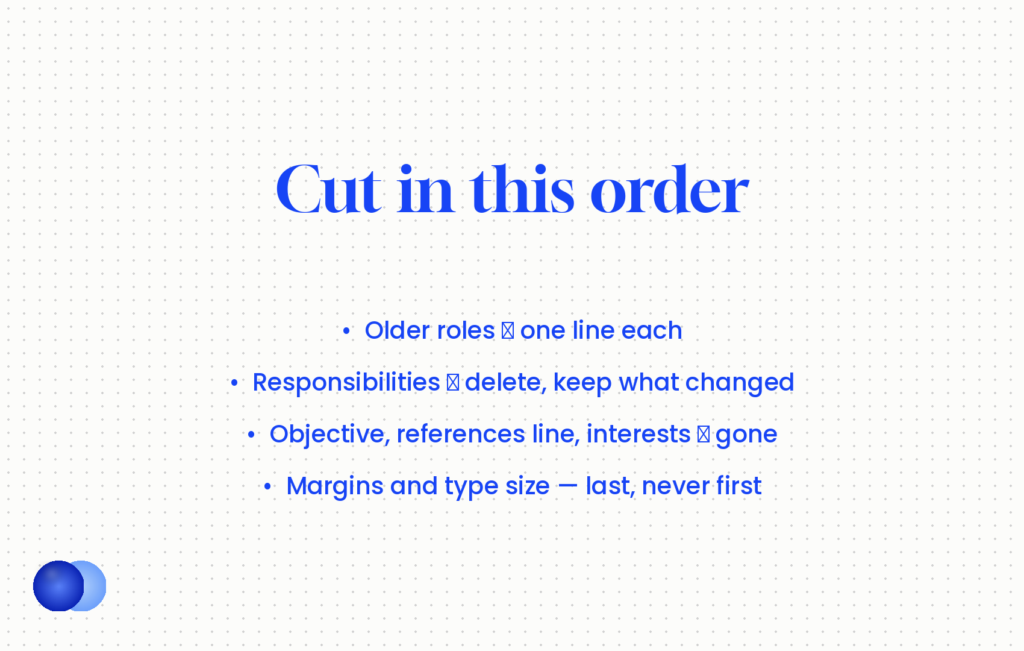
Trim the oldest roles to a line each, delete responsibilities that are not achievements, remove sections that earn nothing, and tighten phrasing before touching margins or type size. Shrinking the layout is the last resort and the first thing people reach for.
Broadly, five cuts, in order of how much they remove for how little loss:
1. Older roles to one line. Anything beyond ten years becomes Earlier roles at Acme, Wexford and Northgate, 2008–2015. That single line frequently frees a third of a page.
2. Responsibilities, not achievements. "Responsible for managing the reporting process" restates a job description. Delete it and keep what changed.
3. Sections that earn nothing. An objective statement, "references available upon request", interests, and a full postal address are all space with no return.
4. Phrase-level tightening. "Was responsible for leading" becomes "Led". Applied across twenty bullets, that alone often recovers six lines.
Layout comes last
5. Only then, the layout. Margins down to 0.75 inch and body type at 10.5pt are acceptable. Below that you are cramming, and a crammed page reads as crammed before anyone reads a word.
The order matters because most people invert it — they shrink the type first and never do the editing that would have made shrinking unnecessary.
Crammed: 0.5-inch margins, 9.5pt type, no white space, every role since 2007 with three bullets each. Technically one page. Visually unreadable, and the 2007 role is doing nothing.
Edited: 0.75-inch margins, 11pt, generous line spacing, the last three roles in full and everything earlier on a single line. Same page count, half the words, and every remaining line carries evidence.
The second one gets read. The first one gets skimmed and set down — the outcome one page was supposed to prevent.
Keep white space. A one page resume works because it is scannable, and cramming removes the property that made it worth choosing.
Delete a quantified achievement to protect the page count. If real evidence is getting cut, the resume has told you it needs a second page — when a two page resume is fine covers what earns one.
Does page count affect ATS parsing?
No. Greenhouse, Lever, Workday, iCIMS, Taleo and BambooHR all accept multi-page documents, and none rejects on page count. Length affects the human reader only — though a shorter resume does carry less keyword surface area for matching.
Two things worth separating here.
No parser rejects on length. Every major platform settled this years ago, and how an ATS works covers what genuinely filters candidates — knockout answers and search terms rather than page count.
But shorter means less matching surface. A 350-word resume carries roughly half the vocabulary of a 700-word one, which means fewer chances to match a posting's terms. That is a real argument against cutting to one page when you have genuine content to lose, and worth checking with an AI resume checker rather than assuming.
What is the word count that actually matters?
Under 600. TalentWorks' analysis of 6,000 applications across 66 industries found resumes over 600 words were 43% less likely to result in a hire. That ceiling is about density rather than pages — a tight 550-word resume can run to two pages with good spacing.
Finally, this number resolves most of the one-versus-two argument, and it rarely appears alongside it.
Page count is a container. Word count is the content. A one page resume crammed to 650 words performs worse on this measure than a two-page resume at 500 words with white space, even though the first one follows the rule.
So the honest framing is: aim for under 600 words, then let the page count fall out of the layout. If 500 words sit comfortably on one page at 11pt with proper margins, that is your answer. If they do not, a second page is not a failure.
Two-page resumes were preferred 2.3 times more often — and for entry-level openings, employers were still 1.4 times as likely to prefer them.
For one-page layouts already built to these constraints, the resume examples library is organised by role and seniority.
One caveat on that study worth naming. It measured recruiter preference in a review setting, where the two-page versions contained genuinely more relevant content. It does not show that adding a second page to a thin resume helps. Every finding here points the same way: page count follows the evidence, never the reverse.
Frequently asked questions
Is a one page resume still acceptable in 2026?
Yes, and it is the right choice for candidates with under five years of experience, for networking and career fairs, for high-volume screening, and whenever a second page would hold padding.
Do recruiters prefer one-page resumes?
Not generally. ResumeGo's study of 482 recruiters reviewing 7,712 resumes found two-page versions preferred 2.3 times more often, though 17% of hiring managers still treat anything over one page as a negative.
How many years of experience fit on one page?
Roughly five. Beyond about ten years, limiting yourself to one page usually means cutting evidence that would have helped you.
How do I cut my resume to one page?
Trim older roles to a single line, delete responsibilities that are not achievements, remove sections that earn nothing, and tighten phrasing. Adjust margins and type size last rather than first.
What margins and font size are acceptable on a one page resume?
Down to 0.75-inch margins and 10.5pt body type. Below that the page reads as crammed, which removes the scannability that made one page worth choosing.
Does a one page resume hurt me with an ATS?
No parser rejects on page count. But a shorter resume carries less vocabulary to match against a posting, which is a genuine cost when you cut real content to fit.
Is a full one page better than a partial two pages?
Yes. A second page holding three bullets reads as padding, and padding is what recruiters penalise.
How many words should a resume be?
Under 600. TalentWorks found resumes above that were 43% less likely to result in a hire, and the ceiling applies regardless of how many pages the words sit on.
Comments