
Summary
Controlled testing found recruiters prefer two-page resumes 2.3 times more often, and rate them 21% higher. But the 7-second initial scan never reaches page two, so page one has to work as a complete document on its own. The second page is earned by content rather than chosen by seniority, and everything on it is supporting detail.
The evidence for a two page resume is stronger than most people expect.
ResumeGo ran a hiring simulation with 482 recruiters across 7,712 resumes. Recruiters preferred two-page versions 2.3 times more often, rated them 21% higher on quality, and spent four minutes on them against two minutes twenty-four seconds.
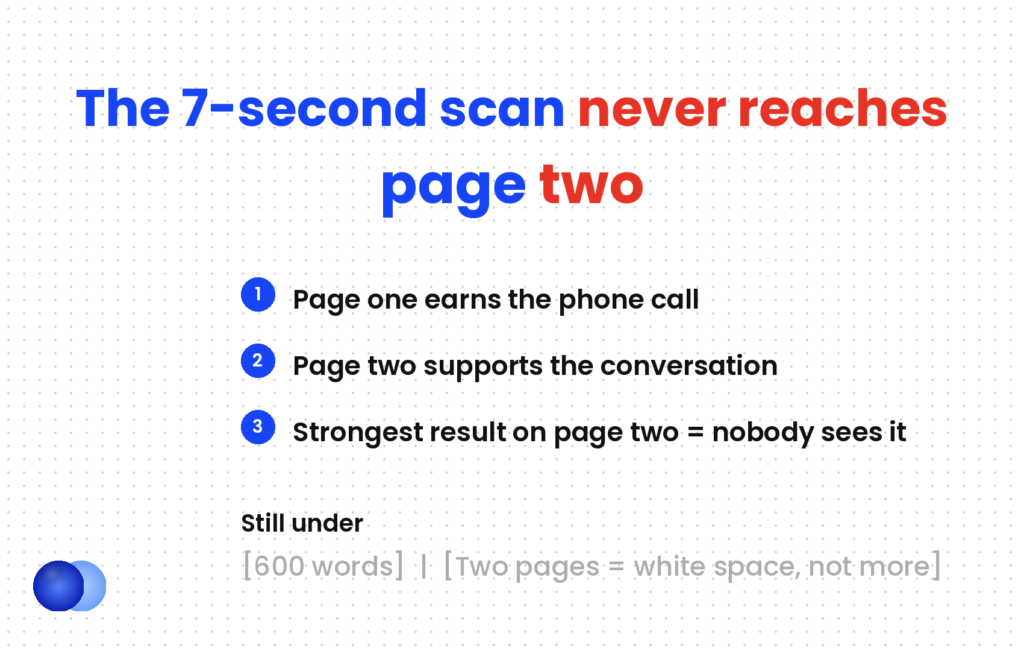
But there is a catch that changes how you build one. The initial scan takes about seven seconds and never reaches page two. So a two page resume is really one document that has to work twice: page one earns the read, page two supplies what the conversation needs.
When does a two page resume make sense?
When the content genuinely fills it. Beyond roughly ten years of experience, for technical roles with real tool and project depth, for senior and executive positions, and in the UK where two sides of A4 is the ordinary convention. Not for seniority alone.
| Situation | Why the second page is earned |
|---|---|
| 10+ years of experience | Real roles to describe, not padding |
| Technical roles | Tools, stacks and projects recruiters search for |
| Senior and executive | Scope, budgets, teams, outcomes |
| UK and much of Europe | Two sides of A4 is the standard CV |
| Career changers | Room for both the old evidence and the new |
| Academic, research, federal | Different conventions entirely, often longer |
What does not earn a second page: a job title, a years-of-experience number, or the wish to look substantial. When a one page resume still wins covers the other side, and the rule holds in both directions — page count follows the evidence.
Why must page one stand alone?
Because the initial scan is 6 to 7 seconds and follows an F-pattern across the top third of page one. Page two only gets read if page one earns it. That makes page one a complete argument rather than the first half of one.
Crucially, this is the structural fact that most two-page advice omits, and it dictates the whole layout.
Ladders eye-tracking research found recruiters form an initial impression in roughly six to seven seconds, reading the top third of page one, skimming the left margin for titles and dates, then glancing at skills. Nothing in that pattern crosses to a second sheet.
So the division of labour holds firm:
Page one earns the phone call. Summary, core skills, and your most recent and most impressive roles. If a reader saw only this page, they should still want to talk to you.
Page two supports the conversation. Earlier roles, certifications, publications, additional context — the detail that makes an interview substantive rather than the material that persuades.
Getting this backwards is the most common two-page failure: a chronological dump where the strongest achievement sits in the 2019 role on page two, and nobody ever reaches it. How long recruiters look at a resume covers the scan in more detail.
Print page one and hand it to someone
Give page one alone to a friend for ten seconds, then take it back and ask what the person does, how senior they are, and what their strongest result is. If they cannot answer all three, page one is not standing alone — and no amount of good material on page two will fix that, because nobody is getting there.
What goes on each page?
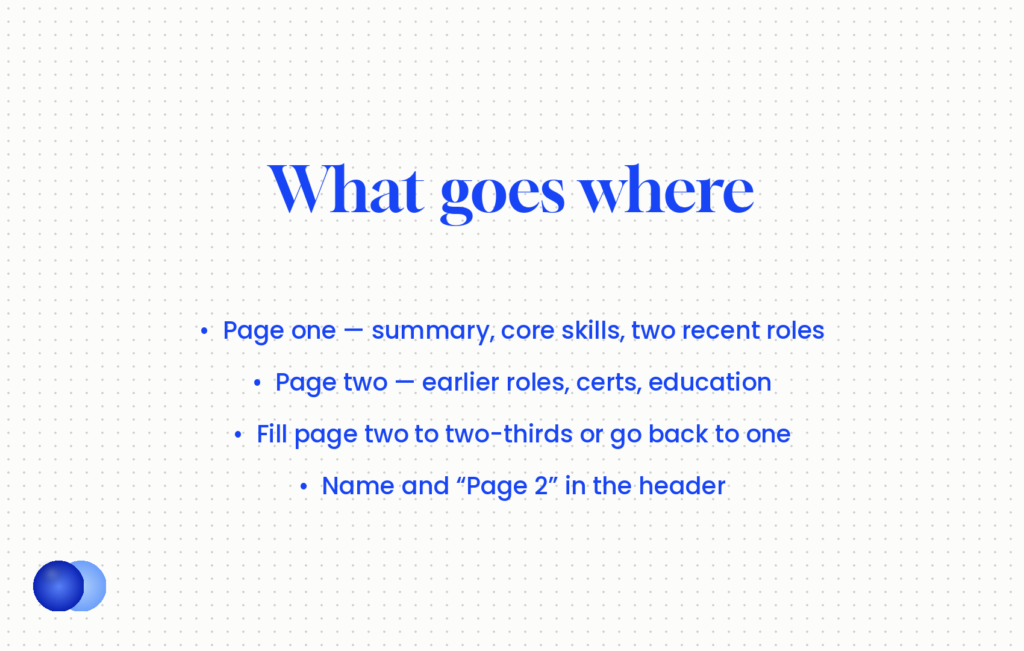
Page one: contact header, summary, core skills, and your two most recent roles in full. Page two: earlier roles in decreasing detail, certifications, education, and anything supplementary. Repeat your name and a page marker at the top of page two.
A two page resume allocates content like this:
Page one
- Contact header
- Professional summary, 75–100 words
- Core skills, five or six drawn from the posting
- Most recent role, three to five bullets
- Second most recent role, three to four bullets
Page two
- Earlier roles, two bullets then one line as they age
- Certifications and training
- Education
- Publications, patents, speaking — where relevant
Two mechanical details people miss: put your name and "Page 2" in the header of the second sheet, in case the pages get separated or printed. And never let a single role split across the page break — move it entirely to page two rather than orphaning two bullets.
Wrong: Straight chronology. 2015 role on page one, 2026 role also on page one, and the achievement that best matches this posting sits in the 2019 role halfway down page two.
Right: Summary and core skills at the top, the two most recent roles filling page one with the posting-relevant results leading each. Page two holds 2015 and earlier, compressed, plus certifications.
Same content, same two pages. Only one of them survives a seven-second scan.
Fill the second page to at least two-thirds. A page holding three bullets reads as padding, and at that point the content belongs on one page.
Go to three pages. Three-page resumes are near-universally disfavoured outside academic CVs, certain research roles and federal applications, where the conventions are different anyway.
Is there a word limit regardless of pages?
Yes, and it matters more than the page count. TalentWorks' analysis of 6,000 applications across 66 industries found resumes over 600 words were 43% less likely to result in a hire. Two pages at 550 words with white space beats one page crammed to 650.
This constraint keeps a two page resume honest.
The 600-word ceiling and the two-page preference pull against each other, and the resolution is density. Two pages does not mean twice the words — it means the same disciplined content with room to breathe, larger type, and white space that makes the scan work.
A two page resume at 900 words is not following the research. It is using the page count as permission to stop editing.
| Approach | Words | Verdict |
|---|---|---|
| One page, crammed | 650+ | Over the ceiling and unreadable |
| One page, edited | 400–500 | Strong for early career |
| Two pages, disciplined | 500–600 | The range the research supports |
| Two pages, padded | 800+ | Past the ceiling; recruiters notice |
Does a second page hurt ATS parsing?
No. Greenhouse, Lever, Workday, iCIMS, Taleo and BambooHR all accept multi-page documents and none rejects on page count. A longer resume actually carries more vocabulary to match against a posting, which is a small argument in its favour.
Finally, worth stating because the worry is common and unfounded.
Parsers extract fields and match vocabulary. Page count is not an input, and how an ATS works covers what actually removes candidates — knockout answers and boolean search rather than document length.
There is even a modest advantage. A 700-word resume has roughly double the keyword surface of a 350-word one, which gives more opportunity to match the posting's terms. That is not a reason to pad, but it does mean cutting real content to reach one page carries a cost on both sides of the screen. An AI resume checker against the specific posting will show you whether the terms actually landed.
The first page earns the phone call; the second page provides the detail they need to have a meaningful conversation with you.
Frequently asked questions
Is a two page resume acceptable in 2026?
Yes, and often preferred. ResumeGo's study of 482 recruiters across 7,712 resumes found two-page versions preferred 2.3 times more often and rated 21% higher on quality.
When should a resume be two pages?
Beyond roughly ten years of experience, for technical roles with real tool depth, for senior and executive positions, and in the UK where two sides of A4 is the standard convention.
Do recruiters read the second page?
Only if page one earns it. The initial six-to-seven-second scan covers the top third of page one, so page two gets read during the fuller review rather than the screen.
What goes on page two of a resume?
Earlier roles in decreasing detail, certifications, education, and supplementary material such as publications. Page one holds the summary, core skills and your two most recent roles.
Should I put my name on page two?
Yes — your name and a page marker in the header, in case the pages get separated or printed.
Is a two page resume too long for an ATS?
No. Every major platform accepts multi-page documents, and a longer resume carries more vocabulary to match against a posting.
How many words should a two page resume have?
Between 500 and 600. TalentWorks found resumes over 600 words were 43% less likely to result in a hire, so two pages should mean white space rather than twice the content.
Can a resume be three pages?
Only for academic CVs, certain research roles and federal applications where the conventions differ. Three pages is near-universally disfavoured elsewhere.

Comments