

Summary
A duty describes what your job required; an accomplishment shows how well you did it and what changed as a result. To tell duties vs accomplishments apart, ask whether anyone else in the same job could write the same line. If yes, it is a duty. Convert it by adding scope, your specific action, and a result such as time saved, errors cut, or people served. Keep a short duty line only when it sets needed context.
The difference between duties vs accomplishments on a resume is simple: a duty says what you were supposed to do, and an accomplishment proves how well you did it. Hiring managers already know the duties of most jobs, so duty-only bullets tell them almost nothing about you.
The fix is not to delete your responsibilities. It is to rebuild each one around a result. This guide gives you a quick test, a four-question conversion method, and the few cases where a plain duty line still earns its place.
What is the difference between duties vs accomplishments on a resume?
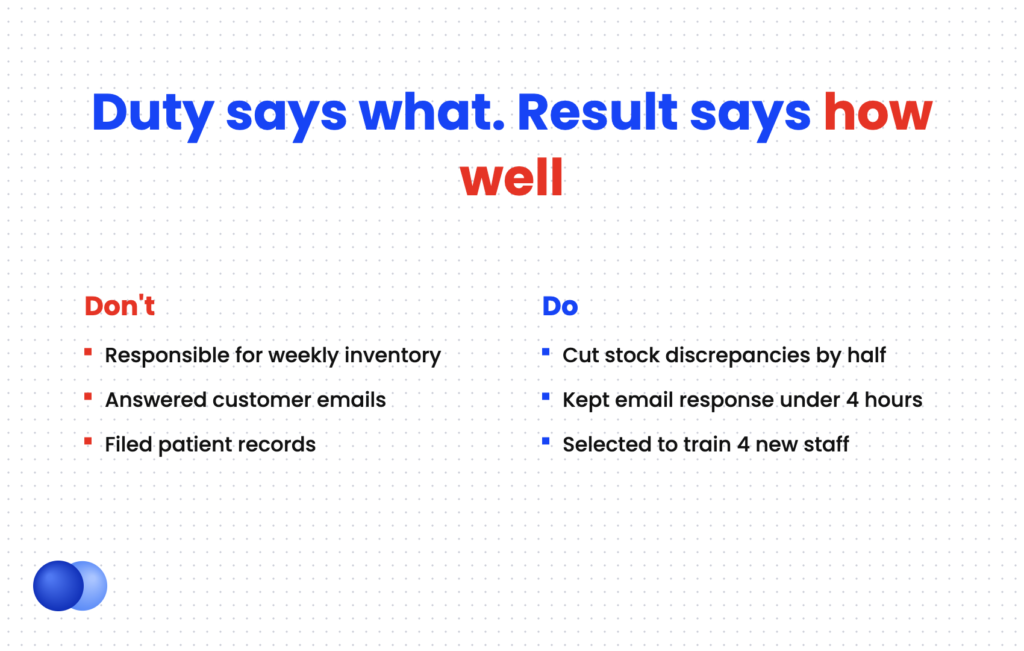
A duty is a task assigned to your role, such as "processed invoices." An accomplishment is the outcome you produced while doing it, such as "cut invoice processing time from 4 days to 2." Duties describe the job. Accomplishments describe your performance in it, which is what a hiring manager is trying to predict.
The Muse puts it neatly: a duty describes what you did, while an accomplishment describes how well you did it. A career guide republished by Arcadia University makes the same point with an event example: planning an event is routine, but raising money from it is what sets you apart.
Recruiters reward the second kind. In Jobscan's 2025 survey of 384 hiring professionals, 58% said measurable achievements impress them on a resume.
| Duty | Accomplishment | |
|---|---|---|
| Answers | What was my job? | What changed because I did it? |
| Typical opener | "Responsible for," "Duties included" | A specific action verb |
| Who could write it | Anyone in the same role | Only you |
| Contains | Tasks and tools | Scope, action, and a result |
| Example | Answered customer emails | Answered 80+ customer emails daily, keeping response time under 4 hours |
How can you tell if a bullet is a duty or an accomplishment?
Use the swap test. Imagine a coworker in the same job reading your bullet. If they could put it on their resume unchanged, it is a duty. An accomplishment contains something only your record can claim: a result, a scale, a first, a recognition, or a before-and-after change.
Run each bullet through three quick checks:
- The swap test. Could any peer in your role claim this line word for word?
- The "so what" test. Does the line say what happened after you did the work?
- The verb test. Does it start with "Responsible for," "Tasked with," or "Assisted with"? Those phrases almost always signal a duty.
If a line fails two of the three, it needs converting. Sorting duties vs accomplishments this way takes about a minute per job.
Audit your resume in five minutes
Print your resume and highlight every bullet that passes the swap test in yellow. If more than half of your recent job is yellow, you are describing the job posting, not yourself. Convert the top three yellow lines first, since readers weigh the first bullets under each role most.
How do you turn duties into accomplishments?
Take one duty and answer four questions: How much or how often? What did I do differently or better? What changed as a result? Who benefited? Then rewrite it as action verb, plus scope, plus result. If you lack exact data, use an honest estimate or a non-money result like speed, accuracy, or recognition.
Career centers use the same core formula. Princeton teaches Action verb, Context, End result. UC Davis frames it as "Action verb + context = results".
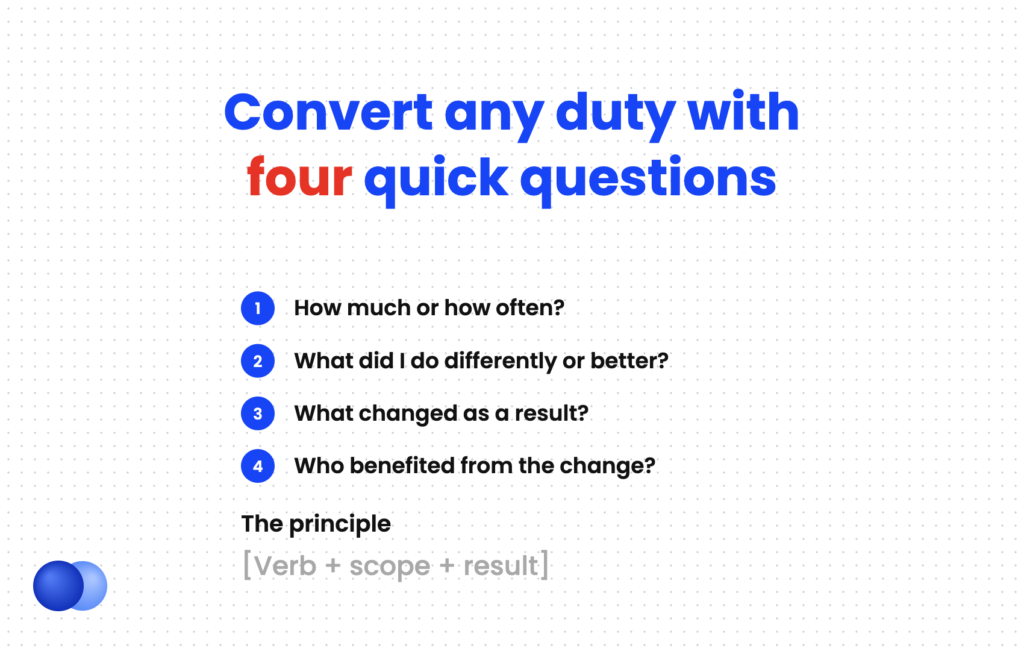
Here is the four-question method in practice:
- How much or how often? Count what you handled: calls, patients, accounts, reports, dollars, people.
- What did I do differently? Name the process, tool, or idea you added beyond the basic task.
- What changed? Look for time saved, errors reduced, revenue gained, or satisfaction raised.
- Who benefited? Your team, customers, manager, or the company budget.
Duty: Responsible for weekly inventory counts.
+ Scope: Ran weekly inventory counts for a 2,000-SKU store.
+ Your action: Ran weekly inventory counts for a 2,000-SKU store and built a shared variance tracker in Google Sheets.
+ Result: Built a variance tracker for weekly counts across 2,000 SKUs, cutting stock discrepancies by about half in 6 months.
Notice the final version drops "Responsible for" and leads with the action. For more on measuring outcomes, see our batch guide on how to quantify your resume.
What if your duties have no measurable results?
Many roles never see a revenue number, but every role produces some evidence. Use volume, speed, accuracy, recognition, trust, or adoption instead. Being picked to train new hires, having your checklist become the team standard, or keeping zero errors across an audit are all accomplishments without a dollar sign.
UC Davis shows that a strong line can rely on a qualitative result. Its example turns "watched children at elementary school" into supervising children ages 4 to 11 while building strong rapport with children, teachers, and parents.
Try these conversion patterns when numbers are thin:
- Trust: "Filed patient records" becomes "Selected to train 4 new front-desk staff on the records system."
- Adoption: "Wrote meeting notes" becomes "Created a meeting-notes template now used by all 3 project teams."
- Accuracy: "Reconciled accounts" becomes "Reconciled 120 accounts monthly with zero audit adjustments in 2025."
- Recognition: "Helped customers" becomes "Earned 11 named customer commendations in one year."
If your field tracks formal metrics, our batch article on how to put KPIs on a resume shows how to present them.
When is it okay to list duties on a resume?
A duty line is fine when it sets context the reader needs to judge your results, such as team size, budget, or territory. It also helps entry-level candidates and people in tightly regulated roles, where core tasks match required keywords. Keep it to one opening line per job, then follow with accomplishments.
The balance of duties vs accomplishments does not have to be zero duties. A short scope line can make every result that follows more impressive.
Operations Coordinator | Harbor Logistics | Tacoma, WA | 2022 – Present
Coordinate inbound freight for a 3-dock warehouse handling 150+ shipments weekly.
- Cut average trailer unload time from 90 to 55 minutes by redesigning dock assignments.
- Built a carrier scorecard that reduced late deliveries 30% in two quarters.
- Trained 6 new coordinators on the warehouse management system.
Duties also carry keywords. If a posting requires "HIPAA compliance" or "accounts payable," make sure that phrase appears in a true line. Our guide to resume keywords covers how screening systems read them.
For students with thin work history, some task-based lines are unavoidable. Wrap them in context where you can, as our college student resume guide shows.
What mistakes do people make when converting duties?
The biggest mistakes are inventing numbers, keeping "Responsible for" in front of a result, bundling several wins into one bullet, and claiming team results as solo work. A converted line should be honest, specific, and short enough to read in a few seconds, with your personal contribution clear.
Lead with a strong verb such as "cut," "built," or "grew." do: Use honest estimates like "about" when exact data is missing. do: Name your personal role in a team result. do: Keep one scope line per job if context helps.
Write "Responsible for increasing sales 20%." dont: Guess a precise percentage you cannot defend in an interview. dont: List every daily task you performed. dont: Stack three results into a single sentence.
Need ideas for results in your field? Our companion article has resume accomplishments examples by role and situation. For line-level mechanics, read how to write resume bullet points, and swap weak openers using our list of 500 powerful action verbs.
Once your draft is ready, Rezoom's AI resume builder can flag duty-style bullets and suggest result-first rewrites you can check and edit.

Frequently asked questions
Should I remove all job duties from my resume?
No. Keep one short scope line per role when it helps the reader understand the size of your work. Everything else should show results.
Is "Responsible for" bad on a resume?
It is not wrong, but it signals a duty and wastes the strongest spot in the line. Start with the action you took instead.
What is an example of a duty vs an accomplishment?
"Managed social media accounts" is a duty. "Grew Instagram followers from 2,000 to 9,500 in a year through a weekly video series" is an accomplishment.
How many accomplishments should each job have?
Three to five for recent, relevant roles works for most resumes. See our batch guide on [how many bullet points per job](https://rezoom.io/how-many-bullet-points-per-job-on-resume/).
What if I do not remember my exact numbers?
Use honest approximations such as "about 50 calls a day." Check old performance reviews, emails, or reports to confirm figures where you can.
Do accomplishments matter for entry-level jobs?
Yes. Employers want proof of skills like teamwork and problem-solving. NACE's Job Outlook 2026 Spring Update advises students to [show evidence of skills rather than just list them](https://www.naceweb.org/about-us/press/2026/the-high-impact-skills-college-students-should-showcase-on-their-resumes).



Comments