

Summary
To put KPIs on a resume, write each one as a bullet with four parts: the metric, the change you drove, the baseline or target it beat, and the time frame. Choose the KPIs the job posting cares about, not the ones that sound biggest. Place the strongest two or three in your summary and the rest under each job. When numbers are confidential or missing, use percentages, ranges, rankings, or scope instead of inventing figures.
The fastest way to put KPIs on a resume is to turn each one into a bullet that shows the metric, the change, the comparison point, and the time frame. "Grew net revenue retention from 94% to 108% in 12 months" works because a recruiter can judge it in one glance.
That glance is short. In a 2018 eye-tracking study, recruiters spent an average of 7.4 seconds on an initial resume scan, and resumes with bulleted accomplishments performed best. A clean KPI is the easiest accomplishment to read that fast.
This guide covers how to put KPIs on a resume step by step: the formula, which KPIs to pick for your role, where to place them, and what to do when you cannot share the real numbers.
What Are KPIs on a Resume and Why Do They Matter?
KPIs on a resume are the key performance indicators your employer actually measured you on, such as quota attainment, ticket resolution time, or on-time delivery rate. They matter because they replace claims with evidence. A recruiter trusts "hit 118% of quota" more than "strong sales performer" because the number sets a standard they can compare.
A KPI is not just any number. It is a number your team or manager used to decide whether the work went well. That is what makes KPIs on a resume more persuasive than a general statistic like "answered emails."
Career centers push the same idea. Harvard's resume guide tells students to be "fact-based (quantify and qualify)" and lists "not demonstrating results" among the top resume mistakes. UC San Diego's guide says to describe what you contributed and achieved rather than your job description.
KPIs also help with screening software. A posting that asks for someone who can "reduce churn" matches a resume that says "reduced churn." For the broader skill of adding numbers to any bullet, see our guide on how to quantify your resume. This article focuses on the performance indicators themselves.
How to Put KPIs on a Resume: The Four-Part Formula
Write every KPI bullet as action verb, metric, change, baseline or target, and time frame. Example: "Cut average ticket resolution time from 26 to 14 hours in two quarters." If one part is missing, the number loses meaning. The baseline and time frame are the parts most resumes leave out.
Most KPI advice stops at "add a number." That produces bullets like "increased sales by 40%." Forty percent of what, compared to what, over how long? Here is the fuller formula.
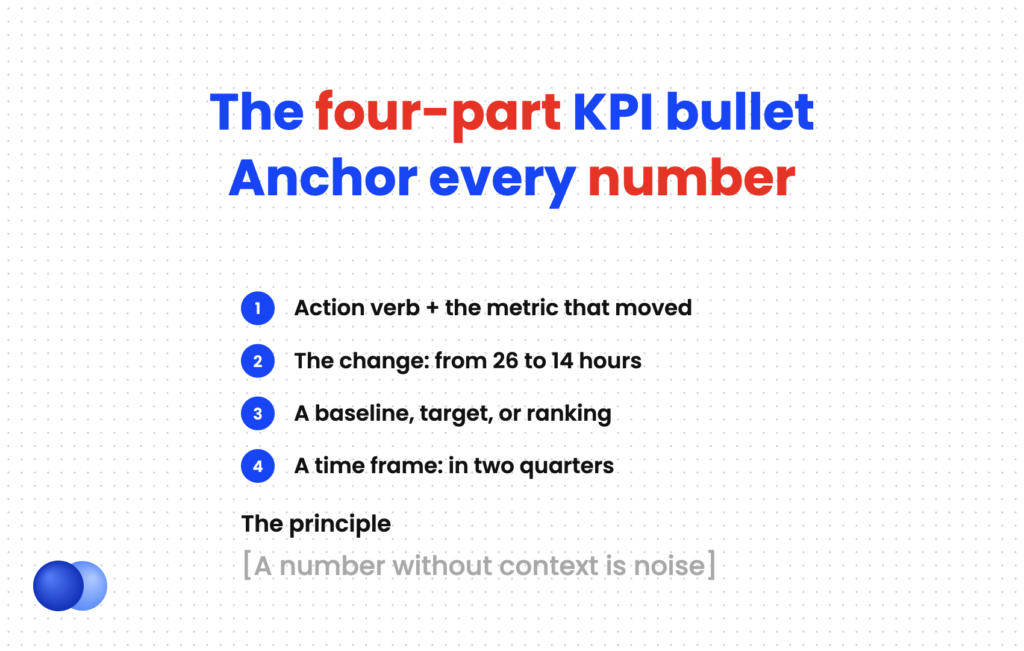
| Part | What it answers | Example |
|---|---|---|
| Action verb | What did you do? | Cut, grew, raised, recovered |
| Metric | Which KPI moved? | Average resolution time |
| Change | How much? | From 26 to 14 hours |
| Baseline or target | Compared to what? | Team goal of 20 hours |
| Time frame | Over how long? | In two quarters |
You do not need all five parts in every bullet. But you need at least the metric, the change, and one anchor: a baseline, a target, or a time frame.
Weak: Increased sales by 40%. Strong: Grew territory revenue 40% year over year, from $1.2M to $1.68M, finishing #2 of 14 reps.
Weak: Improved customer satisfaction. Strong: Raised CSAT from 82% to 91% in six months by rewriting 30 help-center articles.
Weak: Managed projects on time. Strong: Delivered 11 of 12 client projects on or before deadline in FY2025, against a team average of 8 of 12.
Notice the second half of each strong bullet. The ranking, the method, or the team average tells the recruiter the number is good. For more on bullet structure, read how to write resume bullet points.
Which KPIs Should You Choose for Your Role?
Choose the KPIs the target job posting mentions or implies, then pick your best result for each. A sales posting that stresses retention should see renewal rate before new-logo revenue. Use two or three KPIs per job, and favor outcome metrics like revenue, cost, or quality over activity metrics like calls made.
The decision rule is simple. Read the posting and circle every result it describes: "grow pipeline," "reduce errors," "improve adoption." Those are the KPIs that hiring manager is measured on. Lead with your results on the same indicators.
The posting is a reliable map. NACE found that more than 80% of employers highlight key skills when they write job descriptions.
Then rank your options by type. Outcome KPIs (revenue, cost, quality, retention) beat output KPIs (units shipped, tickets closed). Output KPIs beat activity KPIs (calls made, emails sent). Use activity numbers only when they show unusual scale.
| Role | Outcome KPIs to lead with | Weaker activity KPIs |
|---|---|---|
| Sales | Quota attainment, revenue, win rate, deal size | Calls per day |
| Marketing | Pipeline sourced, conversion rate, cost per lead | Posts published |
| Customer support | CSAT, first-contact resolution, resolution time | Tickets answered |
| Operations | On-time delivery, error rate, cost per unit | Orders processed |
| Project management | On-time and on-budget rate, scope delivered | Meetings run |
| Software engineering | Latency, uptime, deploy frequency, incidents | Tickets closed |
| Nursing and healthcare | Patient satisfaction, readmission or fall rates on your unit | Patients seen |
| Teaching | Test score growth, attendance, pass rates | Lessons taught |
Two or three KPIs per job is enough. Every bullet does not need a number, and a wall of percentages is hard to read. Our guide to resume accomplishments examples shows how to mix quantified and qualitative wins.
Where Do KPIs Go on Your Resume?
Put your single strongest KPI in the resume summary, then place two or three KPI bullets under each recent job, with the most relevant one first. Older roles need only one. Do not create a separate "KPIs" section, because recruiters want to see each result tied to the job where it happened.
Placement follows the same pattern recruiters read in: top to bottom, left to right. Your summary gets the headline number. Your experience section carries the proof.
SUMMARY Customer success manager with 6 years in B2B SaaS. Grew net revenue retention from 94% to 108% across a $9M book of business.
EXPERIENCE Customer Success Manager | Northwind Software | 2022 to Present - Grew net revenue retention from 94% to 108% in 12 months across 60 mid-market accounts - Cut logo churn from 11% to 6% by launching a 90-day onboarding playbook - Ranked #1 of 9 CSMs for expansion revenue in FY2025
Start each bullet with the verb, not the number. "Grew revenue 32%" scans better than "32% revenue growth achieved." For help framing your top line, see our resume summary guide. For the rest of the section, see writing work experience on a resume.
Mirror the posting’s KPI language
If the job posting says "first-contact resolution," do not write "solved issues on the first call." Use the posting's exact term once in your KPI bullet. It reads as fluency to the hiring manager and matches the keyword a screening system may scan for.
How Do You Show KPIs Without Exact Numbers?
If numbers are confidential, use percentages, ratios, rankings, or ranges instead of dollar amounts. If you never tracked a number, estimate conservatively with words like "about" or "over," and base it on something you can explain in an interview. Never invent a KPI you cannot defend when asked how you measured it.
Many people skip KPIs because they think they need exact data. You rarely do. UC San Diego's guide says it's okay not to have an exact number and suggests phrases like "approximately 50" or "over 75".
Use this ladder, from most to least precise:
- Exact figure: "Cut returns from 4.2% to 2.9%."
- Percentage only: "Cut returns by 31%." Useful when dollar values are confidential.
- Ranking: "Top 3 of 25 stores for return rate."
- Range or floor: "Over 40 accounts" or "$2M+ pipeline."
- Scope: "Handled returns for a 12-store region."
To rebuild missing numbers, check old performance reviews, sent emails, dashboards you still have access to, and award announcements. Then ask yourself one test question: could I explain how I got this number in an interview? If not, move down the ladder.
What Mistakes Make KPIs Look Fake?
KPIs look fake when they are too round, too large for the role, or missing context. A junior analyst claiming "$50M saved" or an unanchored "increased efficiency 300%" invites doubt. Credit the team when a result was shared, state your specific part, and keep every number consistent with your LinkedIn profile and interview answers.
Recruiters see inflated numbers every day. A believable KPI is specific, matches the scope of your title, and credits others where needed. Knowing the difference between duties vs. accomplishments on a resume also helps, because a duty with a number bolted on is still a duty.
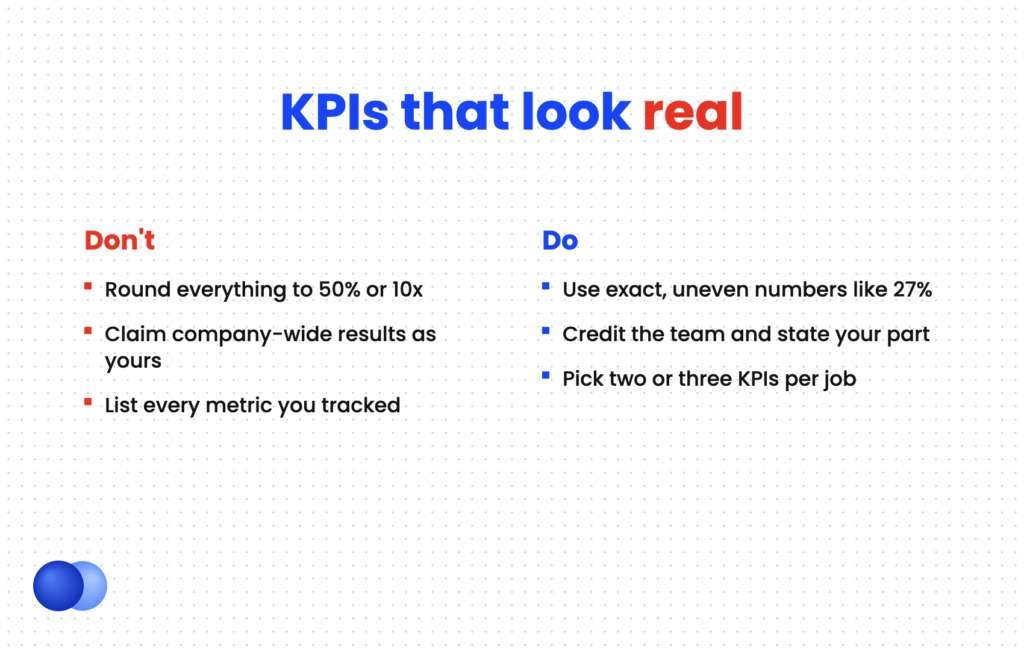
Use exact, uneven numbers when you have them, like 27% or $1.34M do: Say "led the team that" or "contributed to" for shared results do: Anchor each KPI with a baseline, target, or time frame do: Keep the same figures on your resume, LinkedIn, and in interviews
Round everything to 50%, 100%, or 10x dont: Claim company-wide results as your personal KPI dont: List every metric you tracked in a single job dont: Share confidential revenue or client names without permission
Once your KPI bullets are written, run the draft through the Rezoom ATS resume checker to confirm your metrics sit next to the keywords the posting uses.

Frequently asked questions
What is a KPI on a resume?
A KPI on a resume is a key performance indicator your employer used to measure your work, written as a result. Examples include quota attainment, customer satisfaction score, error rate, and on-time delivery rate.
How many KPIs should I put on my resume?
Aim for two or three KPI bullets per recent job and one for older jobs. Add your single strongest KPI to your summary. More than that tends to crowd out context.
Should I put KPIs in a separate section?
No. A separate KPI section strips each result from the job where it happened. Keep KPIs inside your work experience bullets and summary.
Can I use KPIs if my job was not numbers-driven?
Yes. Use scope (people served, projects handled), quality (error rates, audit results), speed (turnaround time), or rankings. Every role has some measure of doing it well.
Is it okay to estimate KPIs on a resume?
Yes, if the estimate is conservative and you can explain how you got it. Use words like "about" or "over" and avoid precise-looking numbers you cannot back up.
Should I use percentages or dollar amounts?
Use dollar amounts when they are impressive and shareable. Use percentages when figures are confidential or when the raw number would look small out of context.



Comments