Product Owner Resume Summary: Template and 9 Examples by Situation
Write a product owner resume summary in 3 lines: a template, 9 examples for new, technical, SaaS, SAFe and senior POs, plus CSPO, PSPO and backlog metrics.

On this pageWhat is a product owner resume summary?
- What is a product owner resume summary?
- How do you write a product owner resume summary?
- What are the best product owner resume summary examples?
- Which metrics belong in a product owner resume summary?
- Should you list CSPO, PSPO or SAFe in a product owner resume summary?
- What mistakes weaken a product owner resume summary?
- FAQ
- Sources
A strong product owner resume summary is 2 to 4 lines at the top of your resume. It names your certification (CSPO, PSPO or SAFe POPM), your years and product type, the team or backlog you own and one result tied to adoption, revenue, release speed or customer satisfaction. Copy the posting's framework and tool terms, and keep every number one you can explain.
A product owner resume summary is 2 to 4 lines that tell a hiring manager your product, your scope and one result. Lead with your title and certification, then prove your value with an adoption, revenue, release or satisfaction number.
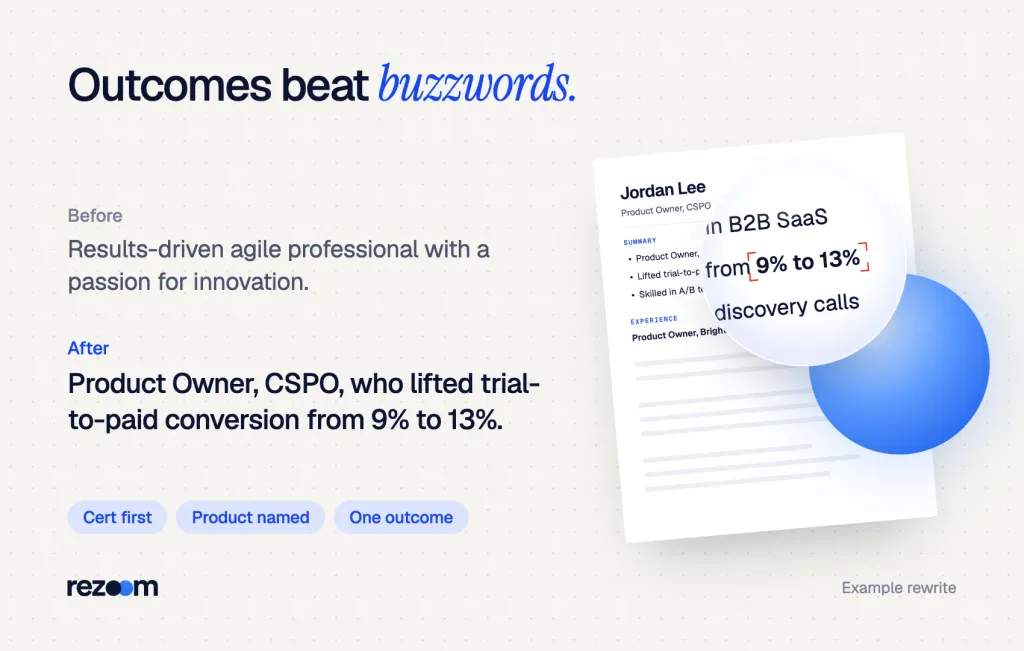
Most product owner resumes open with "results-driven agile professional with a passion for innovation." However, that line could describe a scrum master, a BA or a product manager. The table below shows what to lead with in your situation instead.
Quick answers by situation
| Your situation | What to lead with | Example line |
|---|---|---|
| New PO from BA, QA or scrum master | Certification and the backlog work you already did | CSPO and former BA who wrote 300+ user stories for a claims app |
| Technical product owner | Platform, APIs and engineering partners | Technical PO for a payments API serving 40 partner banks |
| SaaS product owner | Activation, retention or expansion revenue | SaaS PO who lifted trial-to-paid conversion from 9% to 13% |
| Enterprise or SAFe | Agile release train, PI planning and features | SAFe POPM owning 3 team backlogs on a 120-person release train |
| Regulated (health, finance) | Compliance and release quality | PO who shipped HIPAA-ready patient portal releases with zero audit findings |
| Senior PO moving to product manager | Product strategy, roadmap and P&L | Senior PO who owned a $6M product line roadmap for 4 years |
What is a product owner resume summary?
A product owner resume summary is a short profile at the top of the resume, usually 2 to 4 lines or 3 bullets. It states your certification, years and product type, the team or backlog you own and one measurable result, so a recruiter can see in seconds that you maximize product value.
A product owner turns business goals into a ranked backlog. So the summary must show both sides: the customer value and the delivery work. The Scrum Guide defines the role in one line.
The Product Owner is accountable for maximizing the value of the product resulting from the work of the Scrum Team.
Ken Schwaber and Jeff Sutherland, The 2020 Scrum Guide
What hiring managers check first
The Scrum Guide also lists the backlog work a PO owns: the Product Goal, backlog items, their order and their transparency1. As a result, recruiters scan your summary for proof of each part.
- Certification. Name CSPO, PSPO or SAFe POPM if you hold it.
- Product. Say what you own, such as a mobile banking app or a B2B billing platform.
- Scope. Give the team count, users, revenue or release train size.
- Proof. Add one result on adoption, revenue, cycle time or satisfaction.
For full resumes that build on these lines, browse Rezoom's product owner resume examples by experience level.
How do you write a product owner resume summary?
Use a four-part template: title and certification, years and product type, scope with one result, then 2 to 3 skills from the posting. Keep it to 2 to 4 lines. Write in the implied first person, so drop "I," and cut every buzzword a number already proves.
Here is the template in one line: [Title + certification] with [years] owning [product type] for [users or market] who [result with a number]. Skilled in [2 to 3 methods or tools from the posting]. Then trim it until each word earns its place.
- Name your title and certificationStart with "Product Owner, CSPO" or "Technical Product Owner, PSPO I" so the reader sees your status first.
- Add years and productState your years of experience and what you own, such as a B2B invoicing platform for mid-size firms.
- Prove one resultAdd one number on adoption, revenue, release cadence, cycle time or customer satisfaction.
- Match the postingClose with 2 to 3 terms the ad names, such as Jira, PI planning, story mapping or A/B testing.
Fill-in-the-blank product owner resume template
[TITLE + CERTIFICATION] with [NUMBER] years owning [PRODUCT TYPE] for [USERS OR MARKET].
[RESULT VERB] [METRIC] by [NUMBER] through [BACKLOG OR DISCOVERY ACTION].
Skilled in [TOOL FROM POSTING], [METHOD FROM POSTING] and [SKILL FROM POSTING].
Open your release notes, Jira reports and product analytics before you write. Then compare one metric before and after a feature you ranked first. That gap is your result, and it proves your judgment, not just your output.
What are the best product owner resume summary examples?
The best examples change with your situation. A new PO leads with a certification and the backlog work they already did. A technical PO leads with the platform, a SaaS PO with conversion or retention, a SAFe PO with the release train, and a senior PO with roadmap and revenue.
Use these product owner resume samples as models, then swap in your own facts. The numbers below are examples, so replace them with figures you can defend.
Entry-level PO from business analyst
The CSPO from Scrum Alliance comes from a two- to four-day course, with no exam required2, per Coursera. So it is a common first step for analysts who move into the role.
Product Owner, CSPO, with 4 years as a business analyst on an insurance claims platform. Wrote 300+ user stories and acceptance criteria that cut sprint rework from 18% to 7%. Skilled in backlog refinement, story mapping, Jira and stakeholder workshops.
From QA or scrum master
Product Owner, PSPO I, with 5 years as a scrum master for two mobile app teams. Helped teams raise release cadence from monthly to every two weeks with no rise in defects. Skilled in sprint planning, release planning, user interviews and Confluence.
Technical product owner
Technical Product Owner with 6 years owning payment APIs used by 40 partner banks. Cut partner onboarding time from 10 weeks to 4 by ranking SDK and documentation work first. Experienced in REST APIs, SQL, system design reviews and developer experience research.
SaaS product owner
Product Owner with 5 years in B2B SaaS for HR and payroll teams. Lifted trial-to-paid conversion from 9% to 13% by reworking onboarding in 3 releases. Skilled in A/B testing, Amplitude, customer discovery calls and OKR-based backlog ranking.
Enterprise or SAFe product owner
A SAFe POPM holder can "write epics, features, and stories," according to the Scaled Agile badge on Credly4. Therefore, name the release train and the PI cadence in your summary.
Product Owner, SAFe POPM, owning 3 team backlogs on a 120-person agile release train. Delivered 92% of committed PI objectives over 6 program increments for a retail order system. Skilled in PI planning, WSJF, feature writing and dependency management.
Regulated product owner (health or finance)
Product Owner with 7 years on patient portal and telehealth products. Shipped 14 releases with zero HIPAA audit findings and raised portal adoption from 38% to 61%. Experienced in compliance reviews, accessibility testing and clinician feedback loops.
Senior product owner moving to product manager
Senior Product Owner, CSPO and PSPO II, with 9 years in fintech lending products. Owned the roadmap for a $6M product line and grew annual revenue 24% in two years. Known for pricing tests, roadmap reviews and coaching two junior product owners.
If you aim for product management next, compare this version with our product manager resume objective examples. For more models across roles, see our business and management resume examples.
Which metrics belong in a product owner resume summary?
Use one or two outcome numbers, such as adoption, conversion, retention, revenue or customer satisfaction, plus one delivery number, such as release cadence or cycle time. Treat velocity with care: it measures team output, not value, so pair it with a result the customer felt.
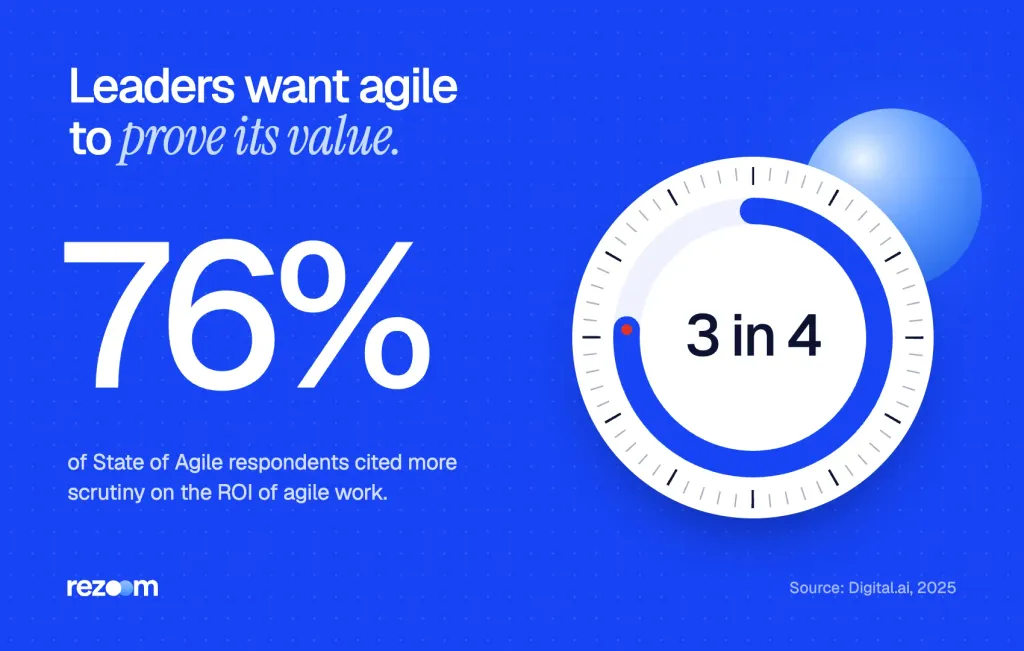
But leaders now ask what agile work earns. In Digital.ai's 18th State of Agile report, 76% of respondents cited more scrutiny on the business impact and ROI of agile5. Customer satisfaction, at 52%, was the top success measure.
| What to quantify | How to phrase it | Best for |
|---|---|---|
| Adoption | Raised feature adoption from 22% to 40% | All products |
| Conversion or revenue | Lifted trial-to-paid conversion 4 points | SaaS, e-commerce |
| Customer satisfaction | Raised CSAT from 3.9 to 4.5 | Service and support products |
| Release cadence | Moved from monthly to biweekly releases | Platform and mobile teams |
| Cycle time | Cut idea-to-release time from 70 to 30 days | Enterprise, SAFe |
| Velocity, with context | Kept velocity steady while cutting rework 60% | Any Scrum team |
Why velocity alone is weak
Velocity is a team planning tool, and every team counts story points differently. So "increased velocity 30%" invites a hard question. Instead, show what the extra output did for users or the business.
Our guide on how to put KPIs on a resume shows more ways to phrase these numbers.
KPIs on a resume: use the 4-part formula (metric, change, baseline, time frame), pick the right KPIs for your role and show results when numbers are private.
Free ATS score, the text the software extracts and your missing keywords. No sign-up.
Should you list CSPO, PSPO or SAFe in a product owner resume summary?
Yes, if you hold one. Put it right after your title in line one, because many postings screen for it. Match the framework the posting names: SAFe for large enterprises with release trains, CSPO or PSPO for Scrum teams. Never claim a credential you have not earned.
But each credential tells the reader something different. The PSPO I assessment has 80 questions in 60 minutes and an 85% passing score3, per a 2022 Scrum.org post. In contrast, the CSPO is earned through a course.
Which credential fits where
| Credential | Issuer | How you earn it | Best for |
|---|---|---|---|
| CSPO | Scrum Alliance | Two- to four-day course, no exam | Scrum teams, first PO role |
| PSPO I, II or III | Scrum.org | Timed assessment | Scrum teams that value tested knowledge |
| SAFe POPM | Scaled Agile | Course plus certification | Large enterprises on release trains |
For more on how to place these, read our guide to resume certifications. Then copy the posting's exact terms, as our guide on how to find keywords in a job description explains.
What to say if they push back
Interviewers often test the numbers in your summary. So prepare a short answer for each claim.
- "Was the conversion gain your work or the team's?" Say what you decided, such as ranking onboarding fixes above new features.
- "How did you say no to a senior stakeholder?" Name the data you used, such as usage numbers or a WSJF score.
- "You list PSPO I. What changed in how you work?" Give one habit, such as writing a clear Product Goal per quarter.
Hiring manager: "Your summary says trial-to-paid rose from 9% to 13%. What did you change?"
"I moved three onboarding fixes to the top of the backlog and pushed a reporting feature back a quarter."
Hiring manager: "How did sales react to that delay?"
"I showed them trial drop-off data each week. Then they agreed, because more trials meant more deals."
Your product owner cover letter can expand one of these claims into a full story.
What mistakes weaken a product owner resume summary?
The biggest mistakes are agile buzzwords with no proof, no product named, output numbers like story points with no outcome, a summary that reads like a scrum master's, and one version sent to every job. Each one hides the value you added, so the recruiter moves on.
So a product owner resume summary should prove your judgment. Instead of claiming you are "customer-focused," show the decision you made and what it changed. Other roles follow the same rule, as our sibling guide to the HR business partner resume summary shows.
Do
- Name your certification and product in line one.
- Give users, revenue, teams or release train size.
- Add one outcome on adoption, revenue or satisfaction.
- Use the posting's framework and tool names.
Don’t
- Open with "results-driven agile professional."
- Lead with velocity or story points alone.
- Describe scrum master duties as PO work.
- Claim a certification you have not earned.
Keep two saved versions: a Scrum version with CSPO or PSPO terms and a SAFe version with PI planning and features. Big companies often run SAFe, while startups rarely do. Then tailor the last line to each posting.
Final check before you apply
Before you send your product owner resume
To turn this template into a finished page fast, draft your summary in Rezoom's AI resume builder and tailor it to each posting. For general rules in every field, read our main guide to the resume summary.
Write an HR business partner resume summary that proves impact: a formula, 9 examples for new, senior, tech, healthcare and union HRBPs, plus metrics to use.
Free plan, no card.
Frequently asked questions
What should I write in a product owner resume summary?
First write your title and certification, your years and product type, the team or backlog you own and one result on adoption, revenue or satisfaction. Close with 2 to 3 skills from the posting.
How do I write a product owner summary with no PO experience?
Lead with your certification and the backlog work you already did as a BA, QA analyst or scrum master. Name one result, such as stories you wrote or rework you cut.
Is CSPO or PSPO better on a resume?
Neither wins everywhere. Match the posting: some ads name CSPO, others PSPO. The PSPO uses a timed assessment, while the CSPO comes from a course.
Should I put velocity in my product owner resume?
Only with context. Velocity measures team output, so pair it with an outcome, such as fewer defects or higher adoption.
How long should a product owner resume summary be?
So keep it to 2 to 4 lines or 3 short bullets, about 40 to 70 words. Move the rest of the detail into your experience section.
What is the difference between a product owner and a product manager on a resume?
A product owner usually owns the team backlog and works with developers each sprint. But a product manager owns the wider strategy, market and roadmap, so a summary for that role leads with revenue and roadmap results.
Sources
We opened and read each page below. The small numbers in the text point here. Pages that carry no publication date show n.d.
- Ken Schwaber and Jeff Sutherland, Scrum Guides2020
The Product Owner is accountable for maximizing product value and owns the Product Goal, backlog items, their order and their transparency
- Coursera2026
The Scrum Alliance CSPO comes from a two- to four-day course with no exam required
- Scrum.org2022
The PSPO I assessment has 80 questions in 60 minutes with an 85% passing score
- Scaled Agile on Credlyn.d.
SAFe 6 POPM holders can write epics, features and stories, and earn the badge by taking the course and the certification
- Digital.ai via Business Wire2025
In the 18th State of Agile report, 76% cited more scrutiny on the ROI of agile and 52% named customer satisfaction the top success measure
Mohammad has spent more than ten years designing consumer products and leads product at Rezoom, deciding what gets built and what gets left out. His guides cover the whole job search, from resume sections and cover letters to interview answers and career moves.
Goodi, M. (2026, October 26). Product Owner Resume Summary: Template and 9 Examples by Situation. Rezoom. https://rezoom.io/product-owner-resume-summary/