

Summary
To write resume bullet points, start with an action verb, name what you did, add how or at what scale, and end with the result. Keep each bullet to one or two lines, drop pronouns, and put your most relevant win first. Choose a formula based on what you have: XYZ when you have a metric, ACE when you have context but no clean number, and a short problem-action-result line for fixes and turnarounds.
Here is how to write resume bullet points that get read: use four parts: action verb, what you did, how or at what scale, and the result. Keep each one to a line or two and lead with the win that matters most for the job.
That is the whole method. The hard part is applying it when your work does not come with neat numbers, or when you have ten duties and room for four lines.
This guide shows how to write resume bullet points for any situation. It includes a rule for choosing between the popular formulas, and a fallback for bullets with no metrics.
How do you write resume bullet points that get read?
Build every bullet from four parts: an action verb, the task, the method or scale, and the outcome. Example: "Rebuilt onboarding emails in HubSpot, lifting 30-day activation from 41% to 55%." Keep it to one or two lines, skip pronouns, and use past tense for past roles and present tense for your current one.
Recruiters give your first screen very little time. The Ladders eye-tracking study measured an average of 7.4 seconds. Its best-performing resumes paired bold job titles with bulleted accomplishments and short declarative sentences.
So strong resume bullet points do one job: prove a skill with evidence, fast. The four-part build does that.
- Action verb. "Led," "Rebuilt," "Negotiated." Not "Responsible for." Pull from our 500 action verbs if you get stuck.
- What you did. The task, project or problem in plain words.
- How, or at what scale. The tool, method, team size, budget or volume.
- Result. What changed because you did it.
UConn's career center frames the same idea as "what you did, how you did it, why you did it." Either way, the reader should finish the line knowing your skill and your impact.
Verb only: Managed inventory.
+ What: Managed inventory for a 3-location bakery.
+ How/scale: Managed inventory for a 3-location bakery using a shared Google Sheets tracker.
+ Result: Managed inventory for a 3-location bakery with a shared Google Sheets tracker, cutting weekly food waste by roughly a third.
Which formula should you use for resume bullet points?
Pick the formula that matches the evidence you have. Use XYZ (accomplished X, measured by Y, by doing Z) when you have a clear metric. Use ACE (action, context, end result) when the context is the impressive part. Use a problem-action-result line for fixes and turnarounds. All three produce one or two tight lines.
Top guides list five or more formulas and leave you to choose. That creates more rewriting, not better bullets. A simpler rule: let your evidence decide.
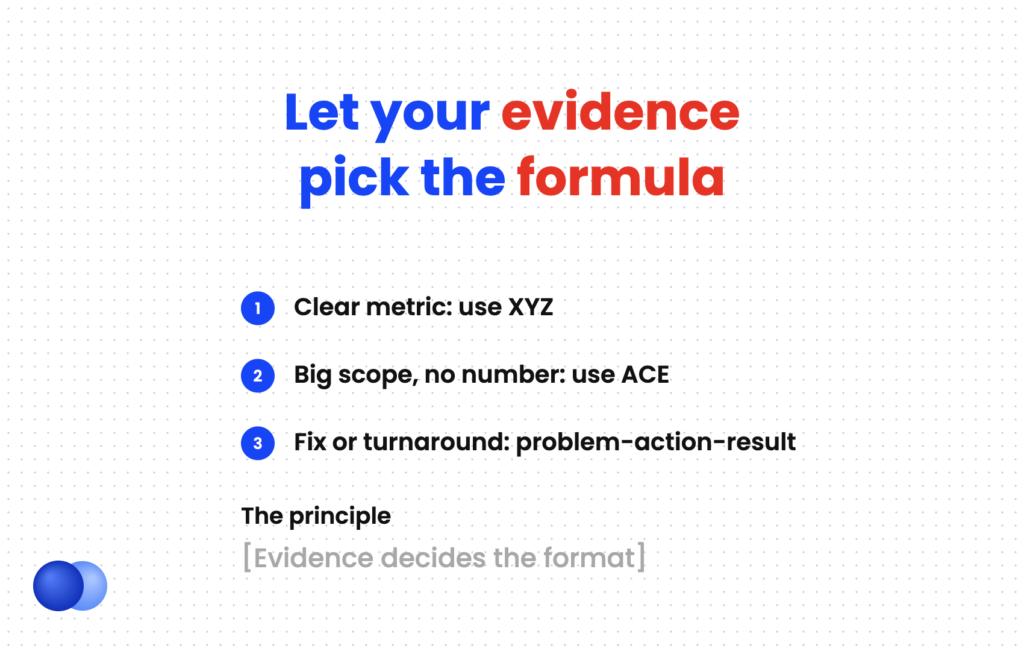
| Formula | Structure | Best when you have | Example |
|---|---|---|---|
| XYZ | Accomplished X, measured by Y, by doing Z | A clear metric | Cut ticket backlog 45% by building a triage macro library in Zendesk |
| ACE | Action, Context, End result | Impressive scope but no clean number | Coordinated a 200-person volunteer event for a regional food bank, now run annually |
| Problem-Action-Result | Problem, what you did, outcome | A fix, save or turnaround | Replaced a failing vendor mid-season, keeping all 18 client shipments on schedule |
| Four-part build | Verb, what, how, result | Everyday tasks | Trained 6 new cashiers on POS and returns policy, cutting register errors in their first month |
The XYZ structure appears in UNC's resume guide, alongside two other frameworks. ACE comes from Princeton's resume guide: start with an action verb, give context in quantitative and qualitative terms, then show the end result.
STAR is useful too, but it is an interview framework. Its four parts usually make a bullet too long. Use STAR to prepare stories for your interview, and compress them into one of the formats above for the page. Our STAR method guide covers the interview side.
How do you turn a job duty into an accomplishment?
Ask three questions about each duty: How much or how many? What improved because I did it? Who benefited? Then rewrite the line so it ends on that answer. "Handled customer calls" becomes "Resolved 50+ customer calls daily, keeping first-call resolution above team target for 4 straight quarters."
Most weak resume bullet points are job descriptions in disguise. They say what the role required, not what you achieved in it. The fix is a short interrogation of every line.
- How much or how many? Volume, budget, headcount, frequency.
- What improved? Time, cost, quality, revenue, satisfaction, risk.
- Who benefited? Customers, a team, a client, leadership.
Harvard's career center asks for language that is "fact-based (quantify and qualify)" and focused on results. Those three questions get you there. For a deeper look at the difference, see duties vs. accomplishments on a resume and our accomplishments examples.
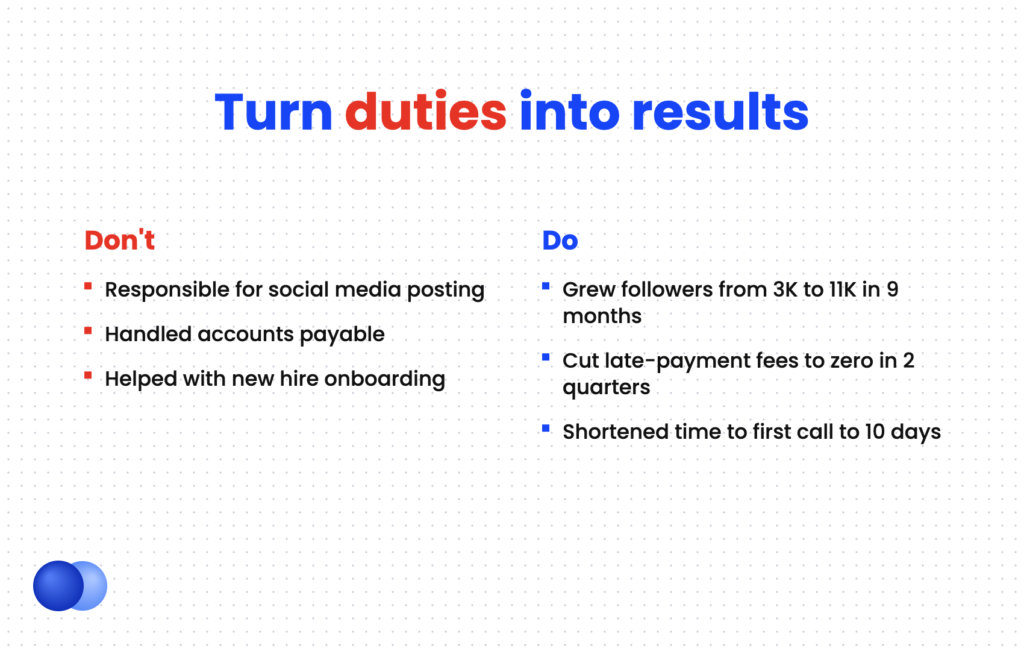
Duty: Responsible for social media posting. Accomplishment: Planned and posted 5 weekly Instagram and TikTok posts, growing followers from 3K to 11K in 9 months.
Duty: Handled accounts payable. Accomplishment: Processed 300+ vendor invoices monthly in NetSuite, cutting late-payment fees to zero within 2 quarters.
Duty: Helped with new hire onboarding. Accomplishment: Rewrote the new-hire checklist for a 40-person sales team, shortening time to first call from 3 weeks to 10 days.
What if your resume bullet points have no numbers?
Use scale, frequency, scope or a qualitative outcome instead. "Supported 3 department heads," "Ran weekly inventory counts," or "Wrote the SOP still used by the team" all prove impact without a percentage. Estimates are fine if you can defend them in an interview. Never invent a figure.
Plenty of jobs do not track your personal metrics. Teachers, assistants, nurses and junior staff often have no dashboard. You still have evidence. It just comes in other forms.
- Scale: "Managed calendars for 3 executives across 2 time zones."
- Frequency: "Prepared weekly board-ready sales summaries."
- Scope: "Sole point of contact for 25 key accounts."
- Recognition: "Selected to train all new hires after 6 months."
- Durable output: "Wrote the returns SOP adopted company-wide."
If you know a rough number, use a range or a qualifier like "about" or "30+." Only include figures you could explain to an interviewer. Our guide on how to quantify your resume covers estimation in detail, and how to put KPIs on a resume helps when your role does have targets.
How long should each bullet be, and how should it be formatted?
Aim for one line, and never more than two. Start with a verb, drop "I" and most articles, and keep punctuation consistent: either every bullet ends with a period or none do. Order bullets by relevance to the target job, not by date. Use a simple round bullet so applicant tracking systems parse the text cleanly.
Length is where good content often dies. Two lines is the ceiling. If a bullet runs to three, split it into two achievements or cut the method details.
Formatting rules that hold across every guide worth trusting:
- Verb first, no pronouns. Career centers at UConn and UNC both say to drop "I" and "my." Our guide on using I on a resume explains why.
- Tense matches the role. Present for your current job, past for the rest. See past or present tense on a resume.
- Best first. The top bullet under each job gets the most attention. Put your strongest, most relevant result there.
- Plain symbols. Standard round bullets or hyphens parse reliably. Avoid icons and custom glyphs.
- One punctuation style. Periods or no periods, applied everywhere.
How many bullets each job gets depends on its recency and relevance. We cover that separately in how many bullet points per job on a resume.
Start every bullet with a specific action verb. do: End with a result, number or visible outcome. do: Put the most relevant achievement first. do: Keep each bullet to one or two lines.
Open with "Responsible for" or "Duties included." dont: Write in full paragraphs or use "I." dont: Reuse the same verb three bullets in a row. dont: Invent metrics you cannot explain.
How do you tailor resume bullet points to a job posting?
Read the posting and list its top five skills and tools. Make sure each one appears in at least one bullet, in the employer's own wording, backed by a result. Then reorder bullets so the most relevant ones sit at the top of each role. Tailoring changes emphasis, not facts.
Knowing how to write resume bullet points is half the work. Tailoring is where a solid bullet becomes a winning one. Recruiters and applicant tracking systems both look for the posting's language.
Run this three-pass edit before each application:
- Match. Highlight the posting's must-have skills. Find the bullet that proves each one, and use the same term. If they say "stakeholder management," do not write "worked with partners."
- Reorder. Move matching bullets to the top of each role.
- Cut. Drop bullets that support none of the posting's priorities to make room.
Our resume keywords guide shows how to find the right terms. You can also weave in transferable skills when changing fields.
The so-what test
Read each bullet and ask "so what?" If the line does not answer it, add the result. If you cannot name a result at all, the bullet is probably a duty and may not deserve a spot on the page.

When your bullets are drafted, paste them into the Rezoom AI resume builder to tighten wording and match them to a specific job posting.
Frequently asked questions
What makes a good resume bullet point?
A good bullet starts with an action verb, names a specific task, and ends with a result. It fits on one or two lines and uses keywords from the job posting.
Should resume bullet points have periods?
Either style is acceptable. What matters is consistency, so use periods on every bullet or on none.
Should resume bullet points be full sentences?
No. Use sentence fragments that start with a verb and leave out "I." That keeps each line short and easy to scan.
How long should a resume bullet point be?
One line is ideal and two is the limit. If a bullet runs longer, split it or cut the method details.
Can I write resume bullet points with AI?
Yes, as a first draft. Always add your own real numbers and results, and cut any claim you cannot back up in an interview.
What is the XYZ formula for resume bullets?
It is a structure that reads "accomplished X, as measured by Y, by doing Z." It works best when you have a clear metric for your result.



Comments