

Summary
Transferable skills are abilities you built in one job, school, or life role that work in another, such as communication, problem-solving, and project coordination. To use them on a resume, map the skills in the target posting, translate your past work into that posting's language, and prove each skill with a result in a bullet. Listing skills alone is weak. Employers increasingly hire on skills, so evidence of how you used them carries the most weight.
Transferable skills are the abilities you can carry from one job to another, like communication, problem-solving, and organization. The best transferable skills for a resume are the ones the target job asks for and that you can prove with a specific result from past work. Juggling several of them at once counts as well, as long as you know how to present multitasking on a resume.
That proof matters more than ever. NACE reports that 70% of employers now use skills-based hiring, up from 65% a year earlier. LinkedIn estimates a skills-based approach could expand the US talent pool 15.9 times compared to hiring on job titles alone.
So the question is not whether you have transferable skills. You do. The question is how to show them so a recruiter sees the match. This guide gives you a three-step method, a translation table, and copy-ready examples.
What Are Transferable Skills on a Resume?
Transferable skills are abilities that stay useful across jobs, industries, and settings. They include soft skills like communication and teamwork and portable hard skills like budgeting, data analysis, or scheduling. On a resume, they connect experience that looks unrelated to the job you want, which is why career changers and new graduates lean on them.
Transferable skills are not only soft skills. A retail manager who built weekly staff schedules has a scheduling skill that works in operations, healthcare, or logistics. A teacher who analyzed test data has a data skill that works in training or research. If moving fast into the new field is the real selling point, see quick learner on a resume for stronger wording and the proof to back it.
The University of Illinois Chicago career office puts it plainly: "every job you have equips you with transferable skills." That includes food service, caregiving, tutoring, and course projects.
They matter for experienced workers too. The median worker has been with their current employer for 4.1 years, according to BLS data from January 2026. Most careers include several employers, and often more than one field. Your skills are the thread that connects them.
Which Transferable Skills Do Employers Want Most?
Employers most often look for teamwork, problem-solving, and communication, followed by technical skills, work ethic, and analytical ability, according to NACE's 2026 employer survey. The right mix for you depends on the posting. Pick the four to six transferable skills the job names most, then match each with your strongest evidence.
NACE's 2026 Spring Update found that employers want candidates who can "work in a team, problem-solve, and communicate effectively." Employers also valued technical skills, strong work ethic, and analytical ability. More than half of respondents wanted to see 10 or more skills on a resume.
Here are the transferable skills that show up across most job postings, with a concrete way to phrase each:
| Transferable skill | Specific version to write | Where it often comes from |
|---|---|---|
| Communication | Client presentations, technical writing, de-escalation | Sales, teaching, customer service |
| Problem-solving | Root-cause analysis, troubleshooting, process fixes | IT, operations, retail |
| Teamwork | Cross-functional coordination, peer training | Almost any team role |
| Leadership | Supervising shifts, mentoring, leading projects | Retail, military, student groups |
| Organization | Scheduling, inventory control, event planning | Admin, hospitality, parenting roles |
| Data and analysis | Reporting, spreadsheets, tracking outcomes | Teaching, finance, research |
| Adaptability | Learning new systems, changing priorities | Startups, healthcare, freelancing |
| Budgeting | Managing spend, forecasting, cost control | Nonprofits, events, operations |
Notice the middle column. UC San Diego's resume guide advises keeping skills "specific and position-focused", such as "public speaking" rather than "communication." For deeper lists, see our guides to soft skills for a resume and hard skills examples.
How Do You Find Your Transferable Skills?
Use a three-step method. First, map the skills the target posting repeats. Second, list what you did in past roles that used those same skills, including volunteer and school work. Third, translate your old job language into the new field's terms. Aim for overlap on at least half of the posting's key skills before applying.
Most guides tell you to "reflect on your experience." That is too vague. Use this method instead.
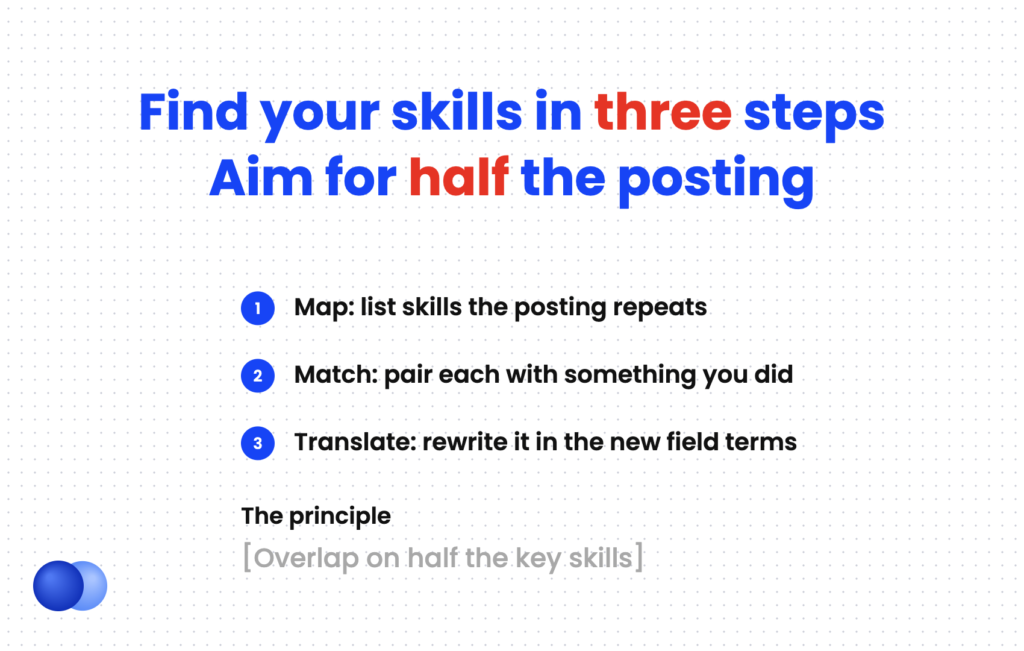
Step 1: Map. Copy the posting's requirements into a list. Highlight every skill or result it mentions more than once. Those repeats are what the hiring manager cares about most.
Step 2: Match. Next to each skill, write one thing you did that used it. Pull from jobs, volunteering, school projects, and side work. If nothing matches, leave it blank.
Step 3: Translate. Rewrite each match in the new field's language. A "shift lead" becomes a "team supervisor." "Upselling" becomes "consultative sales."
LinkedIn's research treats roles as related when they share at least 50% of key skills with the target job. That makes a useful personal benchmark. If you can fill in half or more of your map, you are a credible candidate. If not, target a nearer role first.
Borrow the posting’s nouns, keep your verbs
Translation fails when you swap in jargon you cannot discuss. Keep your real action verb, like "trained" or "resolved," and borrow the posting's noun, like "new-hire onboarding" or "escalations." You stay honest, and the recruiter sees their own language. Our guide to resume keywords shows how to pull those terms.
How to Show Transferable Skills on a Resume
Show transferable skills in three places: name two or three in your summary, prove them in experience bullets with results, and list the specific versions in your skills section. The bullets carry the most weight. A skill in a list is a claim, while a skill used in a bullet with an outcome is evidence.
Here is how the same skill looks weak versus strong. The strong version names the skill in the new field's terms and ties it to a result.
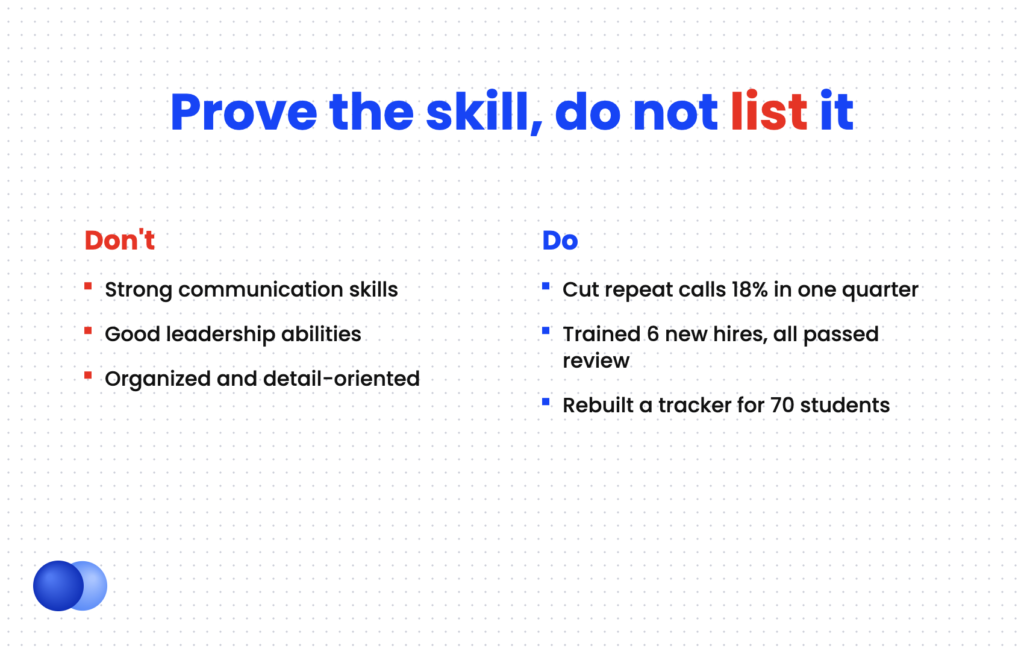
Weak: Strong communication skills. Strong: Explained billing changes to 40+ customers a day, cutting repeat calls 18% in one quarter.
Weak: Good leadership abilities. Strong: Supervised a 9-person weekend shift and trained 6 new hires, all of whom passed 90-day review.
Weak: Organized and detail-oriented. Strong: Coordinated schedules for 3 teachers and 70 students, rebuilding the attendance tracker in Google Sheets.
Each strong bullet follows the same shape: action verb, what you did, and a measurable result. For more on that shape, see how to write resume bullet points. To add numbers when you think you have none, read how to quantify your resume.
Your summary should name the bridge between your past and your target. It tells the recruiter how to read everything below it.
Former high school math teacher moving into corporate learning and development. Designed 120+ lessons, analyzed assessment data for 150 students a year, and trained 12 new teachers on a district curriculum rollout. Skilled in instructional design, Google Workspace, and presenting to groups of 30+.
If your whole resume needs restructuring for a pivot, our career change resume guide covers format choice. For section placement, see how to highlight skills on your resume.
What Mistakes Hide Your Transferable Skills?
The biggest mistakes are listing generic skills with no proof, keeping old-industry jargon the new employer will not understand, and leaving out unpaid experience that shows the skill best. Another common error is listing every skill you have rather than the ones the posting asks for, which buries the match a recruiter is looking for.
Recruiters scan quickly, so any mismatch between your words and theirs costs you. The fixes are simple once you see them.
Tie each transferable skill to a result in a bullet do: Translate old titles and jargon into the target field's terms do: Include volunteer, freelance, and school work that proves a skill do: Tailor your skills list to each posting
List "communication" or "team player" with no evidence dont: Keep military, academic, or retail acronyms unexplained dont: Hide your strongest transferable skill in an old job at the bottom dont: Claim skills you cannot back up with an example in an interview
Returning after time away or leaving the military? The same method applies. See our guides for a military-to-civilian resume and a returning-to-work resume.
When your map is done, the Rezoom AI resume builder can help you turn each match into a tailored bullet for the posting you are targeting.

Frequently asked questions
What are the top transferable skills for a resume?
Communication, problem-solving, and teamwork top most employer lists, followed by leadership, organization, data analysis, and adaptability. The right ones for you are the skills the target posting repeats.
How many transferable skills should I list?
Name two or three in your summary and prove four to six in your bullets. Your skills section can hold more, but only if each one is relevant to the job.
Are transferable skills the same as soft skills?
No. Many soft skills are transferable, but so are portable hard skills like budgeting, scheduling, Excel, and data analysis. Transferable describes where a skill can be used, not what type it is.
How do I show transferable skills with no work experience?
Use school projects, volunteering, clubs, caregiving, and part-time jobs. A group project shows teamwork and deadlines, and a club treasurer role shows budgeting.
Should I use a functional resume to highlight transferable skills?
Usually not. Most recruiters prefer a chronological or hybrid format that ties skills to real jobs and dates. A hybrid format with a short skills summary at the top works well for career changers.
How do I describe transferable skills in a cover letter?
Pick one or two skills the posting stresses and tell a short story of using each one, with a result. Then state how that experience applies to the new role.



Comments