Another Word for Quick Learner: 25 Phrases That Come With Proof
Need another word for quick learner? Get 25 alternatives sorted by resume summary, bullets, skills, cover letter and interview, each with a proof-based line.

On this pageWhat is another word for quick learner on a resume?
- What is another word for quick learner on a resume?
- Why do employers still care about fast learners?
- Which quick learner synonyms work in a resume summary?
- How do you show fast learning in resume bullets and the skills section?
- How do you say quick learner in a cover letter?
- How do you describe fast learning in a job interview?
- Which words should you avoid instead of quick learner?
- FAQ
- Sources
The best other word for quick learner depends on where it goes. In a resume summary, use "adaptable" or "quick study" plus a time frame. In bullets, use verbs like "mastered," "ramped up" or "cross-trained" with a number. In a cover letter, tell one short story about learning a new system fast. Every synonym needs proof, because employers want examples, not labels.
Another word for quick learner works only when proof sits next to it. Pick the phrase that fits the spot: "adaptable" in a summary, "mastered" or "ramped up" in a bullet, a short story in a cover letter. Then add how fast you learned and what changed.
"Quick learner" is not a bad claim. But anyone can type it, so a hiring manager skims past it. The fix is to swap the label for a word that points to a result.
Quick answers by situation
| Your situation | What to say instead | Example line |
|---|---|---|
| Resume summary | Adaptable, quick study | "Adaptable office assistant who learned three scheduling systems in one year" |
| Resume bullet | Mastered, ramped up, cross-trained | "Ramped up on Salesforce in 2 weeks and closed 14 tickets on day 10" |
| Skills section | Active learning, learning agility | "Active learning: earned Google Workspace certificate in 3 weeks" |
| Cover letter | Get up to speed, grasp new tools | "I got up to speed on a new POS system before my first weekend shift" |
| Interview | Coachable, curious | "My manager showed me once, and I trained the next hire" |
| No experience yet | Self-taught, upskilled | "Self-taught Excel pivot tables to track club budget for 40 members" |
What is another word for quick learner on a resume?
Good alternatives include adaptable, quick study, versatile, resourceful, self-taught, mastered, ramped up, cross-trained, upskilled and coachable. The right one depends on the section: adjectives fit a summary, action verbs fit bullets, and named skills fit a skills list. Each word needs a time frame or result next to it, or it reads like filler.
Another word for quick learner should do two jobs. It should sound less generic, and it should hint at a fact you can show. "Adaptable" alone is still a label, yet "adaptable" plus "learned three systems in one year" is evidence.
So think in two parts: the word and the proof. The word gets attention, and the proof earns trust. Our main guide to listing a quick learner on a resume covers when to use the phrase itself.
Quick learner on a resume? Use fast learner synonyms recruiters believe, a ramp-up proof formula, and copy-ready bullets that show how quickly you learn.
All 25 alternatives at a glance
| Where it goes | Alternatives | Proof to add |
|---|---|---|
| Resume summary (7) | adaptable, quick study, versatile, resourceful, agile learner, self-directed, self-starter | Time frame, number of tools or roles |
| Resume bullets (7) | mastered, ramped up, picked up, cross-trained, self-taught, upskilled, adapted | Days or weeks, plus the result |
| Skills section (3) | active learning, learning agility, adaptability | A certificate, course or tool next to it |
| Cover letter (4) | get up to speed, grasp new concepts, learn on the job, take on new tools | One short story with an outcome |
| Interview (4) | coachable, curious, receptive to feedback, learn by doing | A STAR story told in under 2 minutes |
"Active learning" is not a buzzword we made up. O*NET, the U.S. Labor Department's job database, lists it as a basic skill. It defines it as "understanding the implications of new information for both current and future problem-solving and decision-making."4
Why do employers still care about fast learners?
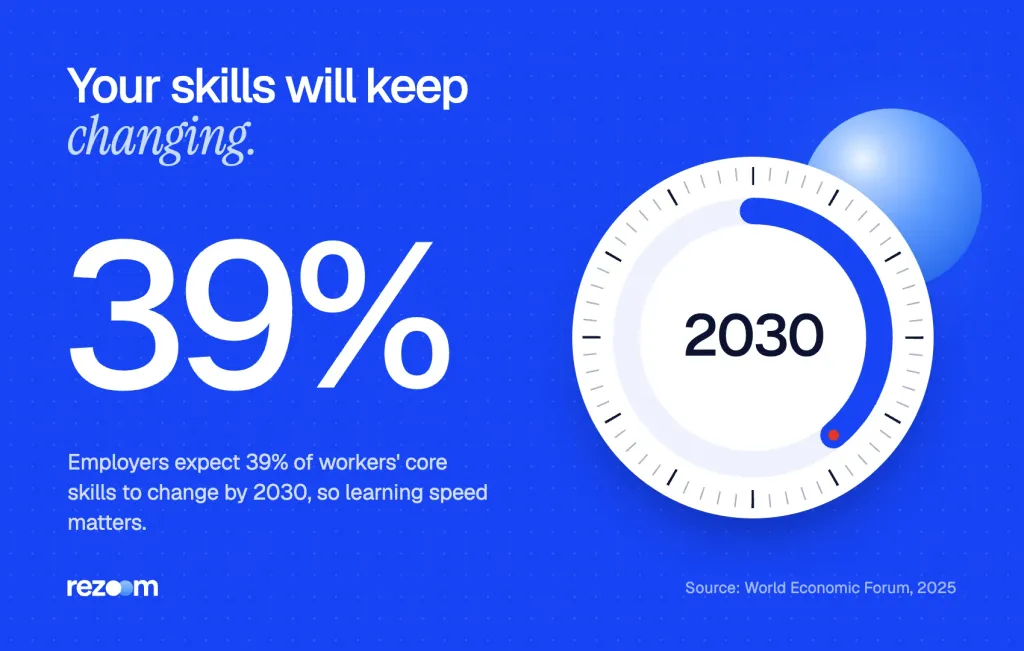
Jobs keep changing, so employers value people who learn new tools without long training. The World Economic Forum's 2025 report says employers expect 39% of workers' core skills to change by 2030. Resilience, flexibility and agility also gained ground as a core skill. So learning speed matters, and proof matters more.
Employers in the World Economic Forum's Future of Jobs Report 20253 expect 39% of workers' core skills to change by 2030. The same report says "resilience, flexibility and agility" rose 17 points as a core skill since 2023. Half of employers worldwide also call curiosity and lifelong learning a core skill.
But employers don't hire a label. NACE's Job Outlook 2026 Spring Update says teamwork, problem-solving and communication top the list of skills employers look for on resumes. It also says something blunt about how to show them.
It is not enough for candidates to simply list their skills: Employers want to see examples.
NACE, Job Outlook 2026 Spring Update
That line from the NACE 2026 press release1 is the whole case for swapping "quick learner." A synonym with an example beats the plain label every time. Learning speed also pairs well with the problem-solving skills for a resume that NACE ranks near the top.
Which quick learner synonyms work in a resume summary?
In a summary, use one adjective such as adaptable, versatile, quick study or resourceful. Then back it with a fact: how many tools, roles or weeks. Keep the summary to two or three lines. Don't stack three learning words in a row, because they cancel each other out and push out real results.
The summary is the one place where an adjective still works. So choose one word and prove it in the same sentence.
Summary alternatives with example lines
- Adaptable. "Adaptable office assistant who learned 3 scheduling systems in one year."
- Quick study. "Quick study in new software; trained on Zendesk in 5 days."
- Versatile. "Versatile support rep who covered phones, chat and email queues."
- Resourceful. "Resourceful coordinator who taught herself Canva to cut design costs."
- Self-directed. "Self-directed learner who finished 2 Excel courses while working full time."
JORDAN LEE
Administrative Assistant | Chicago, IL
Adaptable administrative assistant with 1 year of front-desk work.
Learned 3 scheduling systems and trained 2 new hires on them.
Known for clean calendars, fast replies and accurate records.
If you want to see how real summaries balance adjectives and facts, browse our administrative resume examples. Most of them use one trait word, then a number.
Pick the single trait that matters most for the job post. If the post says "fast-paced," use "adaptable." If it lists five tools, use "quick study" and name the tools.
How do you show fast learning in resume bullets and the skills section?
In bullets, drop the adjective and use an action verb such as mastered, ramped up, picked up, cross-trained or self-taught. Add how long it took and what happened next. In the skills section, list "active learning" or "adaptability" only next to a real certificate, course or tool, so the skill has a source.
Bullets are where hiring managers look for proof. So use a verb that shows learning in motion, then add a time frame and a result.
Bullet verbs that replace "quick learner"
- Pick the verbChoose mastered, ramped up, picked up, cross-trained, self-taught, upskilled or adapted.
- Name what you learnedSay the tool, process or role, such as "Salesforce" or "returns desk."
- Add the time frameWrite the days or weeks it took, because speed is the whole point.
- Show the resultEnd with what you did next: tickets closed, people trained, errors cut.
SAM CARTER
Customer Service Representative | Austin, TX
Ramped up on Salesforce Service Cloud in 2 weeks; closed 14 tickets solo by day 10.
Cross-trained on billing and returns, covering 3 queues during peak season.
Mastered the new phone system in 1 shift and wrote a one-page guide for the team.
Picked up basic Spanish phrases to help 20+ callers a week without a transfer.
Customer service is a great field for these verbs, because new tools and policies roll out often. Our customer service representative resume example shows bullets that pair fast ramp-up with call and ticket numbers.
Customer service representative resume example
See how a junior rep turns fast training into numbered bullets instead of a quick learner label.
For the full method, read our guide on how to write resume bullet points. It shows how to put the verb, the task and the number in the right order.
Resume bullet points examples for 8 roles, plus a 4-part formula, a rule for picking XYZ, ACE or STAR, and fixes for bullets that have no numbers.
The fill-in-the-blank bullet
[Verb: mastered / ramped up / picked up] [tool or process] in [days or weeks], then [result with a number].
Example: Picked up QuickBooks in 3 weeks, then reconciled 120 monthly invoices with zero late fees.
What to put in the skills section
The skills section should hold named skills, not traits. So list "active learning" or "adaptability" only if a real item sits next to it. For example, write "Active learning: Google Workspace certificate (3 weeks)."
Learning words also fit next to other soft skills. Our guide to organizational skills for a resume shows how to pair a trait with a tool in the same line.
Free ATS score, the text the software extracts and your missing keywords. No sign-up.
How do you say quick learner in a cover letter?
In a cover letter, don't name the trait. Tell one short story instead: what you had to learn, how long it took and what you did with it. Use phrases like "got up to speed," "grasped the new system" or "learned on the job." Keep it to two or three sentences in the middle paragraph.
The cover letter is where "quick learner" fails most, because the reader wants a story. George Mason's Writing Center says it plainly: "if you make a claim about yourself, provide evidence to support that claim."5 Penn's career services also tells writers to use specific stories6 instead of listing traits.
So when people ask for another word for quick learner in a cover letter, the honest answer is a short story. Use one of these four phrases to start it.
Cover letter phrases with example lines
- Get up to speed. "I got up to speed on our new POS system before my first weekend shift."
- Grasp new concepts. "I grasped the clinic's billing codes in a week and cut claim errors."
- Learn on the job. "I learned inventory software on the job and now run the weekly count."
- Take on new tools. "When our office moved to Teams, I took on the setup for 12 coworkers."
Last spring, our office switched to a new scheduling system with two days' notice. I learned it over one weekend and booked the full Monday calendar without a single conflict. By Friday, I had trained two coworkers, and I can bring that same speed to your front desk.
For more full letters in this field, see our administrative cover letter examples. Look at how each one uses a single story in the middle paragraph.
Find the one tool or task in the post that you have never used. Then tell a story about learning a similar tool fast. That answers the hiring manager's real worry before they ask it.
How do you describe fast learning in a job interview?
In an interview, say "I'm coachable" or "I learn by doing," then give a STAR story. Describe the situation, the task, the actions you took to learn and the result. Keep it under two minutes. If the interviewer pushes back, point to a time frame, a number or a person you trained.
Interviewers ask about learning because they want to see how you handled new things in the past. The University of Washington's career center says behavior questions aim to show "how you have handled situations in the past."7 Its STAR guide puts about 60% of the answer on the Action part.
Interview words with example lines
- Coachable. "My lead showed me the returns process once, and I ran it alone the next day."
- Curious. "I read the product manual on my first night, so I could answer callers by day two."
- Receptive to feedback. "My manager flagged slow replies, so I built templates and cut my time in half."
- Learn by doing. "I learn best hands-on, so I asked to shadow the night shift for a week."
If they ask you to sum yourself up in a word, "adaptable" works well. Our guide on how to answer "describe yourself in one word" shows how to back that word with a quick story.
What to say if they push back
- "Everyone says they learn fast." Give the time frame: "I learned it in 2 weeks, and here is what I closed."
- "You haven't used our software." Name a similar tool: "I learned Zendesk in 5 days, and your tool works the same way."
- "How do I know you'll keep up?" Point to a person: "I trained the next hire on the same system."
Interviewer: "You've never used Salesforce. Why should I believe you'll pick it up?"
"At my last job, I learned Zendesk in five days and closed 14 tickets on my own by day ten."
Interviewer: "That's a different tool."
"It is, but the ticket flow is the same. I'd ask for one shadow shift, then I can take my own queue."
Which words should you avoid instead of quick learner?
Avoid "eager to learn," "willing to learn," "fast learner" and "learns fast" on their own. They point to a gap instead of a strength. Also skip slang like "sponge" or "rockstar." Swap each one for a verb with a time frame, such as "mastered Excel in 3 weeks."
Some swaps make things worse. "Eager to learn" and "willing to learn" tell the reader what you lack, not what you did. So they work only in a cover letter, and only next to proof.
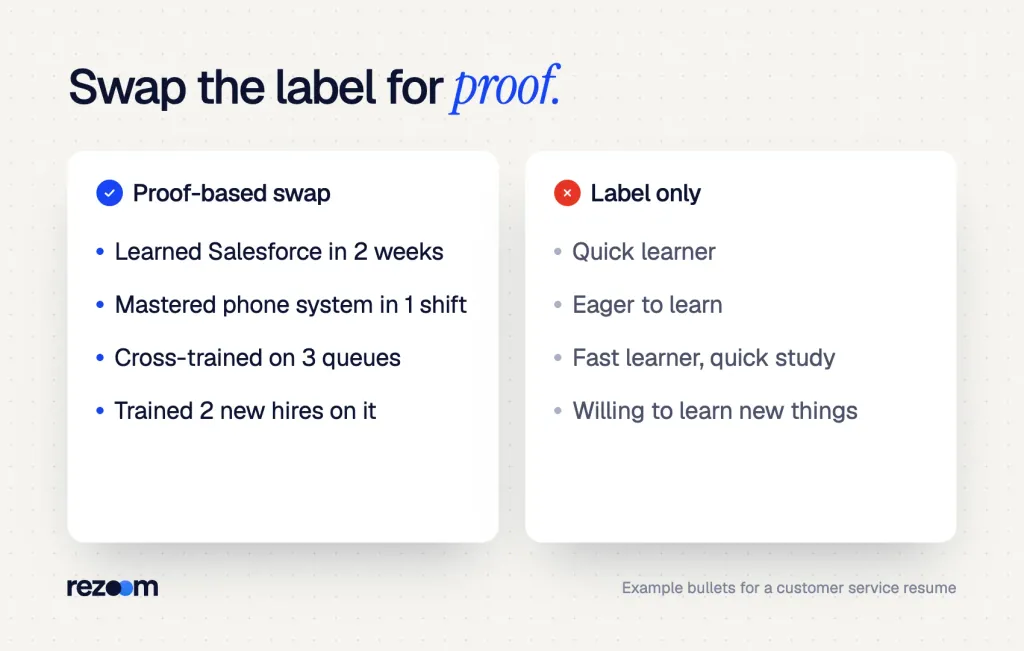
Do
- Write "Mastered Excel pivot tables in 3 weeks."
- Use one trait word in your summary, then a fact.
- Name the tool, the time frame and the result.
- Tell one learning story in your cover letter.
Don’t
- Write "Eager to learn" as your summary.
- Stack "fast learner, quick study, adaptable" in one line.
- Use slang like "sponge" or "rockstar."
- List "quick learner" in your skills section with no proof.
Leaders face the same test, because "fast learner" sounds junior on a senior resume. Our guide to leadership skills for a resume shows how to frame learning as "led the rollout" instead.
Final check before you send
Before you send your resume
Want help turning a vague trait into a strong line? Our AI resume builder suggests action verbs and asks for the numbers that make each bullet credible.
Free plan, no card.
Frequently asked questions
What is another word for quick learner?
Good options include adaptable, quick study, versatile, resourceful and coachable. On a resume, action verbs like mastered, ramped up and cross-trained work even better, because they show learning instead of claiming it.
How do I say quick learner without saying it?
Describe what you learned, how fast and what you did next. For example: "Learned QuickBooks in 3 weeks, then reconciled 120 invoices."
Is "quick study" better than "quick learner"?
It sounds a bit more polished, but it is still a label. Use it in a summary only with a fact, such as a tool and a time frame.
How do I mention quick learning in a cover letter?
Tell one short story in the middle paragraph. Say what you had to learn, how long it took and the result.
Should I put quick learner in my skills section?
Usually no. List the tools you learned instead, or write "active learning" next to a certificate or course.
What does an interviewer want to hear about fast learning?
They want a past example with a time frame and a result. Use the STAR method and keep the answer under two minutes.
Sources
We opened and read each page below. The small numbers in the text point here. Pages that carry no publication date show n.d.
- National Association of Colleges and Employers2026
Employers most want teamwork, problem-solving and communication on resumes and want to see examples, not lists
- National Association of Colleges and Employers2026
The Job Outlook 2026 Spring Update surveyed 185 employers from February 12 to March 17, 2026
- World Economic Forum2025
Employers expect 39% of core skills to change by 2030, and resilience, flexibility and agility rose 17 points as a core skill
- O*NET OnLinen.d.
Active learning is understanding the implications of new information for current and future problem-solving
- George Mason University Writing Centern.d.
If you make a claim about yourself in a cover letter, provide evidence to support it
- University of Pennsylvania Career Servicesn.d.
Use specific stories and examples to show skills instead of listing them
- University of Washington Career and Internship Centern.d.
The STAR method answers behavioral questions, with about 60% of the answer on the actions you took
Mohammad has spent more than ten years designing consumer products and leads product at Rezoom, deciding what gets built and what gets left out. His guides cover the whole job search, from resume sections and cover letters to interview answers and career moves.
Goodi, M. (2026, November 2). Another Word for Quick Learner: 25 Phrases That Come With Proof. Rezoom. https://rezoom.io/another-word-for-quick-learner/