

Summary
Writing "quick learner" on a resume rarely convinces anyone, because every applicant can claim it and nobody can verify it. Employers do value the trait: the World Economic Forum expects 39% of core job skills to change by 2030. The fix is proof. Name the skill you learned, how fast you became productive, and what you delivered, and use sharper terms such as "ramped up," "self-taught" or "learning agility" in place of the cliché.
You can call yourself a quick learner on a resume, but the phrase alone does almost nothing. Recruiters believe it only when a bullet shows a new skill, a short timeline and a result.
That proof matters more than ever. The World Economic Forum's Future of Jobs Report 2025 found employers expect 39% of workers' core skills to change or become outdated by 2030. Learning speed is valuable. A label is simply the weakest way to show it.
This guide covers when the phrase is acceptable, better alternatives, a ramp-up formula, and copy-ready examples for different situations.
Should you write quick learner on a resume?
You can, but only in a narrow way. "Quick learner" works in a summary or cover letter when the very next words prove it, such as a tool mastered in weeks. As a standalone skill-list entry, it reads as filler. Employers value learning ability, yet they discount self-ratings, so evidence beats the label every time.
Hiring managers see the phrase constantly, which is the problem. It costs nothing to write, so it signals nothing.
There is also a trust gap. In NACE research, 61.5% of students rated themselves proficient in career and self-development, but only 43.2% of employers agreed. That competency covers continual learning. A self-description lands on the wrong side of that gap.
Use this decision rule:
- Skills section: never list it. Put the skills you actually learned there instead.
- Summary: acceptable only if the same sentence names what you learned and how fast.
- Cover letter or interview: fine, because you have room to tell the story.
What employers mean by a quick learner
Employers usually mean someone who reaches full productivity fast, needs little hand-holding, absorbs feedback, and adapts when tools or processes change. Researchers call this learning agility. NACE describes it as displaying curiosity, seeking out opportunities to learn, and applying feedback. Your resume should show those behaviors, not the adjective.
When a posting asks for a fast learner, it is really asking about ramp-up time. How soon can you work without someone checking every step?
NACE's career readiness framework spells out the behaviors. Its Career and Self-Development competency includes displaying curiosity, seeking out opportunities to learn, and applying feedback.
The Center for Creative Leadership goes further. Its research on learning agility, based on Mitchinson and Morris, names four helpful behaviors: innovating, performing under unfamiliar conditions, reflecting and seeking feedback, and taking stretch risks. Low defensiveness matters too.
Each of those behaviors can become a resume line. That is the shift this article is about.
Better ways to say quick learner
Replace the label with a term that implies evidence: "ramped up," "self-taught," "mastered," "cross-trained," "adapted quickly to" or "learning agility." The best alternative is a verb inside a bullet, because a verb forces you to name what you learned. Save adjectives like "adaptable" for a summary, and only with a proof point attached.
Synonyms help only if they are more specific. Swapping "quick learner" for "fast learner" changes nothing. This table shows which alternatives work and where.
| Instead of | Try | Best place | Why it works |
|---|---|---|---|
| Quick learner | Ramped up on [tool] in [time] | Experience bullet | Names the skill and the speed |
| Fast learner | Self-taught [skill] | Skills section or project | Shows initiative without help |
| Eager to learn | Completed [certification] in [time] | Education or certifications | Third-party proof |
| Adaptable | Cross-trained in [role or area] | Experience bullet | Shows the employer trusted you |
| Picks things up easily | Trained [number] coworkers on [process] | Experience bullet | You learned it well enough to teach |
| Learns on the job | Learning agility | Summary, with proof | Recognized term from leadership research |
Notice the pattern. The strongest options are not adjectives at all. They are actions. For more descriptive language, see our list of words to describe yourself, and pair them with the right action verbs.
How to prove you are a quick learner on your resume
Use the ramp-up formula: new skill or system + time to productivity + result. "Learned Salesforce in two weeks and closed my first deal in month one" proves the trait without naming it. Add a comparison when you can, such as the usual training period, a promotion timeline, or being asked to train others.
Every bullet that proves learning speed needs three parts:
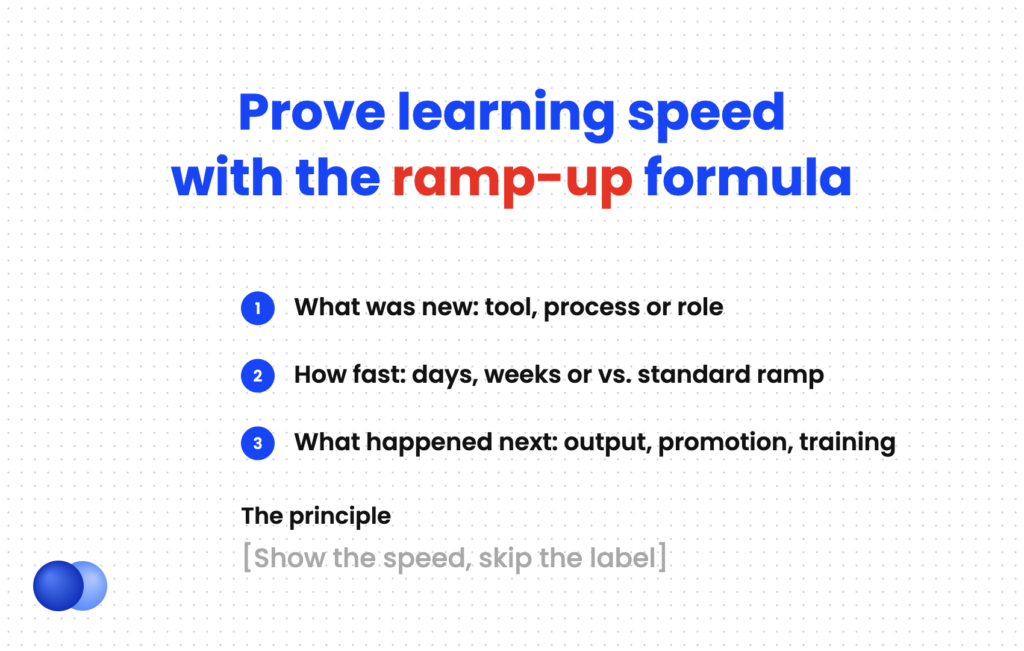
- What was new. A tool, process, product line, regulation or role.
- How fast. Days, weeks, or a comparison to the standard ramp-up period.
- What happened next. Output, accuracy, a promotion, or teaching others.
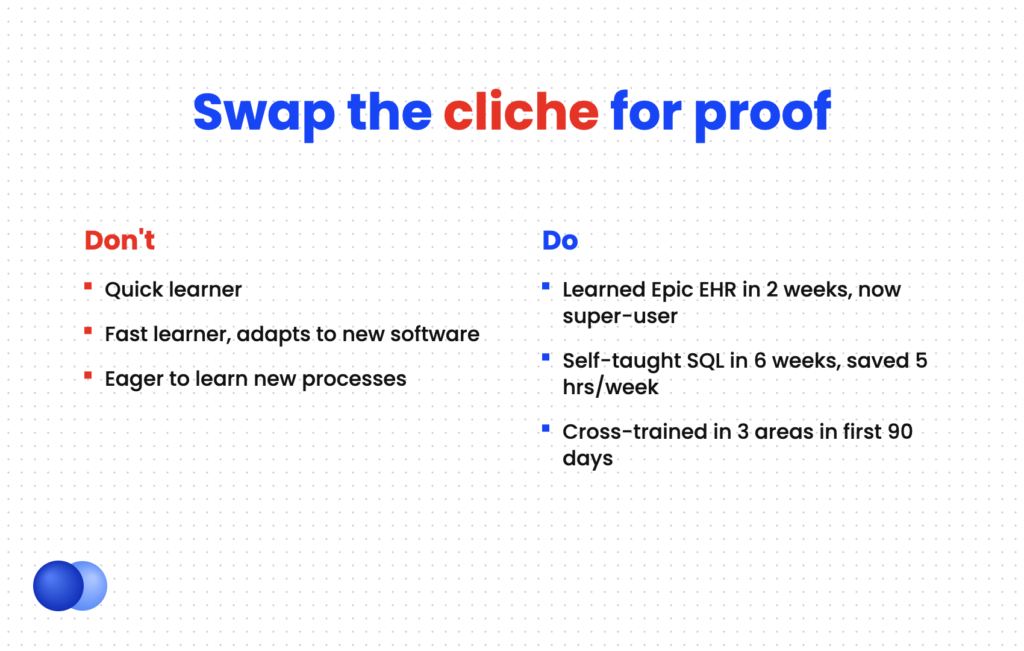
Before: Quick learner with strong technical aptitude After: Learned Epic EHR during a 2-week onboarding and became the unit's go-to super-user for 14 nurses
Before: Fast learner, adapts to new software After: Self-taught SQL in 6 weeks to automate weekly sales reports, saving the team 5 hours per week
Before: Eager to learn new processes After: Cross-trained in receiving, returns and inventory within first 90 days; promoted to shift lead at month 8
Comparisons make speed visible. "Hit full quota in month two of a standard six-month ramp" is far stronger than "hit quota quickly." If you don't know the standard, a promotion timeline or a training role does the same job.
Numbers sharpen every line, but scale works too. For more ways to add measurable detail, read how to quantify your resume and our guide to writing resume bullet points.
Teaching is the strongest learning signal
If you were asked to train others on something you learned recently, lead with that. "Trained 6 new hires on the POS system I learned 3 months earlier" proves speed, mastery and trust in one line. Managers don't assign training to people who are still figuring things out.
Where to show learning speed on your resume
Show it in four places: experience bullets with ramp-up timelines, a summary line that pairs one trait with one proof point, a skills section listing the specific tools you learned, and a certifications section with completion dates. Spreading evidence across sections lets the reader reach the conclusion without you ever writing the cliché.
Each section carries a different kind of proof:
- Experience. Ramp-up bullets, promotions and cross-training. This is where most proof belongs.
- Summary. One sentence that names the trait with evidence. See our resume summary guide for structure.
- Skills. The actual tools and methods you picked up, not the adjective.
- Certifications or projects. Dates show pace. A certification earned in your first quarter on the job says a lot.
IT support specialist moving from retail management. Earned CompTIA A+ in 10 weeks while working full-time, then resolved 40+ tickets per week within my first month on a help desk contract. Comfortable learning new ticketing systems and hardware on the fly.
The word "quick" never appears, yet the reader finishes convinced. That is the goal.
Quick learner examples for different situations
Tailor the proof to your situation. Students can point to coursework, projects or part-time jobs learned fast. Career changers can show certifications earned alongside work. Experienced hires can show new systems adopted, roles expanded or teams trained. In every case, name the thing learned and the timeline.
Your evidence depends on where you are in your career:
- Student or new graduate. "Learned Figma for a class project in 3 weeks; design was adopted by the campus food pantry." See transferable skills for your resume for more ways to frame school experience.
- Career changer. "Completed Google Data Analytics Certificate in 4 months while working full-time as a teacher."
- Experienced professional. "Led migration from legacy CRM to HubSpot after learning the platform in 3 weeks; 30 users live on schedule."
- Hourly or frontline role. "Mastered all 9 register and kitchen stations within 6 weeks; first new hire that quarter cleared for every station."
Learning speed pairs naturally with related traits. If the role also stresses precision or structured thinking, see our sibling guides on attention to detail on a resume and analytical skills for a resume.
Common mistakes when claiming you learn fast
The biggest mistakes are listing "quick learner" in a skills section, pairing it with no evidence, using it to cover a skill gap the posting requires, and stacking it with other clichés like "hard worker." Each one signals that you have nothing concrete to show, which is the opposite of what you want.
Write "Ramped up on NetSuite in 3 weeks, closing month-end 2 days early"
List "Quick learner" as a bullet in your skills section do: Name the exact tool, process or regulation you learned dont: Use the phrase to excuse a required skill you lack do: Show a timeline, promotion or training role as proof dont: Stack it with "hard worker, team player, self-starter" do: Mention it in a cover letter when you can tell the full story dont: Repeat "fast learner" in your summary and every job entry
One mistake deserves extra attention. If a posting requires a skill you don't have, "quick learner" draws attention to the gap. Show a similar skill you learned fast instead, and let the reader connect the dots.
When your draft is ready, the Rezoom AI resume builder can turn generic claims into ramp-up bullets tailored to the posting.

Frequently asked questions
Is it okay to put quick learner on a resume?
Yes, but only with proof in the same sentence. On its own, especially in a skills list, it reads as filler.
What is a professional way to say fast learner?
Use specific phrases like "ramped up on," "self-taught," "cross-trained in" or "learning agility." The most professional option is a bullet that names what you learned and how quickly.
How do I show I am a fast learner with no experience?
Use school projects, certifications, volunteer roles or part-time jobs. A dated certification or a tool learned for a class project shows pace without paid experience.
Should I mention learning ability in a cover letter?
Yes. A cover letter gives you room to tell one short story about learning something fast and the result it produced.
What is learning agility on a resume?
Learning agility is the ability to learn from experience and apply it to new situations. Mention the term in a summary only when a bullet below proves it.
How do I answer "Are you a quick learner?" in an interview?
Tell one specific story: what was new, how fast you became productive, and what you delivered. The [STAR method](https://rezoom.io/star-method-interview/) keeps the answer tight.



Comments