

Summary
To show attention to detail on a resume, replace "detail-oriented" with evidence: error rates, audit results, accuracy percentages and catches that prevented problems. The resume itself is also a test. In a 2023 study of 445 recruiters, resumes with five spelling errors were 18.5 percentage points less likely to get an interview. Prove the skill in your bullets, name it in your summary only with a result, and proofread line by line.
The best way to show attention to detail on a resume is to prove it with accuracy: error rates you kept low, audits you passed, mistakes you caught before they cost money. The word "detail-oriented" does almost nothing. A clean, consistent, typo-free resume does a lot.
That second point matters more than most guides admit. In a 2023 PLOS ONE experiment, resumes with five spelling errors were 18.5 percentage points less likely to earn an interview, and recruiters rated those applicants lower on conscientiousness.
This guide covers what employers mean by the skill, how to write bullets that prove it, examples by job and a proofreading routine you can run in ten minutes.
What does attention to detail mean on a resume?
Attention to detail means working accurately and thoroughly so that small errors do not slip through. O*NET defines it as "a tendency to be detail-oriented, organized, and thorough in completing work." On a resume, employers read it as a reliability signal: your numbers will be right, your records complete and your work checked before it ships.
The US Department of Labor's O*NET database lists Attention to Detail as a core work style, defined as "a tendency to be detail-oriented, organized, and thorough in completing work." It rates the trait across 891 occupations, from accountants to air traffic controllers, and groups it with dependability and integrity as a conscientious work style.
In practice the skill shows up in a few concrete forms:
- Accuracy: correct numbers, records, orders, code or dosages.
- Thoroughness: nothing missing from a checklist, file or handoff.
- Quality control: reviewing, testing or auditing work before it moves on.
- Consistency: following procedures and formats the same way every time.
It overlaps with organization but is not the same thing. If the posting stresses planning and systems, see our guide to organizational skills for your resume.
Why does your resume itself prove or disprove the skill?
A recruiter judges attention to detail first from the document in front of them. Research on 445 recruiters found that resumes with spelling errors got fewer interview offers and lower ratings for conscientiousness and mental ability. A single typo next to the phrase "detail-oriented" undercuts the claim more than any bullet can repair.
The Ghent University study published in PLOS ONE tested 1,335 fictitious graduate resumes with 445 recruiters. Two spelling errors cut interview probability by 7.3 percentage points; five errors cut it by 18.5. The five-error penalty was larger than for any other resume trait the researchers tested.
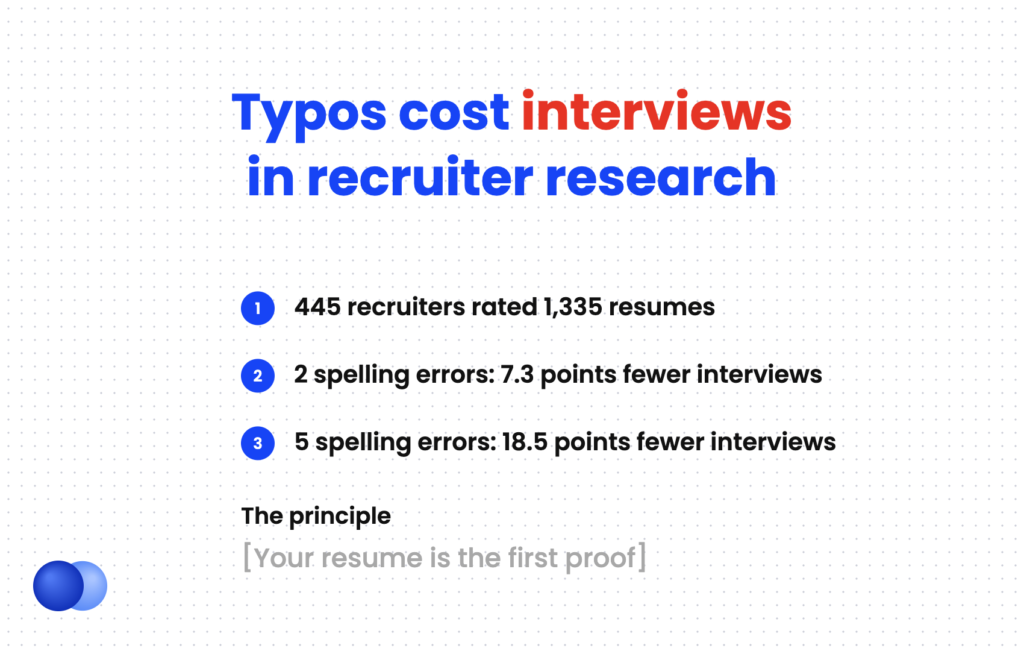
Recruiters did not just dislike the typos. They inferred character from them. Lower perceived mental ability, conscientiousness and interpersonal skills explained about half of the penalty.
So consistency counts too. Mismatched date formats, uneven bullet punctuation and two different fonts send the same signal as a typo. Our guides to resume mistakes and resume red flags list the most common slips.
How do you show attention to detail in resume bullets?
Write bullets that measure accuracy or show a catch. Use error rates, audit scores, accuracy percentages, zero-defect streaks, or a specific mistake you found and fixed before it caused harm. Lead with verbs like audited, reconciled, verified, proofread or inspected, so the bullet proves attention to detail without naming it.
Every detail-oriented bullet answers one of four questions. Pick whichever fits the role.
- How accurate were you? "Maintained 99.8% order accuracy across 1,200 monthly shipments."
- What did you catch? "Found a $42K duplicate vendor payment during month-end reconciliation."
- What did you check? "Reviewed 60 contracts per quarter for compliance clauses."
- What standard did you hold? "Passed 3 consecutive state inspections with zero findings."
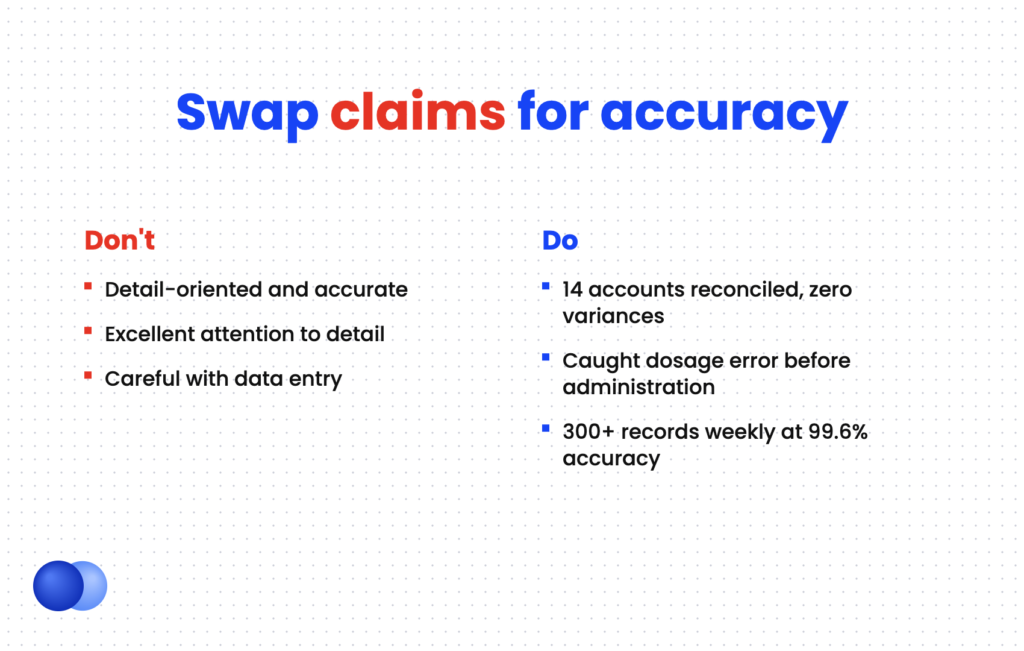
Before: Detail-oriented and accurate After: Reconciled 14 bank accounts monthly with zero unresolved variances across 2 annual audits
Before: Excellent attention to detail After: Caught a dosage-unit error on a pediatric order during double-check verification and escalated it before administration
Before: Careful with data entry After: Entered and verified 300+ patient insurance records weekly at a 99.6% accuracy rate, reducing claim rejections by 18%
Accuracy figures are measurable, but they should be real. If you do not track an exact rate, describe the scale and the outcome ("no errors flagged in 2 years of audits"). For more on safe estimates, see how to quantify your resume and our guide on how to write resume bullet points.
The catch is the strongest proof
A single bullet about an error you caught often beats a page of accuracy claims. Name what you found, how you found it and what it would have cost. "Spotted a mislabeled lot during receiving inspection, preventing a 5,000-unit recall" is memorable, specific and easy to discuss in an interview.
Attention to detail examples by job
Each field measures precision differently. Accountants show reconciliation and audit results, nurses show medication safety and charting accuracy, developers show test coverage and bug catches, and administrative staff show error-free records and scheduling. Choose the metric your target employer already tracks, and the bullet will read as fluent and credible.
The Bureau of Labor Statistics names "detail oriented" as an important quality for accountants and auditors, who "must pay attention to detail when compiling and examining documents." Many other roles share the expectation, just with different evidence.
| Job | What precision looks like | Bullet idea |
|---|---|---|
| Accountant | Reconciliations, audit readiness | Closed books 2 days faster with zero audit adjustments |
| Registered nurse | Medication safety, charting | Maintained 100% compliance on medication barcode scanning for 12 months |
| Software developer | Code review, testing | Raised unit test coverage from 55% to 85%, cutting production bugs 30% |
| Administrative assistant | Records, scheduling, proofreading | Proofread 40+ executive documents a month with no errors reported |
| Warehouse associate | Picking accuracy, inventory counts | Achieved 99.9% pick accuracy across 800 orders a week |
| Paralegal | Document review, deadlines | Cite-checked 25 briefs with no missed filing deadlines |
Medical billing specialist with 4 years in multi-provider practices. Keeps first-pass claim acceptance above 97% through line-by-line coding review, and cut denied claims 22% in 2025 by catching modifier errors before submission.
If you work with spreadsheets, our sibling guide to Excel skills for your resume shows how to pair accuracy with tools. Analysts can also read our guide to analytical skills for your resume.
Where should attention to detail go on your resume?
Prove attention to detail mainly in your experience bullets, and mention it in your summary only beside a result. Add it to the skills section only if the posting uses the exact phrase, and prefer concrete terms like "quality assurance," "reconciliation" or "proofreading." The cleanliness of the whole document is the final proof.
Each section plays a different role:
- Experience: two or three bullets that measure accuracy or show a catch.
- Summary: one result that implies precision. See our resume summary guide.
- Skills section: concrete, checkable terms such as "QA testing," "GAAP reconciliation" or "medical coding (ICD-10)." For more on list placement, read how to highlight skills on your resume, or see our sibling guide to core competencies on a resume.
Show an accuracy rate, audit result or error you caught
Write "detail-oriented" with no evidence behind it do: Use one date format and one bullet style throughout dont: Mix "Jan 2024," "01/2024" and "January 2024" do: Use precise verbs like reconciled, verified or audited dont: Pair a precision claim with a typo anywhere on the page do: Match the posting's terms, like "quality control" dont: List "detail-oriented" and "meticulous" as two skills
How do you proofread a resume for attention to detail?
Proofread in separate passes rather than one read-through. Check spelling and grammar, then numbers and dates, then formatting consistency, then names and contact details. Read the resume aloud or backwards line by line, print it once, and have one other person review it. Spellcheck alone misses wrong-but-real words like "manger."
A ten-minute routine catches most problems:
- Spelling pass: run spellcheck, then read for real-word errors (form/from, manger/manager).
- Numbers pass: confirm every date, percentage and dollar figure.
- Format pass: one font, one date style, consistent periods at the end of bullets, aligned margins.
- Names pass: company names, job titles, your email and phone number.
- Fresh-eyes pass: a friend reads it, or you read it the next morning.
Finally, scan the file with the Rezoom ATS resume checker to catch formatting problems that software, rather than a person, might trip over.

Frequently asked questions
How do I say I have attention to detail on a resume?
Show it rather than say it. Use a bullet with an accuracy rate, audit result or specific error you caught, such as "Reconciled 14 accounts monthly with zero variances."
Is detail-oriented a good word for a resume?
It is acceptable only when backed by proof, but on its own it is a claim every applicant can make. Use it in a skills list only if the posting uses it, and prove it in a bullet.
Is attention to detail a hard skill or a soft skill?
It is a soft skill, or work style, though it often shows up through hard skills such as proofreading, auditing, coding review or quality testing.
Can one typo really cost me an interview?
It can hurt. In a study of 445 recruiters, even two spelling errors lowered interview probability by 7.3 percentage points, and five lowered it by 18.5.
What is another way to say detail-oriented?
Try precise, thorough, meticulous or accuracy-focused, or better, name the task: proofreading, quality assurance, reconciliation or compliance review.
How do I show attention to detail with no work experience?
Use school, volunteer or club work. Examples include proofreading a student newsletter, managing a club budget with no discrepancies or verifying lab data for a class project.



Comments