

Summary
A core competencies section is a short keyword block near the top of your resume, usually 6 to 12 job-matched strengths set in two or three columns under your summary. It works best for mid-career, senior and career-changing candidates whose best qualifications would otherwise sit low on the page. Entry-level candidates and highly technical roles usually do better with a categorized skills section. Every competency you list should be backed by an experience bullet.
Core competencies on a resume are a short, scannable list of your 6 to 12 strongest job-relevant abilities, placed right under your summary. The section tells a recruiter in seconds what you do best and puts the posting's keywords high on the page. Work habits belong there only when you can back them with proof, which is what how to show multitasking on a resume walks through.
It is not always the right choice, though. A skills section at the bottom does a similar job, and for some candidates it does it better. The difference comes down to placement, content mix and career level.
This guide explains what the section is, when to use it instead of a skills section, how to format it, and examples for each stage of a career.
What are core competencies on a resume?
Core competencies are the professional strengths that define what you do best: a mix of functional expertise (such as budgeting or patient education), methods or tools, and a few posting-matched soft skills. On a resume, they appear as a compact keyword section near the top, usually labeled "Core Competencies" or "Areas of Expertise."
Think of the section as a table of contents for your value. Each item is a short phrase, two to four words, that a recruiter can scan and then confirm in your experience bullets. A claim like fast learning needs the same proof, so see how to prove you are a quick learner on a resume.
The term comes from business strategy, but career educators use it too. NACE frames career readiness as the core competencies that prepare college graduates for the workplace, including communication, critical thinking, leadership and technology.
On a resume, the label matters less than the content. Case Western Reserve University's resume guide suggests headings such as "Skills and Areas of Expertise" or "Professional Skills" for the same idea.
Core competencies vs. skills section: which should you use?
Use a competencies block when your strongest qualifications are broad professional strengths that should be seen first, typical for mid-career, senior and career-change resumes. Use a skills section when your value is mostly tools, software and certifications, or when you are entry level and your education leads. Most resumes need one or the other, not both.
The two sections overlap, so choose by purpose rather than by habit.
| Factor | Competencies block | Skills section |
|---|---|---|
| Placement | Top, under the summary | Lower, after experience or education |
| Content | Functional strengths, methods, key soft skills | Tools, software, languages, certifications |
| Format | 2–3 columns of short phrases | Categorized lines (Software: …) |
| Best for | Mid-career, senior, career changers | Entry level, technical roles |
| Main job | Frame your value in seconds | Confirm specific technical fit |
A simple decision rule: if a recruiter would see your best qualifications only on page two, add the section at the top. If your experience bullets already open with your strongest strengths, a standard skills section is enough.
Technical candidates can combine the ideas. Put three or four functional strengths in the top block, then keep a separate technical skills list for languages and tools. For more on choosing what to list, see our guide to the best skills to put on a resume.
Where does a competencies section go on a resume?
Place the section directly below your professional summary and above your work experience. That puts your most relevant keywords in the top third of page one, where recruiters look first. If you use a summary of qualifications instead of a paragraph summary, the competency block can sit right under it.
Placement is the whole point of the section. In an eye-tracking study, Ladders found recruiters spent an average of 7.4 seconds on an initial resume screen, guided by section headers and job titles. Our guide on how long recruiters look at a resume covers what that means for layout.
A typical order looks like this:
- Header with contact details
- Resume summary or a summary of qualifications
- Key competencies block
- Professional experience
- Education and certifications
How do you format a core competencies section?
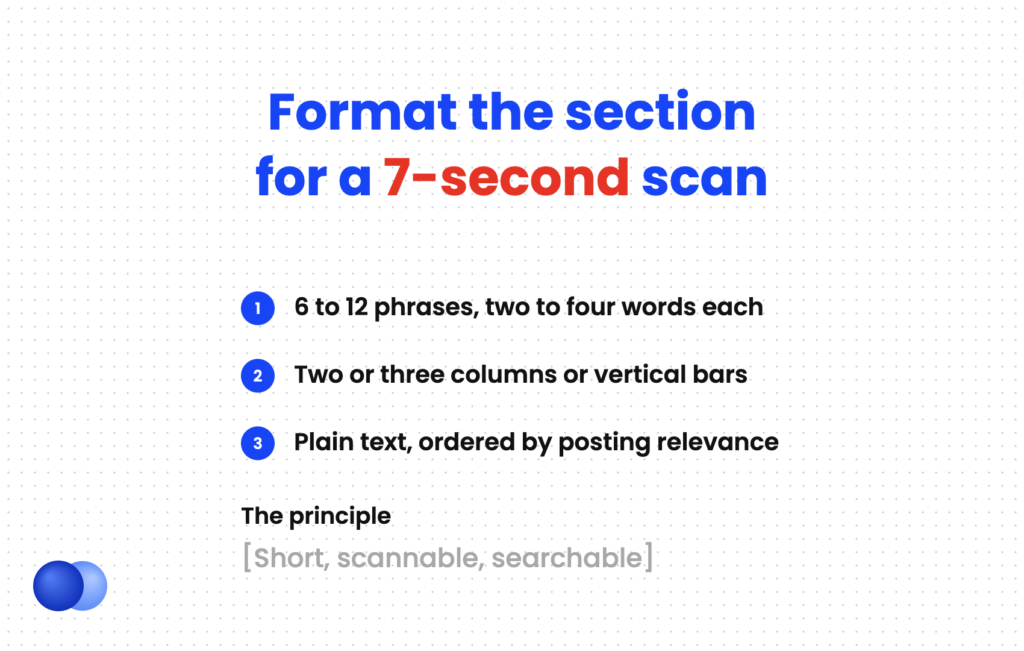
List 6 to 12 short phrases, two to four words each, in two or three columns or separated by vertical bars. Use plain text rather than graphics, rating bars or tables that some applicant tracking systems read poorly. Order items by relevance to the posting, and use the employer's exact wording where it is accurate.
Keep it tight. More than 12 items turns a quick scan into a wall of words.
CORE COMPETENCIES Budget Forecasting Vendor Negotiation Process Improvement Team Leadership Stakeholder Reporting SAP S/4HANA Inventory Optimization Lean Six Sigma Cross-Functional Projects
AREAS OF EXPERTISE Patient Education | Care Coordination | Epic EHR | Wound Care | Staff Training | Quality Improvement
Both versions work in a standard resume builder. The single-line version saves vertical space on a one-page resume.
Plain text matters for searchability. Many recruiters search their applicant tracking system directly. Greenhouse, for example, lets recruiters search resumes for keywords using full text search. A competency set inside an image or a fancy graphic may not be found. Our explainer on how ATS works covers parsing in more detail.
Use the posting’s exact phrase
If the job says "stakeholder management," do not write "relationship building." Case Western's career guide advises using the language already in the job description, because the reader is primed to look for it. Only use a phrase you can back with a bullet.
How do you choose which competencies to list?
Start with the job posting. Highlight the skills in the requirements and preferred sections, keep the ones you can prove, and rank them by how often and how prominently they appear. Mix roughly two thirds functional or technical strengths with one third soft skills, and drop anything every applicant would claim.
Use this four-step process:
- Pull keywords. Copy every skill and responsibility phrase from the posting. Our resume keywords guide shows how to spot the ones that matter.
- Filter for proof. Keep only items you can support with a bullet, project or certification.
- Rank by relevance. Put the requirements the posting repeats or lists first at the start of your block.
- Balance the mix. Lean toward functional strengths. Soft skills earn a spot only when the posting stresses them.
Employers do weigh soft skills. In NACE's Job Outlook 2026 Spring Update, 85% of employers said they look for teamwork skills on the resume. The same report stresses that employers want examples, not just a list. That is why each competency needs a matching bullet. Our guide on how to highlight skills on your resume shows how to connect the two.
Core competencies examples by career level
Entry-level candidates should use fewer items (6 to 8) drawn from coursework, internships and tools. Mid-career professionals should lead with functional expertise and results-driving methods. Senior leaders should list strategic strengths such as P&L management, organizational change and executive stakeholder relations. Career changers should lead with transferable strengths that match the new field.
What belongs in the block changes as your career grows. Here are copy-ready examples for four situations.
Entry level (marketing graduate): Social Media Content | Google Analytics | Copywriting | Canva | Market Research | Campaign Reporting
Mid-career (operations manager): Process Improvement | Lean Six Sigma | Vendor Management | Budget Forecasting | Team Leadership | KPI Reporting | ERP Systems | Safety Compliance
Senior (VP of finance): P&L Management | Financial Planning & Analysis | M&A Due Diligence | Board Reporting | Capital Allocation | Audit Oversight | Team Building | ERP Transformation
Career changer (teacher to corporate trainer): Instructional Design | Adult Learning Principles | Training Needs Analysis | Presentation Delivery | LMS Administration | Performance Coaching
For project-heavy roles, our sibling guide to project management skills for resume lists the terms recruiters search for most.
What mistakes weaken a competencies section?
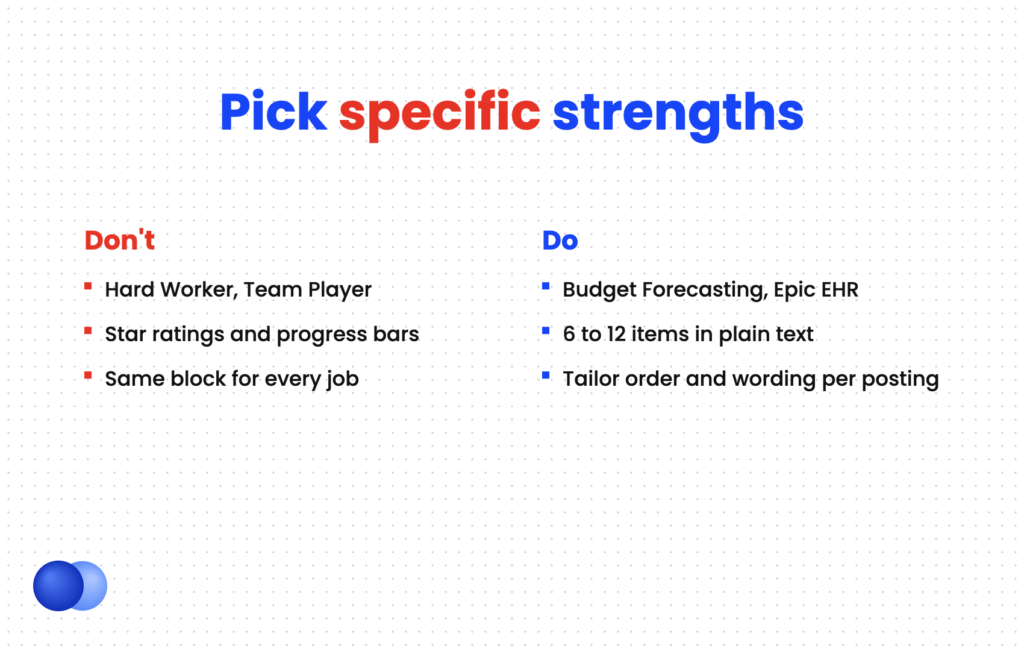
The most common mistakes are listing generic traits such as "hard worker," including more than 12 items, repeating the same keyword in different words, using graphics or skill-rating bars, and listing competencies that no bullet supports. Another is reusing one block for every application instead of tailoring it to each posting.
Use specific phrases like "Budget Forecasting" or "Epic EHR"
List clichés like "Hard Worker" or "Team Player" do: Keep the block to 6–12 items in plain text dont: Use star ratings, progress bars or icons for skills do: Tailor the order and wording to each posting dont: Paste the same block into every application do: Back every competency with a bullet in your experience dont: List strengths you could not discuss in an interview
Before you apply, run your draft through the Rezoom ATS resume checker to see whether your competencies match the posting's keywords.

Frequently asked questions
How many core competencies should I list on a resume?
List 6 to 12. Entry-level candidates can stay near 6, while senior candidates with broad experience can go up to 12.
Is a competencies section the same as a skills section?
They overlap. Core competencies usually emphasize broad professional strengths placed near the top, while a skills section lists tools and technical abilities lower on the page.
Should I include soft skills in my competencies?
Yes, a few, when the posting stresses them. Keep most items functional or technical, and prove any soft skill in a bullet.
Do core competencies help with ATS?
They can, because they put posting keywords in plain text near the top. The ATS still needs the same terms in context, so repeat key ones in your experience bullets.
Can I have both a competencies section and a skills section?
Yes, if they do different jobs, such as broad strengths at the top and a technical tools list at the bottom. Avoid listing the same items twice.
What is another name for core competencies on a resume?
Common alternatives include "Areas of Expertise," "Key Skills," "Professional Skills" and "Skills Summary."



Comments