

Summary
The project management skills employers look for fall into three groups: planning and control (scope, scheduling, budgeting, risk), people skills (stakeholder communication, leadership, negotiation) and methods or tools (Agile, Scrum, Jira, MS Project). You do not need a project manager title to claim them. Show each one as a project you owned, with its scope, constraint and result, in your experience bullets, then repeat the posting's exact terms in your skills section.
The project management skills that belong on your resume are the ones the posting names, usually scheduling, budgeting, risk management, stakeholder communication and a method such as Agile. You prove them with projects you actually ran, not with a job title. A marketing coordinator who launched a campaign on time and under budget has project management experience.
That matters because projects are everywhere. PMI estimates about 40 million people already work as project professionals worldwide, and many of them carry other titles.
This guide covers which skills employers want, how to show them with or without a PM title, and copy-ready bullets you can adapt.
What are project management skills on a resume?
Project management skills are the abilities you use to take work from idea to finished result: defining scope, building a schedule, managing a budget, handling risk, coordinating people and reporting progress. On a resume, they appear as hard skills (methods and tools) and as soft skills (leadership, communication, negotiation), both backed by real project outcomes.
The US Bureau of Labor Statistics describes project management specialists as people who coordinate the budget, schedule, staffing and other details of a project. That definition is a useful checklist. If you have planned, tracked and delivered work against a deadline, you have used these skills.
PMI's Talent Triangle groups them into three areas:
- Ways of working. Predictive, agile, design thinking and hybrid approaches.
- Power skills. Collaborative leadership, communication, an innovative mindset and empathy.
- Business acumen. Knowing how your project connects to the organization's goals.
A strong resume shows at least one skill from each area.
Which project management skills do employers look for?
Employers look for planning and scheduling, budget management, risk management, stakeholder communication, leadership and fluency in a delivery method such as Agile or Scrum. BLS lists analytical, communication, organizational, problem-solving and time-management skills as important qualities for project management specialists. Always confirm priorities against the specific posting.
BLS names the important qualities for project management specialists as analytical, communication, critical-thinking, interpersonal, organizational, problem-solving and time-management skills. Postings then add the hard skills and tools.
Here is how the most requested project management skills break down, with the evidence that makes each believable.
| Skill | Type | How to prove it on a resume |
|---|---|---|
| Scope and requirements | Hard | Number of requirements gathered, stakeholders interviewed |
| Scheduling | Hard | Milestones hit, days early, timeline length |
| Budget management | Hard | Budget size, variance, dollars saved |
| Risk management | Hard | Risks logged and mitigated, issues avoided |
| Agile / Scrum | Method | Sprint length, velocity, release cadence |
| PM tools (Jira, Asana, MS Project) | Tool | What you built or tracked in the tool |
| Stakeholder communication | Soft | Who you reported to, how often, decisions secured |
| Team leadership | Soft | Team size, cross-functional groups, turnover |
| Negotiation | Soft | Vendor terms, scope trade-offs resolved |
Demand for these skills is strong. BLS projects employment of project management specialists to grow 7% from 2025 to 2035, with about 76,500 openings each year. If you also use spreadsheets to track budgets, our sibling guide to Excel skills for resume shows how to list them.
How do you show project management skills without a project manager title?
Treat any time-bound piece of work you owned as a project. Name it, state its scope (budget, people, timeline), and show the result. Event planning, software rollouts, office moves, process changes, campaigns and class or volunteer initiatives all count. A clear project with a measurable outcome proves the skill better than the job title.
Most people who manage projects never hold the title. Coordinators, analysts, engineers, nurses, teachers and office managers run projects every quarter. The trick is to describe that work in project language.
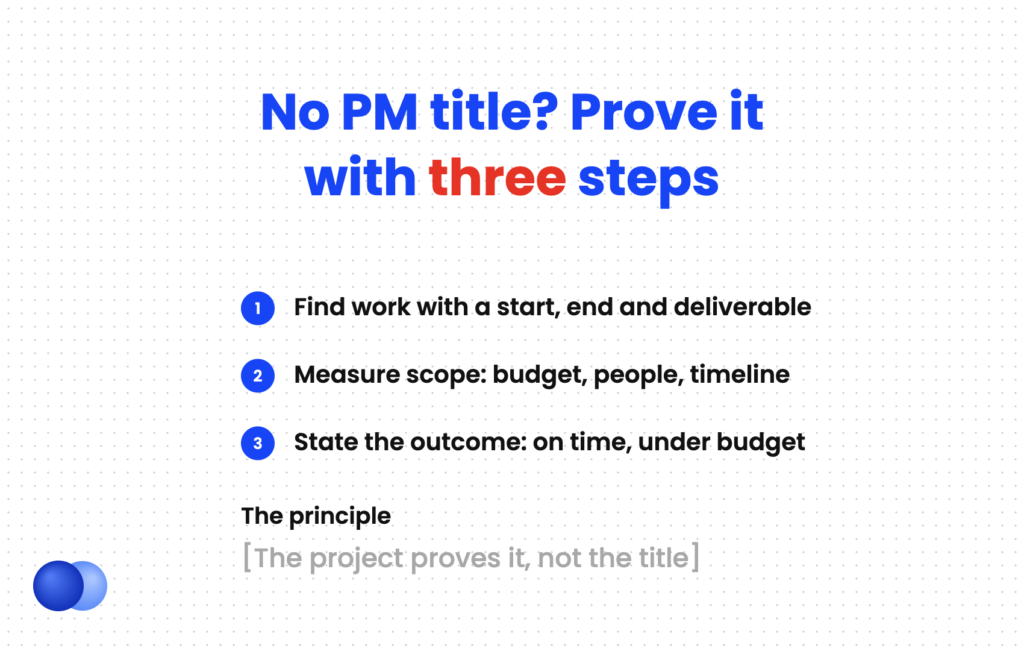
Use this three-step check on your past roles:
- Find the projects. Look for work with a start date, an end date and a deliverable.
- Measure the scope. Note the budget, number of people, timeline and anything you tracked.
- State the outcome. Did it finish on time, under budget, with fewer errors or better adoption?
Marketing coordinator: Coordinated a 6-week product launch across design, sales and web teams, delivering 14 assets on schedule and $4K under a $30K budget
Registered nurse: Led the unit's switch to a new charting workflow, training 22 nurses in 3 weeks with no missed documentation audits
Office manager: Planned and executed an office move for 45 employees over one weekend, keeping downtime under 4 hours
Software engineer: Owned the migration of 3 legacy services to a new cloud platform, sequencing work across 2 teams and finishing one sprint early
Notice that none of these lines says "project management." Each one shows planning, coordination and a result. That is what recruiters read as project management skills. For career changers, our guide to transferable skills for your resume shows how to frame this experience for a new field.
How do you write project management bullets that prove results?
Use a simple formula: action verb, the project and its scope, the constraint you managed, and the result. For example, "Delivered a $120K vendor rollout across 4 sites two weeks early." Numbers for budget, timeline, team size and outcome make the bullet credible and give interviewers something specific to ask about.
Strong bullets answer three questions: how big was it, what was hard about it, and what changed. Our guide to how to quantify your resume covers ways to find numbers when you did not track them.
The formula: verb + project and scope + constraint + result.
Managed a $1.2M ERP implementation for a 300-person manufacturer, delivering on the original go-live date despite a vendor change mid-project
Ran 2-week Scrum sprints for a 9-person product team, raising on-time story completion from 68% to 91% over two quarters
Built a risk register in Jira for a hospital network upgrade, flagging 18 risks and preventing 2 projected schedule slips
Negotiated revised scope with 3 stakeholders, cutting 4 low-value features and saving 5 weeks of development time
Leadership and coordination often sit in the same bullet. If you want more on those angles, see leadership skills for resume and time management skills for resume.
Mirror the method the posting uses
If the posting says "Agile," "Scrum," "waterfall" or "hybrid," use that exact word in at least one bullet and in your skills section. Recruiters often search their applicant tracking system for method names, and a bullet like "ran 2-week Scrum sprints" proves the term rather than just listing it.
Where should project management skills go on your resume?
Put project management skills in four places: your summary (one headline project result), experience bullets (the proof), a skills section (methods, tools and posting keywords) and a certifications section if you hold one. Senior candidates can add a short core competencies block near the top to group their strongest project skills.
Each section does a different job:
- Summary. Lead with your strongest project result. Our resume summary guide shows the structure, and resume objective for project manager helps if you are entering the field.
- Experience. This is where your project management skills become believable.
- Skills section. List methods (Agile, Scrum, Kanban), tools (Jira, Asana, MS Project, Smartsheet) and phrases from the posting such as "stakeholder management."
- Core competencies. For mid-career and senior roles, a keyword block under the summary works well. Our guide to core competencies on a resume explains the format.
Planning and prioritizing skills overlap with organization. If those are your strengths, organizational skills for resume has more bullet ideas.
Do project management certifications belong on your resume?
Yes, if you hold or are actively earning one. PMP, CAPM, PRINCE2 and Scrum certifications are strong keywords. A 2025 PMI salary survey found US PMP holders reported a median salary of $135,000 versus $109,157 for non-certified respondents. CAPM requires no project experience, so it suits entry-level candidates and career changers.
Certifications give recruiters a quick, verifiable signal. In PMI's 2025 salary survey of 14,628 project professionals, US PMP holders reported a 24% higher median salary than those without it.
If you are new, the CAPM is the usual starting point. PMI requires a secondary degree and 23 hours of project management education, with no experience needed.
List the full name once, then the acronym: "Project Management Professional (PMP), PMI, 2025." If you are still studying, write "CAPM, expected March 2027." Our guide to resume certifications covers placement in detail.
Which mistakes make project management skills look weak?
The biggest mistakes are listing skills with no project behind them, describing duties instead of outcomes, leaving out scope (budget, team size, timeline), and stuffing every PM buzzword into the skills section. Another common error is ignoring the posting's method, such as writing "waterfall" when the job asks for Agile.
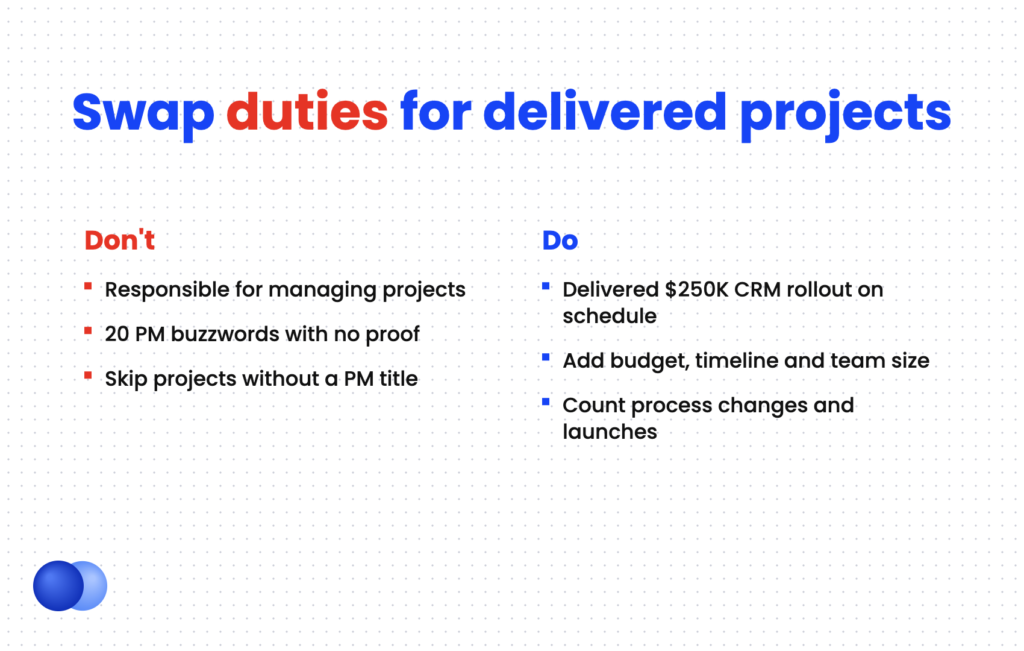
Write "Delivered a $250K CRM rollout to 4 offices on schedule"
Write "Responsible for managing projects" do: Include budget, timeline and team size where you can dont: List 20 PM buzzwords with no bullet that proves them do: Match the posting's method, such as Agile or Scrum dont: Claim PMP-level experience you cannot discuss in an interview do: Count side projects, volunteer work and process changes dont: Leave out projects because your title was not "project manager"
Once your draft is ready, the Rezoom AI resume builder can turn duty-style lines into scoped, result-focused bullets matched to a specific posting.

Frequently asked questions
What are the top project management skills to put on a resume?
Scheduling, budget management, risk management, stakeholder communication, leadership and an Agile or Scrum method are the most common. Choose the ones your target posting names and prove each in a bullet.
Can I put project management on my resume if I was never a project manager?
Yes. If you planned and delivered work with a deadline, budget or team, that is project management. Describe it as a project with scope and results.
Should I list project management tools like Jira or Asana?
Yes, in your skills section, especially if the posting names them. Add one bullet that shows what you tracked or built in the tool.
Is PMP worth listing for non-PM jobs?
It helps for any role with heavy coordination, such as operations, IT or consulting. For unrelated roles, list it in certifications without making it the headline.
How many project management skills should I list?
Six to ten in the skills section is enough. The proof belongs in your experience bullets, not in a longer list.
What is the difference between project management and program management on a resume?
A project has a defined end and deliverable. A program coordinates several related projects toward a larger goal, so program bullets usually show broader scope and longer timelines.



Comments