

Summary
Organizational skills are your ability to build and keep order in systems, records, spaces and projects. Employers name them often, especially for administrative, operations, event and project roles, but the label alone convinces no one. The strongest resumes show a system you created or fixed, the scale it handled and what improved. Put the proof in experience bullets, add the exact posting phrase to your skills section, and leave deadline-juggling claims to time management.
The best way to show organizational skills on a resume is to describe a system you built or fixed, how much it handled, and what improved. "Highly organized" is a claim. "Rebuilt a 4,000-file shared drive so the team found contracts in seconds" is evidence.
That difference matters because the phrase is common. In a sample of 23,042 job posts, organizational skills appeared in 7.2% of listings, and employers marked them required far more often than preferred. Many applicants will claim the skill. Few will prove it.
This guide breaks organizational skills into five types recruiters actually mean, gives you a proof formula, and shows copy-ready bullets for different jobs.
What are organizational skills on a resume?
Organizational skills are the abilities that keep work orderly and findable: designing filing and record systems, tracking inventory and resources, documenting processes, coordinating projects and keeping physical or digital spaces in order. On a resume, they show up as systems you created, maintained or improved, measured by accuracy, retrieval speed, errors avoided or work completed.
Think of organizational skills as structure. They answer one question for an employer: will things be in order when this person is in charge of them?
That makes them different from time management, which is about how you spend hours and hit deadlines. An office manager who redesigns the supply room uses organizational skills. The same manager finishing payroll a day early on a busy week uses time management. If deadlines and prioritizing are your main story, see our guide to time management skills for your resume.
Organizational skills sit between soft and hard skills. The habit is a soft skill, but the tools you use, such as a CMMS, an ERP or a project board, are hard skills you can name.
Which organizational skills do employers look for?
Employers look for five clusters: information and records management, physical and inventory organization, process documentation, project and event coordination, and attention to detail. Job-post data shows attention to detail at 7.5% and organizational skills at 7.2% of listings. The Bureau of Labor Statistics names organizational skills as a key quality for administrative assistants, event planners and project specialists.
Postings rarely stop at one phrase. In the same 23,042-post sample, attention to detail appeared in 7.5% of listings, documentation in 2.5% and multitasking in 1.1%. Those neighbors tell you which kind of organization the employer wants.
The Bureau of Labor Statistics is just as specific. Administrative assistants keep "files, folders, and schedules in order so that an office runs efficiently." Event planners must "multitask, pay attention to details, and meet tight deadlines." Project management specialists may "oversee more than one project at one time."
Use this table to match the posting's wording to the type of proof that fits it.
| Organizational skill type | Posting phrases to watch for | Best proof on a resume |
|---|---|---|
| Records and information management | Recordkeeping, data entry accuracy, file management | Records handled, error rate, retrieval time |
| Physical and inventory organization | Inventory control, stockroom, supply management | SKUs tracked, shrink or stockouts reduced |
| Process documentation | SOPs, documentation, standardization | Procedures written, onboarding time cut |
| Project and event coordination | Project coordination, logistics, vendor management | Projects or events run, budget, headcount |
| Attention to detail | Accuracy, quality control, compliance | Audit results, error-free streaks |
NACE's career readiness framework lists attention to detail, "resulting in few if any errors in their work," as a core professional behavior. Accuracy is therefore one of the easiest organizational traits to quantify.
How do you prove organizational skills on a resume?
Use a three-part formula: the system you built or fixed, the scale it handled and the result. Name the tool or method, give a number for volume such as files, SKUs, vendors or attendees, then show the outcome in accuracy, speed, cost or errors avoided. The bullet proves organization without ever using the word "organized."
Recruiters trust structure they can picture. So every bullet should answer three questions: what did you organize, how big was it, and what got better?
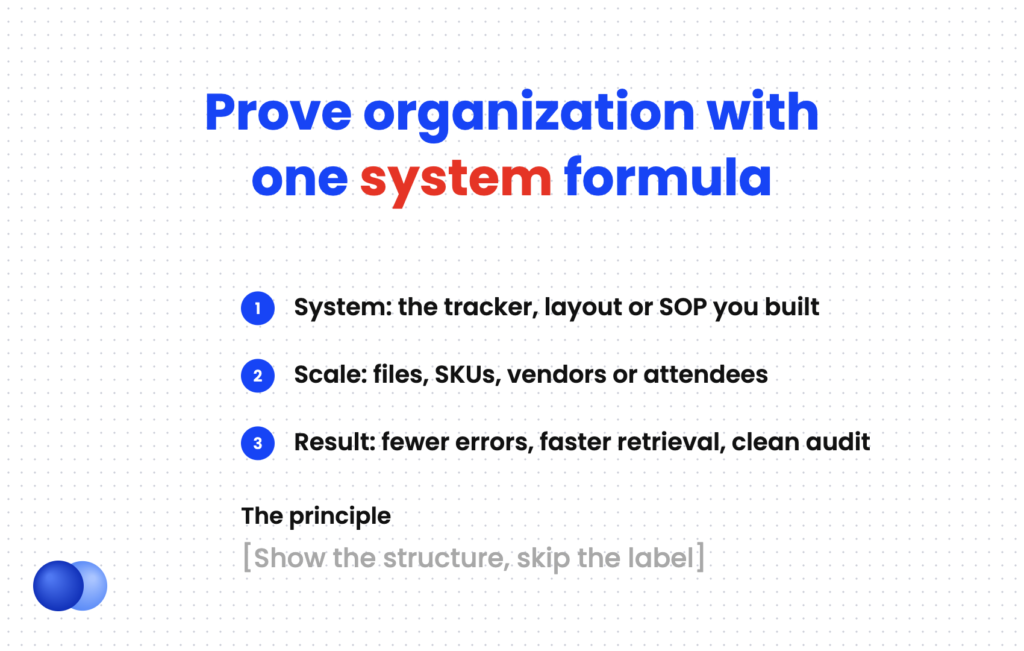
The system formula: system + scale + result.
- System. The filing structure, tracker, layout, SOP or workflow you created or fixed.
- Scale. Files, records, SKUs, vendors, attendees, team members or locations.
- Result. Fewer errors, faster retrieval, lower cost, a clean audit or smoother handoffs.
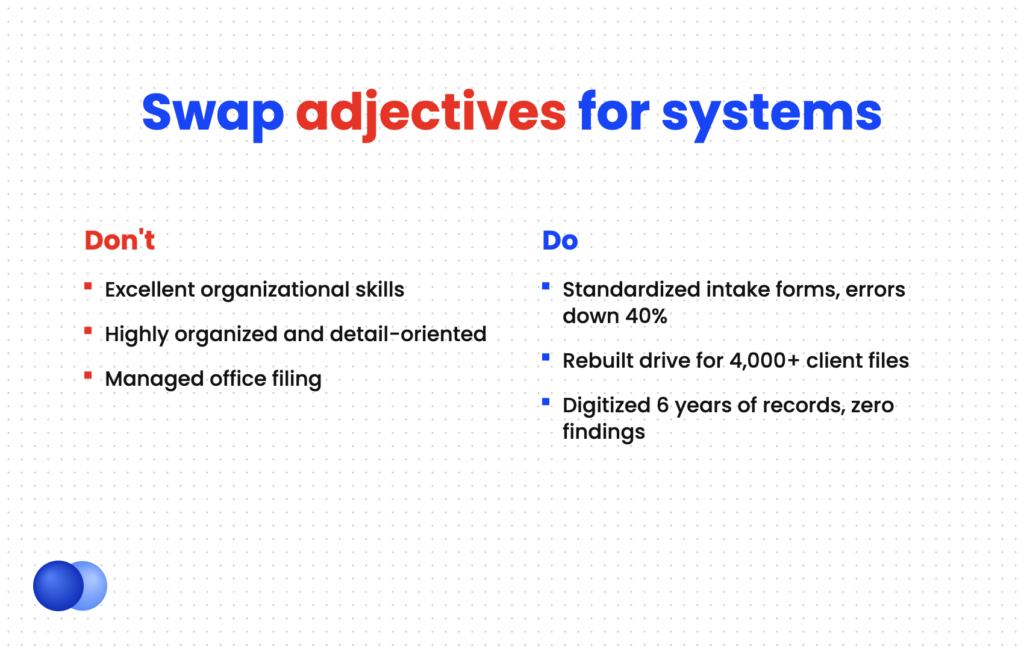
Before: Highly organized and detail-oriented After: Rebuilt the shared drive's folder and naming structure for 4,000+ client files, cutting average document search time from 10 minutes to under 1
Before: Responsible for inventory After: Introduced bin labeling and weekly cycle counts for 1,200 SKUs, reducing stockouts 35% over two quarters
Before: Managed office filing After: Converted 6 years of paper personnel records to a searchable HRIS archive, passing the annual compliance audit with zero findings
Numbers make the bullet stronger, but scale alone still works. "For 3 clinics" or "across 14 vendors" tells the reader the system had real weight. For more ways to add figures, see how to quantify your resume, and for line structure, our guide to writing resume bullet points.
Start with a builder verb
Verbs like "standardized," "cataloged," "consolidated," "streamlined" and "restructured" signal organization before the reader reaches the result. Save "organized" for when nothing more precise fits. A precise verb also helps you avoid repeating the same claim in every bullet.
Where should organizational skills go on your resume?
Put the proof in your experience bullets, name one organizational strength with a result in your summary, and add the posting's exact phrase, such as "inventory control" or "records management," to your skills section. Pair each soft label with a named tool so applicant tracking systems and human readers both see substance.
Each part of the resume does a different job.
- Experience section. This is where organizational skills earn belief. Aim for two or three system bullets in your most relevant role.
- Summary. Name one strength and attach a quick result, not a list of adjectives.
- Skills section. Mirror the posting's wording and pair it with tools, for example "Records management (Laserfiche, SharePoint)." Our guide to resume keywords shows how to pull those phrases from a job ad.
Summary: Operations coordinator with 4 years supporting a 60-person distribution team. Built the SOP library and vendor tracker that cut new-hire ramp-up from 3 weeks to 8 days.
Skills: Inventory control (NetSuite) · Process documentation · Vendor management · Records management (SharePoint) · Event logistics
Notice that the summary never says "organized." The SOP library and the ramp-up result say it for you.
Organizational skills examples by job
Match the organizational skill to the job's main object. Administrative roles organize records and calendars, warehouse and retail roles organize inventory and space, healthcare roles organize patient documentation, and project or event roles organize people, vendors and timelines. Lead with the type the posting emphasizes and prove it with one system bullet.
The same skill looks different in each field. Here are proof lines you can adapt.
- Administrative assistant. "Designed a color-coded master calendar for 3 executives, eliminating double-bookings for 12 straight months."
- Medical office specialist. "Reorganized the referral tracking log for 900+ monthly referrals, cutting lost paperwork to zero within 60 days."
- Retail associate. "Reset backroom layout by category and size, cutting restock time per shipment from 3 hours to 90 minutes."
- Event coordinator. "Built a vendor and run-of-show tracker for a 450-guest conference with 22 vendors, delivered on budget."
- Project coordinator. "Set up a shared project board and naming conventions across 5 concurrent client projects, ending missed handoffs between teams."
- Teacher. "Organized a classroom library of 600 titles by reading level, letting students self-select books in under 5 minutes."
Organization is often a strong transferable skill, so career changers can use these patterns with volunteer or side work. Browse resume examples by job to see how organizational proof fits into a full resume.
What mistakes make organizational skills look weak?
The biggest mistakes are listing "organized" or "detail-oriented" with no evidence, describing duties instead of systems you improved, and sending a resume with formatting errors that contradicts the claim. Also avoid mixing organization with deadline claims in every bullet. Keep organizational bullets about structure, and let time management bullets cover speed and priorities.
Write "Standardized intake forms across 3 clinics, cutting data entry errors 40%"
Write "Excellent organizational skills" do: Name the tool, such as SharePoint, Asana or an inventory system dont: List "organized," "detail-oriented" and "meticulous" in a row do: Keep fonts, dates and spacing perfectly consistent dont: Claim attention to detail in a resume with typos or uneven bullets do: Show the system after you changed it dont: Describe filing or scheduling as a bare duty
Your resume is itself a sample of your organizational skills. Consistent date formats, aligned sections and parallel bullets quietly back up every claim you make.
When the draft is ready, the Rezoom AI resume builder can turn duty lines into system-and-result bullets matched to a specific posting.

Frequently asked questions
What are examples of organizational skills for a resume?
Common examples are records management, inventory control, process documentation, project coordination, scheduling systems and attention to detail. Choose the ones the posting names and prove each with a system you built or improved.
How do I describe myself as organized on a resume?
Describe a result instead of the trait. "Restructured the team's shared drive for 4,000 files" shows organization more convincingly than "highly organized."
Are organizational skills hard or soft skills?
The habit of keeping order is a soft skill. The tools and methods you use, such as inventory software, an HRIS or a project management platform, are hard skills you can list by name.
Should I put organizational skills in my skills section?
Yes, if the posting uses the phrase. Pair it with a tool or method, for example "Records management (SharePoint)," and prove it in at least one experience bullet.
What is the difference between organizational and time management skills?
Organizational skills keep systems, records, spaces and projects in order. Time management skills cover how you prioritize, schedule and meet deadlines. Many jobs ask for both, but they need different proof.
How do I show organizational skills with no work experience?
Use school, volunteer or club work. A line like "Built the sign-up and supply tracker for a 120-volunteer food drive" proves organization without a formal job.



Comments