

Summary
Hard skills are teachable, testable abilities such as SQL, phlebotomy, GAAP reporting or AutoCAD. The best hard skills examples for a resume come straight from the job posting, match its exact wording, and appear twice: once in a grouped skills section and once inside an experience bullet that shows the result. List 8 to 15 relevant hard skills, add proficiency only when it helps, and cut anything you could not use on day one.
The strongest hard skills examples for resume use are the specific tools, methods and certifications named in the job you want. Pick 8 to 15 hard skills from the posting that you can actually perform, group them by type, and prove the top three inside your work history.
That second step is where most lists fail. A skills section tells a recruiter what you claim. A bullet that shows the tool producing a result tells them you can do it.
Below you will find hard skills grouped by field, a quick rule for choosing which ones to include, and copy-ready formats for the skills section and experience bullets.
What are hard skills on a resume?
Hard skills are job-specific abilities you learn through training, education or practice and can demonstrate or test. Examples include Python, bookkeeping, forklift operation, IV insertion and Spanish fluency. They differ from soft skills, such as communication, because a hiring team can verify them with a test, a license, a portfolio or a work sample.
A simple test separates the two types. If someone could give you an exam or a practical check on it, it is a hard skill. Excel pivot tables, OSHA 30 certification and Adobe Illustrator all pass. "Team player" does not.
Hard skills also tend to be the literal keywords in a posting. That matters because 70% of employers in NACE's Job Outlook 2026 survey say they use skills-based hiring, up from 65% the year before. When hiring starts from skills, your list is the first thing screened.
The people side of the job still counts, of course. For that half of the picture, see our guide to soft skills for resume writing, which focuses on proving them with evidence.
Hard skills examples for resume, grouped by field
Group hard skills by the field or function they belong to, such as data, healthcare, finance, trades or marketing. Within each field, list named tools, methods and credentials rather than broad labels. "Tableau" and "HIPAA compliance" beat "computer skills" and "healthcare knowledge" because they match what employers type into job postings and search filters.
Use this table as a starting bank. Pull only the items that appear in your target postings and that you have used for real work.
| Field | Hard skills examples |
|---|---|
| Software and IT | Python, JavaScript, Java, SQL, Git, AWS, Microsoft Azure, Docker, Kubernetes, Linux, REST APIs, CI/CD pipelines, Active Directory, network troubleshooting |
| Data and analytics | SQL, Excel (pivot tables, XLOOKUP, Power Query), Tableau, Power BI, R, Python (pandas), A/B testing, regression analysis, data cleaning, Looker, dbt |
| Finance and accounting | GAAP, financial modeling, variance analysis, accounts payable and receivable, QuickBooks, NetSuite, SAP, month-end close, forecasting, tax preparation, audit support |
| Healthcare | Patient assessment, phlebotomy, IV therapy, EHR systems (Epic, Cerner), ICD-10 coding, medication administration, HIPAA compliance, BLS and ACLS certification, wound care |
| Marketing | SEO, Google Analytics 4, Google Ads, Meta Ads Manager, HubSpot, email automation, copywriting, content strategy, CRO, marketing attribution |
| Sales and customer success | Salesforce, CRM pipeline management, lead qualification, solution selling, contract negotiation, Zendesk, account renewals, sales forecasting |
| Design and creative | Figma, Adobe Photoshop, Illustrator, InDesign, UX research, wireframing, prototyping, typography, video editing (Premiere Pro), motion graphics |
| Skilled trades and manufacturing | Blueprint reading, welding (MIG, TIG), CNC operation, PLC programming, OSHA 30, forklift certification, preventive maintenance, electrical wiring, lean manufacturing |
| Operations and supply chain | Inventory management, ERP systems, demand planning, logistics coordination, vendor management, Six Sigma, process mapping, procurement |
| Administrative | Microsoft 365, calendar management, data entry (with speed), minute taking, records management, bookkeeping, travel coordination |
| Education | Curriculum design, lesson planning, IEP development, Google Classroom, Canvas LMS, formative assessment, classroom technology integration |
| Languages | Spanish (professional working proficiency), ASL, Mandarin (conversational), medical interpretation, translation |
Teachers can go deeper with our guide to skills on a resume for teachers. If AI tools are part of your target role, pair this table with our list of the best AI skills to put on a resume.
Which hard skills do employers ask for most?
Office software, SQL, Python and major cloud and enterprise platforms top US job postings. O*NET's Hot Technologies list, built from Lightcast data on about 44.5 million 2023 postings, ranks Microsoft Office and Excel first, followed by Outlook, PowerPoint, Word, SQL and Python. Always confirm demand in your own target postings.
The US Department of Labor's O*NET project tracks the technologies employers name most often. Its Hot Technologies list is built from Lightcast's count of nearly 44.5 million US job postings from 2023.
Its top 15 are Microsoft Office, Excel, Outlook, PowerPoint, Word, SQL, Python, SAP, AWS, Java, Salesforce, Microsoft Azure, JavaScript, Microsoft Access and Linux.
Two practical lessons follow from that ranking:
- Basic tools still count. Excel alone appeared in roughly 2.7 million postings in that dataset. If a posting names it, list it, and say what you do with it.
- Named platforms beat categories. Employers ask for "Salesforce" and "SAP," not "CRM software." Use the product name.
National rankings only tell you what is common. Your target posting tells you what is required. NACE reports that more than 80% of employers highlight key skills in their job descriptions, so the posting is your most reliable skills list.
How do you choose the right hard skills for a job?
Run each skill through three tests. Is it named or clearly implied in the job posting? Could you use it on day one without retraining? Can you point to one place in your work history where you used it? Keep skills that pass all three, put posting matches first, and cut the rest.
Most guides stop at "match the job description." That is correct but incomplete. A three-test filter gives you a faster, more honest shortlist.
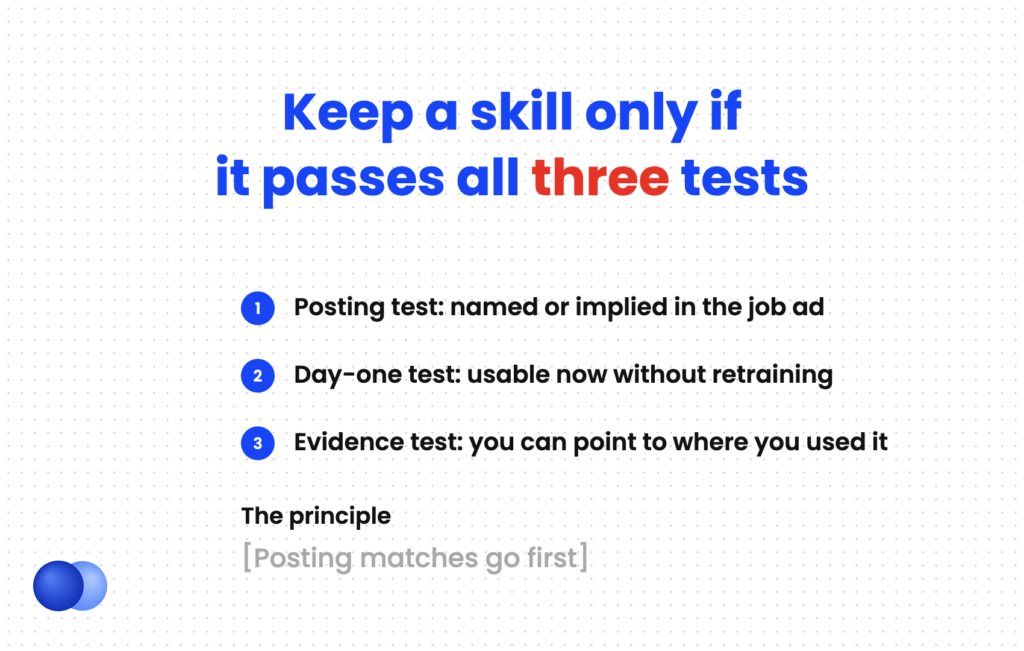
- Posting test. The skill is named in the posting, or it is a standard tool for the exact task described.
- Day-one test. You could use it this week without a refresher course.
- Evidence test. You can point to a job, project or certification where you used it.
Skills that pass all three go at the front of your list. Skills that pass only the first two belong in a "learning" line or nowhere at all. A skill that passes none is clutter.
Copy the posting's exact wording. Jobscan's 2026 guide notes that exact-match systems may not treat an acronym and its full term as the same thing, so write both once: "Search Engine Optimization (SEO)." Our resume keywords guide covers this matching in more detail.
How should you format hard skills on a resume?
Put hard skills in a dedicated skills section below your summary or experience, grouped under two to four bold category labels with comma-separated items. Order categories and items by relevance to the job. Add proficiency levels only for languages and tools where depth matters, and put certifications in their own section with issuer and date.
The University of Georgia Career Center recommends bold category labels followed by comma-separated lists, ordered from most to least relevant. That format scans fast and parses cleanly.
Technical Skills: SQL (PostgreSQL, BigQuery), Python (pandas, NumPy), Excel (Power Query, XLOOKUP, pivot tables)
Visualization: Tableau, Power BI, Looker Studio
Methods: A/B testing, regression analysis, cohort analysis, data cleaning
Certifications: Google Data Analytics Professional Certificate (2025)
Clinical Skills: Patient assessment, IV therapy, phlebotomy, wound care, medication administration
Systems: Epic EHR (advanced), Cerner (working knowledge), Pyxis MedStation
Certifications: BLS and ACLS, American Heart Association (renewed 2026)
Languages: Spanish (professional working proficiency)
Keep the section to 8 to 15 items for most roles. Technical roles can run longer if every item passes the three tests. For credential formatting, see how to list certifications on a resume.
Use levels sparingly
Skip star ratings and progress bars. They do not parse well in applicant tracking systems, and "3 out of 5 stars" invites the question of what you cannot do. Use words like "advanced" or "working knowledge" only where the posting asks for a level.
How do you prove hard skills in your work experience?
Name the tool inside an accomplishment bullet and attach a result. Use the pattern action verb, plus tool, plus task, plus measurable outcome. "Built a Power BI dashboard that cut weekly reporting time from 6 hours to 1" proves the skill. The skills section alone only claims it.
Your skills list should echo your bullets, not replace them. Pick your top three hard skills for the target job and make sure each appears in at least one bullet.
- Automated month-end reconciliation in NetSuite and Excel Power Query, cutting close time from 8 days to 5
- Wrote SQL queries in BigQuery to segment 2.1M customer records, feeding a retention campaign that lifted repeat orders 12%
- Programmed and maintained 14 Allen-Bradley PLCs, reducing unplanned line downtime by 30% over two quarters
- Rebuilt 40 product pages for SEO using GA4 and Search Console data, growing organic sessions 58% in six months
Each line names a specific tool and a specific outcome. For more on structure, read how to write resume bullet points and how to quantify your resume.
Which hard skills should you leave off your resume?
Leave off skills you cannot use without retraining, tools every applicant is assumed to have (such as email or web browsing), outdated software the posting does not mention, and vague labels like "computer skills." Also cut anything unrelated to the target job. Each weak item dilutes the strong ones next to it.
A long list feels safer. In practice, it hides the skills that matter and invites interview questions you cannot answer.
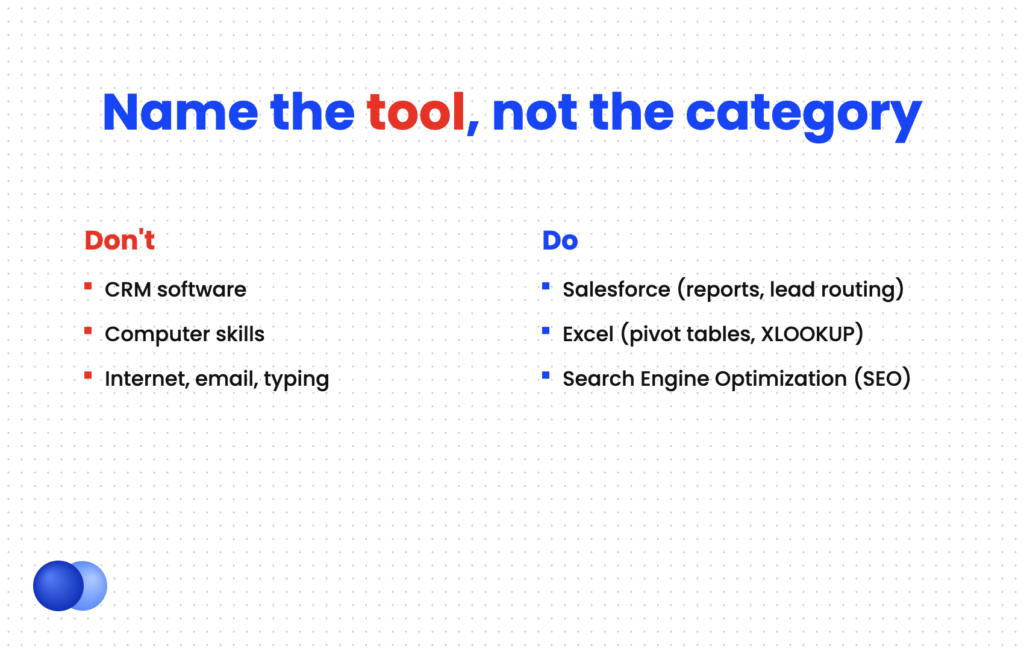
List "Salesforce (reports, dashboards, lead routing)"
List "CRM software" with no product name do: Write "Search Engine Optimization (SEO)" once, with both forms dont: Repeat the same keyword five times to game a scanner do: Keep skills you used within the last few years dont: Include software the posting never mentions and you last opened in 2015 do: Cut "Microsoft Word" when the job is senior engineering dont: Pad the list with "internet," "email" or "typing"
If you are switching fields, some older tools may still transfer. Our guide to transferable skills for your resume shows how to frame them. Before you apply, run your draft through the Rezoom ATS resume checker to see which posting keywords your hard skills still miss.

Frequently asked questions
What is the difference between hard skills and soft skills?
Hard skills are specific, teachable abilities you can test, such as coding, accounting or welding. Soft skills are interpersonal and behavioral traits, such as communication and adaptability. Most jobs need both.
How many hard skills should I put on my resume?
Most resumes work best with 8 to 15 hard skills. Technical roles can list more if each one is relevant and backed by experience.
Where do hard skills go on a resume?
Put them in a dedicated skills section, grouped by category. Then repeat your top three inside experience bullets with measurable results. Our guide on [how to highlight skills on your resume](https://rezoom.io/how-to-highlight-skills-on-your-resume/) covers placement in more depth.
Is Microsoft Office still a good hard skill to list?
Yes, when the posting names it or the role is administrative, financial or analytical. Name the specific app and feature, such as "Excel (pivot tables, XLOOKUP)," rather than just "Microsoft Office."
Should I list hard skills I am still learning?
Only if the posting values them and you can explain your progress. Label them clearly, such as "Python (in progress, coursework 2026)," and never present them as fluent.
Are certifications hard skills?
Certifications are proof of hard skills. List the underlying skill in your skills section and the credential, issuer and date in a certifications section.


Comments