

Summary
List each language by name followed by a proficiency level, such as "Spanish (Professional working proficiency)" or "French (CEFR B2)." Put languages in your skills section by default, in a dedicated Languages section when the job requires them, and in your summary when bilingual ability is a core requirement. Use a standard scale (ACTFL, ILR or CEFR) if you have a test score, and a plain-English label if you do not. Never overstate your level.
Write the language name, then a proficiency level you can defend in an interview: "Spanish (Professional working proficiency)." That is the core of how to list languages on resume. Everything else is about where the line goes and which scale you use.
Most guides stop at "fluent, proficient, conversational." Those words mean different things to different readers. This guide shows you how the three standard scales (ACTFL, ILR and CEFR) line up, which labels to use without a test score, and where language skills belong for different kinds of jobs.
The stakes are real. In ACTFL's employer survey, 9 out of 10 U.S. employers said they rely on employees with skills in languages other than English. A clear, honest language line helps a recruiter see that value in seconds.
How do you list languages on a resume?
List each language on its own line or separated by commas, with the language name first and the proficiency level in parentheses or after a dash. Order languages from strongest to weakest. Use one scale consistently: plain-English labels, ILR, ACTFL or CEFR. Add a test name and year only if you have an official score.
A good language entry has three parts: the language, the level, and (optionally) the proof. Keep the format identical for every language so the section scans cleanly.
Languages: English (Native), Spanish (Full professional proficiency), Portuguese (Conversational)
Languages
Spanish — ACTFL OPI: Superior (2025)
French — CEFR B2, DELF B2 (2024)
Mandarin Chinese — Elementary (reading and speaking)
A few formatting rules apply to both styles:
- Strongest first. Your native language can go first or last. Consistency matters more than position.
- Write the full language name. "Mandarin Chinese" or "American Sign Language (ASL)," not "Mand." or a flag icon.
- Use text, not graphics. Skill bars, stars and dots mean nothing without a scale, and parsing software can skip them. Our guide on how ATS software reads resumes explains why plain text wins.
- Split skills if they differ. Heritage speakers often speak better than they write. "Korean (fluent speaking, basic writing)" is more useful than a single inflated label.
What are the language proficiency levels for a resume?
The three standard scales are ACTFL (Novice, Intermediate, Advanced, Superior, Distinguished), used in US education; ILR (0 to 5), used by the US government; and CEFR (A1 to C2), used in Europe and by many international tests. Without a test score, use plain labels such as Elementary, Conversational, Professional working and Native.
Each scale was built for a different audience, which is why resume advice often mixes them up.
ACTFL has five major levels: Novice, Intermediate, Advanced, Superior and Distinguished. The first three split into Low, Mid and High. The ACTFL Proficiency Guidelines 2024 describe Advanced speakers as able to narrate and describe in past, present and future using paragraph-length speech.
ILR runs from 0 to 5, with "plus" levels in between. The official ILR speaking descriptions name Level 2 "Limited Working Proficiency," Level 3 "General Professional Proficiency," Level 4 "Advanced Professional Proficiency" and Level 5 "Functionally Native Proficiency." A plus level means you clearly exceed one level but don't fully meet the next.
CEFR has six levels in three bands. The Council of Europe's global scale groups A1 and A2 as "Basic user," B1 and B2 as "Independent user," and C1 and C2 as "Proficient user."
How do ACTFL, ILR and CEFR levels compare?
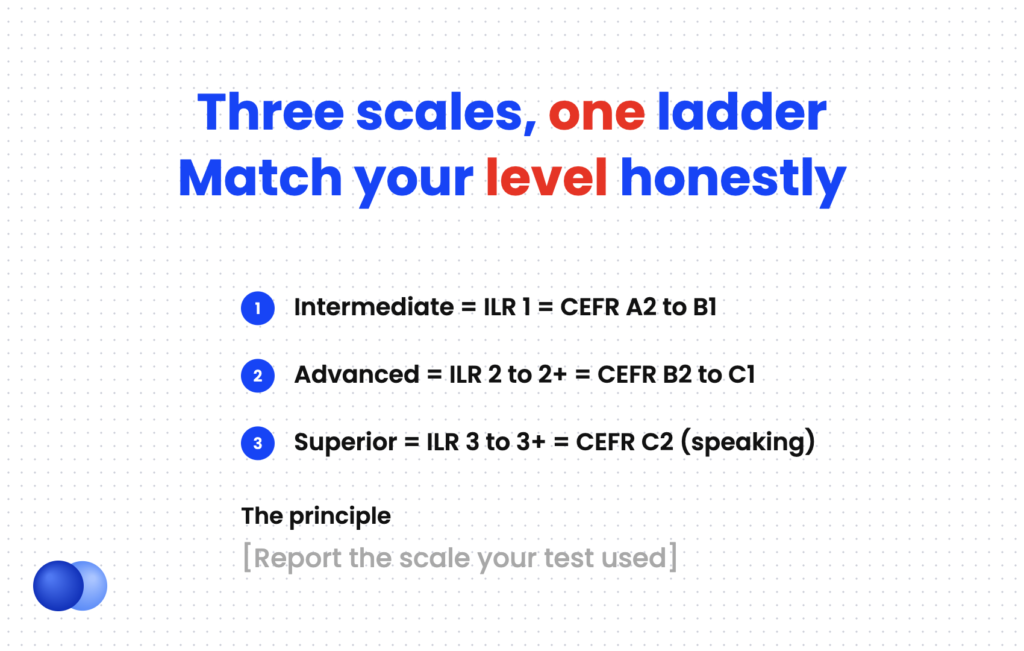
Roughly, ACTFL Intermediate matches ILR 1 and CEFR A2 to B1; ACTFL Advanced matches ILR 2 to 2+ and CEFR B2 to C1; ACTFL Superior matches ILR 3 and CEFR C2 for speaking. These are approximations. ACTFL says CEFR ratings can be assigned to its tests, but not the reverse.
The table below combines two published crosswalks for speaking. The ACTFL-to-ILR column comes from the Center for Applied Linguistics. The ACTFL-to-CEFR column comes from ACTFL's own speaking and writing correspondence, set in 2011. The last column is our suggested plain-English resume label.
| ACTFL (speaking) | ILR | CEFR (speaking) | Suggested resume label |
|---|---|---|---|
| Novice Low / Mid | 0 | Below A1 | Leave off, or "Basic" |
| Novice High | 0+ | A1 | Elementary |
| Intermediate Low / Mid | 1 | A2 / B1.1 | Conversational |
| Intermediate High | 1+ | B1.2 | Conversational (strong) |
| Advanced Low / Mid | 2 | B2.1 / B2.2 | Professional working proficiency |
| Advanced High | 2+ | C1 | Professional working proficiency (advanced) |
| Superior | 3 to 3+ | C2 | Full professional proficiency |
| Distinguished | 4 to 5 | Not rated in ACTFL's speaking crosswalk | Fluent / Native or bilingual |
Two caveats keep this table honest. First, ACTFL states its CEFR links are one-directional: a CEFR rating can be assigned to an ACTFL test, but a CEFR score does not convert back. Second, reading and listening map differently from speaking. On ACTFL's receptive table, for example, Advanced Mid corresponds to B2, not B2.2.
So on your resume, report the scale your test actually used. If you took a DELF exam, write "CEFR B2." Don't translate it into an ILR number you never earned.
Use the recruiter’s scale, not yours
Read the job posting first. ILR is the US government's scale, ACTFL grew out of US education, and CEFR comes from Europe, so postings often follow those lines. If the posting names a scale and you hold a score on it, use that exact wording. It doubles as a keyword match.
Where should languages go on a resume?
Put languages in your skills section by default. Give them a dedicated Languages section when you speak two or more besides English or when the job lists a language requirement. When bilingual ability is central to the role, also name it in your summary and show it in a work experience bullet.
Use this decision rule based on how much the job depends on the language:
- Nice to have (not in the posting): one line in your skills section. See our guide to the best skills to put on a resume.
- Listed as preferred: a dedicated Languages section, plus one work bullet that shows the language in use.
- Required (bilingual roles, interpreters, international sales): name it in your headline or resume summary, keep the Languages section, and prove it in two or more bullets.
Work bullets carry the most weight because they show real use. Compare "Spanish (Fluent)" with a bullet that describes the work itself.
- Handled 40+ weekly patient intake calls in Spanish and English, cutting interpreter requests for the front desk - Translated onboarding guides into French for a 25-person Montreal team - Led vendor negotiations in Mandarin Chinese with three Shenzhen suppliers
Numbers in these examples are placeholders. Replace them with your own figures.
If you studied a language formally, it can also appear in education. A language minor or study-abroad term goes there; our sibling guide on how to put a minor on resume shows the format.
How do you describe your level honestly without a test score?
Without a test, pick the label that matches what you can do on the job today. If you can run a meeting or write a client email unaided, "Professional working proficiency" fits. If you can hold everyday conversations with some errors, use "Conversational." If an interviewer could switch languages and you would struggle, lower your label.
Most job seekers never take a formal proficiency test. That is fine. The fix is to describe ability, not years of study.
Use this self-check, based on the ILR speaking descriptions:
- Can you handle routine work tasks, with some gaps? That is close to ILR 2, "Limited Working Proficiency." Write "Professional working proficiency" only if you manage most work conversations without help.
- Can you join most professional conversations accurately? That is ILR 3. Write "Full professional proficiency."
- Is your speech functionally equal to an educated native speaker? That is ILR 5. Write "Native" or "Bilingual."
Assume the interviewer speaks the language. Many do, especially when the job requires it. A recruiter who switches to Spanish mid-interview will find any gap quickly, and it can cost you the offer.
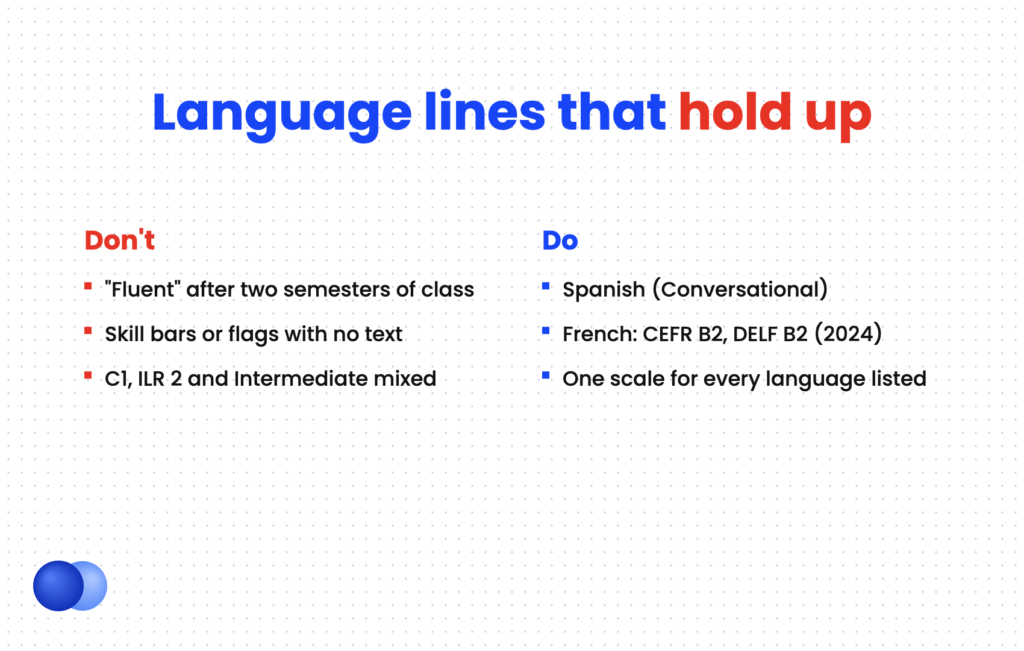
Write "Spanish (Conversational)" when you can chat but not negotiate. do: Name the test and year when you have an official score. do: Split speaking and writing when they differ. do: Keep one scale across every language on the page.
Call yourself "fluent" after two semesters of classes. dont: Use skill bars, stars or flag icons without text. dont: Mix "C1," "ILR 2" and "Intermediate" in one section. dont: List a language you could not use in an interview.
Should you list a language if you are only a beginner?
Usually no. Beginner or Novice-level ability rarely helps with a job and uses space. List a beginner language only if the posting mentions it, you are actively studying it with a clear goal, or it signals cultural fit for the role. Label it plainly as "Elementary" or "Basic."
The one strong exception is a language the employer names. A posting for a hotel in Miami that "prefers Spanish" rewards even basic Spanish. In that case, write "Spanish (Elementary, currently studying)."
Everything else is a trade-off. Every line on a resume competes for a few seconds of attention; our guide on how long recruiters look at a resume covers that time budget.
Language demand is also growing. In the same ACTFL survey, 56% of employers said their need for foreign language skills would increase over the next five years. A language you are building now may earn a line later.
How do you list language certifications on a resume?
List a language certification with the exam name, your score or level, and the year. Place it in your Languages section beside the language, or in a Certifications section if you have several credentials. Examples: "ACTFL OPI: Advanced Mid (2025)" or "DELE C1, Spanish (2024)."
An official score removes the guesswork for the recruiter. Put the exam name next to the level so the reader knows which scale applies.
If you hold multiple professional credentials, a Certifications section may make more sense. Our guide to resume certifications covers ordering and dates. You can also build the section with the Rezoom AI resume builder, which formats language entries as parseable text.
Frequently asked questions
Is "bilingual" enough on a resume?
"Bilingual" alone doesn't say which languages. Write "Bilingual: English and Spanish" or list each language with its level. Then prove it with at least one work bullet.
What is the difference between fluent and proficient on a resume?
There is no official definition for either word, which is why standard scales help. In practice, "fluent" suggests near-native ease. "Proficient" or "professional working proficiency" suggests you can do your job in the language with minor gaps.
Should I put English on my resume if it is my native language?
For US jobs, it is optional because the resume itself shows your English. Include it when you list other languages, so the reader sees your full range, or when applying abroad.
Does American Sign Language count as a language on a resume?
Yes. ASL is a full language and belongs in your Languages or skills section, with a proficiency level like any other language.
What CEFR level counts as professional?
On ACTFL's speaking crosswalk, CEFR B2 corresponds to ACTFL Advanced Low or Mid, which aligns with ILR 2 (Limited Working Proficiency). If a posting asks for a CEFR level, match it exactly rather than guessing an equivalent.
Can ATS software read language skills?
Yes, if they are written as plain text. Graphic ratings, icons and text inside images may not be read. Write the language name and level in words.



Comments