

Summary
To put bilingual on a resume, name both languages in your headline or summary, list them with proficiency levels in your skills or languages section, and show the second language at work in at least one experience bullet. Never write "bilingual" alone, because recruiters need to know which languages. For bilingual-preferred jobs, move the language to the top third of the page and add proof such as a fluency certification or a measurable result.
The right way to show you are bilingual on a resume is to name both languages, place them where a recruiter looks first, and prove the second one with a real work example. "Bilingual" alone tells a reader almost nothing. "Bilingual English/Spanish" in your headline, backed by a bullet showing you used Spanish with customers, tells them everything.
The skill is worth the space. In a 2019 survey of 1,200 US employers, 90% said they rely on employees with language skills other than English, and one in three of those employers reported a shortage.
This guide covers where "bilingual" belongs, how to adjust when a job says "bilingual preferred," and how to make the claim credible.
What does bilingual on a resume actually mean to employers?
To employers, "bilingual" means you can do the job's work in two languages, not just hold a conversation. Recruiters read it as professional or native fluency in both. If you can chat but not handle a customer complaint, a contract or a patient intake in that language, describe your level honestly instead of using the word "bilingual."
Employers who screen for bilingual candidates usually have a concrete task in mind. It might be answering calls, explaining a bill, translating forms or working with a regional team.
That is why the word sets a high bar. If you use it, expect an interviewer to switch languages mid-conversation. Some employers go further and test you formally, which we cover below.
If your second language is conversational, list it with a proficiency label instead. Our guide on how to list languages on a resume explains the common proficiency scales and which label fits your level.
Where should you put bilingual on a resume?
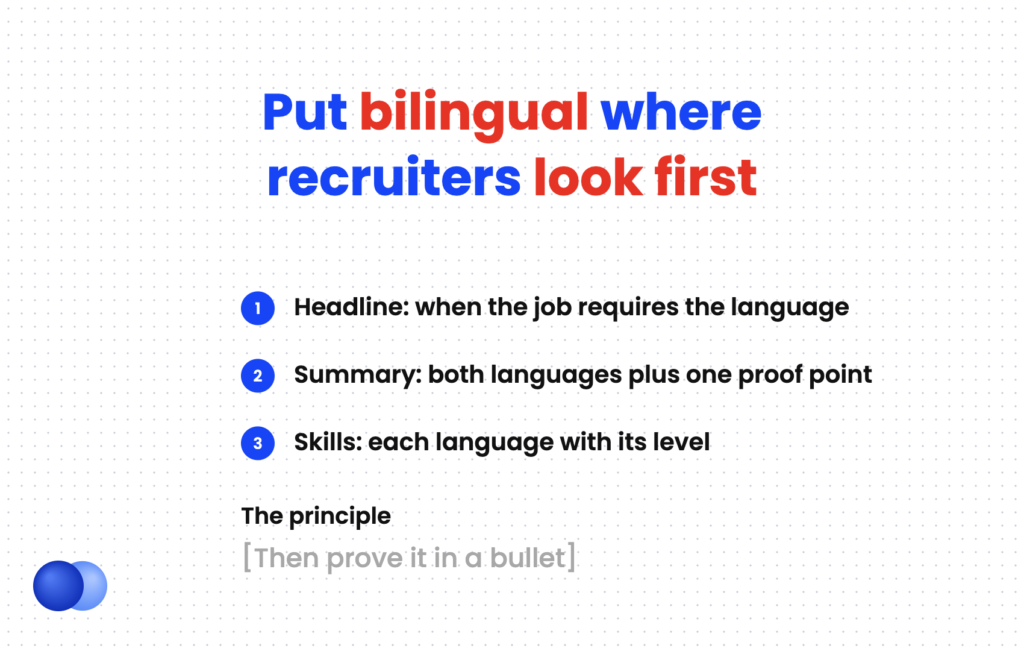
Put it in up to four places: your headline (for language-driven roles), your summary, your skills or languages section, and your experience bullets. The headline and summary make the skill visible in seconds. The skills section helps applicant tracking systems match it. The bullets prove it. Use all four only when the job requires the language.
Each location does a different job. Use this table to decide how many you need.
| Location | What to write | When to use it | What it does |
|---|---|---|---|
| Headline | "Bilingual (English/Spanish) Customer Service Representative" | Job lists the language as required or preferred | Makes the skill visible in the first second |
| Summary | One clause naming both languages plus a proof point | Most applications where the language is relevant | Connects the language to your value |
| Skills or languages section | "Spanish (native), English (native)" | Every application | Gives ATS an exact keyword match |
| Experience bullets | A task you performed in the second language, with a result | Whenever you have used it at work | Proves the claim |
The skills or languages line is the baseline. Add the headline and summary placements when the posting asks for the language. Add bullets whenever you have real examples, because they carry the most weight.
In your headline
A headline sits under your name. For roles where the language is a core requirement, this is the most visible spot for bilingual on a resume, because a recruiter scanning dozens of applications sees it instantly.
In your summary
One sentence is enough. Name the languages and tie them to an outcome. For structure, see our resume summary guide or the sibling guide to a summary of qualifications, which works well for bullet-style openings.
In your skills section
List each language with its level. If you have only one other language, a line in your skills section works. With three or more, a separate "Languages" heading keeps things clean.
Headline: Bilingual (English/Spanish) Patient Access Representative
Summary: Patient access representative with 4 years in high-volume clinics. Bilingual in English and Spanish; registered 60+ patients per shift and handled all Spanish-language insurance calls for a 9-person team.
Skills: Languages: Spanish (native), English (native) Systems: Epic, Cerner, Microsoft Office
How do you show bilingual skills in experience bullets?
Write bullets that show what you did in the second language and what happened as a result. Name the language, the task, the audience and a number where you can. "Handled 40 Spanish-language calls per day with a 95% resolution rate" proves fluency far better than "bilingual" in a skills list ever could.
Bullets are where the claim becomes believable. Think about who you spoke with, what you produced and what changed.
Good raw material includes:
- Customers, patients or clients you served in the language
- Documents you translated or reviewed
- Colleagues or regional offices you coordinated with
- Training or onboarding you delivered to non-English speakers
- Revenue, retention or satisfaction gains tied to that work
Numbers make bullets stronger. Our guide on how to quantify your resume shows ways to add scale even when you lack hard metrics.
- Resolved 40+ Spanish-language support calls per day, maintaining a 94% first-contact resolution rate
- Translated 120 product safety sheets from English to French for the Quebec launch, with zero compliance revisions
- Served as primary Mandarin liaison for 3 supplier accounts in Shenzhen, cutting order errors 30%
- Interpreted parent-teacher conferences for 25 Vietnamese-speaking families each semester
- Grew Portuguese-speaking client base from 15 to 48 accounts in 18 months through referrals
Notice that none of these bullets says "bilingual." They show it. The word belongs at the top of the page, and the proof belongs here.
How should you handle "bilingual preferred" job postings?
These roles are common. A New American Economy analysis found US job postings seeking bilingual workers rose from about 240,000 in 2010 to about 630,000 in 2015, with Spanish, Chinese and Arabic in highest demand. The same research found that 60% of the highest-demand bilingual roles did not require a bachelor's degree.
The customer base explains why. Census data from 2017 to 2021 shows 22% of US residents age 5 and older speak a language other than English at home, and about 61% of them speak Spanish.
For these postings, follow three steps:
- Match the wording. If the ad says "Bilingual English/Spanish," use that exact phrase. Exact matches help with resume keywords and ATS screening.
- Move it up. Put the language in your headline and the first line of your summary.
- Stack the proof. Include two or more bullets, plus any certification.
Expect a fluency test
Many public employers test before they pay for language skills. California's corrections department, for example, requires employees to pass a bilingual fluency exam and use the language about 10% of the time to qualify for bilingual pay. Only claim the level you could pass a test at.
Bilingual skills can also mean extra pay. In one California state bargaining unit, the bilingual differential is $125 per month. If a posting mentions a differential, that is a strong signal to put the language near the top.
How can you prove you are bilingual on a resume?
Prove it with three kinds of evidence: work bullets that show the language in use, a recognized test or certification, and context such as study or work abroad. A certificate is not required, but it helps when the employer pays a differential or when your name, schooling or work history does not make the language obvious.
Recruiters cannot hear you speak from a PDF, so give them signals they trust.
- Work evidence. The bullets above are the strongest proof because they show real use.
- Credentials. A language proficiency test, interpreter certification or employer fluency exam carries weight. List it under certifications. Our resume certifications guide covers formatting.
- Context. A degree taught in the language, a semester abroad or years working in a region all support the claim.
If you are a heritage speaker who grew up with the language but never studied it formally, you are still bilingual on a resume when you can work in it. Be specific about strengths, such as strong spoken fluency with professional writing still developing, rather than overclaiming.

What mistakes should you avoid with bilingual on a resume?
The biggest mistakes are writing "bilingual" without naming the languages, listing English as a second language on a US resume when you are native in both, overstating proficiency, and burying a required language at the bottom of the page. Each one either confuses the recruiter or creates a problem in the interview.
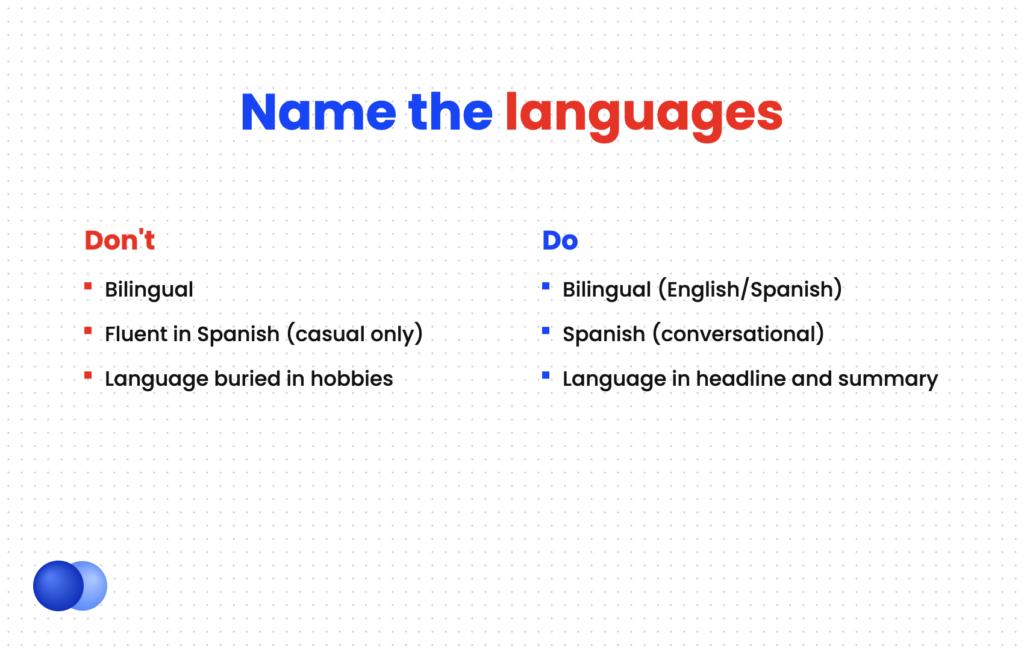
Write "Bilingual (English/Spanish)" so both languages are clear
Write "Bilingual" alone with no languages named do: Put a required language in your headline and summary dont: Bury a required language in a hobbies or interests line do: Show the language in action with a measurable bullet dont: Call yourself fluent when you can only hold a casual chat do: Mirror the posting's exact phrase for ATS matching dont: List five languages at beginner level to look impressive
One more point: languages you speak casually do not belong in a hobbies and interests section. If a language is a work skill, give it a skills or languages line.
When your draft is ready, the Rezoom AI resume builder can help you rewrite generic language claims into tailored, posting-matched lines.
Frequently asked questions
Should I put bilingual on my resume if I am not fluent?
No. Use "bilingual" only if you can do the job in both languages. If you are conversational, list the language with an honest proficiency label instead.
Is bilingual a hard skill or a soft skill?
It is a hard skill because it can be tested and measured. It also supports soft skills like communication and customer service, which your bullets can show.
Where do I put bilingual on a resume with no work experience?
Put it in your summary and skills section, then prove it with volunteer work, tutoring, school projects or community roles where you used the language.
Do I need a certificate to say I am bilingual?
No, but one helps for roles with a bilingual pay differential or a fluency test. Work examples are often enough for other jobs.
Should I list English as a language on a US resume?
Usually only when you are bilingual and want to show both clearly, as in "Spanish (native), English (native)." Otherwise, English is assumed.
Can I put bilingual in my resume headline?
Yes, when the job requires or prefers the language. A headline like "Bilingual (English/Korean) Sales Associate" makes the match obvious in seconds.



Comments