

Summary
Hobbies and interests belong on a resume only when they add evidence the rest of the page lacks: a job-relevant skill, a sign of culture fit, or proof of commitment for candidates with thin experience. Pick two to four specific, active pursuits, describe each with a concrete detail, and place them in a short section at the bottom. Leave off anything that reveals religion, politics or other protected traits.
Hobbies and interests can earn a place on your resume, but only when they tell an employer something useful. A relevant pursuit, described specifically, can show a skill, a work habit or a culture match. A generic list like "reading, travel, movies" usually wastes the line.
So the real question is not whether to include them. It is which ones add evidence, and when your space is better spent elsewhere. Career advisers at UCSF put it bluntly: you are far more likely to be hired for your qualifications than for an unrelated hobby.
This guide gives you a decision rule, a list of hobbies by the skill they signal, the ones to avoid, and a copy-ready format.
Should you put hobbies and interests on a resume?
Include hobbies and interests when you have spare space and at least one pursuit that shows a skill, trait or connection relevant to the job. Skip the section if it would push out experience, skills or results. For most experienced candidates it is optional; for students and early-career applicants it can add useful evidence.
Use a three-question test before adding anything:
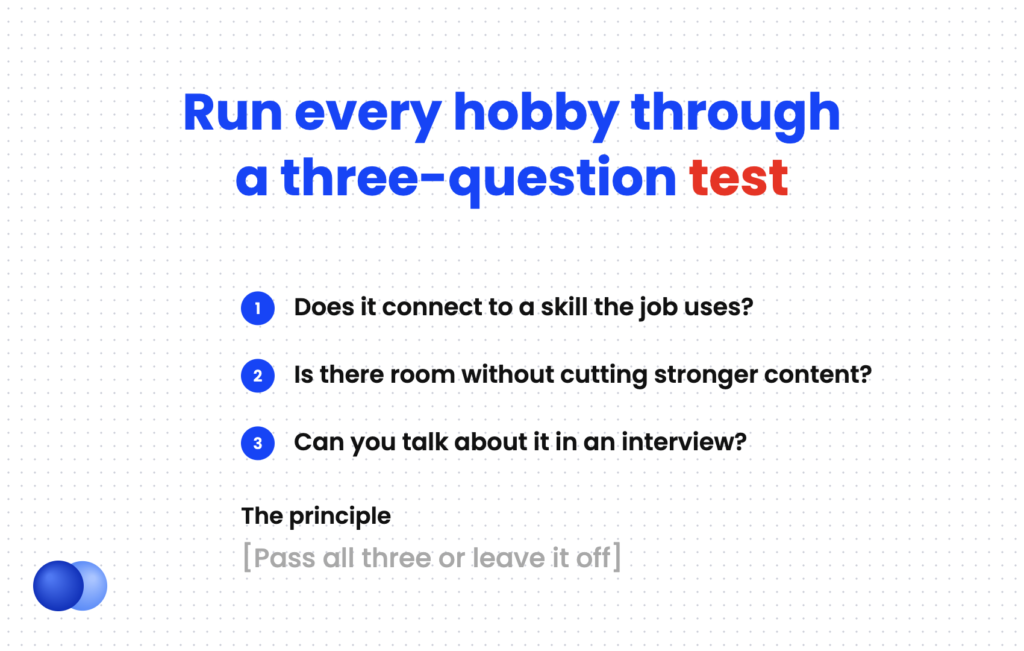
- Does it connect to the job? It should show a skill, a trait or knowledge the role uses, even indirectly.
- Is there room? It should never displace a stronger bullet or push your resume onto a second page.
- Can you talk about it? Interviewers often ask about this section, so list only real, current activities.
If a pursuit passes all three, it can stay. UCSF's career team gives the same advice: list a hobby only if it could add value to the role, even tangentially, and you have space for it.
When do hobbies and interests actually help?
Hobbies and interests help most in four situations: you have little work experience, the hobby builds a skill the job needs, the employer's culture or product connects to it, or it shows sustained commitment such as marathon training or competitive play. Research on elite firms also shows interviewers weigh shared interests when judging cultural fit.
The strongest cases look like this:
- Thin experience. Students and career starters can use hobbies to show discipline and initiative. Our guides to a college student resume and a resume with no experience cover where this fits.
- Direct skill transfer. A video editor who shoots short films, or a data analyst who builds sports models, is showing job skills.
- Industry connection. An outdoor gear retailer may value climbing experience. A game studio may value tabletop design.
- Commitment signals. Long-term, measurable pursuits show persistence better than a trait word.
Personal interests also feed the "fit" judgment. In sociologist Lauren Rivera's study of elite banks, law firms and consulting firms, more than half of evaluators ranked cultural fit as the most important criterion at the interview stage, often judged through shared leisure pursuits.
That cuts both ways. A follow-up audit study sent resumes to 316 law firm offices, using hobbies such as sailing versus track and field, and classical versus country music, to signal social class. Hobbies shaped how candidates were judged, and not always fairly. Choose ones that show skills, not status.
Which hobbies and interests should you list?
Choose active, specific hobbies and interests that map to a skill in the job posting. Team sports suggest collaboration, endurance training shows discipline, coding projects show technical skill, and volunteering shows community commitment. Add a concrete detail to each one, such as a number, a level or a result, so it reads as evidence rather than filler.
Match the hobby to what the posting asks for. This table shows common choices and the skills they can signal.
| Hobby or interest | Skill it can signal | Strongest for |
|---|---|---|
| Team sports or coaching | Collaboration, leadership | Sales, management, customer roles |
| Marathon or triathlon training | Discipline, goal-setting | Any role, especially high-pressure ones |
| Coding side projects | Technical skill, self-learning | Software, data, IT |
| Writing or blogging | Communication, editing | Marketing, content, communications |
| Chess or strategy games | Planning, analysis | Finance, consulting, analytics |
| Photography or design | Visual skill, attention to detail | Creative, marketing, product |
| Language learning | Communication, persistence | International, customer-facing roles |
| Volunteering | Community focus, reliability | Nonprofit, healthcare, education |
Some of these overlap with other sections. Structured volunteering usually belongs in its own section; see how to list volunteer work on a resume. Fluency in a second language belongs with your skills, as our sibling guide on how to put bilingual on a resume explains.
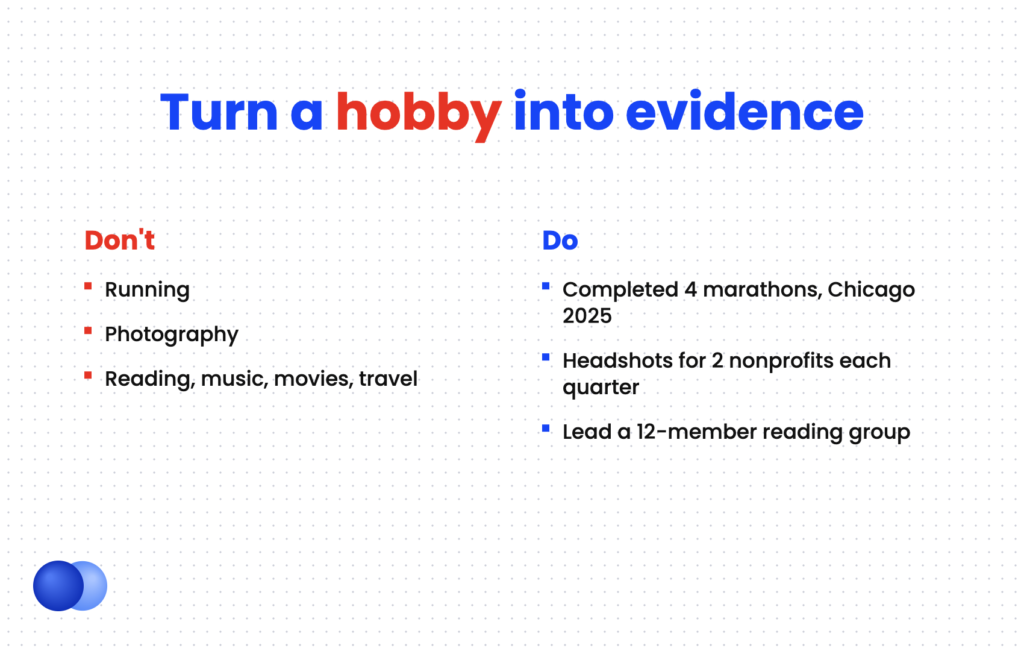
Before: Running After: Distance running: completed 4 marathons; ran Chicago 2025 in 3:28
Before: Photography After: Portrait photography: shoot headshots for 2 local nonprofits each quarter
Before: Gaming After: Competitive chess: USCF-rated 1650; organize a 20-member workplace club
Before: Reading After: Behavioral economics reading group: lead monthly discussions for 12 members
Which hobbies should you leave off your resume?
Leave off hobbies that reveal religion, political views, health or other protected traits, anything risky or controversial, and passive pastimes like watching TV or sleeping. Also skip generic entries such as "reading" or "travel" with no detail. When in doubt, ask whether the hobby could prompt a bias rather than a conversation.
The EEOC advises employers to keep pre-employment information to what is needed to judge qualifications, and to avoid inquiries about clubs and organizations that may indicate an applicant's religion, national origin, age or other protected traits. Do not volunteer that information yourself.
List 2–4 specific hobbies with a concrete detail each
Write a long list like "reading, music, movies, travel, food" do: Pick pursuits you can discuss for two minutes in an interview dont: Include anything you have not done in the last year do: Describe faith-based volunteering by the skill used, if you list it dont: Name political campaigns or causes unless the job is in that field do: Tailor the list to the company's industry and culture dont: List risky or polarizing activities like hunting or gambling for a general audience
Culture matters too. UMGC's career team notes that hobbies such as video games or comic collecting may suit a pop culture website but could undermine an application at a traditional firm like an accounting practice. Research the employer first.
How do you format a hobbies and interests section?
Put hobbies and interests in a short section at the bottom of your resume, under a plain heading such as "Interests." List two to four items on one or two lines, each with a brief qualifier. Keep it below your experience, education and skills, and never let it run longer than three lines.
Formatting rules that keep the section tight:
- Placement. Last, after education and skills. UMGC also recommends placing hobbies toward the bottom of your resume.
- Heading. "Interests" or "Hobbies and Interests" both parse cleanly in an ATS.
- Length. Two to four items, one or two lines in total.
- Style. Use a single line with separators, or short bullets if each item has detail.
STUDENT (applying for a retail management trainee role) INTERESTS Varsity soccer captain (2 seasons) | Thrift-flip side business, 150+ sales on Depop | Spanish (conversational)
SOFTWARE ENGINEER INTERESTS • Open-source: maintain a Python CLI tool with 1,200 GitHub stars • Home automation projects using Raspberry Pi and Home Assistant
CAREER CHANGER (nurse to health tech customer success) INTERESTS Health tech podcasts and newsletters | Half-marathon training | Mentor for new-grad nurses
Use the section as an interview hook
Interviewers often open with the interests line because it is easy small talk. Pick one item with a short story behind it, such as what you learned organizing a club or finishing a race. It gives you a natural way to show a soft skill early in the conversation.
If you are still deciding what belongs on the page, our guide to how to highlight skills on your resume helps you rank what goes first. When your draft is ready, run it through the Rezoom ATS resume checker to confirm every section parses correctly.

Frequently asked questions
Is it unprofessional to put hobbies on a resume?
No, as long as they are relevant, specific and brief. They become unprofessional when they are generic, controversial or take space from stronger content.
How many hobbies and interests should I list?
Two to four is enough. More than that starts to look like filler.
Where should hobbies go on a resume?
At the bottom, after experience, education and skills. Use a plain heading such as "Interests."
Should I put hobbies on my resume with no experience?
Yes, they can help. Choose ones that show discipline, teamwork or initiative, and add a concrete detail to each.
What is the difference between hobbies and interests?
Hobbies are activities you do, such as running or coding. Interests are topics you follow, such as behavioral economics. Both can go in the same section.
Do recruiters read the hobbies section?
Some do, but it sits last and recruiters spend [about 7.4 seconds on an initial resume scan](https://www.hrdive.com/news/eye-tracking-study-shows-recruiters-look-at-resumes-for-7-seconds/541582/). That is why the line must be short, specific and easy to scan.



Comments