

Summary
Extracurricular activities belong on a resume when you are a student or recent graduate, or when an activity shows a skill the job needs. Put leadership roles with real responsibility in your experience or a "Leadership" section, and list simple memberships in one line. Write them like jobs: organization, role, dates and one or two results. Most candidates should drop them a few years after graduation.
Listed well, extracurricular activities on your resume can do the work of a job when you do not have much work history yet. A club leadership role, a team captaincy or a student publication shows the same skills employers screen for: teamwork, communication and follow-through.
The catch is how you write them. A line that says "Member, Marketing Club" proves almost nothing. A line that says you ran a 40-person event budget proves a lot.
This guide covers when extracurricular activities help, how to choose where they go, a bullet formula, examples by situation and the point at which you should cut them.
Should you put extracurricular activities on a resume?
Yes, if you are a student, a recent graduate or someone with limited work experience, and the activity shows a skill the job values. Leadership roles and long-term commitments carry the most weight. Once you have two to three years of relevant work, keep only activities that are still active or directly tied to the role.
Employers do weigh them. In NACE's Job Outlook 2026 survey, a GPA of 3.0 or higher fell below general work experience, holding a leadership position and involvement in extracurricular activities as factors when choosing between otherwise equal candidates. Internships remained the top deciding factor.
Extracurriculars also count at selective firms. Sociologist Lauren Rivera's study of investment banks, law firms and consulting firms found evaluators often favor extracurricular activities associated with people of their own background. That means activities get read closely. Present them as evidence of skills, not status.
Use a quick test for each one:
- Did you do something, not just join? A role, project or result beats membership.
- Does it show a skill in the posting? Match it to the job description.
- Is it recent? Activities from more than four or five years ago rarely help.
Where do extracurricular activities go on a resume?
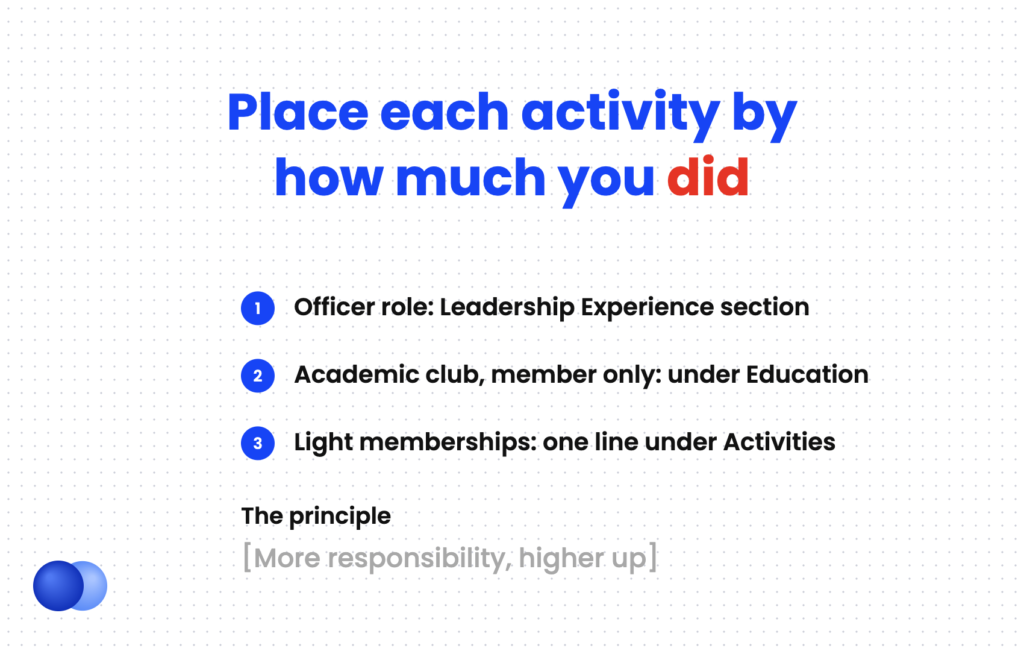
Put a substantial leadership role in your experience section or a "Leadership Experience" section. Put academic clubs and honor societies under education. Use a separate "Activities" section for two or more memberships with lighter involvement. The more responsibility you held, the closer to the top it should sit.
The right spot depends on how much you did, not on what the activity is called.
| Type of involvement | Best placement | Heading to use |
|---|---|---|
| Officer or leadership role with real duties | Experience or a dedicated section | "Leadership Experience" |
| Varsity or club sports with captaincy | Leadership or activities section | "Leadership" or "Athletics" |
| Academic club or honor society, member only | Education section, one line | (under your degree) |
| Several memberships with light involvement | Separate section near the bottom | "Activities" or "Campus Involvement" |
| Structured volunteering with hours and outcomes | Volunteer section | "Volunteer Experience" |
| Greek life officer role | Leadership section | "Leadership Experience" |
Texas A&M's Career Center recommends titling the section "Leadership" if you held positions and "Activities" if you were only a member. That one heading choice tells a recruiter what to expect before they read a word.
Some activities have their own conventions. See our guides on how to put a sorority or fraternity on a resume, study abroad on a resume and how to list volunteer work on a resume.
How do you write extracurricular activities so they show skills?
Treat each activity like a job entry. List the organization, your role, the location and the dates, then add one or two bullets that start with an action verb and include a number. Focus on what changed because of you: members recruited, money raised, events run or results achieved.
The University of Nebraska–Lincoln career guide says an activities entry should include organization name, location, position title and dates of involvement. Texas A&M adds that you should use at least one or two bullet points to demonstrate leadership skills.
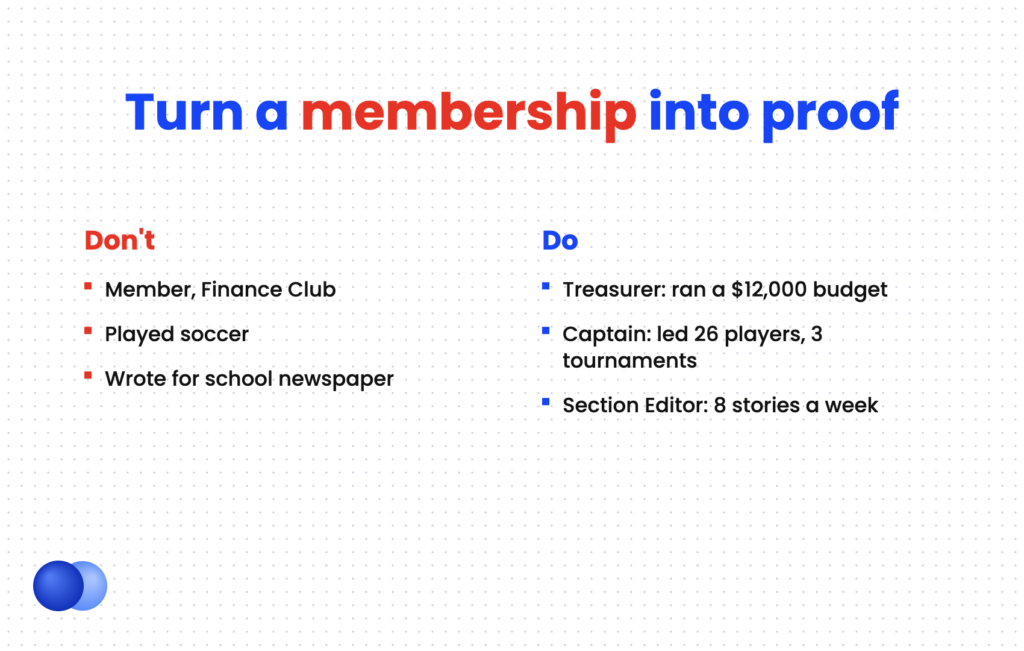
Use this bullet formula: action verb + what you did + scale + result.
Bullets matter more now that employers focus on skills. NACE reports that 70% of employers in its Job Outlook 2026 survey use skills-based hiring. A bullet with a number gives a recruiter proof of the skill, not just a claim.
Before: Member, Finance Club After: Treasurer, Finance Club, Arizona State University | Tempe, AZ | Aug 2024 – Present • Managed a $12,000 annual budget and cut event costs 18% by renegotiating vendor contracts
Before: Played soccer After: Captain, Women's Club Soccer | Columbus, OH | Sep 2023 – May 2025 • Led 26 players through 3 tournaments; organized weekly practices and travel logistics
Before: Wrote for school newspaper After: Section Editor, The Daily Collegian | State College, PA | Jan 2025 – Present • Edit 8 stories per week for 4 staff writers; grew section newsletter to 2,100 subscribers
For more verb options and structure, see our guide on how to write resume bullet points.
Which extracurricular activities should you leave off?
Leave off activities you only signed up for, anything you cannot discuss in an interview, high school activities once you have college or work entries, and groups that reveal religion, political views or other protected traits unless the job is in that field. If an activity adds nothing the rest of your resume lacks, cut it.
The EEOC advises employers that inquiries about organizations, clubs and societies that may indicate race, national origin, religion, age or other protected traits should generally be avoided. You do not need to volunteer that information yourself. If the skill matters, describe the skill and use a neutral name, such as "student service organization."
Title the section "Leadership" if you held a position
Call a list of memberships "Leadership Experience" do: Add one result with a number to each key activity dont: List ten clubs with no roles or dates do: Keep activities you can talk about for two minutes dont: Include clubs you joined once and never attended do: Describe faith-based or political roles by the skill used dont: Keep high school activities after your first college year
High school activities are a special case. Our sibling guide on whether to put high school on your resume explains when to drop them. Distinctions like an Eagle Scout award are an exception that can stay longer.
How do extracurricular activities change by career stage?
Students can give extracurricular activities a full section with bullets. New graduates should keep only leadership roles and the most relevant clubs. After two to three years of work, most activities should come off, except ongoing professional associations, board roles or anything directly tied to the job.
Current students. Extracurricular activities can fill half the page. Use bullets for leadership roles and single lines for memberships. Our college student resume guide shows the full layout.
New graduates. Keep two or three entries. Pick the ones closest to the job.
Early-career professionals. Swap student clubs for professional associations, alumni boards or industry groups.
Career changers. An activity can bridge the gap. A software tester who leads a campus coding club can show teaching and mentoring for a developer advocate role.
STUDENT WITH NO INTERNSHIP (applying for a sales development role) LEADERSHIP EXPERIENCE Vice President of Recruitment, Business Student Association | Athens, GA | Aug 2025 – Present • Grew membership from 60 to 145 students through tabling and class presentations • Booked 9 employer speakers; secured $3,500 in sponsorship
ACTIVITIES Club Tennis (2023–Present) | Habitat for Humanity Campus Chapter (2024–Present)
NEW GRAD (applying for a data analyst role) ACTIVITIES Member, Data Science Society, University of Michigan (2023–2026) • Placed 2nd of 18 teams in a 48-hour data challenge using Python and Tableau
If your activity earned recognition, list the honor with it. Our guide to awards on a resume covers how to add rank and selectivity.
Use the employer’s words for the skill
Read the posting and pick the two skills it repeats most, such as "stakeholder communication" or "project coordination." Then write your activity bullets using those exact terms. A club event you organized becomes evidence of project coordination, and an ATS can match it to the posting.
Do recruiters care about extracurricular activities?
Recruiters care when activities show the skills the job requires and when they help separate early-career candidates with similar records. Recruiters scan quickly, so activities must be easy to spot, clearly labeled and written with results. Vague memberships get skipped, while leadership roles with numbers get read.
Speed is the constraint. The Ladders eye-tracking study found recruiters spend about 7.4 seconds on an initial resume scan, and favor clear section headings. A bold role title and a number in the first bullet give a skimming reader something to stop on.
When you are ready to build the page, the Rezoom AI resume builder can turn rough notes about your activities into structured entries with action verbs and results.

Frequently asked questions
What counts as extracurricular activities on a resume?
Anything outside required classes or paid work: student clubs, sports, student government, publications, performing arts, academic competitions and volunteer groups.
Should I put extracurricular activities on my resume after graduation?
For the first year or two, yes, if they show leadership or relate to the job. After that, replace them with work results and professional groups.
How many extracurricular activities should I list?
Two to four is enough for most students. Give full bullets to one or two leadership roles and list the rest on a single line.
Can extracurricular activities replace work experience on a resume?
They can stand in for it when you have little work history, especially leadership roles. Write them like jobs, with dates and results, and place them under a "Leadership Experience" heading.
Should I include high school extracurricular activities on a college resume?
Only in your first year or two of college, and only the strongest ones, such as captaincies or major awards. Replace them with college activities as soon as you can.
Is a hobby the same as an extracurricular activity?
Not quite. An extracurricular activity is usually organized, with a group, role or schedule. A hobby is personal. Our guide to [hobbies and interests on a resume](https://rezoom.io/hobbies-and-interests-on-resume/) covers how to list those.


Comments