

Summary
List study abroad on a resume under your home degree in the Education section when it was mostly coursework, and in Experience when you interned, researched or volunteered abroad. Give the host school, city, country and dates, then add one or two bullets that prove a skill the job needs, such as language use or cross-cultural teamwork. Short programs get one line; semester and year programs earn bullets.
To list study abroad on a resume, put it in your Education section under your home degree, with the host school, city, country and dates. If you worked, interned or did research abroad, give that part its own entry in Experience instead.
Placement is the easy part. What most resumes get wrong is the content: "Studied in Spain, Spring 2025" tells a recruiter where you went, not what you can do. The fix is one or two bullets that turn the trip into evidence of a skill the job posting names.
This guide gives you a placement rule by program type and length, copy-ready entries for each case, and the mistakes that make an international semester read like a vacation.
Does study abroad look good on a resume?
Yes, when you describe what you learned and did. In an Institute of International Education survey of more than 4,500 alumni, 53% said study abroad contributed to a job offer. Employers respond to evidence of skills like adaptability, communication and teamwork, so the entry needs specifics, not just a country name.
Study abroad is common enough that the label alone no longer stands out on a resume. Open Doors 2025 reports 298,180 US students studied abroad for academic credit in 2023/24, up 6% from the year before. What separates you is how you describe it.
The payoff can be real. In IIE's Gaining an Employment Edge study, 53% of alumni said study abroad contributed to a job offer. Respondents reported the biggest gains in intercultural skills (76%), curiosity, and flexibility and adaptability (both 75.4%).
Those are the traits employers say they want. NACE's Job Outlook 2026 Spring Update ranks teamwork, problem-solving and communication at the top. NACE's president adds a warning that applies here: listing skills is not enough, because employers want to see examples.
Where should you put study abroad on a resume?
Put academic study abroad in your Education section, nested under the degree it counted toward. Put internships, research or volunteer work abroad in Experience, formatted like any job. Put lasting hard skills, such as a language, in Skills. A single program can appear in two sections if each entry shows something different.
Match the section to what you actually did. Career advisers at St. Catherine University note there is no single right way to include time abroad, and that one semester can be split across Education, Experience and Skills.
| What you did abroad | Best section | What to include |
|---|---|---|
| Semester or year of coursework | Education, under home degree | Host school, city, country, term, 1–2 bullets |
| Faculty-led trip of 2–8 weeks | Education, one line | Program name, country, dates |
| Internship or job abroad | Experience | Title, employer, city, country, dates, 2–4 bullets |
| Research abroad | Research or Experience | Project, lab or school, methods, output |
| Language immersion | Skills (plus Education line) | Language and proficiency level |
| Volunteer project abroad | Volunteer or Experience | Role, organization, measurable result |
Two placement details matter for applicant tracking systems. First, nest the program under your home degree so the parser does not read it as a second, unfinished degree. Second, keep the date format identical to the rest of your Education section. Our guide on how to list education on your resume covers the base format.
A third option exists when the experience is your strongest qualification. The University of Louisville career center shows a dedicated "International Study" section for that case. It recommends the single Education line instead when other professional experience is more relevant.
How long does a program need to be to list study abroad on a resume?
Any credit-bearing program can go on a resume, but length decides how much space it gets. List a short faculty-led trip as one line. Give a semester or full year one to three bullets. In IIE research, 68% of full-year participants said the experience contributed to a job offer, compared with 43% of those abroad under eight weeks.
Length changes how much a recruiter will read into study abroad on a resume. In the same IIE study, 68% of students abroad for a full year said it contributed to a job offer, against 43% of those abroad for fewer than eight weeks. Language gains also rose with duration.
Short programs still have value. The same research found shorter programs were more effective for building teamwork, often because they rely on group projects. So a two-week program can earn one bullet if it produced a team result.
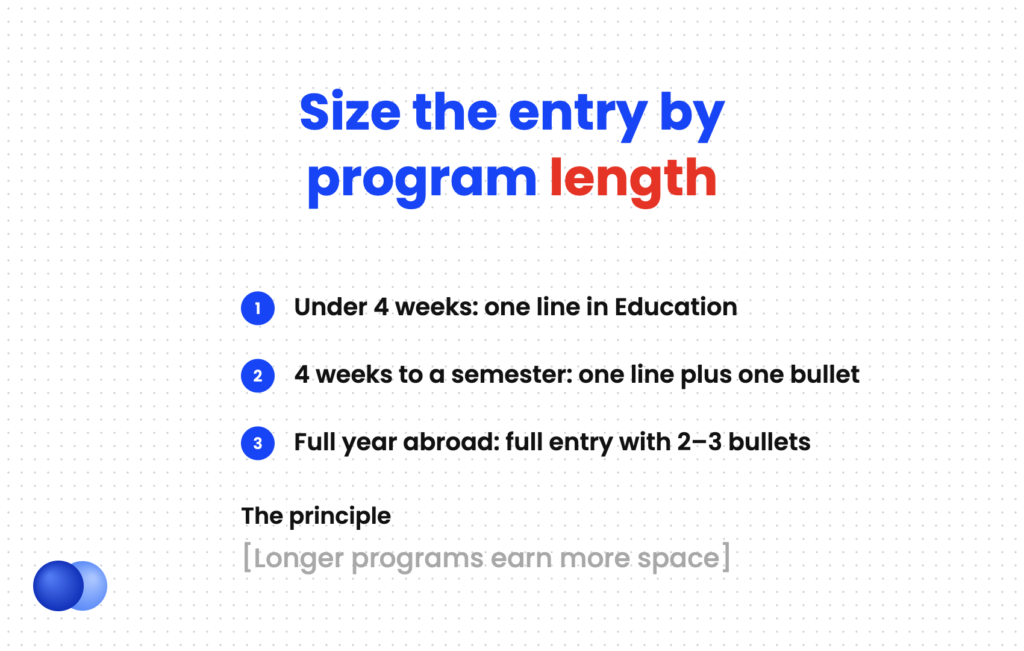
Use this sizing rule:
- Under 4 weeks: one line in Education, no bullets, unless a project directly matches the job.
- 4 weeks to one semester: one line plus one bullet.
- Full year or degree abroad: a full entry with two or three bullets.
How do you format study abroad on a resume?
Use the host institution, city, country and dates on one line, indented under your home degree. Add bullets that pair an action with a result, such as coursework taught in the local language or a team project. Keep the date format consistent with the rest of the page and write the country name in full.
Each entry needs four facts: program or host school, city, country and dates. Hendrix College's career office uses the pattern "Study Abroad, University, City, Country – Dates" followed by skill bullets.
EDUCATION Boston University, Boston, MA Bachelor of Arts in International Relations, May 2026 Study Abroad: Sciences Po, Paris, France | Jan 2025 – May 2025 • Completed 4 upper-level courses taught in French, including EU trade policy • Co-wrote a 25-page policy brief with a 5-student team from 4 countries
University of Michigan, Ann Arbor, MI Bachelor of Science in Public Health, May 2026 Faculty-led program: Global Health Practicum, Accra, Ghana | Summer 2024
The second entry shows the short-program rule: one clean line. If you took courses that match the job, see our guide on how to list relevant coursework on a resume.
When the time abroad included work, write it as a job. The employer, title and results matter more than the fact that it was overseas.
EXPERIENCE Marketing Intern | Lumen Digital, Barcelona, Spain | Feb 2025 – May 2025 • Translated and localized 30+ social posts from English into Spanish for 2 retail clients • Built a weekly engagement report in Google Sheets used by a 6-person team
SKILLS Languages: Spanish (professional working proficiency; semester immersion, Barcelona)
For the language line, use a recognized scale. Our guide on how to list languages on a resume explains the levels recruiters understand. For the internship itself, the same rules as any other internship apply.
What skills should study abroad bullets show?
Pick the skills the job posting asks for and prove them with something you did abroad. Strong choices are language use, cross-cultural teamwork, adaptability, independent problem-solving and communication. Each bullet should name a task, a context and a result, such as a project, a number or a language milestone.
Start with the posting, not the trip. Circle three skills it asks for, then find one moment abroad that shows each.
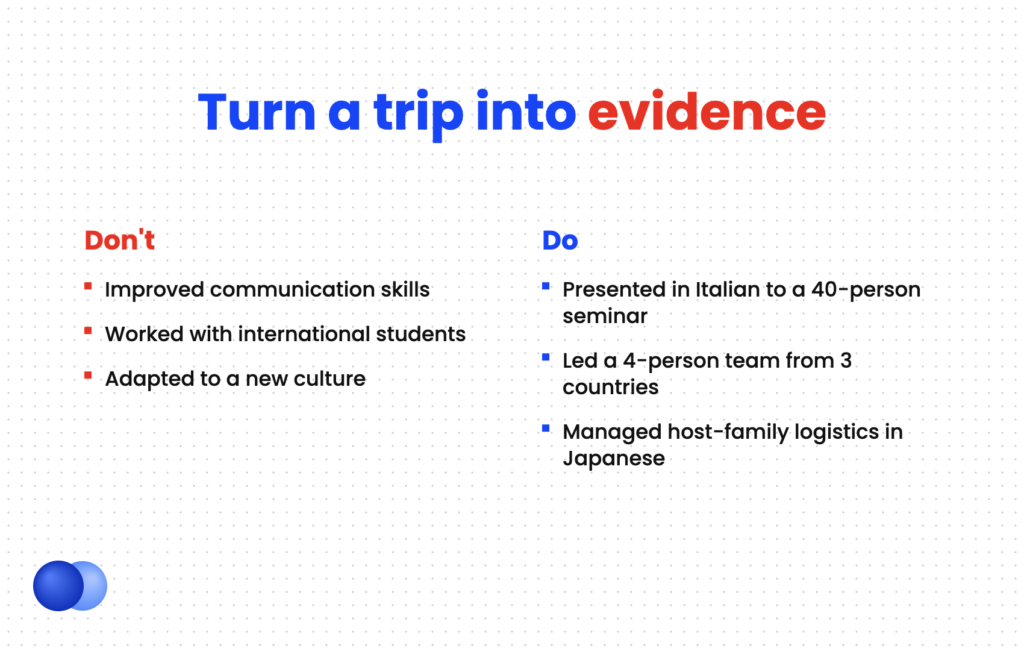
| Skill the job asks for | Weak bullet | Strong bullet |
|---|---|---|
| Communication | Improved communication skills | Presented research findings in Italian to a 40-person seminar |
| Teamwork | Worked with international students | Led a 4-person team from 3 countries to a top-grade capstone |
| Adaptability | Adapted to a new culture | Lived with a host family and managed all logistics in Japanese |
| Problem-solving | Overcame challenges | Rebuilt a field survey after a site closed, keeping 90% of the sample |
Keep the claims honest and checkable. Interviewers often ask about time abroad, so every bullet should lead to a story you can tell in under a minute. Hendrix's example of interviewing 25 rural women across a language barrier is the right level of detail.
Write the bullet the interviewer will ask about
Pick one moment abroad where something went wrong and you fixed it. Write that as a bullet with a number in it. Recruiters skim, but interviewers read closely, and a specific problem-and-fix bullet gives you a ready answer to "Tell me about a time you adapted to change."
What mistakes should you avoid with study abroad on a resume?
The most common mistakes are listing the host school as a separate degree, using vague phrases like "gained cultural awareness," overstating language fluency, and giving a two-week trip the space of a full job. Also avoid travel details unrelated to the program, and remove the entry once stronger professional experience takes its place.
Nest the program under the degree it counted toward
List the host school as a separate degree you never finished do: Name the city, country and exact term dont: Write "Europe" or "Traveled through 6 countries" do: Rate languages on a recognized scale you can defend dont: Claim fluency after one semester of beginner classes do: Show a skill with a task and a result dont: Write "gained cultural awareness" with nothing behind it do: Shrink the entry to one line as your work history grows dont: Keep a three-bullet semester abroad on a senior-level resume
Time matters too. Study abroad on a resume carries the most weight in your first few years out of school. After that, a single line in Education is usually enough, unless the job is international or uses the language.
When should you remove study abroad from your resume?
Shrink study abroad to one line once you have two to three years of relevant work, and remove it when space is tight unless the role is international, language-based or tied to the host country. Keep any lasting skill, such as a language, in your Skills section even after the program entry is gone.
Recent graduates should give it full space, especially on a college student resume where experience is thin. Mid-career candidates should keep it only when it still connects to the target role.
A few cases keep it relevant longer. Roles in international business, foreign service, tourism, education and global nonprofits all value time abroad. So do jobs that ask for a language you used there. If you are applying overseas, check the local resume conventions of the host country as well.
Study abroad often sits next to other campus items. If you also want to show clubs or honors, see today's guides on extracurricular activities on a resume and awards on a resume. When your draft is ready, the Rezoom AI resume builder can format each section and suggest skill-based bullets.

Frequently asked questions
Should I put study abroad on my resume?
Yes, if it was credit-bearing or included work, research or volunteering. Give it more space early in your career and less as relevant work experience grows.
Where does study abroad go on a resume?
Usually in Education, under your home degree. Internships or research abroad go in Experience, and languages go in Skills.
Do I list the foreign university as a separate school?
No. List it as a study abroad line under the degree it counted toward. A separate entry can look like an unfinished second degree.
How do I list a short-term study abroad program?
Give it one line under your degree with the program name, country and dates. Add a bullet only if a project matches the job.
Should I mention study abroad in my cover letter?
Yes, if it connects to the role. Use one short story that shows a skill the employer listed, rather than describing the trip.
Can I list study abroad if it was online or virtual?
Yes, if it carried academic credit. Label it clearly, for example "Virtual exchange," so the format is not misleading.



Comments