

Summary
Communication skills are among the traits employers want most, yet they doubt candidates who simply claim them. NACE data shows 78.1% of new graduates rate their communication as proficient, while only 53.5% of employers agree. The fix is proof: name who you communicated with, through which channel, and what changed as a result. Show written, verbal, presentation, listening and persuasion skills in your bullets and summary, and let the resume itself serve as your writing sample.
The strongest communication skills for resume use are the specific types your target job relies on, such as client writing, presenting to executives or explaining technical topics to non-experts. Name them through evidence, not adjectives. A bullet that shows the audience, the channel and the result proves more than "excellent communicator" ever will.
Employers care about this skill and are skeptical of it at the same time. This guide breaks communication into five types, shows where each belongs on a resume, and gives a simple formula for turning claims into proof.
What counts as communication skills on a resume?
Communication skills on a resume are your abilities to exchange information clearly through writing, speaking, presenting, listening and persuading. NACE defines the competency as clearly and effectively exchanging information, ideas, facts and perspectives with people inside and outside an organization. It is about conveying information, which separates it from relationship-focused interpersonal skills.
NACE's career readiness framework describes communication as the ability to clearly and effectively exchange information, ideas, facts, and perspectives with persons inside and outside of an organization. Its sample behaviors include verbal, written and nonverbal ability, active listening, persuasion, and communicating in a clear, organized way.
That definition helps you separate communication from its neighbors. Interpersonal skills are about building relationships: empathy, rapport, conflict handling. Communication is about getting information across accurately. For the relationship side, see our guide to interpersonal skills. For the full set of behavioral traits, read soft skills for resume.
Why do employers doubt the communication skills on your resume?
Employers doubt communication claims because almost every applicant makes them and few prove them. In NACE research, 78.1% of graduating students rated themselves proficient in communication, but only 53.5% of employers rated new grads proficient. That gap of nearly 25 points means a bare claim reads as self-assessment, not evidence.
Communication sits near the top of every employer wish list. In NACE's Job Outlook 2026 Spring Update, problem-solving and communication were the chief priorities employers look for on resumes, alongside teamwork. Lightcast's July 2025 analysis of more than 75 million postings found that 8 of the top 10 most requested skills are durable skills such as communication.
But demand does not equal belief. NACE compared its 2024 Student Survey with employer ratings from Job Outlook 2025 and found that 78.1% of students rated their communication proficient, against 53.5% of employers.
In other words, students believe they communicate far better than employers think they do. So listing communication skills is not enough. You need to show them working.
Which types of communication skills should you put on a resume?
Break communication into five types: written, verbal, presentation, listening and persuasion. Each one is proven differently, with documents for writing, audiences for presenting and outcomes for persuasion. Pick the two or three types your target job depends on most, and show those rather than claiming general communication.
"Communication" is too broad to be convincing. Splitting it into types tells you what evidence to look for.
| Type | What it looks like at work | How to prove it on a resume |
|---|---|---|
| Written | Reports, emails, documentation, proposals, web copy | Document type, audience size, adoption or error reduction |
| Verbal | Calls, meetings, client conversations, training | Volume handled, satisfaction score, issues resolved |
| Presentation | Pitches, briefings, workshops, demos | Audience and seniority, frequency, decision or deal won |
| Listening | Discovery calls, intake interviews, feedback gathering | What you learned and what changed because of it |
| Persuasion | Negotiation, sales, stakeholder buy-in, fundraising | Approval won, revenue, savings or adoption rate |
Use the posting to choose. A technical writer leads with written communication. A sales rep leads with persuasion and listening. A nurse leads with verbal communication and patient education.
The BLS confirms how role-specific this is. It says registered nurses must communicate effectively with patients to understand their concerns. For accountants, it stresses the need to discuss results in meetings and in written reports.
How do you prove communication skills in resume bullets?
Use the audience-channel-outcome formula. State who you communicated with, how you did it, and what happened next. "Presented quarterly cost analysis to 5 department heads, securing approval for a $40K tooling upgrade" proves presentation and persuasion without using either word. Concrete audiences and results are what make communication skills believable.
Every communication bullet needs three parts:
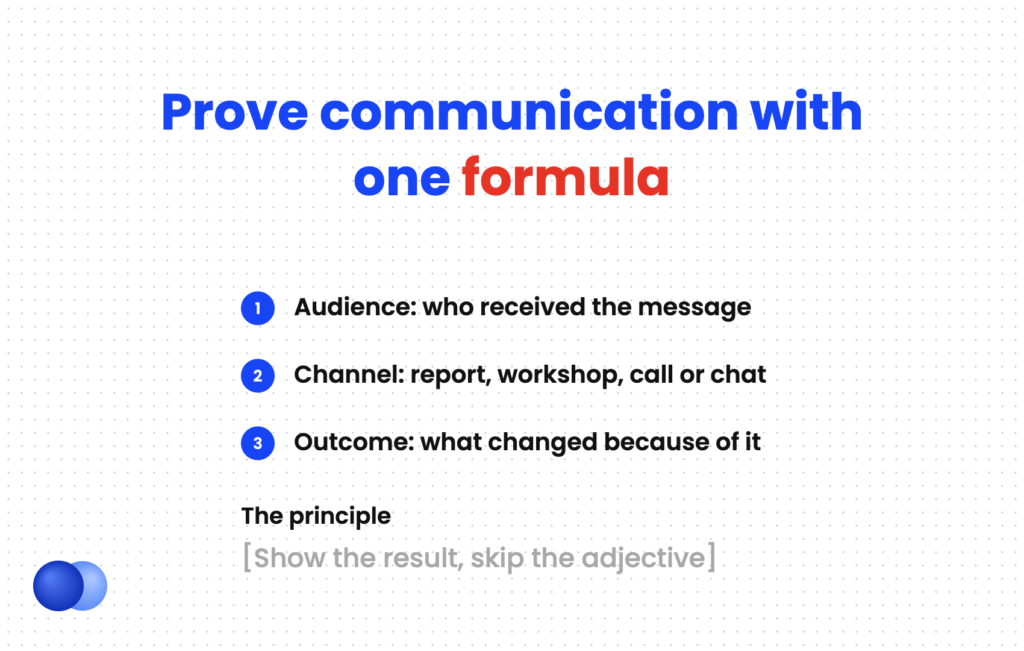
- Audience: who received the message (customers, executives, new hires, a city council)
- Channel: how you delivered it (report, workshop, live chat, proposal, training video)
- Outcome: what changed (fewer tickets, faster onboarding, a signed contract, a policy adopted)
Start with an action verb that implies the skill, such as "presented," "drafted," "negotiated," "trained" or "translated." Our list of 500 powerful action verbs has more options. For bullet structure, see how to write resume bullet points.
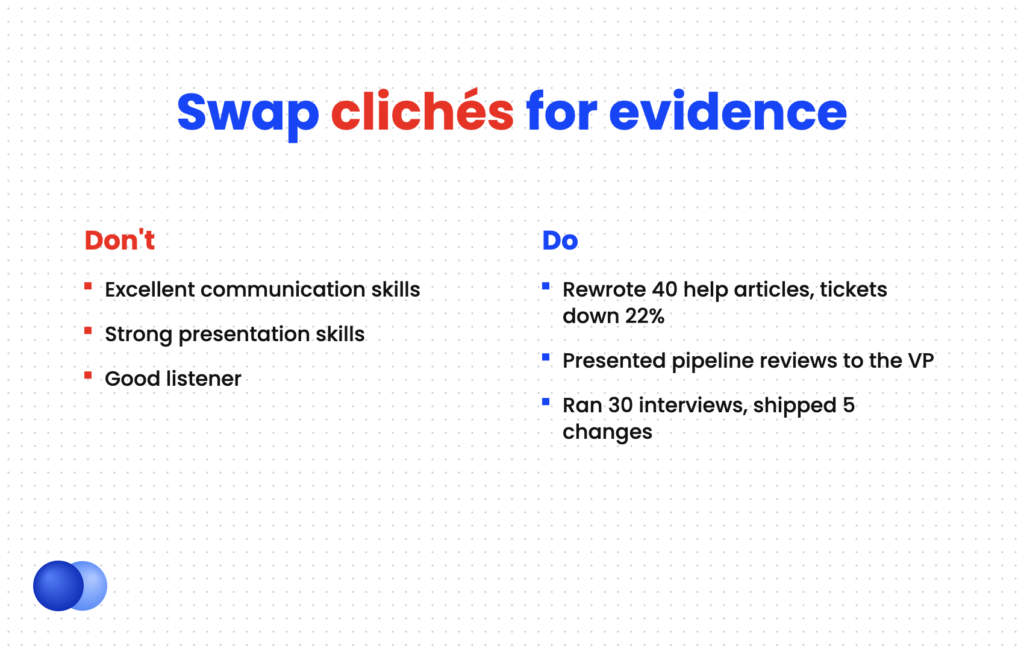
Before: Excellent written and verbal communication skills After: Rewrote 40 help-center articles in plain language, cutting "how do I" support tickets 22% in one quarter
Before: Strong presentation skills After: Presented monthly pipeline reviews to the VP of Sales and 6 regional leads, informing territory changes for 2026
Before: Good listener After: Ran 30 customer discovery interviews and turned findings into 5 onboarding changes that lifted week-one activation
If you lack a metric, scale works. "Trained 18 seasonal hires" or "wrote weekly updates for a 60-person department" still shows reach.
Your resume is the first writing sample
Recruiters judge your written communication before they read a single bullet. Typos, long paragraphs and vague phrases undercut any claim. Keep bullets to one or two lines, cut filler words, and read the whole page aloud once before sending it.
Where should communication skills go on your resume?
Prove communication skills mainly in your experience bullets and your summary. Add specific types to the skills section only when the posting names them, such as "technical writing" or "public speaking." Reinforce them in your cover letter with one short story. Avoid a standalone line that just says "communication."
Each section plays a different role:
- Experience bullets. The main proof. Aim for two or three bullets across your recent roles that show communication with a result.
- Summary. Name one communication strength and attach a proof point. See our resume summary guide.
- Skills section. List specific, searchable terms like "technical writing," "stakeholder presentations" or "bilingual customer support," not the generic word.
- Cover letter. Tell one brief story that shows you explaining, persuading or listening well.
IT support specialist with 4 years supporting 300+ non-technical staff. Known for translating complex fixes into plain-language guides: authored a 25-page self-service knowledge base that reduced repeat tickets 30%. Trained 3 departments on a new VPN rollout with zero escalations.
The summary never calls the candidate a "great communicator." It shows translation, writing and training, and lets the reader conclude the rest.
Communication also overlaps with other skills. If a role leans on guiding people, see leadership skills for resume. For client-facing jobs, see customer service skills for resume.
Which communication phrases should you avoid on a resume?
Avoid generic phrases such as "excellent communication skills," "strong communicator," "people person" and "good listener." They appear on so many resumes that recruiters skip them. Replace each one with a specific type of communication, a named audience and a result, or remove it entirely.
Write "Presented budget proposal to 8 board members, winning approval"
Write "Excellent verbal and written communication skills" do: Name the channel: reports, workshops, live chat, proposals dont: Call yourself a "people person" or "great communicator" do: List specific terms like "technical writing" if the posting uses them dont: Put the single word "communication" in your skills list do: Keep bullets short and error-free as proof of writing skill dont: Claim attention to detail in a resume with typos
Once your draft is ready, the Rezoom AI resume builder can turn generic communication claims into audience-and-outcome bullets matched to a specific posting.

Frequently asked questions
What are good communication skills to put on a resume?
Strong options include technical writing, public speaking, client presentations, active listening, negotiation, and bilingual communication. Choose the ones your target job posting mentions.
How do I describe communication skills on a resume without saying "communication"?
Show the activity and result instead. "Trained 12 new hires on the POS system in their first week" proves verbal communication without naming it.
Should I list communication skills in my skills section?
Only as specific, posting-matched terms like "public speaking" or "technical writing." Prove the rest in your experience bullets and summary.
What is the difference between communication and interpersonal skills?
Communication is about conveying information clearly through writing, speaking and listening. Interpersonal skills are about building relationships, such as empathy, rapport and conflict resolution.
How do I show communication skills with no work experience?
Use class presentations, group projects, club roles, tutoring or volunteering. For example, "Presented capstone research to a 60-person faculty panel" shows presentation skill.
Do I need communication skills for technical jobs?
Yes. Engineers, analysts and IT staff often need to explain technical work to non-experts, write documentation and present findings, so proof of that skill can set you apart.



Comments