

Summary
Soft skills such as communication, teamwork, problem-solving and adaptability rank among the traits employers want most, but a list of them proves nothing. Employers already rate new graduates far lower on these traits than graduates rate themselves. The fix is evidence: show each soft skill as a behavior with a result inside your experience bullets and summary, and keep the skills section for hard skills and a few posting-matched terms.
The best soft skills for resume use are the ones the job posting names, usually communication, teamwork, problem-solving and adaptability. But writing those words in a list does little. Recruiters believe soft skills only when a bullet shows you using them and something improving as a result.
That gap between claim and proof is real. In NACE research, 78.1% of students rated themselves proficient in communication, but only 53.5% of employers agreed. Self-description is exactly what employers discount.
This guide covers which soft skills employers want, a simple formula for proving each one, and copy-ready examples by job.
What are soft skills on a resume?
Soft skills are the behavioral and interpersonal abilities that shape how you work: communication, collaboration, problem-solving, adaptability, leadership, time management and similar traits. Unlike hard skills, they are hard to test directly, so employers judge them from evidence in your bullets, your summary and your interviews rather than from a skills list.
Soft skills describe how you do the work. Hard skills describe what you can do. A nurse's IV technique is a hard skill. How she calms a frightened patient during it is a soft skill.
Both belong on your resume, but they are shown differently. Hard skills fit neatly in a skills section. Soft skills need context. For the technical side, see our hard skills examples for resume writers, grouped by field.
Which soft skills do employers want most?
Teamwork, problem-solving and communication lead most employer surveys. NACE's Job Outlook 2026 Spring Update found 85% of employers look for teamwork skills on resumes. An Indeed survey of 1,000 hiring managers ranked problem-solving, communication, self-direction, drive and adaptability as the top traits of high performers.
Several credible data points line up on the same short list:
- Teamwork. 85% of employers in NACE's Job Outlook 2026 Spring Update look for it on the resume, alongside problem-solving and communication.
- Problem-solving and communication. An Indeed survey of 1,000 hiring managers ranked them first and second among traits of top performers, followed by self-direction, drive and adaptability.
- Conflict mitigation and adaptability. LinkedIn's 2025 Skills on the Rise list, reported by Forbes, placed both in its top three, just behind AI literacy.
Job-specific priorities vary, so check the source. The Bureau of Labor Statistics lists "Important Qualities" for each occupation. For software developers, it names analytical, communication, creativity, detail orientation, interpersonal and problem-solving skills.
Why does listing soft skills fail to convince recruiters?
Listing soft skills fails because every applicant claims them and nobody can verify a word. NACE data shows students consistently rate their own soft skills far higher than employers do, with gaps of about 25 points in communication and 35 points in leadership. A claim without evidence reads as the same self-assessment employers already distrust.
The NACE comparison, drawn from its 2024 Student Survey and Job Outlook 2025, shows the size of that trust gap.
| Soft skill | Students rating themselves proficient | Employers rating new grads proficient | Gap (points) |
|---|---|---|---|
| Communication | 78.1% | 53.5% | 24.6 |
| Critical thinking | 80.8% | 55.9% | 24.9 |
| Professionalism | 79.7% | 50.3% | 29.4 |
| Leadership | 66.0% | 31.0% | 35.0 |
| Teamwork | 83.5% | 81.5% | 2.0 |
Source: NACE
The pattern is clear. The more a skill depends on judgment, the more employers doubt the self-report. Leadership shows the widest gap, so it needs the strongest proof. Teamwork, which employers already see in most graduates, needs the least.
How do you prove soft skills on a resume?
Use the proof formula: situation plus the behavior that shows the skill plus a measurable or visible result. Instead of "strong communicator," write what you communicated, to whom, and what changed. The soft skill word becomes optional because the bullet demonstrates it, and a recruiter can probe the story in an interview.
Think of each bullet as a mini story. The STAR method you use in interviews works on paper too, just compressed into one line.
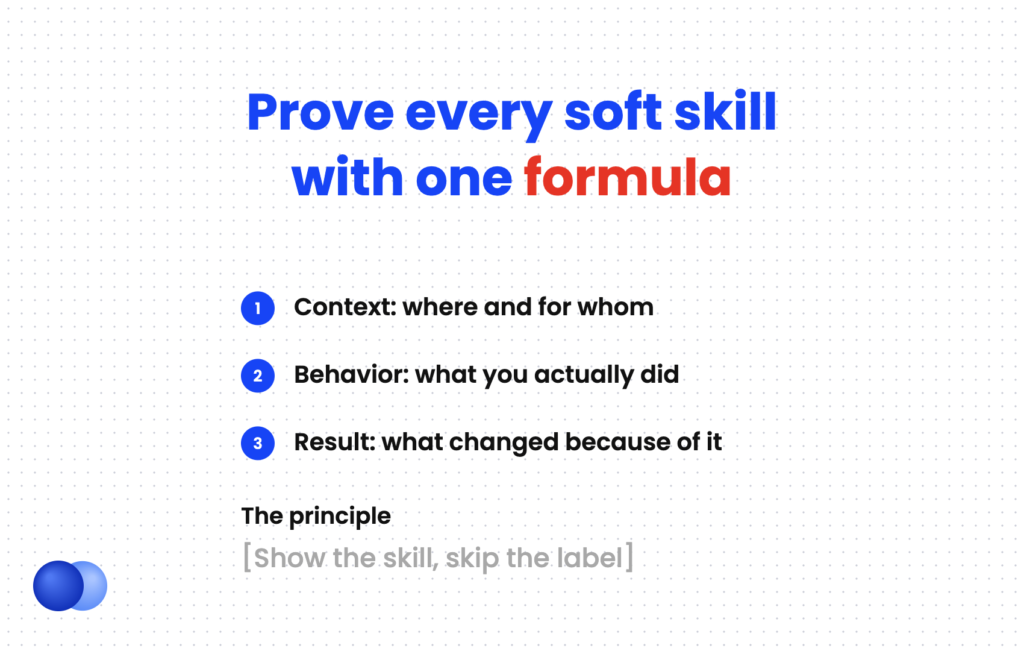
The proof formula: context + observable behavior + result.
- "Communication" becomes what you explained, presented or wrote, and what happened next.
- "Leadership" becomes how many people you guided, what you decided, and the outcome.
- "Adaptability" becomes what changed, how fast you adjusted, and what you kept on track.
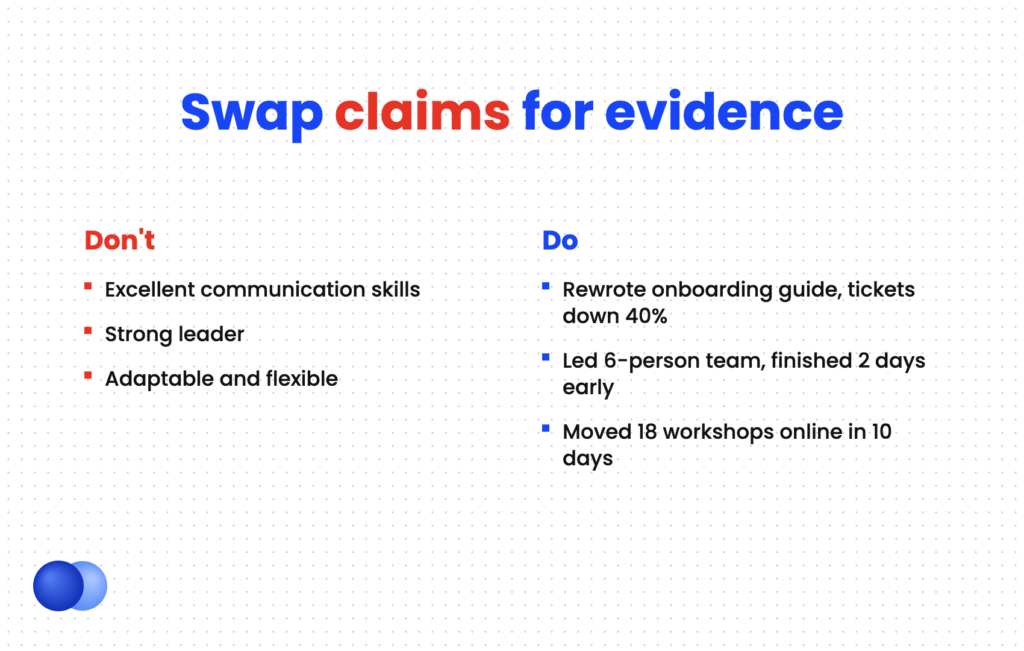
Before: Excellent communication and teamwork skills After: Rewrote the onboarding guide for 3 departments after gathering feedback from 25 new hires, cutting first-week support tickets 40%
Before: Strong leader After: Led a 6-person volunteer team through a warehouse relocation, finishing 2 days early with zero lost inventory
Before: Adaptable and flexible After: Moved 18 in-person client workshops online within 10 days of a venue cancellation, keeping 92% of registrants
Numbers help, but they are not mandatory. A concrete scale ("for 3 departments," "25 new hires") already signals the skill. For more ways to add measurable detail, see how to quantify your resume and our resume accomplishments examples.
Let the verb carry the skill
Start bullets with verbs that imply the soft skill: "mediated" for conflict resolution, "coached" for leadership, "negotiated" for persuasion. The verb does the claiming, so the rest of the line can focus on the result. Our list of 500 powerful action verbs is sorted by skill.
Where should soft skills go on your resume?
Put soft skills mainly in two places: your experience bullets, where you prove them, and your summary, where you name one or two that match the job. Use the skills section sparingly for soft skills, adding only terms the posting names, so applicant tracking systems still find them without crowding out hard skills.
Each section has a different job:
- Experience bullets. This is the proof. Aim for your top two or three posting-matched soft skills to appear here as behaviors.
- Summary. Name one or two soft skills and attach a quick proof point. See our resume summary guide for structure.
- Skills section. Add a soft skill only if the posting names it word for word, such as "stakeholder management" or "cross-functional collaboration."
Customer success manager with 5 years in B2B SaaS. Known for turning at-risk accounts around through clear, proactive communication: retained 94% of a $3.2M book in 2025. Comfortable leading cross-functional escalations with product and engineering teams.
Notice the summary never says "excellent communicator." It shows the result of good communication and lets the reader draw the conclusion.
Soft skills examples for your resume, by job
Match soft skills to what the role actually demands. Nurses need composure and patient communication, sales reps need persuasion and resilience, engineers need collaboration and clear technical explanation, and managers need coaching and decision-making. Pick the two or three the posting emphasizes and prove those rather than covering every trait.
Different jobs reward different soft skills, so there is no universal list of soft skills for resume writing. Use this as a starting point, then confirm against the posting.
| Job | Priority soft skills | Proof bullet idea |
|---|---|---|
| Registered nurse | Composure, patient communication, teamwork | Educated 12 patients per shift on discharge plans, lowering callbacks |
| Sales representative | Persuasion, resilience, active listening | Rebuilt pitch around discovery calls, raising close rate from 18% to 26% |
| Software engineer | Collaboration, clear explanation, problem-solving | Wrote design docs adopted by 4 teams, cutting review cycles by a week |
| Teacher | Patience, adaptability, classroom communication | Differentiated lessons for 3 reading levels, raising benchmark scores |
| Project manager | Stakeholder management, decision-making, conflict resolution | Mediated scope dispute between 2 vendors, saving the launch date |
| Retail associate | Customer service, dependability, teamwork | Trained 5 new hires on returns process during holiday peak |
For the people-focused traits in more depth, see our guide to interpersonal skills. If you are changing careers, transferable skills for your resume shows how to carry these traits into a new field.
Which soft skills should you avoid listing?
Avoid clichés that every resume uses and no reader believes: "hard worker," "team player," "detail-oriented," "self-starter" and "excellent communication skills." Also skip personality words with no work context, such as "friendly" or "passionate." If you keep a term because the posting uses it, back it up in a bullet.
Write "Resolved 30+ escalated complaints per week with a 4.8/5 CSAT"
Write "Excellent customer service skills" do: Show detail orientation with an error rate or audit result dont: Call yourself "detail-oriented" in a resume with typos do: Match the posting's phrase, like "cross-functional collaboration" dont: List ten soft skills in a row with no evidence anywhere do: Keep soft skills specific to the role you want dont: Use personality words like "bubbly" or "passionate"
When your draft is ready, the Rezoom AI resume builder can help rewrite generic soft skills claims into evidence-based bullets tailored to a posting.

Frequently asked questions
What are the top soft skills to put on a resume?
Communication, teamwork, problem-solving, adaptability and leadership appear most often in employer surveys. Choose the ones your target posting emphasizes, then prove them in your bullets.
Should I have a soft skills section on my resume?
Usually not a separate one. Mix a few posting-matched soft skills into your main skills section and prove the rest in your experience and summary.
How many soft skills should I include on a resume?
Focus on two to four that matter most for the job. Proving three well beats listing ten with no evidence.
How do I show soft skills with no work experience?
Use school projects, volunteer work, clubs, sports or part-time jobs. A line like "Organized a 40-person club fundraiser that raised $2,100" proves initiative and coordination.
Are soft skills more important than hard skills?
Neither replaces the other. Hard skills usually get you through the first screen, and soft skills often decide who gets the offer.
Can ATS software read soft skills?
Yes, an ATS can match soft skill keywords from the posting. That is why exact phrases like "stakeholder management" help, as long as a human reader also sees proof.


Comments