

Summary
Problem solving skills are the attribute employers most often look for on a resume, but writing "problem solver" proves nothing. Show the skill instead: name the problem, the cause you found, the fix you chose and the result. Pick the type of problem solving your target job depends on, such as troubleshooting, process improvement or analysis, and prove it in two or three experience bullets. Keep only posting-matched terms in your skills section.
The strongest problem solving skills for resume use are the ones your target job relies on every day, such as troubleshooting, root cause analysis or process improvement. You prove them by describing a real problem, what you did about it and what changed. A word like "problem solver" in a skills list does almost nothing on its own.
The stakes are high. In NACE's Job Outlook 2025, nearly 90% of employers said they look for evidence of problem-solving ability on a resume, more than any other attribute. That also means every competing applicant claims it.
This guide covers the five types of problem solving employers hire for, a four-part bullet formula, and copy-ready examples by job.
Why do employers care about problem solving skills on a resume?
Employers rank problem solving skills at the top of their hiring wish lists. NACE's Job Outlook 2025 found nearly 90% of employers look for problem-solving ability on resumes, and an Indeed survey of 1,000 hiring managers named problem solving the top trait of high performers. It signals you can handle work nobody wrote instructions for.
Most jobs come with a manual for the routine parts. Employers hire for what happens when the routine breaks. That is why the skill shows up across so much research:
- Resume screening. Nearly 90% of employers in NACE's Job Outlook 2025 look for problem-solving ability, ahead of teamwork and written communication.
- Top performers. An Indeed survey of 1,000 hiring managers ranked problem solving first among the traits their best employees share, followed by communication.
- Future demand. The World Economic Forum's Future of Jobs Report 2025 found 7 out of 10 companies consider analytical thinking essential, making it the most sought-after core skill.
There is a catch. NACE data shows 80.8% of graduating students rate themselves proficient in critical thinking, but only 55.9% of employers agree. Employers already discount self-reported thinking skills, so your resume needs proof, not adjectives.
What types of problem solving skills should you list?
Problem solving is not one skill. Most jobs reward one of five types: troubleshooting, analysis, process improvement, creative solutions or decision-making under pressure. Identify which type your target role depends on, use the posting's exact wording for it, and build your bullets around that type instead of claiming general problem-solving ability.
Generic articles list dozens of related skills. A more useful approach is to decide which kind of problem your next employer needs solved. Match the type to the job, then use the matching keywords.
| Problem-solving type | What it looks like at work | Resume keywords | Jobs that lean on it |
|---|---|---|---|
| Troubleshooting | Diagnosing why something broke and fixing it | Troubleshooting, diagnostics, root cause analysis | IT support, technicians, engineers |
| Analysis | Finding the answer hidden in data | Data analysis, research, forecasting | Analysts, finance, marketing |
| Process improvement | Removing waste, delays or errors from a workflow | Process improvement, Lean, workflow optimization | Operations, healthcare, admin |
| Creative solutions | Inventing a new approach when old ones fail | Innovation, design thinking, brainstorming | Product, design, teaching |
| Decisions under pressure | Choosing fast with incomplete information | Decision-making, crisis management, triage | Nursing, retail management, logistics |
The Bureau of Labor Statistics shows how specific employers get. For computer support specialists, it describes problem-solving as identifying simple and complex computer problems, then analyzing and solving them. That is troubleshooting, so a support resume should say "troubleshooting," not "creative thinker."
Some types overlap with other skill groups. Analysis often sits under technical skills, and decision-making under pressure pairs naturally with leadership skills.
How do you show problem solving skills on a resume?
Use a four-part formula in your experience bullets: the problem, the cause you identified, the fix you chose, and the measurable result. Naming the cause is what separates real problem solving from simply being busy. If you lack numbers, state scale or frequency instead, such as how many users, orders or patients were affected.
Most advice stops at "add a result." The missing piece is the cause. Anyone can say they fixed something. Showing that you diagnosed why it happened proves the thinking behind the fix.
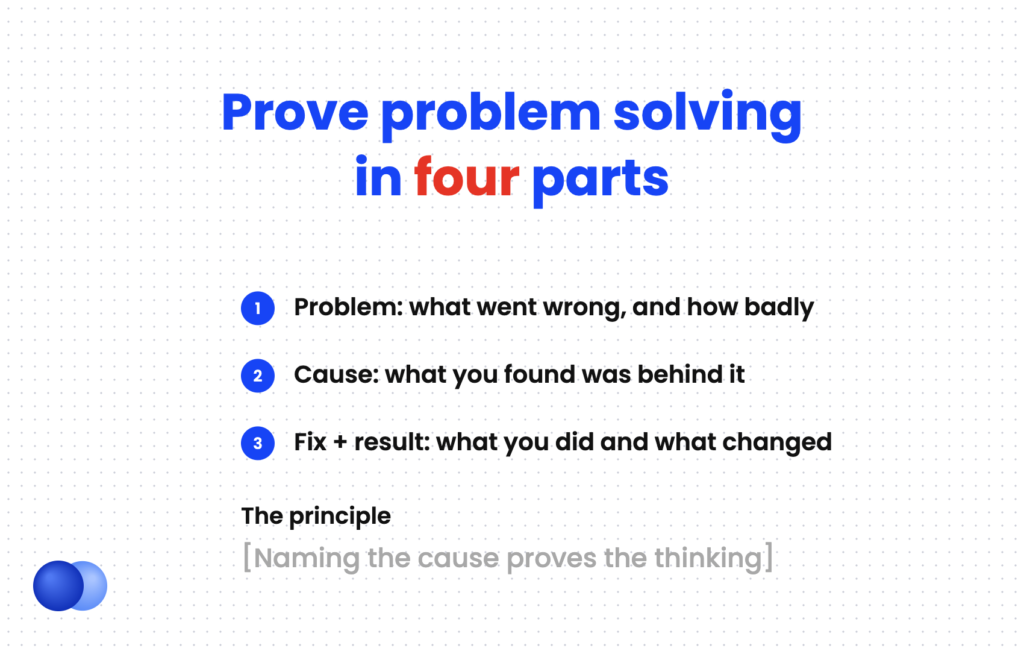
The formula: problem + cause + fix + result.
- Problem. What was going wrong, and how badly? ("Late shipments on 12% of orders")
- Cause. What you discovered was behind it. ("Traced delays to manual label printing")
- Fix. The specific action you took. ("Set up batch printing from the order system")
- Result. What changed, ideally with a number. ("Cut late shipments to 3% in six weeks")
Compressed into one line, that becomes a bullet a recruiter can believe and an interviewer can ask about. It works like the STAR method, shrunk to resume length.
- Traced a 12% late-shipment rate to manual label printing; set up batch printing from the order system, cutting late shipments to 3% within six weeks
- Diagnosed recurring VPN drops for 140 remote staff as a firmware conflict; rolled out a patch that reduced related tickets by 70%
- Found that 40% of patient call-backs stemmed from unclear discharge sheets; rewrote them with the nursing team, lowering call-backs by a third
- Identified duplicate vendor payments through a reconciliation audit and recovered $18,400 before quarter close
Not every bullet needs all four parts spelled out. If the fix makes the cause obvious, skip it. For more ways to add numbers, see how to quantify your resume.
Start with the diagnosis verb
Open bullets with verbs that show analysis before action: "diagnosed," "traced," "identified," "isolated" or "pinpointed." They signal you understood the problem before you solved it. Save "fixed" and "resolved" for the middle of the line, where they connect the cause to the result.
Where should problem solving skills go on your resume?
Prove problem solving skills in your experience bullets, mention one strong example in your summary, and list only specific, posting-matched terms in your skills section, such as "root cause analysis" or "troubleshooting." Applicant tracking systems match those exact phrases, while recruiters look for the proof in your bullets.
Each section plays a different role:
- Experience bullets. This is where the skill becomes believable. Aim for two or three formula bullets in your most recent role.
- Summary. Name the type of problem you solve and give one result. Keep it to two or three sentences.
- Skills section. List concrete methods or tools, not the generic phrase. "Root cause analysis," "Six Sigma Green Belt" or "SQL" all imply problem solving and match resume keywords an ATS scans for.
Operations coordinator with 4 years in e-commerce fulfillment. Known for finding the root cause behind recurring delays: redesigned the returns workflow in 2025, cutting processing time from 5 days to 2. Skilled in process mapping, inventory reconciliation and Excel reporting.
The summary never says "excellent problem solver." It shows a solved problem and lets the reader draw the conclusion.
Problem solving skills examples by job
Different jobs need different kinds of problem solving. Nurses triage and adapt care plans, software engineers debug and design, customer service reps resolve escalations, and teachers adjust lessons that are not working. Choose the example closest to your role, then swap in your own problem, cause, fix and numbers.
Use these as starting points, not templates to copy word for word.
- Customer service representative: "Resolved 25+ escalated complaints per week by spotting a billing-code error behind 30% of them, which led to a system fix." See more in customer service skills for your resume.
- Software engineer: "Isolated a memory leak causing weekly outages; refactored the caching layer and raised uptime to 99.9%."
- Registered nurse: "Noticed a pattern of missed medication times on night shift; proposed a handoff checklist adopted unit-wide."
- Teacher: "Redesigned a unit after 60% of students failed the pre-test, raising the class average 18 points on the final."
- Retail manager: "Cut weekend checkout lines by reassigning two stock associates to registers during peak hours."
- Student or entry-level: "Fixed a group project's scheduling conflicts by building a shared calendar, delivering the final report a week early."
No work history yet? Class projects, clubs, part-time jobs and volunteering all contain problems you solved. Our guides to transferable skills and soft skills show how to frame them.
What mistakes make problem solving claims fall flat?
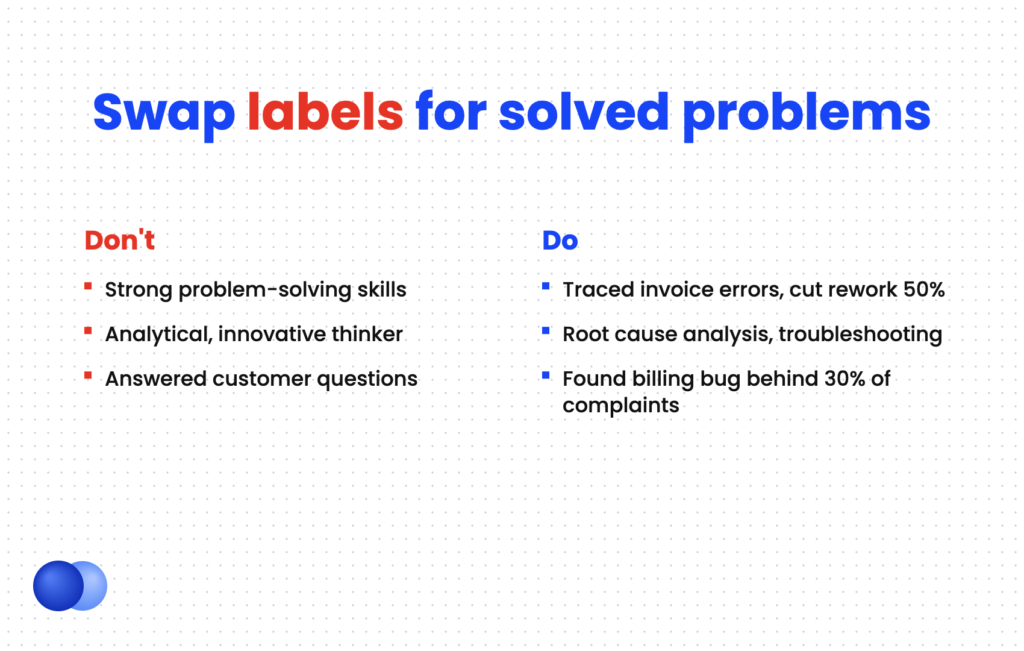
The most common mistakes are listing "problem solver" without evidence, describing tasks instead of problems, hiding the result, and claiming a team fix as solely yours. Recruiters skim, so a bullet that does not show a clear problem and outcome within one line will read as filler rather than proof.
Write "Traced invoice errors to a template bug, cutting rework 50%"
Write "Strong problem-solving and analytical skills" do: Name the cause you found, not just the fix you applied dont: Describe routine duties like "answered customer questions" do: Credit the team and state your specific part dont: Claim a company-wide fix as your solo achievement do: Use the posting's exact term, such as "root cause analysis" dont: Stack five synonyms like "critical thinker, innovative, analytical"
Once your bullets are drafted, the Rezoom AI resume builder can rewrite generic claims into problem-and-result bullets tailored to the posting you are targeting.

Frequently asked questions
What are good problem solving skills to put on a resume?
Choose specific methods tied to the job: troubleshooting, root cause analysis, data analysis, process improvement or decision-making. Specific terms match ATS keywords better than the generic phrase "problem solving."
Should I list problem solving in my skills section?
Only if the posting uses the phrase or you pair it with a concrete method. Your experience bullets should carry the real proof.
How do I describe problem solving skills with no experience?
Use school projects, clubs, sports, volunteering or part-time work. Describe a problem, what you did and what changed, such as fixing a club's sign-up process to double membership.
Is critical thinking the same as problem solving?
They overlap but are not identical. Critical thinking is evaluating information and arguments; problem solving applies that thinking to reach a working fix.
How many problem-solving bullets should a resume have?
Two or three strong ones in your recent roles are usually enough. One bullet per job that shows a clear problem and result is a good minimum.
How do I talk about problem solving in an interview?
Expand one of your resume bullets into a full STAR story. Interviewers often probe the cause you found, so be ready to explain how you identified it.



Comments