

Summary
The right technical skills for a resume are the specific tools, software, platforms and methods your target job names, not a generic list of everything you have touched. Pick skills that appear in the posting and that you can discuss in an interview. Group them into labeled categories so a recruiter can scan them in seconds, then prove the most important three to five inside your experience bullets with a task and a result.
The best technical skills for resume use are the exact tools, software and methods your target job lists, such as SQL, Salesforce, AutoCAD or Epic. List them in grouped categories, then prove the most important ones in your work bullets. That combination satisfies both the applicant tracking system and the human reader.
Most guides stop at a long list of examples. This one gives you a decision rule for choosing technical skills, a grouping format by field, and a way to show proficiency without star ratings or skill bars.
What are technical skills on a resume?
Technical skills on a resume are the job-specific tools, software, platforms, programming languages, equipment and methods you use to do the work. They are a subset of hard skills: concrete and testable, but tied to named technologies. Examples include Python, QuickBooks, Tableau, Epic EHR, AutoCAD, Google Ads and CNC programming.
Hard skills cover any teachable ability, from bookkeeping to Spanish. Technical skills are the narrower slice that names a tool or technology. "Financial analysis" is a hard skill. "Financial modeling in Excel with Power Query" is a technical skill.
That distinction matters because recruiters and ATS filters search for named tools. For the broader category, including languages and certifications, see our hard skills examples for resume guide.
NACE, the national association for college career services and employers, defines its Technology competency as the ability to understand and leverage technologies ethically to enhance efficiencies, complete tasks, and accomplish goals. Your resume should show both halves of that: the tool, and what you accomplished with it.
Which technical skills do employers ask for most?
Office software leads overall demand. O*NET's Hot Technologies list, built from about 44.5 million 2023 US job postings, ranks Microsoft Office and Excel first, followed by Outlook, PowerPoint, SQL, Python, SAP and Amazon Web Services. AI is rising fast: Indeed found AI mentions in 4.2% of US postings by December 2025.
The clearest public data comes from O*NET, the US Department of Labor's occupation database. Its Hot Technologies list counts how often employers name each tool across 44,472,970 US job postings from 2023.
The top of that list looks like this:
- Microsoft Office: 2,709,700 postings
- Microsoft Excel: 2,678,830 postings
- Microsoft Outlook and PowerPoint: about 1.4 million postings each
- SQL: 676,265 postings
- Python: 619,487 postings
- SAP and Amazon Web Services: about 400,000 postings each
AI skills are climbing on top of that base. Indeed Hiring Lab reported that the share of US postings mentioning AI reached 4.2% in December 2025, and 45% of data and analytics postings mentioned it.
Still, national rankings only tell you what is common. The posting in front of you tells you what matters. If you need help with office tools specifically, see how to list Microsoft Office skills on a resume and our guide to computer skills for resume.
How do you choose which technical skills to list?
Use a three-question filter. Does the job posting or a similar posting name the skill? Have you used it on real work, school or project output? Could you answer a detailed interview question about it today? Keep skills that pass all three. Drop anything you used once, years ago, or only in a tutorial.
A skills section is not an inventory. It is a match list. Run every candidate skill through this filter:
- Is it relevant? The posting names it, or three similar postings do.
- Is it real? You produced something with it: a report, a feature, a model, a campaign.
- Is it current? You could handle a technical interview question about it this week.
Skills that pass all three go near the top of your list. Skills that pass only the first are learning goals, not resume lines.
To find relevant tools beyond one posting, open the O*NET OnLine page for your occupation. Each one lists the technology skills employers request for that role, with in-demand tools flagged. Then mirror the posting's exact wording. Our guide to resume keywords covers how to extract and place those terms.
How should you group technical skills in a skills section?
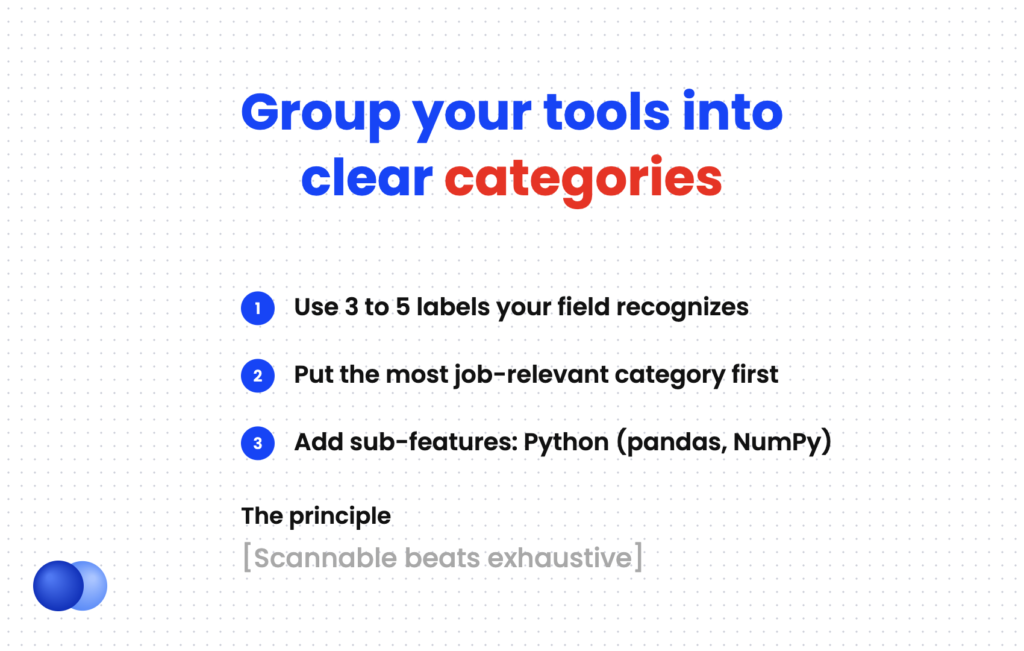
Group technical skills into three to five labeled categories that match how your field thinks, such as Languages, Frameworks, Cloud and Tools for engineers. Put the most job-relevant category first and the most relevant skill first in each line. Labels help recruiters scan quickly and keep a long list readable.
A flat list of 20 tools is hard to scan. Category labels fix that and also signal that you understand how the tools fit together.
| Field | Suggested categories | Sample entries |
|---|---|---|
| Software engineering | Languages, Frameworks, Cloud and DevOps, Databases | Python, TypeScript; React, Django; AWS, Docker; PostgreSQL |
| Data and analytics | Analysis, Visualization, Data platforms, Statistics | SQL, Python (pandas); Tableau, Power BI; Snowflake; regression, A/B testing |
| Marketing | Ads platforms, Analytics, Marketing automation, Content tools | Google Ads, Meta Ads; GA4; HubSpot; Canva, WordPress |
| Accounting and finance | Accounting software, ERP, Spreadsheet modeling, Reporting | QuickBooks; SAP, NetSuite; Excel (Power Query, XLOOKUP); Power BI |
| Healthcare | Clinical systems, Equipment, Documentation | Epic, Cerner; telemetry, infusion pumps; ICD-10 coding |
| Skilled trades and engineering | Design software, Equipment, Standards | AutoCAD, SolidWorks; CNC mills, PLCs; OSHA 30 |
TECHNICAL SKILLS
Analysis: SQL (advanced), Python (pandas, NumPy), Excel (Power Query, pivot tables)
Visualization: Tableau, Power BI, Looker Studio
Data platforms: Snowflake, BigQuery, dbt
Methods: A/B testing, regression analysis, cohort analysis
Notice the parenthetical details. "Python (pandas, NumPy)" tells a recruiter far more than "Python" alone. Keep each line to one category so the section stays ATS-readable, and use plain text rather than tables or icons.
How do you prove technical skills in experience bullets?
Name the tool inside a bullet that shows the task and the result: "Built a Power BI dashboard that cut monthly reporting from 3 days to 4 hours." Aim to prove your top three to five posting-matched technical skills this way. A skill that appears in both the skills section and a bullet reads as real experience.
Employers tend to trust technical claims more than soft-skill claims. In NACE's comparison of its 2024 Student Survey and Job Outlook 2025, only 60.5% of graduates rated themselves proficient in technology, while 72.0% of employers rated them proficient. It was the only competency where employers scored graduates higher.
So the problem is rarely belief. It is depth. A recruiter wants to know what you built, at what scale, and with what outcome. Use this structure: action verb + tool + task + measurable result.
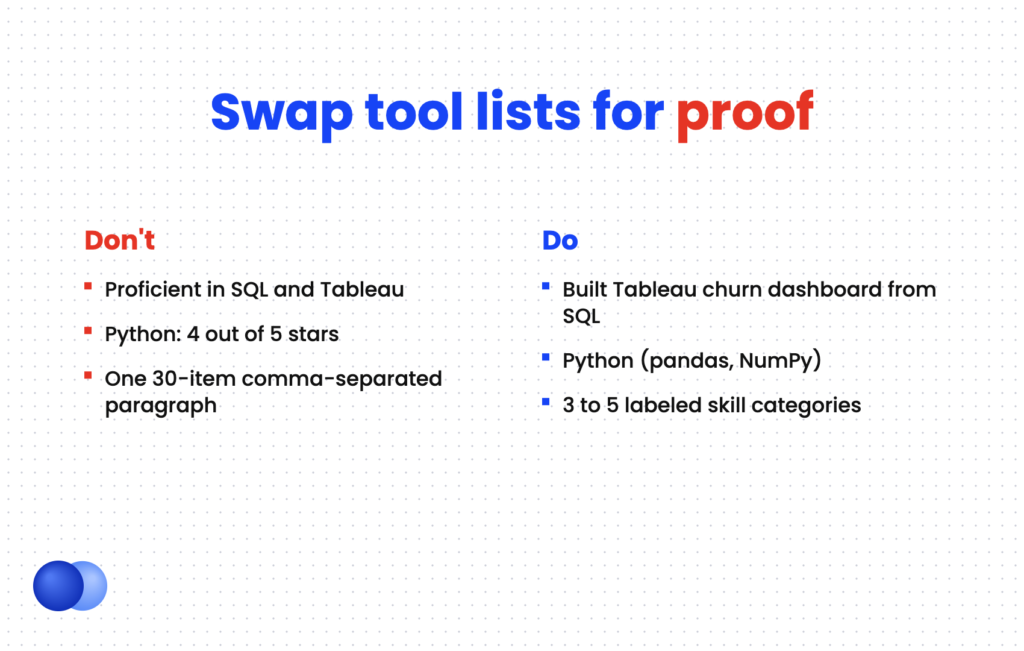
Before: Proficient in SQL and Tableau After: Wrote SQL queries across 12 million order records and built a Tableau churn dashboard used in weekly leadership reviews
Before: Experience with AWS After: Migrated 3 internal apps from on-prem servers to AWS (EC2, RDS), reducing hosting costs 28%
Before: Knowledge of HubSpot After: Built 14 HubSpot nurture workflows that lifted MQL-to-SQL conversion from 9% to 13%
Not every bullet needs a percentage. Scale counts too: record counts, users, sites or files handled. For more ways to add numbers, see how to quantify your resume. Students and career changers can prove skills through projects on a resume or a linked GitHub profile.
Mirror the posting’s tool names exactly
If the posting says "Microsoft Dynamics 365," do not write "Dynamics CRM." If it says "Google Analytics 4," write "GA4 (Google Analytics 4)" once so both forms are covered. ATS keyword matching is often literal, and recruiters search by the vendor's current product name.
Should you show proficiency levels for technical skills?
Skip star ratings, progress bars and percentages. They are subjective, often unreadable to ATS software, and invite doubt. Instead, signal depth with plain words used sparingly (advanced, working knowledge), specific sub-features in parentheses, certifications, and bullets that show the scale of your work.
Graphic skill meters look modern but say little. What does "4 out of 5 stars in Python" mean? A recruiter cannot verify it, and a parser may skip the image entirely.
Better ways to show depth:
- Sub-features: "Excel (Power Query, VBA macros)" instead of "Excel (expert)."
- Selective labels: Mark only one or two core skills "advanced," and leave the rest unlabeled.
- Certifications: Add them in a separate certifications section.
- Bullets: Scale and outcome do the convincing.
If a skill would need the label "beginner," it usually does not belong on the resume yet.
What technical skills mistakes should you avoid?
The most common technical skills mistakes are listing outdated or obvious tools, padding the list with things you cannot discuss, using rating graphics, and hiding key tools in a single long paragraph. Each one costs scan time or credibility. Keep the list current, honest, grouped and matched to the posting.
List the tools the posting names, in its exact wording
Paste every program you have ever opened do: Group skills under 3 to 5 clear category labels dont: Write one 30-item comma-separated paragraph do: Add sub-features like "Excel (Power Query, VBA)" dont: Use star ratings or progress bars do: Prove your top tools in experience bullets dont: List a tool you could not discuss in an interview do: Drop outdated tools unless the posting asks for them dont: Fill space with basics like "email" or "internet"
Before you apply, compare your draft against the posting. The Rezoom ATS resume checker flags which required technical skills are missing from your resume and where they appear. For broader placement strategy, read how to highlight skills on your resume.

Frequently asked questions
What are examples of technical skills for a resume?
Common examples include Microsoft Excel, SQL, Python, Salesforce, QuickBooks, Tableau, AutoCAD, Epic EHR, Google Ads and AWS. The right ones depend on your field and the job posting.
How many technical skills should I list on a resume?
Most resumes work well with 8 to 15 technical skills, grouped into categories. Technical roles can list more, as long as each one passes the relevance and interview test.
Where should technical skills go on a resume?
Put a grouped technical skills section near the top for technical roles and lower for non-technical ones. Then repeat your most important tools inside experience bullets.
What is the difference between technical skills and hard skills?
Hard skills are any teachable, measurable abilities. Technical skills are the subset tied to specific tools, software, equipment or technical methods.
Should I list technical skills I am still learning?
Only if you have produced real work with them, such as a project or coursework deliverable. Label them honestly, for example "Python (coursework, 2 projects)."
Do technical skills help with ATS screening?
Yes. ATS software and recruiters often search for named tools, so listing the posting's exact technical terms improves your chance of matching.



Comments