

Summary
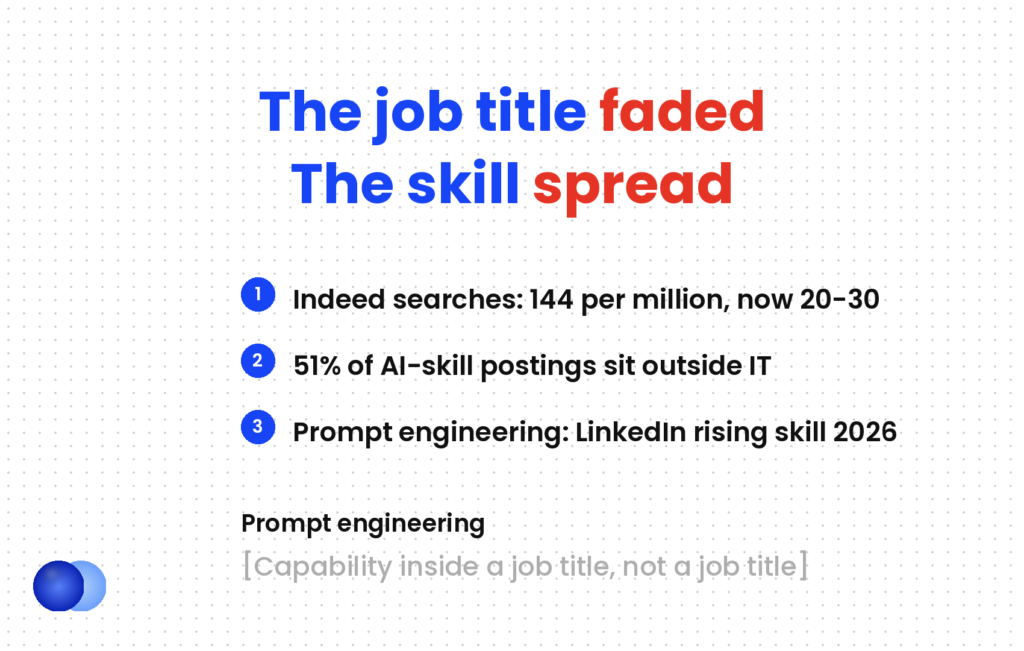
Yes, as a skill inside your real job, not as an identity. Indeed searches for the "Prompt Engineer" title peaked at 144 per million in April 2023 and settled at 20 to 30, yet the skill appears in LinkedIn's 2026 Skills on the Rise lists and Lightcast found 51% of AI-skill postings sit outside IT. List the exact term once for search, then prove it in a bullet with a result.
Putting prompt engineering on a resume is worth doing in 2026, but almost never in the way the phrase first suggests. The job title that made it famous faded within two years. The skill underneath it spread into marketing, HR, finance and law, and that is where it now earns its place.
Most advice mixes up two opposite trends. Indeed search data reported by Salesforce Ben shows interest in the "Prompt Engineer" role jumping from 2 to 144 searches per million in early 2023, then settling at 20 to 30. Over the same stretch, LinkedIn kept adding prompt engineering to its lists of fast-rising skills.
So the useful question is not "should I list it?" but "where, in what words, and with what proof?" This article answers those three for one phrase, not the whole list of AI skills.
Is prompt engineering worth listing on a resume?
Yes, if you have used it to produce a result you can name. List the exact term once in your skills section so keyword searches find you, then prove it in a bullet under a real job. A bare "Prompt Engineering" line with no evidence adds almost nothing, and a "Prompt Engineer" headline usually hurts.
The case for listing it rests on three findings from different sources.
Employers now ask for AI skills in ordinary jobs. Lightcast's analysis of more than 1.3 billion job postings found that 51% of postings requiring AI skills sit outside IT and computer science, and that those postings advertise salaries about 28% higher, close to $18,000 a year.
Hiring leaders say they filter on it. In the 2024 Work Trend Index from Microsoft and LinkedIn, 66% of leaders said they would not hire someone without AI skills, and LinkedIn recorded a 142-fold increase in members adding AI skills such as ChatGPT and Copilot to their profiles.
Hiring managers want proof, not the label. One vendor survey, the Resume Genius 2026 Hiring Insights Report quoted by Built In, found 78% of hiring managers rate AI tool proficiency as at least somewhat important, but only 19% call it very important. Built In's summary of the practitioner view is blunt: tool names matter less than what you did with them.
Put together, the prompt engineering resume answer is conditional. The term helps you get found and does very little to get you believed, because so many profiles now carry it.
What happened to the prompt engineer job title?
It collapsed into other jobs. Companies stopped hiring for "Prompt Engineer" as a standalone role and started expecting the skill inside marketing, analyst, HR and engineering roles. The title now reads as dated on most resumes; the capability reads as current.
The standalone role had a short, loud life, with Anthropic advertising prompt engineering roles at up to $375,000, according to Salesforce Ben.
Then the models improved. As Microsoft's Jared Spataro put it in the same reporting, "you don't have to have the perfect prompt anymore."
| Signal | Early 2023 | 2025–2026 |
|---|---|---|
| Indeed searches for "prompt engineer" (per million) | 2 → 144 (Jan to Apr 2023) | Settled at 20–30 |
| Standalone prompt engineer postings | Headline salaries up to $375,000 | Described as "minimal" |
| Prompt engineering as a listed skill | Emerging | Named in LinkedIn's 2026 Skills on the Rise for the UK, Canada and Australia |
| Where AI-skill postings sit | Mostly tech | 51% outside IT (Lightcast) |
A title describes what you are; a skill describes what you can do inside it. The market kept the second and dropped the first.
Where does prompt engineering go on a resume?
In two places, with different jobs. The skills section carries the exact keyword for recruiter searches and applicant tracking filters. A bullet under a real role carries the proof. The headline and job title fields should describe your actual profession, not the tool technique.
Think of a prompt engineering resume entry as a keyword and a claim, stored in different sections.
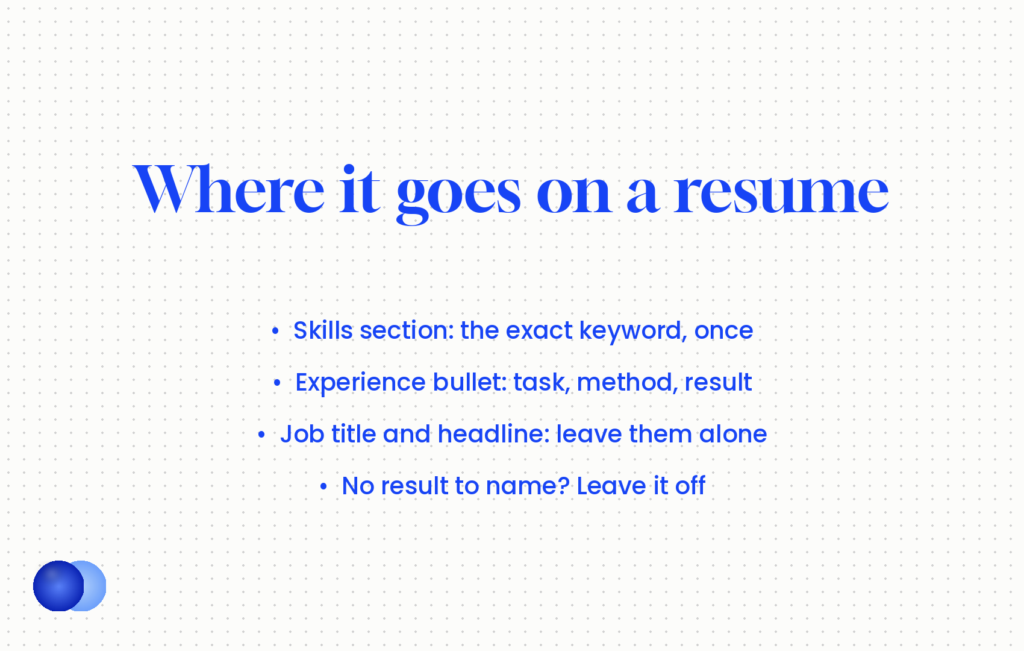
Skills section: the keyword. Recruiters searching a database, and the filters in how an ATS works, match on terms. One line in a grouped skills list does that job: AI & Automation: Prompt Engineering, ChatGPT, Claude, Microsoft Copilot, Retrieval-Augmented Generation.
Experience bullets: the proof. Here a reader decides whether the keyword means anything.
Headline and titles: leave them alone. Your job title is what your employer called the role. Relabelling a content marketer as "Content Marketer & Prompt Engineer" invites exactly the scepticism the Resume Genius survey describes, where 72% of hiring managers said heavy AI reliance makes a candidate seem less skilled.
Put the proof bullet in your most recent role
A recruiter's first scan lasts seconds and rarely leaves the top of page one, so the prompt engineering bullet belongs under your current or latest job, not in a side project at the bottom. Keep the skills-section keyword too, because the search runs before anyone reads the bullet. One keyword plus one proof bullet beats five keywords with none.
What does a believable prompt engineering bullet look like?
It reads like any other achievement bullet: a business task, what you built or changed, and a number. The technique appears as the method, not the headline. If you removed the word "prompt" and the bullet still showed a result, you wrote it correctly.
Weak entries describe the tool rather than the work. In the Resume Genius survey, 76% of hiring managers said AI-written resumes make it harder to see what a candidate actually did, and a vague AI bullet creates the same problem.
A strong bullet has three parts:
The task. Something your employer needed: support replies, campaign briefs, contract review, data cleaning.
The method. What you built: a reusable prompt library, a few-shot template, an evaluation checklist, a retrieval setup over internal documents.
The result. Time saved, volume handled, error rate, adoption by colleagues.
Weak: "Skilled in prompt engineering and ChatGPT. Used AI tools to improve productivity across the marketing team."
Strong: "Built a library of 14 tested prompt templates for campaign briefs in Claude and ChatGPT, adopted by a six-person team; first-draft turnaround fell from two days to three hours, with brand-review edits down by roughly a third."
The first gives two keywords and no reason to believe either. The second adds a named tool, a scope and a measured outcome that would survive an interview follow-up.
The strong version never calls the candidate a prompt engineer; the work does that. For drafting, ChatGPT resume prompts covers how to use the same tools on your own document without producing the generic tone readers flag.
Which exact wording should you use?
Use the exact phrase the posting uses, because LinkedIn Recruiter and most ATS filters match skills verbatim. "Prompt Engineering" and "Prompt Design" are different strings to a search. When a posting names a tool or a technique instead, mirror that specific term as well.
Skill naming is where good candidates quietly lose searches. Recruiter matches skills verbatim, so a profile listing "Prompt Design" does not appear in a search for "Prompt Engineering". The same principle drives the advice on LinkedIn skills: pin the term for the role you want, spelled the way that role's postings spell it.
Mirror the posting. If the advert says "prompt engineering" or "generative AI", use those exact words, provided you can back them up.
Name the tools you actually used. ChatGPT, Claude, Copilot, Gemini: tool names carry search weight and signal concrete use.
Go one level deeper where you can. LinkedIn's 2026 US list of rising skills leans on specific terms such as retrieval-augmented generation, OpenAI API integration, LangChain and vector databases. If you have done that work, the specific term outranks the general one, because it shows you went past typing questions into a chat window.
Copy the posting's exact skill phrase into your skills section and your LinkedIn profile, then prove it in one bullet with a number.
Invent a hybrid title such as "Marketing Manager / Prompt Engineer", which reads as padding and does not match any search a recruiter runs.
When should you leave it off?
Leave it off when you cannot name a result, when the posting shows no interest in AI, or when your use amounts to occasional chatbot questions. Keep the explicit title only if you actually build and evaluate LLM systems for a living, where the specific technical terms serve you better anyway.
Listing a skill you cannot discuss costs more than omitting it. One follow-up — "walk me through a prompt you iterated on" — separates real use from a keyword.
Casual use. Asking ChatGPT to rewrite emails is normal office work in 2026. The Work Trend Index already found 75% of knowledge workers using AI at work, so everyday use no longer differentiates anyone.
Roles that do not ask for it. For a warehouse supervisor or a nurse, the line takes space from evidence the employer did ask for.
Technical AI roles. If you build LLM applications, "prompt engineering" undersells you. Lead with systems vocabulary — evaluation, retrieval, fine-tuning — and treat prompting as one method.
A quick decision check
| Your situation | What to do |
|---|---|
| Built reusable prompts or workflows with a measurable result | Skills keyword plus proof bullet |
| Posting names prompt engineering or generative AI | Mirror the exact phrase; add one proof bullet |
| Only casual chatbot use | Leave it off, or name the tool without the technique |
| Build LLM systems professionally | Use specific technical terms; prompting as a method |
| Career changer into an AI-adjacent role | Projects section entry with dates and outcomes |
For career changers, the last row follows the same rule as the rest of a career change resume: translate what you did into the target role's language, rather than asserting a new identity.
What can listing it not fix?
A keyword cannot make up for thin evidence, and it cannot hide genericness. Readers do not reliably detect whether AI wrote a resume, but they spot bullets that could belong to anyone. Prompt engineering on a resume earns its place only when the rest of the document shows real work.
It will not rescue a generic resume. The research on whether employers can detect an AI resume shows readers react to vagueness, not authorship. A trendy skill on a vague resume makes the vagueness more obvious.
It will not stay distinctive. After a 142-fold rise in AI skills on LinkedIn profiles, the plain phrase drifts towards "expected", much as "Microsoft Office" did.
It will not outrun the market. The title rose and fell in about two years, so update the wording each time you apply.
Whether you're in finance, HR or legal, we see this becoming a capability within a job title, not a job title to itself.
List prompt engineering as a capability, inside a job title you held, with a result attached. An AI resume builder can help you match the posting's exact skill wording and turn a vague AI line into a bullet with a scope and a number.
Frequently asked questions
Should I put prompt engineering on my resume?
Yes, if you can point to a result. List the exact term in your skills section, and add one bullet under a real job showing the task, what you built and a measured outcome.
Is prompt engineer still a real job title?
Rarely as a standalone role. Indeed searches for the title peaked in April 2023 and settled far lower; employers now expect the skill inside other jobs.
Where should prompt engineering go on a resume?
In the skills section as a keyword and in an experience bullet as proof. Keep it out of your job titles and headline unless you genuinely build LLM systems professionally.
Should I write "Prompt Engineering" or "Prompt Design"?
Whichever the posting uses. LinkedIn Recruiter and most applicant tracking filters match skills verbatim, so mirroring the employer's exact phrase decides whether a search finds you.
Does listing AI skills increase salary?
Lightcast found postings requiring AI skills advertise salaries about 28% higher. That is a posting-level average, not a promise for any individual.
Is using ChatGPT enough to list prompt engineering?
Usually not. Occasional chatbot use is ordinary office work now; name the tool if the posting asks, and save "prompt engineering" for reusable workflows with results.
Do hiring managers care about AI skills on a resume?
Somewhat. One vendor survey, Resume Genius 2026, found 78% rate AI tool proficiency at least somewhat important but only 19% very important.
How do I show prompt engineering without work experience?
Use a short Projects section with dates, tools and a measurable outcome, and keep the skills-section keyword so searches still find you.



Comments