

Summary
Advice on the LinkedIn skills section splits between filling all 50 slots and cutting to a dozen specific ones. Both are correct for different readers — a boolean search matches keywords, while a human opening your profile judges credibility. The pinned three serve both, LinkedIn Recruiter matches verbatim, and a search returns a maximum of 1,000 profiles.
Advice on your LinkedIn skills section splits into two confident, opposite recommendations.
"Fill all 50 slots." Every empty one is a recruiter search you will never appear in.
"Cut to twelve." Twelve specific skills prove more expertise than fifty common ones, and generic entries dilute the real ones.
Both are right, and they are optimising for different readers. Your LinkedIn skills section is read first by a boolean search and second by a person — and the two want opposite things.
How do recruiters actually search?
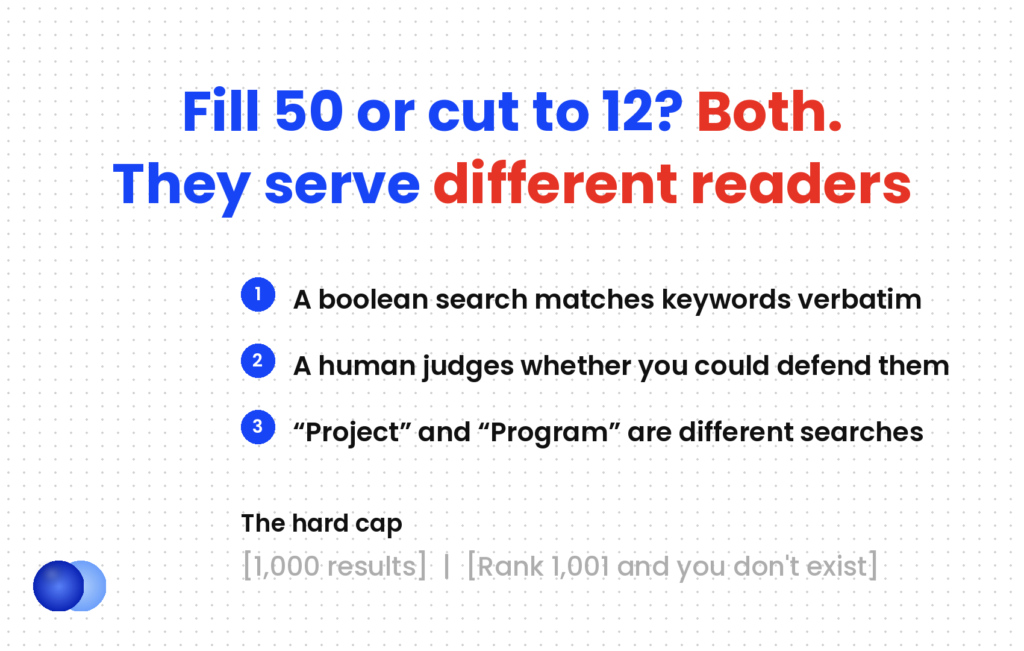
By exact keyword in LinkedIn Recruiter, which matches verbatim. "Project Management" and "Program Management" return different result sets. A search displays a maximum of 1,000 candidates across 40 pages, so ranking inside that list is the whole game.
In practice, three mechanics decide whether you appear at all:
Verbatim matching. LinkedIn Recruiter does not infer synonyms. If a recruiter searches "Program Management" and your profile says "Project Management", you are not in that result set.
A hard cap of 1,000. A search returns at most 1,000 profiles — 40 pages of 25. If you rank 1,001st, you do not exist for that search, however qualified you are.
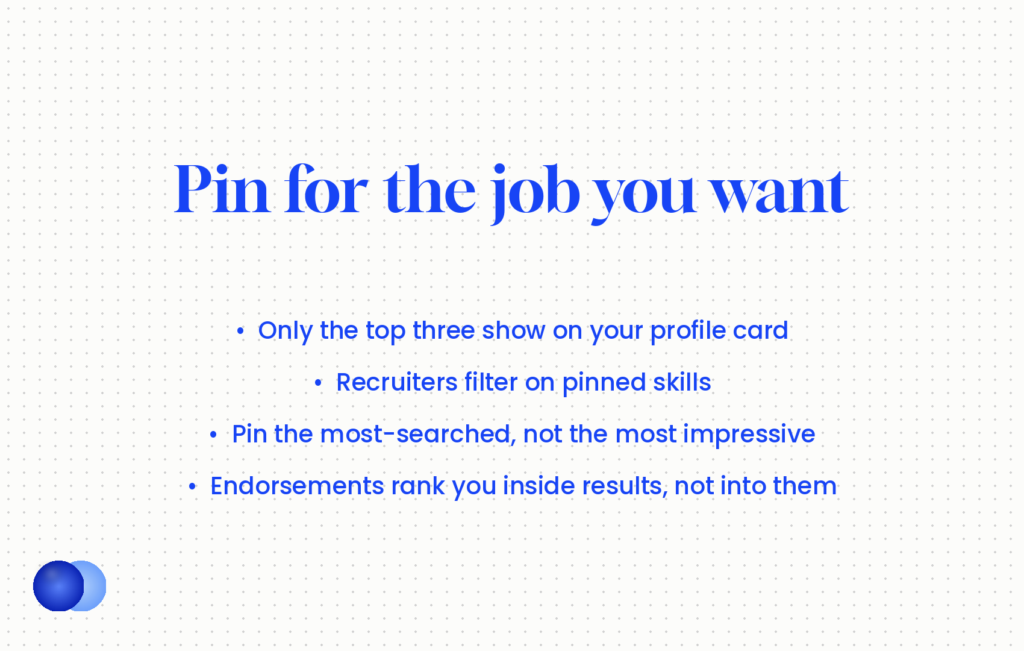
Endorsements rank within the results. Two candidates listing the same skill rank differently by endorsement volume. Endorsements do not get you into the set; they move you up inside it.
That third point resolves a lot of confusion about whether endorsements matter. They are a ranking signal, not an entry ticket. A skill with zero endorsements is still searchable and still visible. Languages sit in the same list, and listing your language levels on a resume keeps the wording consistent across both.
So how many skills should you list?
Fill the list toward the 50 limit with skills you could genuinely defend, and delete anything generic. The two camps only conflict on mid-tier skills — entries like "Microsoft Office" and "Teamwork" fail both tests, because recruiters do not boolean-search them and humans discount them.
Helpfully, the apparent contradiction mostly dissolves on inspection.
| Skill type | Helps search? | Helps the human? | Verdict |
|---|---|---|---|
| Named tools and platforms | Yes | Yes | Keep |
| Specific methodologies | Yes | Yes | Keep |
| Specific human skills ("Stakeholder Communication") | Yes | Yes | Keep |
| Generic soft skills ("Teamwork", "Leadership") | Barely | No | Cut |
| Basic professional skills ("Microsoft Office") | No | Negative | Cut |
| Real skills you would rank mid-pack on | Yes | Neutral | Keep, unpinned |
The genuine disagreement is only about that last row, and the resolution is placement rather than deletion — a real but secondary skill belongs in the list and not in your top three.
One useful filter: if you had to talk about this skill for twenty minutes in an interview, would you hold up? If not, leave it unpinned. It can still sit in the list.
Check the exact wording recruiters use
Open LinkedIn Jobs, search your target role, and read the Skills section of ten postings. Note the exact strings — "Data Analysis" rather than "Analytics", "Program Management" rather than "Project Management". Those are the terms recruiters type into the search bar, because they are the terms in their own requisitions. Matching the posting's vocabulary word for word is the single highest-return edit in this section, and it takes fifteen minutes.
Which three should you pin?
The three that match the role you want, not the role you have. Only the top three appear on your profile card, they carry extra weight in search ranking, and they are the first endorsements a visitor sees.
This is the decision that matters most, and the framing that makes it easy is counterintuitive.
Pin for the target, not the history. A backend engineer moving into machine learning should not pin Java, Spring and Kafka. Pin Python, PyTorch and ML Engineering — because recruiters filter on pinned skills, and the filter you want to pass is for the job you want next.
Searched, not impressive
Pin the most-searched, not the most impressive. If recruiters search "data analysis" ten times more often than "statistical modelling", pin data analysis. The rarer term is more flattering and less findable.
A structure that works by field:
| Field | Pin one of each |
|---|---|
| Engineering | Language · framework · adjacent platform |
| Design | Tool · methodology · specialisation |
| Marketing | Channel · platform · analytical skill |
| Operations | System · process discipline · domain |
Pinned for the current job: Java, Spring, Kafka. Accurate, and it surfaces them for backend roles they are trying to leave.
Pinned for the target: Python, PyTorch, ML Engineering. Also accurate — they have used all three — and it surfaces them for the roles they actually want.
Same person, same profile, same honesty. The second set appears in a completely different pool of searches.
Get endorsements on the pinned three first. Endorsing three colleagues for skills they genuinely have produces reciprocation from a meaningful share within a week, and the ranking benefit concentrates where you pinned.
Accept endorsements from people who have never seen you work. A profile showing 99+ endorsements for a skill you rarely use tells a careful recruiter that your endorsements measure network size rather than ability.
Are soft skills worth listing?
The specific ones, yes. LinkedIn's own 2026 Skills on the Rise data shows roughly half the fastest-growing skills are human-centric — conflict mitigation, adaptability, relationship building. What fails is the generic version, because "Communication" appears on millions of profiles and matches nothing distinctive.
Notably, the old advice was "list hard skills only", and it has partly stopped being true.
Generic fails. "Communication", "Leadership", "Teamwork". Recruiters rarely boolean-search these, and when they appear on your profile they occupy a slot without producing a match.
Specific works. "Executive Communication", "Stakeholder Management", "Conflict Mitigation", "Cross-functional Collaboration". These are less competitive, more searchable, and they describe something.
The rule is the same one that governs the whole section: specificity is what makes a skill findable. A term used by millions is not a differentiator in a system that returns 1,000 results.
How does this connect to the rest of the profile?
Skills are one signal among several. The headline carries the most weight in LinkedIn's search ranking, followed by the About section, experience descriptions and then skills. A strong skills list on a thin profile still ranks below a complete one.
Worth keeping in proportion, because the skills section is easy to optimise and not the whole system.
LinkedIn ranks profiles on keyword match, completeness, endorsement signals and activity. The headline carries the highest weight — LinkedIn headline examples covers why, and the same keyword should usually appear in both places.
Aim for 15 to 25 relevant keywords spread across sections rather than concentrated in one, with three to five integrated naturally into each. LinkedIn profile optimization covers the full ranking picture.
And keep it consistent with what you send. A profile listing skills your resume does not mention reads as inflation — the resume and the profile are usually read within minutes of each other, which is also why converting a LinkedIn profile to a resume needs care rather than an export.
LinkedIn Recruiter matches skills verbatim. "Project Management" and "Program Management" are different search terms with different result sets.
What should you do this week?
Read ten target job postings, extract the exact skill strings, pin the three most-searched, fill the rest of the list with defensible entries, and delete anything generic. About an hour, done once, revisited quarterly.
Finally, five steps:
1. Collect the vocabulary. Ten postings for your target role, exact strings from their Skills sections.
2. Pin three. The most-searched terms for the role you want, not the one you have.
3. Fill the list. Named tools, platforms, methodologies and specific human skills. Toward the 50 limit, but only with entries you could defend.
4. Delete the generic. Microsoft Office, Teamwork, Leadership, Public Speaking. They cost a slot and return nothing.
5. Endorse three colleagues. For skills they genuinely have. Reciprocation handles the rest.
Revisit quarterly, or whenever your target role changes. A skills section pinned for a job you stopped wanting eighteen months ago is surfacing you to exactly the wrong searches.
Frequently asked questions
How many skills should you list on LinkedIn?
Fill the list toward the 50 limit with skills you could genuinely defend, and delete generic entries. Every empty slot is a search you cannot appear in, but a generic skill produces no match either.
Which three LinkedIn skills should I pin?
The three that match the role you want rather than the one you have. Only the top three appear on your profile card and they carry extra weight in search ranking.
Do LinkedIn endorsements matter?
As a ranking signal within results rather than as an entry ticket. Two candidates listing the same skill rank differently by endorsement volume, but a skill with zero endorsements is still searchable.
Does LinkedIn match skills exactly?
Yes. LinkedIn Recruiter matches verbatim, so "Project Management" and "Program Management" return different result sets. Match the exact wording used in your target job postings.
Should I list soft skills on LinkedIn?
The specific ones. "Stakeholder Management" and "Conflict Mitigation" are searchable and distinctive; "Communication" and "Teamwork" appear on millions of profiles and match nothing.
How many candidates does a LinkedIn recruiter search return?
A maximum of 1,000 across 40 pages. If you rank below that, you do not appear at all for that search, which is why ranking inside the set matters as much as entering it.
Should I delete skills like Microsoft Office?
Yes. Recruiters do not boolean-search basic professional skills, and their presence signals that the list was assembled rather than chosen.
How often should I update my LinkedIn skills?
Quarterly, or whenever your target role changes. A section pinned for a role you no longer want surfaces you to the wrong searches.



Comments