

Summary
To quantify your resume, add numbers that show scale, results, time, or frequency to each accomplishment. Ask how many, how much, how long, and how often for every bullet. Add a baseline so the number has context, and round or use ranges when you lack exact data. Only use a figure you can explain in an interview, because hiring managers will ask where it came from.
To quantify your resume, attach a number to each accomplishment that shows how big, how much, how fast, or how often. "Managed social media" becomes "Grew Instagram followers from 2,100 to 9,400 in 10 months." The number turns a claim into evidence.
Most guides stop at "add numbers." This one covers the harder parts: where to find numbers when your job has no dashboard, how to estimate honestly, and how to make sure every figure survives an interview question.
Why should you quantify your resume?
Numbers let a reader judge your impact in seconds. Recruiters averaged 7.4 seconds on an initial resume scan in the Ladders 2018 eye-tracking study. MIT's career office says metrics help readers see the tangible outcomes of your work, and Vanderbilt calls numbers a source of depth, impact, and credibility.
Recruiters skim. The Ladders eye-tracking study, reported by HR Dive, found an average initial review of 7.4 seconds, and the best-performing resumes used bulleted accomplishments. Digits stand out in a block of text, so a quantified bullet gets noticed faster.
Numbers also make your claims believable. MIT Career Advising and Professional Development says metrics help "your reader see the impact and the tangible outcomes of your efforts." Vanderbilt's career development office adds that numbers give "depth, impact, and credibility."
When you quantify your resume, you also give the interviewer better questions to ask. "Tell me about that 31% drop in returns" is a much easier conversation than "tell me about your responsibilities."
How do you find numbers to quantify your resume?
Run every bullet through four questions: how many, how much, how long, and how often. Then check your sources: performance reviews, dashboards, sent emails, calendars, project trackers, and old reports. Records beat memory, and they give you a source if anyone asks.
Vanderbilt recommends asking "how many, how much, how long, how often?" for each accomplishment. That simple prompt surfaces numbers most people forget they have.
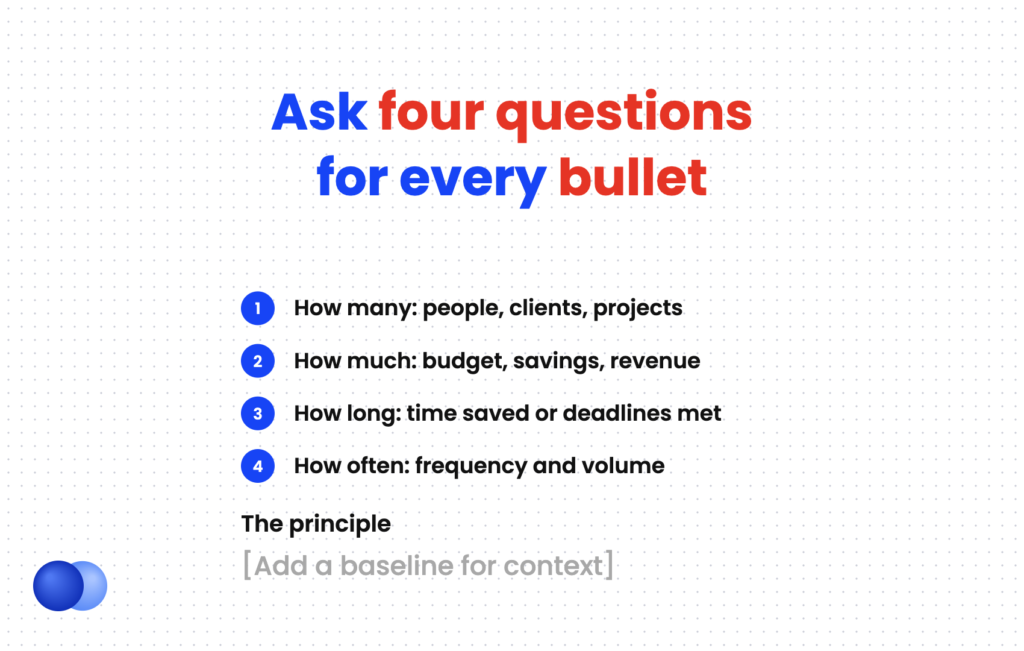
| Question | What it measures | Resume example |
|---|---|---|
| How many? | Scale: people, clients, projects, items | Supported 60+ customers per shift |
| How much? | Money, budget, savings, revenue | Managed a $250K event budget |
| How long? | Time saved, deadlines, speed | Cut month-end close from 8 days to 5 |
| How often? | Frequency and volume | Published 3 reports per week |
| Compared to what? | Change against a baseline | Raised NPS from 32 to 47 |
The last row matters most. Yale's Office of Career Strategy advises giving "a baseline for comparison" so the reader can judge the result. "Grew membership 100%" is vague. "Grew membership from 50 to 100 members" is concrete.
Where to look for your numbers:
- Performance reviews often list goals and whether you hit them.
- Dashboards and reports in your CRM, ticketing tool, or analytics platform.
- Sent email and calendars show meeting counts, launches, and deadlines.
- Project trackers show how many tasks, sprints, or tickets you closed.
- Awards and rankings such as "top 3 of 25 reps" or "employee of the quarter."
What formula should a quantified bullet follow?
Use action verb plus what you did plus the measurable result. Yale's career office also teaches Accomplished X, as measured by Y, by doing Z. Both formulas put the number next to the action that caused it, so the reader sees cause and effect in one line.
Two formulas cover nearly every bullet. Emory Career and Professional Development uses "Action Verb + task/project/initiative, resulting in quantitative outcome." Yale also teaches "Accomplished [X] as measured by [Y] by doing [Z]," a format The Muse attributes to former Google people chief Laszlo Bock.
Pick the one that reads most naturally for each bullet. When you write your work experience, place the strongest quantified bullet first under each job. Our guide on how to write resume bullet points goes deeper on structure and verb choice.
Before: Responsible for customer support tickets After: Resolved 45+ support tickets per day with a 94% satisfaction score, the highest on a 12-person team
Before: Helped improve the onboarding process After: Cut new-hire onboarding from 3 weeks to 10 days by building a self-paced checklist used by 4 departments
Before: Managed the company newsletter After: Grew newsletter subscribers from 3,800 to 11,200 in 14 months and raised open rate from 21% to 34%
How do you quantify a resume without obvious numbers?
Measure scope, frequency, and outcomes instead of revenue. Count the people you served, the projects you handled, the time you saved, or the errors you prevented. Teachers, nurses, researchers, and admins can quantify through class sizes, patient loads, publications, turnaround times, and accuracy rates.
Many roles never touch revenue. You can still quantify your resume through scope and frequency. Vanderbilt's examples come from research roles, where "Trained and mentored undergraduate students" becomes "Trained and mentored 3 undergraduate research students who are now in graduate school pursuing PhDs."
Here is what to count by role type:
- Teachers: class size, grade-level gains, number of courses, parent communication rates.
- Nurses and healthcare: patient load per shift, bed count, charting accuracy, audit scores.
- Administrative roles: calendars managed, travel booked, documents processed, turnaround time.
- Researchers: publications, conference talks, grant dollars, sample sizes.
- Retail and hospitality: transactions per shift, covers per night, shrink reduction, upsell rates.
Pair these numbers with the resume keywords from the posting so the metric sits next to the skill it proves. For a deeper list by function, see our companion guides on resume accomplishments examples and how to put KPIs on a resume.
Elementary Teacher - Taught 26 third-grade students and raised the share reading at grade level from 58% to 81% in one school year
Medical Office Administrator - Scheduled 120+ patient appointments per week across 4 providers with a no-show rate under 6%
Graduate Research Assistant - Presented findings at 6 national conferences, which led to 2 collaborative projects and a co-authored paper
How do you estimate numbers honestly?
Estimate only from something you can explain: a sample week, a known total, or a before-and-after comparison. Round down, use ranges such as 15 to 20, and add words like about or over. If you cannot walk an interviewer through how you got the number, leave it out.
Exact data is not always available. An honest estimate is fine when it rests on a method you can explain.
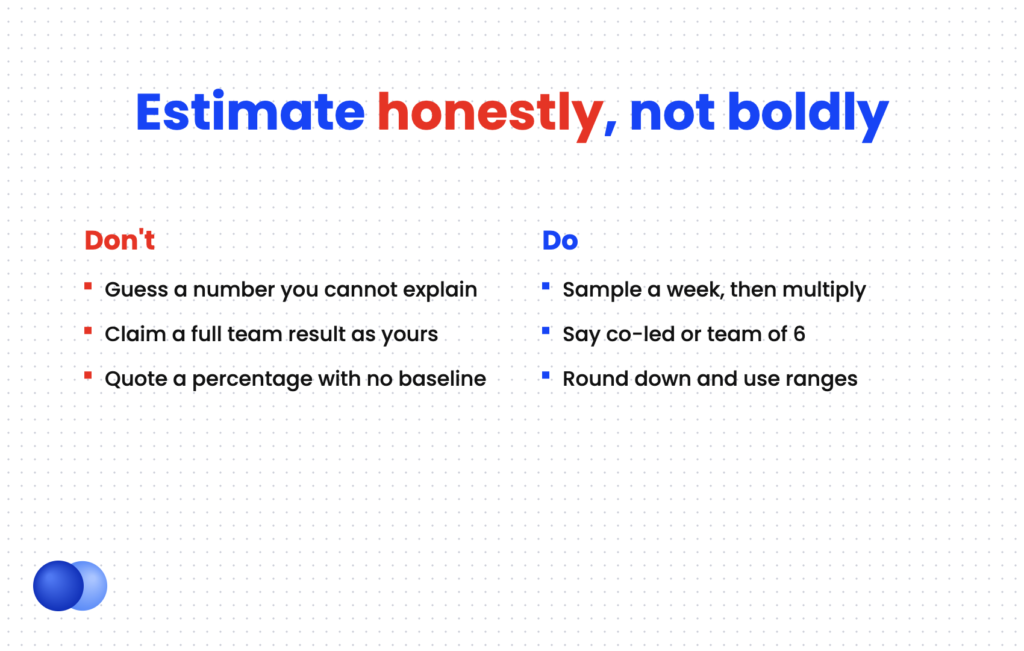
Use one of these three methods:
- Sample and multiply. Count a typical week, then scale it. If you handled about 40 calls a week for a year, "2,000+ calls per year" is defensible.
- Use a known total. If your team of 5 closed 600 tickets and you owned a fair share, "about 120 tickets" is reasonable. Say "team of 5" if needed.
- Compare before and after. If a report took two days and now takes four hours, that is a measured time saving, even without a dashboard.
Then apply the interview test. The Muse suggests asking whether you could discuss the achievement confidently in an interview and whether a former manager would back it up. If the answer is no, cut the number.
Team results need care too. Words like "contributed to," "co-led," or "as part of a 6-person team" let you share a team metric without claiming all of it. Interviewers often ask you to explain a result using the STAR method, so know your part of every number.
Keep a brag file
Start a running note today with the date, the task, and any number attached to it. Update it once a month. When you next update your resume, you will have real, sourced figures instead of guesses made under deadline pressure.
What are the most common mistakes when you quantify your resume?
The biggest mistakes are numbers with no context, inflated or unverifiable figures, too many numbers crammed into one bullet, and quantifying trivial tasks. A strong resume uses one clear number per bullet, tied to a result the target employer cares about.
Numbers help only when they are clear and credible. Watch for these problems:
Add a baseline, such as from 50 to 100 members do: Use digits, not spelled-out numbers do: Round down and use ranges when unsure do: Tie each number to a result the employer values
Quote a percentage with no starting point dont: Invent or inflate figures you cannot explain dont: Pack three or four numbers into one bullet dont: Quantify trivial tasks like emails sent
A quick check of the whole page also helps. Aim for a number in most bullets, not all of them, since a few qualitative bullets add variety. For guidance on how many bullets each role should carry, see how many bullet points per job on a resume. For other slips that cost interviews, review our list of common resume mistakes.
If you want help turning duties into measurable results, the Rezoom AI resume builder suggests metrics for each bullet and flags lines with no measurable outcome. You can also compare your draft against our resume examples for your field.

Frequently asked questions
What if I do not have any numbers for my resume?
Start with scope and frequency: how many people, projects, or items you handled, and how often. Almost every job has something to count, even if revenue is not part of it.
Is it okay to estimate numbers on a resume?
Yes, if the estimate rests on a method you can explain, such as a sample week or a before-and-after comparison. Round down and use words like about or over.
Should every resume bullet have a number?
No. Aim for numbers in most bullets, especially for your most recent role. A few qualitative bullets are fine when the result is real but not measurable.
Should I use percentages or raw numbers?
Use whichever is more impressive and clear, and add the baseline when you can. "From 50 to 100 members" often reads better than "100% growth" alone.
How do I quantify team accomplishments?
Name your role in the result with words like contributed to, co-led, or as part of a 6-person team. Be ready to explain what you personally did.
Should numbers be written as digits on a resume?
Yes. Digits such as 12, 45%, and $250K are easier to scan than spelled-out numbers and stand out in a skim.



Comments