

Summary
Most resumes should use 3 to 5 bullet points per job, with the most for your current or most relevant role and 1 to 2 for older jobs. University career centers such as UC San Diego and Emory recommend the same 3 to 5 range. Instead of fixing one number, set a bullet budget for the whole page: about 12 to 18 bullets on a one-page resume, spent where the target job cares most.
Use 3 to 5 bullet points per job for your recent, relevant roles and 1 to 2 for older or unrelated ones. That is the short answer to how many bullet points per job on a resume, and it matches what major university career centers teach.
The better answer is to stop counting per job and start budgeting per page. A one-page resume holds roughly 12 to 18 bullets once your header, summary, education, and skills take their share. Your job is to spend that budget where the hiring manager will look first.
This guide gives you the ranges, a simple allocation method, copy-ready examples for three career stages, and the mistakes that make a resume look padded or thin.
How many bullet points per job on a resume should you use?
Use 3 to 5 bullet points per job for your most recent and most relevant roles. Older, shorter, or unrelated jobs need only 1 to 2 bullets, and jobs more than 10 to 15 years back can have none. Each bullet should run one to two lines and describe a result, not a duty.
The 3 to 5 range is not a trend from resume blogs. The UC San Diego Career Center tells students to "write 3-5 bullet points describing your outcomes and accomplishments." Emory Career and Professional Development gives the same range and adds that two lines is a typical maximum per bullet.
Both guides also say the number should flex. UC San Diego puts it plainly: use more space for more relevant positions. So the range is a default, not a quota.
Here is how that plays out by role type:
| Role on your resume | Bullet points | Why |
|---|---|---|
| Current or most recent job | 4 to 5 | It shows your current level and gets read first |
| Previous relevant job (last 5 to 10 years) | 3 to 4 | Proves the pattern of results holds |
| Older or less relevant job | 1 to 2 | Shows continuity without eating space |
| Jobs 10 to 15+ years back | 0 to 1 | A title, company, and dates are often enough |
| Short stint (under 6 months) | 1 to 2 | More looks padded for the time spent |
| Internship or part-time job (students) | 2 to 4 | Often your strongest evidence early on |
Why does the number of bullet points per job matter?
Recruiters skim first and read second. The Ladders 2018 eye-tracking study found recruiters spent an average of 7.4 seconds on an initial resume scan, and the best-performing resumes used bold titles and bulleted accomplishments. Too many bullets bury your best results; too few leave nothing to find.
The Ladders eye-tracking study, reported by HR Dive, found an average initial review of 7.4 seconds. Resumes that performed well had simple layouts, clear section headings, and bulleted accomplishments. Poor performers had long sentences and cluttered text.
That tells you what bullet count is really about. It controls how easy it is to spot your strongest result in a few seconds. A role with nine bullets hides its best line in the middle. A role with one vague bullet gives the reader nothing to hold on to.
Harvard's Mignone Center for Career Success lists "not well organized, concise, or easy to skim" among the top resume mistakes. The right number of bullet points per job keeps you on the right side of that line. For more on the skim itself, see how long recruiters look at a resume.
How do you set a bullet budget for the whole page?
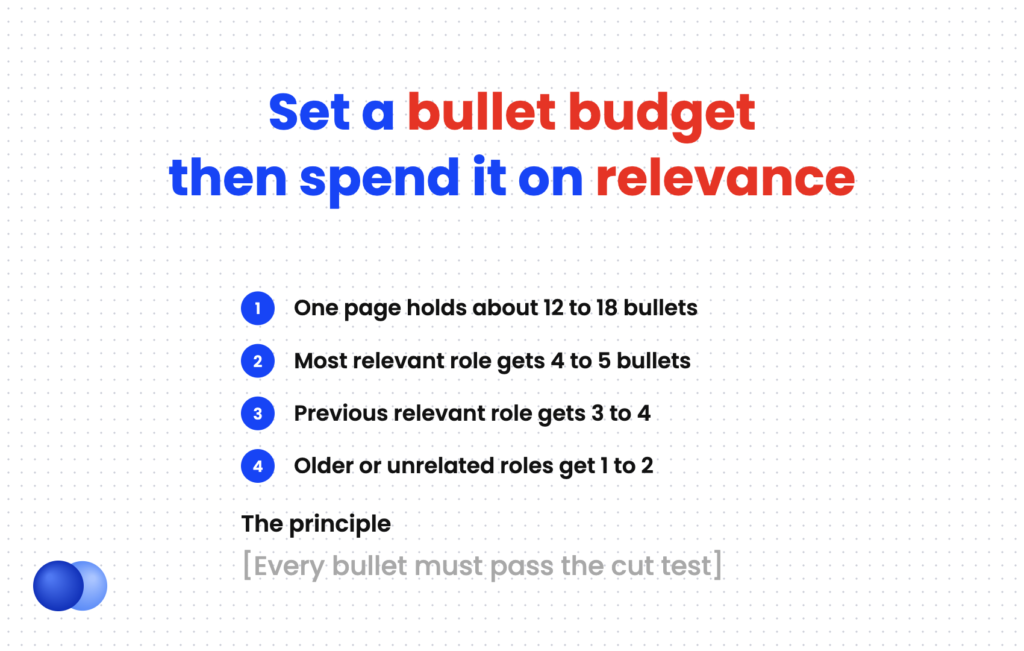
Count the bullets your page can hold, then allocate them by relevance. A one-page resume usually fits about 12 to 18 one- or two-line bullets. Give the largest share to the role closest to the target job, taper older roles, and cut any bullet that would not change a hiring decision.
Counting per job ignores the real limit, which is space. A one-page resume with a standard header, a short summary, education, and a skills line leaves room for roughly 12 to 18 bullets at normal font sizes. A two-page resume roughly doubles that.
Use this four-step method:
- Count your budget. Fill the page with your header, summary, education, and skills first. The space left, divided by about 1.5 lines per bullet, is your budget.
- Rank roles by relevance. Put the job closest to the target posting first in priority, even if it is not the most recent.
- Allocate top-down. Give the top role 4 to 5 bullets, the next 3 to 4, and spread what is left.
- Run the cut test. For each bullet, ask: would a hiring manager for this job miss it? If not, cut it and give the space to a stronger line.
The cut test matters more than the math. It forces every bullet to earn its line, which is the real goal behind any bullet count.
Spend bullets where the posting points
Before you allocate, highlight the three requirements that appear most often in the job posting. Every role on your resume should have at least one bullet that proves one of those three. If a role cannot, it gets one or two bullets at most.
How many bullet points per job by career stage?
Entry-level candidates can use 3 to 5 bullets for internships, projects, and part-time jobs because they have fewer roles. Mid-career candidates use 4 to 5 for the latest role and 2 to 3 for older ones. Senior candidates keep 4 to 5 for recent roles and compress anything older than 10 to 15 years.
Your career stage changes how you spend the budget, not the size of it.
Entry-level (0 to 2 years). You have fewer roles, so each one can carry 3 to 5 bullets. Internships, campus jobs, and projects count. If a role is thin, fold the best result into one strong line rather than stretching it to four weak ones.
Mid-career (3 to 10 years). Give your current role 4 to 5 bullets and earlier relevant roles 2 to 3. This is where tapering matters most, because you now have more results than space.
Senior (10+ years). Recent leadership roles still get 4 to 5 bullets, but they should show scope: budget, team size, or business outcome. Older roles shrink to a line or move to an "Earlier Experience" list. Our guide on how far back a resume should go covers where to draw that line.
Senior Marketing Manager | Brightline Health | 2023 – Present - Grew qualified inbound leads 38% in 12 months by rebuilding the paid search program around 4 core service lines - Cut cost per lead from $142 to $96 by shifting 30% of spend from display to search and retargeting - Led a team of 5 marketers and 2 agencies across a $1.2M annual budget - Launched a patient referral campaign that produced 640 new appointments in its first quarter - Built a weekly dashboard now used by the CMO and 3 regional directors
Marketing Specialist | Arcadia Retail | 2020 – 2023 - Increased email revenue 22% year over year by segmenting a 180,000-contact list by purchase history - Managed 40+ product launches per year across email, social, and in-store channels - Trained 6 store managers on the new campaign request process
Marketing Coordinator | Pinecrest Media | 2018 – 2020 - Coordinated trade show presence for 12 events per year with a $150K budget
How should you handle promotions, short jobs, and long tenures?
Treat a promotion as separate titles under one employer, with 2 to 4 bullets for the current title and 1 to 2 for the earlier one. Give short stints 1 to 2 bullets. For a long tenure at one company, split bullets by title or time period so ten years does not look like one job.
These three cases break the simple range, so handle them on purpose.
Promotions. List the company once and stack the titles underneath. The top title gets the most bullets. The earlier title needs only enough to show what earned the promotion. Our guide on how to show a promotion on a resume has layouts for this.
Short stints. A four-month contract with five bullets looks padded. One or two lines that name the project and its result are more credible.
Long tenures. Eight years at one employer with three bullets undersells you. Break the tenure into titles or phases, then give each 2 to 4 bullets.
Northfield Logistics | Columbus, OH Operations Manager | 2024 – Present - Reduced late shipments from 9% to 3% across 2 warehouses by redesigning pick-and-pack schedules - Manage 48 hourly staff and 4 shift leads across 3 shifts - Cut overtime spend 18% in the first year through cross-training - Led the rollout of a new warehouse management system with zero missed customer deadlines
Shift Supervisor | 2021 – 2024 - Promoted after raising shift pick accuracy from 96.1% to 99.2% - Trained 20+ new hires on safety and scanning procedures
What makes a bullet worth its space?
A bullet earns its space when it names an action, the task or project, and a measurable result. UC San Diego calls this action verb plus specific task plus purpose or result. Keep each bullet to one or two lines and lead with the achievement, not the duty.
The count only works if each bullet is strong. MIT Career Advising and Professional Development recommends keeping each statement to one to two lines and starting with an action verb, then the task, then the outcome.
Numbers do much of the work here. Scale, money, time, and percentages show impact faster than adjectives. Our companion guide on how to quantify your resume walks through where to find those numbers. For the full writing formula, see how to write resume bullet points, and pull strong openers from our list of action verbs.
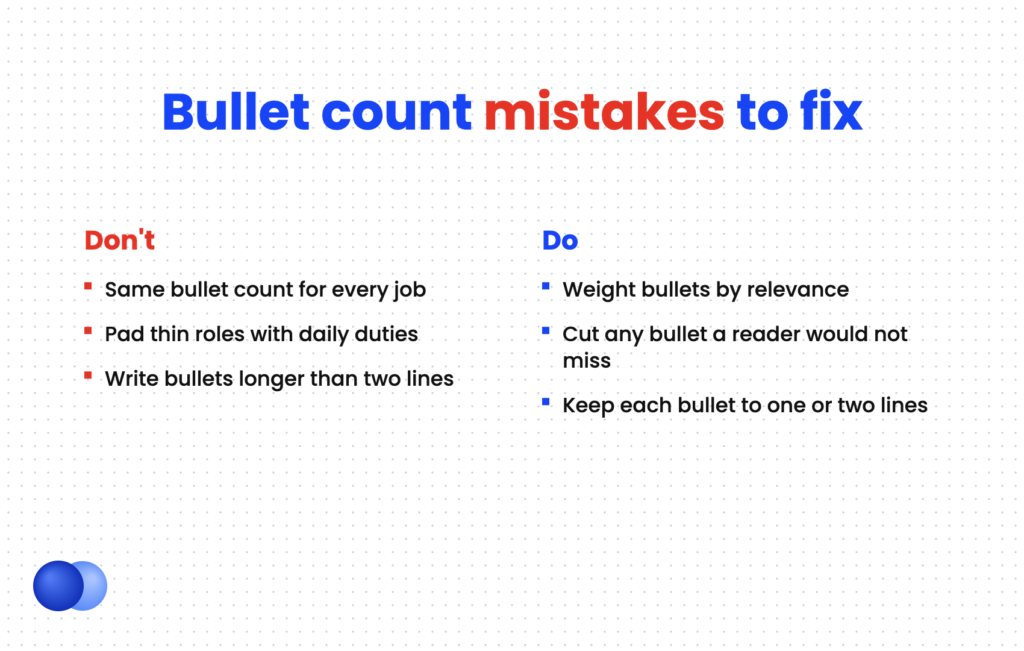
Give your most relevant role 4 to 5 bullets do: Keep each bullet to one or two lines do: Lead each bullet with an action verb and a result do: Trim older roles to 1 to 2 bullets
Use the same number of bullets for every job dont: List daily duties to fill space dont: Write bullets longer than two lines dont: Keep a bullet that repeats another one
What are the most common bullet count mistakes?
The most common mistakes are giving every job the same number of bullets, padding thin roles with duties, letting old jobs take more space than recent ones, and writing long bullets that wrap to three lines. Each one hides your best results from a reader who is skimming.
Equal bullets everywhere. Five bullets for every job ignores relevance. Your 2016 job should not look as important as your current one.
Duties as filler. "Answered phones" and "attended meetings" add length, not evidence. Our sibling guide on duties vs. accomplishments shows how to convert them or cut them.
Upside-down weighting. When an older role has more bullets than the current one, readers assume your best work is behind you.
Three-line bullets. A long bullet is really two bullets or one bullet with filler. Split it or trim it.
If you want a faster way to balance bullets across roles, the Rezoom AI resume builder drafts achievement-focused bullets for each job and helps you keep the page to your budget. For layout ideas by field, browse our resume examples.

Frequently asked questions
Is 6 bullet points per job too many?
Six bullets can work for a current role that is highly relevant and packed with results. For most jobs, 3 to 5 is enough, and six on every role will look padded.
Can a job on my resume have only one bullet point?
Yes. One strong bullet is fine for an older, short, or less relevant role. It shows continuity without taking space from recent work.
How many bullet points should an internship have?
Most internships need 2 to 4 bullets. If the internship is your most relevant experience, give it the higher end and focus on results.
Should every job have the same number of bullet points?
No. Weight bullets by relevance and recency. Your current or most relevant job should have the most, and older roles should taper.
How long should each resume bullet point be?
Keep each bullet to one or two lines. Emory's career center names two lines as a typical maximum.
How many bullet points should a whole resume have?
A one-page resume usually holds about 12 to 18 bullets. A two-page resume can hold roughly twice that, as long as each bullet passes the cut test.



Comments