

Summary
The leadership skills worth putting on a resume are the ones you can prove: coaching, decision-making, delegation, ownership of a project, and influencing people you do not manage. Employers doubt self-reported leadership more than almost any other trait, so a list of adjectives does little. Show leadership as scope plus action plus result inside your experience bullets, and use informal roles such as trainer, project lead or shift lead when you have never held a manager title.
The best leadership skills for resume use are coaching, decision-making, delegation, project ownership and influence. You prove them by showing how many people or how much work you guided, what you decided, and what improved as a result. A manager title helps, but it is not required.
That proof matters more for leadership than for most traits. In NACE research, 66% of students rated themselves proficient in leadership, but only 31% of employers said the same of new graduates. That 35-point gap was one of the widest of any competency measured.
This guide covers which leadership skills to show, how to prove them at any career level, and copy-ready bullets you can adapt.
What counts as leadership skills on a resume?
Leadership skills are the abilities that move other people and work toward a goal: coaching, delegating, deciding, motivating, resolving conflict and owning outcomes. NACE defines leadership as recognizing and using personal and team strengths to reach organizational goals. That definition includes informal leadership, such as training a peer or running a project, not only managing direct reports.
Leadership is broader than supervising a team. NACE's career readiness framework describes it as the ability to recognize and capitalize on personal and team strengths to achieve organizational goals. Its sample behaviors include motivating others, building trust, and planning, managing and evaluating projects.
That means a new hire who trains the next new hire is leading. So is an analyst who runs a cross-team rollout. Leadership sits alongside the other people-focused traits covered in our guide to soft skills for resume, but it needs the strongest evidence.
Which leadership skills should you put on your resume?
Pick the three or four leadership skills the job posting stresses, then prove each one. The most transferable are coaching and training, delegation, decision-making, project ownership, conflict resolution, strategic planning, influence without authority, and accountability. Match the posting's exact wording, such as "team leadership" or "stakeholder management," so applicant tracking systems recognize the term.
The table pairs common leadership skills with the evidence that proves each one on paper.
| Leadership skill | What it looks like on a resume | Evidence to include |
|---|---|---|
| Coaching and training | Onboarded, trained or mentored others | Number of people, ramp time, retention |
| Delegation | Assigned and tracked work across a group | Team size, deadlines met |
| Decision-making | Chose a direction under constraints | The choice, the trade-off, the outcome |
| Project ownership | Ran something start to finish | Budget, timeline, result |
| Conflict resolution | Settled disputes between people or teams | What was at stake, what was saved |
| Strategic planning | Set goals or priorities for a group | Goal, plan, measurable result |
| Influence without authority | Got peers or other teams to adopt a change | Who adopted it, what changed |
| Accountability | Owned a miss and fixed it | The problem, the fix, the recovery |
Leadership rarely appears alone. It overlaps with communication skills when you present a plan, and with teamwork skills when you lead from inside a group.
How do you show leadership skills without a manager title?
Show leadership through informal roles and scope. Training new hires, leading a project, covering as shift lead, mentoring an intern, running a club or volunteer team, and getting another department to adopt your idea all count. Name the role in the bullet ("as acting shift lead"), state the scope, and finish with a result.
Most managers lead before they are promoted. The Bureau of Labor Statistics notes that food service managers often start as cooks, servers or supervisors and spend years gaining skills before promotion. The leadership happens first. The title follows.
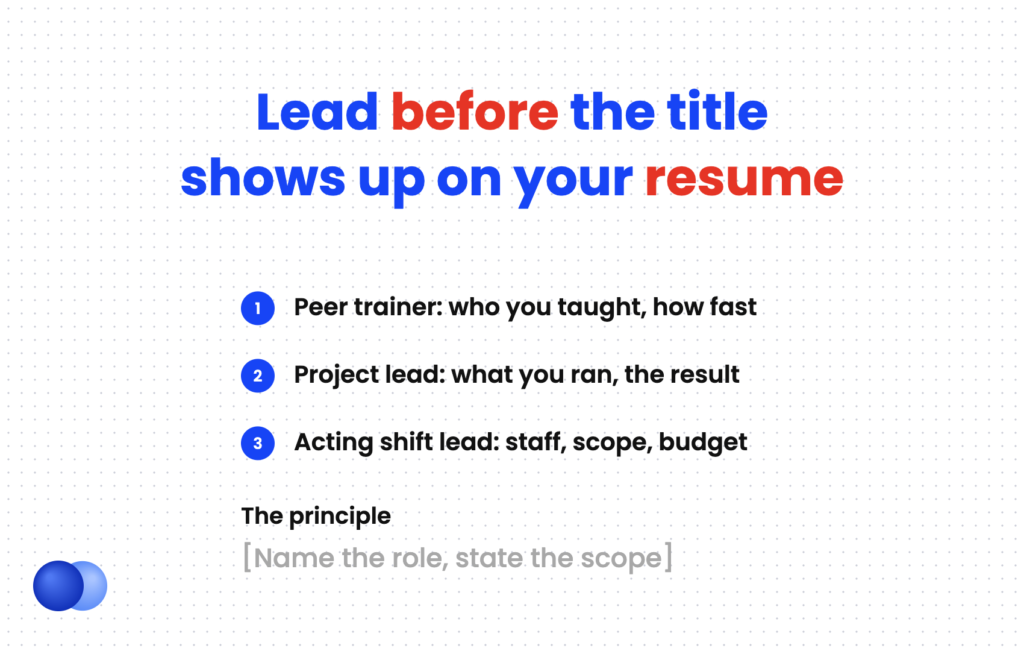
Look for these informal leadership moments in your history:
- Training and onboarding. Who did you teach, and how fast did they get up to speed?
- Project lead. What did you run without formal authority over the people involved?
- Acting or relief lead. When did you cover for a supervisor or run a shift?
- Process change. What did you propose that others adopted?
- Outside work. Volunteer coordinator, club officer, team captain or event organizer.
Write the informal role into the bullet itself. Phrases like "as acting shift lead," "as project lead" or "as peer trainer" tell the recruiter your scope without inflating your job title.
Trained and certified 9 new cashiers as peer trainer, cutting average onboarding time from 3 weeks to 2
Led a 5-person cross-functional team as project lead to migrate 1,200 client files to a new CRM, finishing 1 week ahead of schedule
Ran weekend shifts as acting shift lead for 6 months, coordinating 8 staff and keeping labor costs within budget
Proposed a shared ticket-tagging system that 3 support teams adopted, reducing misrouted requests by 30%
Recruited and scheduled 40 volunteers as event coordinator for a charity 5K that raised $18,000
If you did earn a title later, see how to show a promotion on your resume so the progression is obvious.
How do you prove leadership skills in resume bullet points?
Use a scope, action, result structure. Start with a leadership verb such as coached, directed or mobilized, state how many people or how much budget or work you were responsible for, then close with the outcome. "Led a team" says little; "Coached 6 agents to raise CSAT from 82% to 91%" proves it.
Self-description is exactly what employers discount, so each bullet should show leadership rather than claim it. A simple formula works:
Leadership verb + scope (people, budget, projects) + result.
Scope is what separates leadership from individual work. Six people, a $250,000 budget or three departments signal responsibility instantly. For the result, use whatever your team tracked. Our guide to how to quantify your resume covers metrics for jobs that seem hard to measure.
Before: Managed a team of customer service agents After: Coached a team of 12 support agents through a new ticketing platform, raising first-contact resolution from 68% to 79% in two quarters
Before: Responsible for team hiring After: Hired and onboarded 7 engineers in 2025, keeping first-year retention at 100%
Before: Handled department budget After: Directed a $1.4M operations budget across 3 sites, cutting overtime spend 18% without missed deliveries
Notice that none of these bullets say "strong leader." The scope and result do the work. For more on bullet structure, see how to write resume bullet points.
Lead with the verb that names the skill
Choose verbs that signal the specific leadership skill: "coached" or "mentored" for development, "delegated" or "directed" for management, "mediated" for conflict, "championed" or "mobilized" for influence. Avoid repeating "led" in every bullet, since a varied verb tells the reader which kind of leadership each line proves.
Where should leadership skills go on your resume?
Put the proof in your experience bullets, name one or two leadership skills with a result in your summary, and add posting-matched terms like "team leadership" to your skills section. For students and career changers, a leadership section or a leadership bullet under activities and volunteer work works well.
Each section does a different job:
- Experience. Your strongest leadership evidence goes in the first or second bullet of the most relevant role.
- Summary. Name your leadership scope in one line, such as "led teams of up to 15" or "trained 30+ new hires."
- Skills section. List terms the posting uses word for word, such as "team leadership," "people management" or "cross-functional leadership."
- Activities or volunteer work. Students can add a club, sport or volunteer role with the same scope and result structure.
Employers do weigh leadership roles, but not above everything. In NACE's Job Outlook 2026, internship experience ranked as the strongest tiebreaker between equal candidates, with a leadership position ranking below a 3.0 GPA. So pair leadership with real work evidence rather than relying on titles from clubs alone.
What leadership skills mistakes should you avoid?
Avoid listing "leadership" or "strong leader" without proof, inflating informal roles into manager titles, crediting yourself with the team's whole result, and burying leadership at the bottom of a role. Also avoid vague bullets like "led meetings." Each leadership claim should name your scope and show a change you caused.
Leadership is easy to overstate, and interviewers probe it. Gallup research found managers account for at least 70% of the variance in employee engagement, so hiring teams take leadership claims seriously and test them.
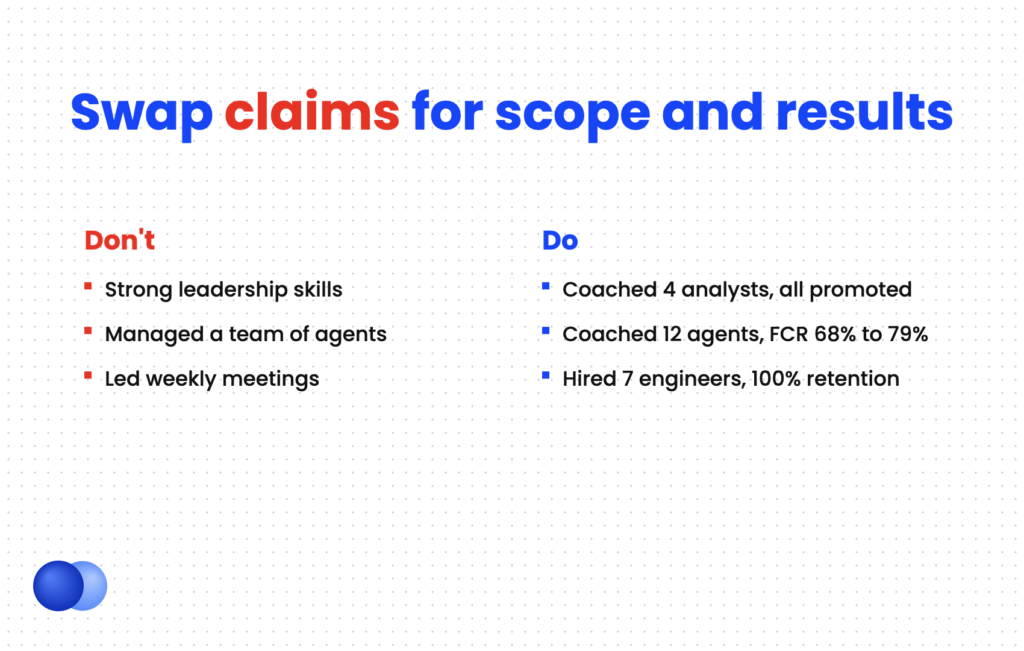
Write "Coached 4 new analysts, all promoted within 18 months"
Write "Strong leadership skills" in your skills section with no proof do: Name informal roles, like "as acting shift lead" dont: Change your job title to "Manager" when you were not one do: Say what you personally drove, like "proposed and ran" dont: Claim the entire department's revenue as your result do: Put your best leadership bullet near the top of the role dont: Use filler like "led weekly meetings" as your proof
When your draft is ready, the Rezoom AI resume builder can rewrite vague leadership claims into scope-and-result bullets matched to a specific posting. If you are moving into a new field, pair this guide with transferable skills for your resume.

Frequently asked questions
What are the top leadership skills to put on a resume?
Coaching, delegation, decision-making, project ownership, conflict resolution and influence without authority are the most transferable. Choose the ones your target posting emphasizes and prove each with scope and a result.
Can I list leadership if I have never been a manager?
Yes. Training coworkers, leading a project, covering as shift lead or running a volunteer team all show leadership. Name the informal role in the bullet so your scope is clear.
Should I put "leadership" in my skills section?
Only if the posting uses the term, and then use its exact phrase, such as "team leadership." Back it up with at least one experience bullet that proves it.
How do I show leadership skills as a student?
Use club offices, team captain roles, group projects, tutoring and part-time jobs. A line like "Led a 6-person class project team to a first-place finish in a regional case competition" proves it.
What is a good leadership action verb besides "led"?
Try coached, mentored, directed, mobilized, championed, delegated or spearheaded. Pick the verb that names the specific leadership skill you are showing.
How many leadership bullets should a resume have?
For leadership-heavy roles, aim for two or three in your most recent job. For individual contributor roles, one strong leadership bullet per role is usually enough.



Comments